Goleta Load Pocket Community Microgrid Renewables-driven Resilience - - PowerPoint PPT Presentation

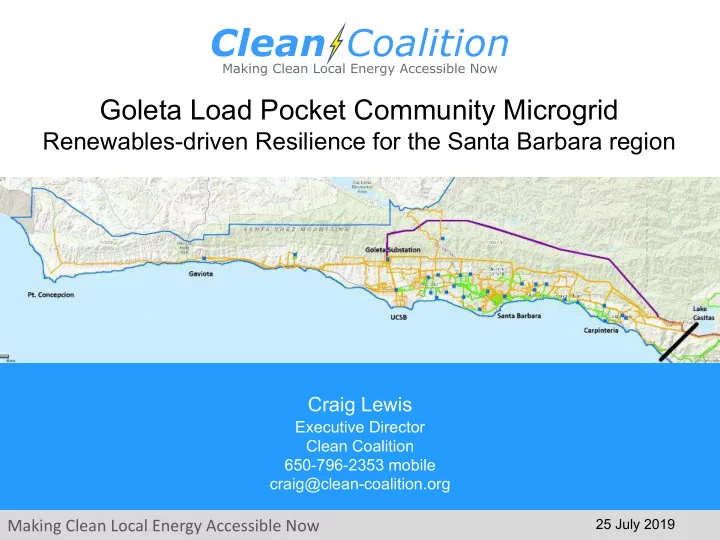
goleta load pocket community microgrid
SMART_READER_LITE
LIVE PREVIEW

Goleta Load Pocket Community Microgrid Renewables-driven Resilience - - PowerPoint PPT Presentation

Goleta Load Pocket Community Microgrid Renewables-driven Resilience for the Santa Barbara region Craig Lewis Executive Director Clean Coalition 650-796-2353 mobile craig@clean-coalition.org Making Clean Local Energy Accessible Now 25 July


slide-1
SLIDE 1

Making Clean Local Energy Accessible Now

Goleta Load Pocket Community Microgrid

Renewables-driven Resilience for the Santa Barbara region

25 July 2019
Craig Lewis

Executive Director Clean Coalition 650-796-2353 mobile craig@clean-coalition.org

slide-2
SLIDE 2

Making Clean Local Energy Accessible Now

2

GoToWebinar FAQ

  • Webinar recording and slides will be

sent to registered attendees within two business days

  • All webinars are archived on clean-

coalition.org and the Clean Coalition’s YouTube channel

  • Submit questions in the Questions

window at any time (window view varies by operating system and browser)

  • Questions will be answered during

the Q&A portion of the webinar

  • Contact Josh for webinar questions:

josh@clean-coalition.org

slide-3
SLIDE 3

Making Clean Local Energy Accessible Now

3

Clean Coalition (non-profit)

Mission To accelerate the transition to renewable energy and a modern grid through technical, policy, and project development expertise. Renewable Energy End-Game 100% renewable energy; 25% local, interconnected within the distribution grid and ensuring resilience without dependence on the transmission grid; and 75% remote, fully dependent on the transmission grid for serving loads.

slide-4
SLIDE 4

Making Clean Local Energy Accessible Now

4

Community Microgrids are the grid of the future

A Community Microgrid is a new approach for designing and

  • perating the electric grid, stacked with local renewables and

staged for resilience.

Key features:

  • A targeted and coordinated distribution grid area

served by one or more substations – ultimately including a transmission-distribution substation that sets the stage for Distribution System Operator (DSO) performance.

  • High penetrations of local renewables and other

distributed energy resources (DER) such as energy storage and demand response.

  • Staged capability for indefinite renewables-driven

backup power for critical community facilities across the grid area – achieved by 25% local renewables mix.

  • A solution that can be readily extended throughout a

utility service territory – and replicated into any utility service territory around the world.

slide-5
SLIDE 5

Making Clean Local Energy Accessible Now

5

Goleta Load Pocket (GLP)

The GLP is the perfect opportunity for a comprehensive Community Microgrid

  • GLP spans 70 miles of California coastline, from Point Conception to Lake Casitas,

encompassing the cities of Goleta, Santa Barbara (including Montecito), and Carpinteria.

  • GLP is highly transmission-vulnerable and disaster-prone (fire, landslide, earthquake).
  • 200 megawatts (MW) of solar and 400 megawatt-hours (MWh) of energy storage will

provide 100% protection to GLP against a complete transmission outage (“N-2 event”).

  • 200 MW of solar is equivalent to about 5 times the amount of solar currently deployed in the GLP and

represents about 25% of the energy mix.

  • Multi-GWs of solar siting opportunity exists on commercial-scale built-environments like parking lots,

parking structures, and rooftops; and 200 MW represents about 7% of the technical siting potential.

  • Other resources like energy efficiency, demand response, and offshore wind can significantly reduce

solar+storage requirements.

slide-6
SLIDE 6

Making Clean Local Energy Accessible Now

6

GLP is critically transmission-vulnerable

slide-7
SLIDE 7

Making Clean Local Energy Accessible Now

7

Need for resilience in GLP: May 2016 Edison Fire

(NW of Santa Clara station, multiple lines threatened)

slide-8
SLIDE 8

Making Clean Local Energy Accessible Now

8

Need for resilience in GLP: December 2017, Thomas Fire (multiple outages)

slide-9
SLIDE 9

Making Clean Local Energy Accessible Now

9

Need for resilience in GLP: Transmission lines subject to preemptive shutoff

Given the recent passage of wildfire legislation and potential liability for wildfires started from utility wires and equipment, SCE has instituted preemptive measures, outlined on the right, that may result in more frequent de-energizing of transmission lines on high fire risk days. The CPUC Fire Map above shows that the Goleta Load Pocket is surrounded by extreme fire threats.

Source: CPUC FireMap, ESRI, SCE DRPEP

slide-10
SLIDE 10

Making Clean Local Energy Accessible Now

10

Community Microgrids obviate gas peakers

  • Thanks in part to Clean Coalition analyses, California regulators blocked repowering of the

Ellwood gas peaker in Goleta and constructing the massive Puente gas peaker in Oxnard.

  • “Let’s take this opportunity to move the Oxnard community into the clean energy future —

which is here already.” Carmen Ramirez, Mayor of Oxnard

  • Significant opportunity to leverage this work to prevent future new gas plant proposals

across the country

slide-11
SLIDE 11

Making Clean Local Energy Accessible Now

11

Community Microgrids cheaper than gas peakers

  • Leveraging our technical and economic expertise, the Clean Coalition conducted

an analysis to determine the viability of solar+storage as a better alternative

slide-12
SLIDE 12

Making Clean Local Energy Accessible Now

12

Natural gas infrastructure is not resilient

  • Assertion: Gas-driven generation is
  • ften claimed to be resilient.
  • Reality: Gas infrastructure is not resilient

and takes much longer to restore than electricity infrastructure.

  • Threats: Gas infrastructure can be flat-
  • ut dangerous and highly vulnerable to

earthquakes, fires, landslides, and terrorism.

2.5 5 10 30 65 100 5 25 60 95 97 98.5 100 100 100 100 1 DAY 2 DAYS 3 DAYS 1 WEEK 2 WEEKS 3 WEEKS 1 MONTH 2 MONTHS 3 MONTHS 6 MONTHS

Potential Service Restoration Timeframes (M7.9 Earthquake)

Gas Electricity

60% electric customers restored in 3 days. 60% gas restoration takes 30 times longer than electricity

Source: The City and County of San Francisco Lifelines Study

2010 San Bruno Pipeline Explosion

slide-13
SLIDE 13

Making Clean Local Energy Accessible Now

13

Recent gas pipeline explosions

  • October 9, 2018: British Columbia.
  • September 13, 2018: Merrimack Valley, Massachusetts. Over 80 individual fires, one person

killed and 30,000 forced to evacuate.

  • February 17, 2017: A natural gas pipeline operated by Kinder Morgan in Refugio Texas

exploded creating a massive fire. The explosion shook homes 60 miles away.

  • February 10, 2017: A natural gas pipeline operated by Phillips 66 Pipeline in St. Charles Parish,

LA exploded, injuring 3 workers.

  • February 1, 2017: A DCP pipeline in Panola County TX exploded and created a crater in an

airport runway, shutting down the airport for a month.

  • January 17, 2017: A natural gas pipeline operated by DCP Midstream exploded in Spearman,

TX, which led to multiple fire crews being called to the scene.

  • From 2010 to 2016: Gas companies reported 35 explosions and 32 ignitions at their

transmission pipelines, according to federal records. The explosion killed 17 people and injured 86.

  • September 9, 2010: A pipeline explosion in San Bruno, California, killed eight people and

injured 51.

slide-14
SLIDE 14

Making Clean Local Energy Accessible Now

14

UCSB Community Microgrid – Area Map

slide-15
SLIDE 15

Making Clean Local Energy Accessible Now

15

Montecito offers opportunity for initial demonstration: First building block for GLPCM

Areas at extreme & high risk for debris flows in the event of major storms.

Source: Santa Barbara County OEM

slide-16
SLIDE 16

Making Clean Local Energy Accessible Now

16

Solar Siting Survey (SSS) for Montecito

slide-17
SLIDE 17

Making Clean Local Energy Accessible Now

17

Montecito Upper Village has a concentration of critical community facilities (Fire, Water, Shelter)

slide-18
SLIDE 18

Making Clean Local Energy Accessible Now

18

Montecito Community Microgrid block diagram

Santa Barbara Substation

Tier 2 & 3 Loads

Diagram Elements

Autonomously controllable microgrid relay/switch (open, closed)

Montecito Fire District Southern Portion Montecito Union School

Coast Village Community Microgrid

Montecito Water District

Hot Springs Feeder (16kV)

slide-19
SLIDE 19

Making Clean Local Energy Accessible Now

19

Montecito Community Microgrid – overview

Overall Goal is to provide renewables- driven energy resilience to critical community facilities in Montecito and to showcase the benefits of Community Microgrids for communities around the world. Initial Facilities:

  • Montecito Fire Protection District

headquarters & primary fire station

  • Montecito Water District

headquarters & critical pumps

  • Montecito Union School

Each site is anticipated to have an independent microgrid with enough solar+storage to be net zero and deliver indefinite renewables-driven backup power to the most critical loads:

  • 10% of the load 100% of the time.
  • 100% of the load at least 25% of

the time.

Montecito Fire and Water Districts Montecito Union School

slide-20
SLIDE 20

Making Clean Local Energy Accessible Now

20

Community Microgrid key stakeholders

slide-21
SLIDE 21

Making Clean Local Energy Accessible Now

21

GLP load profile

  • 201 MW total peak, modeled

using 200 MW

  • Resilience need is for 95 MW

peak and 1,385 MWh max day energy

  • Seasonal load profile from Willdan

showing max, min, avg load for single day in each month for Santa Barbara County

slide-22
SLIDE 22

Making Clean Local Energy Accessible Now

22

Southern California Edison’s planned energy storage

280 MWh (70 MW x 4-hour) of energy storage has been formally proposed by SCE to the CPUC for siting within the GLP, with online dates by March 2021

Source: SCE LCR RFP April 22, 2019

slide-23
SLIDE 23

Making Clean Local Energy Accessible Now

23

Point Conception and Gaviota offshore wind potential

slide-24
SLIDE 24

Making Clean Local Energy Accessible Now

24

Existing Gaviota oil and gas site infrastructure

slide-25
SLIDE 25

Making Clean Local Energy Accessible Now

25

Proposed infrastructure

slide-26
SLIDE 26

Making Clean Local Energy Accessible Now

26

How to realize the GLP Community Microgrid

1. Immediately and ongoing, expand behind-the-meter solar & storage via existing rules and market mechanisms

  • Net Energy Metering (NEM).
  • Self Generation Incentive Program

2. Short-term, fix a misguided prohibition to WDG in Santa Barbara County, that currently blocks WDG, even when sited on built-environments like rooftops, parking lots, and parking structures (only a problem in unincorporated areas).

3. Longer-term, unleash Wholesale Distributed Generation (WDG) and utilize the existing distribution grid during transmission system outages

  • Procurement – implement a comprehensive Feed-In Tariff (FIT).
  • Interconnection – streamline WDG interconnection.
  • Valuation – ensure full and fair valuation for WDG
  • Eliminate Transmission Access Charges (TAC) market distortion.
  • Establish standardized Value of Resilience for Tier 1, 2, and 3 loads

(VOR123).

  • Implement a market mechanism for Dispatchable Energy Capacity

Services (DECS) to attract wide deployment of energy storage that is

  • wned by any party and is fully functional at the operational discretion of

Load Serving Entities, whose economically optimal needs will change with time.

slide-27
SLIDE 27

Making Clean Local Energy Accessible Now

27

Wholesale D Distributed G Generation ( (WDG) d defined

Distribution Grid Project Size Behind the Meter

Central Generation

Serves Remote Loads

Wholesale DG

Serves Local Loads

Retail DG

Serves Onsite Loads

Transmission Grid

5 kW 50+ MW 500 kW

slide-28
SLIDE 28

Making Clean Local Energy Accessible Now

28

Need to redefine Utility-Scale Solar in SB County

Existing definition of Utility-Scale Solar Photovoltaic Facilities prohibits WDG even

  • n built-environments like rooftops, parking lots, and parking structures:

Utility-Scale Solar Photovoltaic Facilities. Facilities that are connected to the electrical grid on the utility side of the electric meter and are built for the primary purpose of generating and selling wholesale power. Proposed new definition of Utility-Scale Solar Photovoltaic Facilities: Solar facilities of greater than 5 MWac capacity on open land that are connected to the electrical grid on the utility side of any pre-existing electric customer meter for the primary purpose of generating and selling wholesale power. Solar facilities of any size that are constructed on built-environments, including rooftops, parking lots, and parking structures, are not considered to be utility- scale solar facilities. The amended definition needs to be applied in the following two places:

  • 1. Santa Barbara County Comprehensive Plan, Land Use Element
  • 2. Santa Barbara County Land Use and Development Code, Definitions
slide-29
SLIDE 29

Making Clean Local Energy Accessible Now

29

WDG and FIT drove huge solar use in Germany

Solar Markets: Germany vs. California (2002-2012)

Germany deployed over 10 times more solar than California in the decade from 2002 — despite California having 70% better solar resource.

Sources: CPUC, CEC, SEIA and German equivalents.

Cumulative MW

  • 5,000

10,000 15,000 20,000 25,000 30,000 35,000

2002 2006 2007 2008 2009 2010 2011 2012

California Germany

slide-30
SLIDE 30

Making Clean Local Energy Accessible Now

30

Majority of German solar is small WDG

  • 200

400 600 800 1,000 1,200 1,400 1,600 1,800 2,000 up to 10 kW 10 to 30 kW 30 to 100 kW 100 kW to 1 MW

  • ver 1 MW

MW

German Solar Capacity Installed through 2012

Source: Paul Gipe, March 2012

Germany’s solar deployments are almost entirely sub-2 MW projects on built- environments and interconnected to the distribution grid (not behind-the-meter).

22.5% 26% 23.25% 9.25% 19%

slide-31
SLIDE 31

Making Clean Local Energy Accessible Now

31

German rooftop solar converts to 3 cents/kWh

Project Size Euros/kWh US$/kWh California Effective Rate US$/kWh

Under 10 kW 0.1270 0.1359 0.0628 10 kW to 40 kW 0.1236 0.1323 0.0611 40.1 kW to 750 kW 0.1109 0.1187 0.0548 Other projects up to 750 kW* 0.0891 0.0953 0.0440 All data in table is from 2016. Foreign exchange conversion applied is 1 Euro to 1.07 US$. California’s effective rate is reduced 40% due to tax incentives and then an additional 33% due to the superior solar resource.

Replicating German scale and efficiencies yields commercial-scale rooftop solar in California at the lowest energy price possible: 3 cents/kWh for delivered energy.

* For projects not sited on residential structures or sound barriers.

slide-32
SLIDE 32

Making Clean Local Energy Accessible Now

32

Why FITs are the world-class solution

FITs are unparalleled in unleashing cost-effective, commercial-scale renewables

slide-33
SLIDE 33

Making Clean Local Energy Accessible Now

33

Feed-In Tariffs (FITs) and Dispatchability Adders

  • The Clean Coalition designs market-based, cost-effective FITs with streamlined

interconnection

  • A FIT is a standardized, long-term, guaranteed contract that allows smaller local renewable energy

projects to sell power to the local utility or other load-serving entity

  • FITs work far better than NEM or auctions to unleash commercial-scale renewables.
  • Our FITs use Market Responsive Pricing, which allows subsequent contract prices to adjust

based on market response to pricing of current contracts— ensuring that energy contracts are always set at the best market price to ensure deployments while protecting ratepayers.

  • A Dispatchability Adder, a fixed ¢/kilowatt-hour (kWh) capacity bonus on top of the FIT rate,

to attract energy storage that make renewable energy fully dispatchable.

slide-34
SLIDE 34

Making Clean Local Energy Accessible Now

34

Direct Relief Microgrid should expand greatly

  • Location: Santa Barbara, CA.
  • Owner: Direct Relief (one of

the largest disaster recover/supply non-profits in the world).

  • Brand new 155,000-square-

foot pharmaceutical warehouse.

  • Ships direct to disasters

zones, internationally. Cold storage cannot be without power.

  • Needed a microgrid for

indefinite renewables- driven backup power.

slide-35
SLIDE 35

Making Clean Local Energy Accessible Now

35

Direct Relief Microgrid – onsite Resilience only

320 kW PV 676 kWh Li 600 kW genset; 4000 gal. fuel

  • Resiliency is #1 concern:
  • 320 kW PV
  • 676 kWh Storage
  • 600 kW generator
  • 4000 gal. of fuel
  • PV annual generation

designed to cover annual consumption.

  • Storage designed to time-

shift the generation to more valuable times, and provide Resiliency.

  • Genset provides “back-up to

the back-up”.

  • Direct Relief’s mission is to

stay operational in the event

  • f a local disaster that

causes interruption of electricity.

slide-36
SLIDE 36

Making Clean Local Energy Accessible Now

36

Direct Relief Microgrid ready to do way more!

Microgrid only serves Direct Relief needs:

  • 70% of roof and 100% of

massive parking area solar potential is unused.

  • Additional storage not

able to be considered due to policy prohibitions around exporting energy from a battery to the grid – even though the energy is 100% stored solar.

Ready to do way more::

  • 1,133 kW in total solar

siting potential, 427 kW more rooftop and 386 kW in parking lots.

  • Existing switch gear is

already sized for the expansion and is just awaiting the policy innovation!

slide-37
SLIDE 37

Making Clean Local Energy Accessible Now

37

  • Across California RPS solicitations, fewer than 1 in 10 project bids were actually developed,

which resulted in high administrative costs for the program and exorbitant risk/cost for renewable energy project development.

  • It is insane to think that auctions could possibly attract commercial-scale renewables and
  • ther DER, and yet, California utilities and policymakers chronically prove Einstein's definition
  • f insanity by continuing to pursue local renewables and other DER via auctions!

Auctions/solicitations have massive failure rates and are NOT appropriate for commercial-scale

slide-38
SLIDE 38

Making Clean Local Energy Accessible Now

38

WDG & & N NEM i interconnection n need t to b be a aligned

Our goal is to address the circumstances that lead to differences in timeframe and costs between what are otherwise identical PV systems, based on whether they are installed “behind the meter” (NEM) or “in front of meter” (IFOM or WDG). Currently, there are significant differences in both project development timing and costs between NEM and IFOM/WDG systems:

1000 Timing IFOM NEM $0 $200 $400 Cost Thousands IFOM NEM Business Days

slide-39
SLIDE 39

Making Clean Local Energy Accessible Now

39

Comparing Investor-Owned Utilities (IOUs) and SMUD project development timelines

  • SMUD: about 1 year total (6 months for interconnection)
  • IOU default cluster process: up to 3.5 years (average of 2 years

for interconnection)

Interconnection with California IOUs takes 4 times longer than with SMUD

slide-40
SLIDE 40

Making Clean Local Energy Accessible Now

40

WDG interconnection

  • Wholesale distributed generation (WDG): projects on the utility side of the meter rather

than behind the customer’s meter — often commercial-scale solar

  • The interconnection process for WDG is broken in California
  • It can take years to interconnect these projects to the grid
  • The process can be arduous and expensive
  • The Clean Coalition has designed a WDG Interconnection Pilot with these aims:
  • Make the WDG interconnection processes efficient and cost-effective while maintaining a safe and

reliable electric grid

  • Give WDG the same advantageous streamlined treatment as net energy metered (NEM) projects,

making it equally fast and predictable. Currently, WDG interconnections are significantly more risky, costly, time-consuming, and expensive.

slide-41
SLIDE 41

Making Clean Local Energy Accessible Now

41

TAC Campaign

  • Transmission Access Charges (TAC) in California are assessed inconsistently and unfairly,

creating a massive market distortion

  • In PTO utility service territories, California ratepayers pay the same charge for “using” the

transmission system whether or not the energy they use travels across that system

  • The TAC market distortion has hidden costs:
  • Californians could pay up to $60 billion extra over the next 20 years

3 cents per kWh is being stolen from clean local energy projects — 50% of their total cost — making them look more expensive than they really are Fewer $$ are available for the resilience that Community Microgrids bring our communities

The Clean Coalition is proposing this reform: Charge for electricity transmission based on actual use of the transmission grid

This method is already being used successfully by California’s municipal utilities

slide-42
SLIDE 42

Making Clean Local Energy Accessible Now

42

Value of Resilience (VOR)

  • Everyone understands there is significant value to resilience provided by indefinite

renewables-driven backup power

  • But, nobody has yet to quantify this value of unparalleled resilience.
  • Hence, there is an economic gap for innovative Community Microgrid projects while learning is

still is the early stages.

  • The Clean Coalition aims to establish standardized Value of Resilience (VOR) for critical,

priority, and discretionary loads that will help everyone understand that premiums are appropriate for indefinite renewables-driven backup power of critical loads and almost constant backup power to priority loads, which yields a configuration that delivers backup power to all loads a lot of the time

  • The Clean Coalition’s VOR approach will establish

standardized values for resilience of three tiers of loads:

  • Tier 1 are mission-critical and life-sustaining loads,

crucial to keep operational at all times, including during grid outages. Tier 1 loads usually represent about 10% of the total load.

  • Tier 2 are priority loads that should be maintained as long as long as

doing so does not threaten the ability to maintain Tier 1 loads. Tier 2 loads are usually about 15% of the total load.

  • Tier 3 are discretionary loads make up the remaining loads, usually

about 75% of the total load, and are maintained when doing so does not threaten the ability to maintain Tier 1 & 2 loads.

slide-43
SLIDE 43

Making Clean Local Energy Accessible Now

43 10 20 30 40 50 60 70 80 90 100 10 20 30 40 50 60 70 80 90 100 Tier 1 = Critical load, ~10% of total load

Percentage of time online for Tier 1, 2, and 3 loads in California solar+storage microgrids

Percentage of total load Percentage of time Tier 3 = Discretionary load, ~75% of total load Tier 1 = Critical, life-sustaining load, ~10% of total load Tier 2 = Priority load, ~15% of total load

slide-44
SLIDE 44

Making Clean Local Energy Accessible Now

44

Dispatchable Energy Capacity Services (DECS) $

DECS

contracted energy capacity (kWh)

kWh

Owner Reserve Owner Reserve

  • LSE contracts for dispatchable daily

cycling of energy capacity (kWh), at a fixed $/kWh fee, used or not.

  • LSE optimizes fully flexible energy

capacity, dispatching for any purpose, which could be based on time of day, day of week, season, event, and/or other optimizations

  • ver the DECS contract period.
  • Initial DECS contracts are priced at

Cost of Service (COS) while subsequent DECS contract pricing is adjusted for market response.

  • Owner retains discretion over

any capacity not under DECS contract.

  • Owner earns guaranteed

$/kWh payments for the DECS- contracted energy capacity.

  • Owner retains discretion over

any capacity not under DECS contract.

Load Serving Entity (LSE) Storage Asset Owner

1. Net Cost of Energy (NCOE). 2. Capital expenditure ("capex"). 3. Operating expenditure ("opex").

Three COS components:

DECS offers a single bankable revenue stream for energy storage owners and a fully flexible & dispatchable energy source for LSEs available daily.

slide-45
SLIDE 45

Making Clean Local Energy Accessible Now

45

Montecito Community Microgrid block diagram

Santa Barbara Substation

Tier 2 & 3 Loads

Diagram Elements

Autonomously controllable microgrid relay/switch (open, closed)

Montecito Fire District Southern Portion Montecito Union School

Coast Village Community Microgrid

Montecito Water District

Hot Springs Feeder (16kV)

slide-46
SLIDE 46

Making Clean Local Energy Accessible Now

46

Ecoplexus WDG solar project at the Valencia Gardens Apartments in San Francisco, ~800 kW equivalent to ~80% of annual load.

Valencia Gardens Energy Storage (VGES) project

slide-47
SLIDE 47

Making Clean Local Energy Accessible Now

47

PG&E Resilience Zones = Community Microgrids

Source: PG&E, Jul2019

slide-48
SLIDE 48

Making Clean Local Energy Accessible Now

48

Get involved in the GLP Community Microgrid

  • Contribute to the funding requirements of the GLP Community Microgrid Initiative,

which should be staffed with several full-time equivalent experts to fulfill the vision.

  • Bring properties into play for near-term NEM installations and to stage for WDG

projects as policies and market mechanisms are innovated.

  • Bring solutions to the GLP, including Demand Response (DR), Electric Vehicle

Charging Infrastructure (EVCI), and Energy Efficiency (EE).

  • Share the GLP Community Microgrid as a game-changing showcase for

delivering renewables-driven resilience to communities.

  • Subscribe to the Clean Coalition newsletter to stay informed.