Goleta Load Pocket and Montecito Community Microgrid Initiatives - - PowerPoint PPT Presentation

goleta load pocket and montecito community microgrid
SMART_READER_LITE
LIVE PREVIEW

Goleta Load Pocket and Montecito Community Microgrid Initiatives - - PowerPoint PPT Presentation

Goleta Load Pocket and Montecito Community Microgrid Initiatives Craig Lewis Alistair Berven Gregory Young Executive Director Program Engineer Program Associate 650-796-2353 mobile 415-596-5727 mobile 805-350-2931 mobile


slide-1
SLIDE 1

Making Clean Local Energy Accessible Now

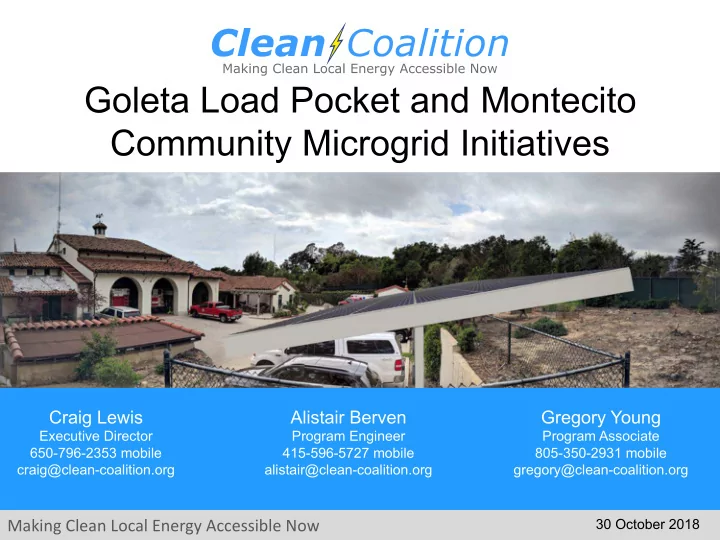
Goleta Load Pocket and Montecito Community Microgrid Initiatives

30 October 2018

Craig Lewis

Executive Director 650-796-2353 mobile craig@clean-coalition.org

Gregory Young

Program Associate 805-350-2931 mobile gregory@clean-coalition.org

Alistair Berven

Program Engineer 415-596-5727 mobile alistair@clean-coalition.org

slide-2
SLIDE 2

Making Clean Local Energy Accessible Now

2

Clean Coalition (non-profit) Mission

To accelerate the transition to renewable energy and a modern grid through technical, policy, and project development expertise

slide-3
SLIDE 3

Making Clean Local Energy Accessible Now

3

Community Microgrid Vision

slide-4
SLIDE 4

Making Clean Local Energy Accessible Now

4

Community Microgrids (CM): The grid of the future

A Community Microgrid is a new approach for designing and operating the electric grid, stacked with local renewables and staged for resilience.

Key features:

  • A targeted and coordinated local grid area served by
  • ne or more distribution substations
  • High penetrations of local renewables and other

Distributed Energy Resources (DER) such as energy storage and demand response

  • Staged capability for ongoing renewables-driven

power backup for critical and prioritized loads across the grid area

  • A solution that can be readily extended throughout

a utility service territory – and replicated into any utility service territory around the world

slide-5
SLIDE 5

Making Clean Local Energy Accessible Now

5

Goleta Load Pocket (GLP)

The GLP is the perfect opportunity for a comprehensive Community Microgrid

The GLP stretches from northwest of Gaviota to southeast of Carpinteria

slide-6
SLIDE 6

Making Clean Local Energy Accessible Now

6

GLPCM collaborators

slide-7
SLIDE 7

Making Clean Local Energy Accessible Now

7

GLP Community Microgrid “APE”

  • Aim:
  • Realize a comprehensive Community Microgrid for the entire Goleta Substation grid area.
  • Ensure that the GLP resilience objective is delivered via local renewables and other DER,

and preempt any new gas peaker infrastructure.

  • Deliver the trifecta of Community Microgrid benefits to the region in the form of

economic, environmental, and resilience benefits.

  • Plan:
  • Assess the level of resilience that can cost-effectively be provided by the GLP Community

Microgrid (GLPCM).

  • Create a multi-dimensional narrative of gas peakers as neither clean, safe, nor resilient.
  • Showcase the Community Microgrid approach via Montecito Community Microgrids.
  • Facilitate policies and programs that can realize a cost-effective GLPCM.
  • Feed-In Tariff (FIT), streamlined interconnection, residential solar+storage programs,

etc.

  • Gain community support for the GLPCM approach from electeds to the public.
  • Prepare to win the CPUC battle that will be fought starting in early-2019.
  • Execution:
  • Assign responsible parties for each planned task.
  • Identify a GLPCM Initiative manager.
  • Secure funding for a successful initiative.
slide-8
SLIDE 8

Making Clean Local Energy Accessible Now

8

GLP is vulnerable to transmission system disruption

slide-9
SLIDE 9

Making Clean Local Energy Accessible Now

9

May 2016 Edison Fire

(NW of Santa Clara station- multiple lines threatened)

slide-10
SLIDE 10

Making Clean Local Energy Accessible Now

10

December 2017-Thomas Fire

(Multiple Outages)

slide-11
SLIDE 11

Making Clean Local Energy Accessible Now

11

Transmission lines subject to preemptive shutdown

Given the recent passage of wildfire legislation and potential liability for wildfires started from utility wires and equipment, SCE has instituted preemptive measures, outlined on the right, that may result in more frequent de-energizing of transmission lines in advance

  • f oncoming wildfires.

The CPUC FireMap above shows that the Goleta Load Pocket is surrounded by extreme (Tier 3) fire threats.

Source: CPUC FireMap

slide-12
SLIDE 12

Making Clean Local Energy Accessible Now

12

SCE is positioning to propose a gas plant in GLP

  • SCE Statement: “Most project offers that can address resiliency are

natural-gas based.”

  • Likely Remote Location: Adjacent to the Capitan Substation, which is

~15 miles northwest of the La Goleta gas storage field.

slide-13
SLIDE 13

Making Clean Local Energy Accessible Now

13

Natural gas infrastructure is not resilient

  • Assertion: SCE will frame gas-fired

generation (GFG) as resilient.

  • Reality: Gas infrastructure is not

resilient and requires 30 times longer to restore service than electricity.

  • Threats: Gas infrastructure is

vulnerable to earthquakes, fires, and mudslides, as well as terrorism.

2.5 5 10 30 65 100 5 25 60 95 97 98.5 100 100 100 100 1 D A Y 2 D A Y S 3 D A Y S 1 W E E K 2 W E E K S 3 W E E K S 1 M O N T H 2 M O N T H S 3 M O N T H S 6 M O N T H S

Potential Service Restoration Timeframes (M7.9 Earthquake)

Gas Electricity

60% electric customers restored in 3 days. 60% gas restoration takes 30 times longer than electricity

Source: The City and County of San Francisco Lifelines Study

2010 San Bruno Pipeline Explosion

slide-14
SLIDE 14

Making Clean Local Energy Accessible Now

14

Recent gas pipeline explosions

  • October 9, 2018: British Columbia.
  • September 13, 2018: Merrimack Valley, Massachusetts. Over 80 individual fires, one person

killed and 30,000 forced to evacuate.

  • February 17, 2017: A natural gas pipeline operated by Kinder Morgan in Refugio Texas

exploded creating a massive fire. The explosion shook homes 60 miles away.

  • February 10, 2017: A natural gas pipeline operated by Phillips 66 Pipeline in St. Charles

Parish, LA exploded, injuring 3 workers.

  • February 1, 2017: A DCP pipeline in Panola County TX exploded and created a crater in an

airport runway, shutting down the airport for a month.

  • January 17, 2017: A natural gas pipeline operated by DCP Midstream exploded in Spearman,

TX, which led to multiple fire crews being called to the scene.

  • From 2010 to 2016 -- Gas companies reported 35 explosions and 32 ignitions at their

transmission pipelines, according to federal records. The explosion killed 17 people and injured 86.

  • September 9, 2010: San Bruno, California, killed eight and injured 51 people.
slide-15
SLIDE 15

Making Clean Local Energy Accessible Now

15

La Goleta Gas Storage Field

  • Converted into a gas storage reservoir in 1941, it is the oldest storage facility of four

maintained by SoCalGas and is the third largest, with a maximum capacity of 21.5 billion cubic feet.

  • The gas field is within an anticlinal structure cut and bounded on the north by the

More Ranch Fault.

slide-16
SLIDE 16

Making Clean Local Energy Accessible Now

16

The GLPCM requires multi-faceted action

  • Amend Santa Barbara County Land Use and Development Code (LUDC)

to remove de facto ban on installing In-Front-of-Meter (IFOM) solar.

  • Santa Barbara, Goleta, and Carpinteria cities to take leadership role in

securing sufficient solar siting potential.

  • Local government review of Laws, Ordinances, Regulations, and

Standards (LORS) in conflict with GFG plant.

  • Amend and/or enact local LORS to impose local regulations/ban on

natural gas power facilities.

  • Persuade SCE to procure local renewables and other DER through a

market-efficient FIT and to allow distribution grid to provide Community Microgrid functionality during transmission grid outages.

slide-17
SLIDE 17

Making Clean Local Energy Accessible Now

17

Community Microgrid key stakeholders

Community Microgrid Financiers Solution Providers Utilities Property Owners Municipalities Residents

Philanthropic Funders

slide-18
SLIDE 18

Making Clean Local Energy Accessible Now

18

Montecito offers opportunity for initial demonstration

Map of areas at high and extreme risk from mud and debris flow in the event of a major storm.

Source: Santa Barbara County OEM

slide-19
SLIDE 19

Making Clean Local Energy Accessible Now

19

Solar Siting Survey (SSS) for Montecito

slide-20
SLIDE 20

Making Clean Local Energy Accessible Now

20

Hot Springs Feeder via Santa Barbara Substation

Santa Barbara Substation

slide-21
SLIDE 21

Making Clean Local Energy Accessible Now

21

Upper Village Community Microgrid block diagram

Transmission Santa Barbara Substation

Tier 2 & 3 Loads Hot Springs Feeder (16 kV)

Diagram Elements

Autonomously controllable microgrid relay/switch (open, closed)

Emergency response cluster Commercial cluster Commercial cluster Southern Portion Emergency sheltering cluster Tier 2 & 3 Loads

Coast Village Community Microgrid

Southern Portion Emergency sheltering cluster

slide-22
SLIDE 22

Making Clean Local Energy Accessible Now

22

Upper Village critical facilities include five along Hot Springs Feeder

slide-23
SLIDE 23

Making Clean Local Energy Accessible Now

23

Upper Village emergency response facilities

slide-24
SLIDE 24

Making Clean Local Energy Accessible Now

24

Montecito Union School District

slide-25
SLIDE 25

Making Clean Local Energy Accessible Now

25

Montecito YMCA

slide-26
SLIDE 26

Making Clean Local Energy Accessible Now

26

Laguna Blanca School

slide-27
SLIDE 27

Making Clean Local Energy Accessible Now

27

Crane Country Day School

slide-28
SLIDE 28

Making Clean Local Energy Accessible Now

28

Our Lady of Mount Carmel Church and School

slide-29
SLIDE 29

Making Clean Local Energy Accessible Now

29

Back Up Slides

slide-30
SLIDE 30

Making Clean Local Energy Accessible Now

30

Feed in Tariffs (FITs) address the Wholesale DG market segment

Distribution Grid Project Size Behind the Meter

Central Generation

Serves Remote Loads

Wholesale DG

Serves Local Loads

Retail DG

Serves Onsite Loads

Transmission Grid

5 kW 50+ MW 500 kW

slide-31
SLIDE 31

Making Clean Local Energy Accessible Now

31

Wholesale DG drove huge solar use in Germany

Solar Markets: Germany vs. California (2002-2012)

Germany deployed over 10 times more solar than California in the decade from 2002 — despite California having 70% better solar resource.

Sources: CPUC, CEC, SEIA and German equivalents.

Cumulative MW

  • 5,000

10,000 15,000 20,000 25,000 30,000 35,000

2002 2006 2007 2008 2009 2010 2011 2012

California Germany

slide-32
SLIDE 32

Making Clean Local Energy Accessible Now

32

The majority of German solar is local solar

  • 200

400 600 800 1,000 1,200 1,400 1,600 1,800 2,000 up to 10 kW 10 to 30 kW 30 to 100 kW 100 kW to 1 MW

  • ver 1 MW

MW

German Solar Capacity Installed through 2012

Source: Paul Gipe, March 2012

Germany’s solar deployments are almost entirely sub-2 MW projects on built- environments and interconnected to the distribution grid (not behind-the-meter).

22.5% 26% 23.25% 9.25% 19%

slide-33
SLIDE 33

Making Clean Local Energy Accessible Now

33

German rooftop solar is 4 to 6 cents/kWh today

Project Size Euros/kWh USD/kWh California Effective Rate $/kWh

Under 10 kW 0.1270 0.1359 0.0628 10 kW to 40 kW 0.1236 0.1323 0.0611 40.1 kW to 750 kW 0.1109 0.1187 0.0548 Other projects up to 750 kW* 0.0891 0.0953 0.0440

Conversion rate for Euros to Dollars is €1:$1.07. California’s effective rate is reduced 40% due to tax incentives and then an additional 33% due to the superior solar resource. Replicating German scale and efficiencies would yield rooftop solar today at only between 4 and 6 cents/kWh to California ratepayers.

* For projects that are not sited on residential structures or sound barriers.

slide-34
SLIDE 34

Making Clean Local Energy Accessible Now

34

Upper Village critical facilities

slide-35
SLIDE 35

Making Clean Local Energy Accessible Now

35

Sites along Hot Springs Feeder

slide-36
SLIDE 36

Making Clean Local Energy Accessible Now

36

Community Microgrids obviate gas peakers

Thanks in part to our analysis, California regulators have rejected Ellwood and signaled their intent to reject Puente as well “Let’s take this opportunity to move the Oxnard community into the clean energy future — which is here already.” Carmen Ramirez, Mayor of Oxnard Significant opportunity to leverage this work to prevent future new gas plant proposals across the country

slide-37
SLIDE 37

Making Clean Local Energy Accessible Now

37

Community Microgrids cheaper than gas peakers

  • Leveraging our technical and economic expertise, the Clean Coalition conducted

an analysis to determine the viability of solar+storage as a better alternative