Renewable Energy Microgrid Testbed at NASA Ames Research Center - - PowerPoint PPT Presentation

renewable energy microgrid testbed at nasa ames research
SMART_READER_LITE
LIVE PREVIEW

Renewable Energy Microgrid Testbed at NASA Ames Research Center - - PowerPoint PPT Presentation

Renewable Energy Microgrid Testbed at NASA Ames Research Center Joel Kubby, Dan OLeary, Daniel Hernandez, Stig Hgberg & Ali Shakouri Baskin School of Engineering, Dept. of Electrical Engineering, UCSC Goals Set-up a unique


slide-1
SLIDE 1

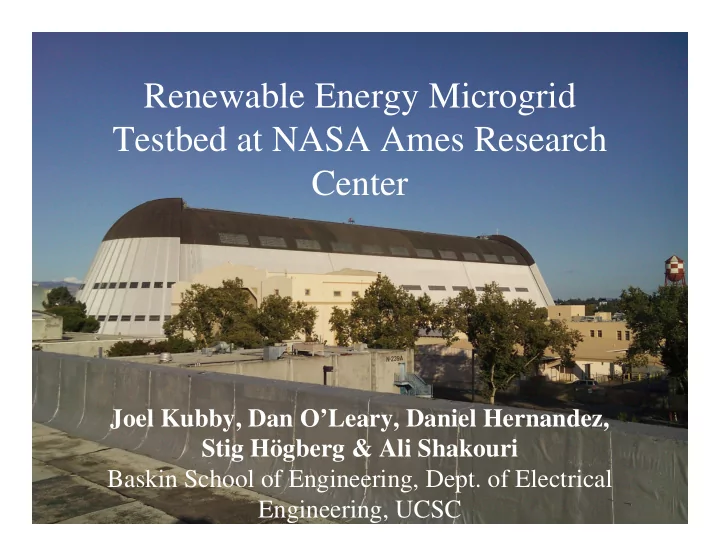
Renewable Energy Microgrid Testbed at NASA Ames Research Center

Joel Kubby, Dan O’Leary, Daniel Hernandez, Stig Högberg & Ali Shakouri Baskin School of Engineering, Dept. of Electrical Engineering, UCSC

slide-2
SLIDE 2

Goals

  • Set-up a unique microgrid test-bed for

renewable energy monitoring, generation and storage

  • Use the facility for testing systems

integration of new renewable energy components

  • Enable web access to the test-bed for a

remote access lab in renewable energy

slide-3
SLIDE 3

Microgrid Components

  • Energy Generation

– Tracking photovoltaic array (six Sharp 180W PV panels, Wattsun AZ 225 tracker) – Wind turbine (Air X-12 400W)

  • Energy Storage

– Batteries

  • 400 Ah SLA

– Electric Vehicle

  • Energy Conversion

– Xantrex inverter

  • Monitoring

– IV curve tracer (Daystar DS-100C) – Weather station (Cambell Instruments) – Wind anemometer – Solar radiometers

  • Normal incidence

Pyroheliometer

  • Precision Spectral

Pyranometer

– Data logger

slide-4
SLIDE 4
slide-5
SLIDE 5

Background

  • Group project from LoCal RE 2008

Summer School on “Electricity Grid using Localized Renewable Generation”

  • Intermittent wind and solar power

generation at the household scale balanced using electric vehicles

slide-6
SLIDE 6

Questions

  • Is it possible to have a hybrid renewable

energy system as a microgrid with an electric vehicle as battery storage?

  • Could this type of microgrid system be

price-competitive with typical grid- connected systems?

  • How will this vary when applied to

Denmark and the USA respectively?

slide-7
SLIDE 7

California: Solar Resource

  • Highest solar radiation in the

southwest (7,000 to 7,500Whr/m2/day, Yearly sum 2700kWh/m2)

  • Lowest solar radiation in

northwest and northeast (2,500Whr/m2/day)

  • Abundant solar resource
slide-8
SLIDE 8

California: Wind Resource

  • Wind resource in the

coastline of California

  • Highest wind power

density of 500-800 W/m2 and wind speed from 8.0 to 8.8 m/s.

  • Wind resource varies

greatly with locality

slide-9
SLIDE 9

Denmark: Solar Resource

  • Yearly sun in Jutland

is between 925kWh/m2 - 950kWh/m2

  • Lolland has the

highest solar radiation with more than 1000kWh/m2

  • Less solar resource

than California

slide-10
SLIDE 10

Denmark: Wind Resource

  • Abundant wind

resource in the coastline. Speed > 10m/s, density > 510W/m2

  • Wind resources vary

by location, but on average are high.

slide-11
SLIDE 11

Batteries

slide-12
SLIDE 12

Solar Cells

slide-13
SLIDE 13

System Modeling using HOMER

https://analysis.nrel.gov/homer/

slide-14
SLIDE 14

Selected Components

  • Bergey Excel-R (7.5 kW DC)
  • Toyota Prius with OEMTek PHEV Kit (9 kWh)
  • Photovoltaic (4 & 8 kW systems considered)
  • Outback 3.6 kW inverter (stackable)
slide-15
SLIDE 15

Initial Findings

  • The PHEV Prius Battery is too small to balance

the system. – HOMER was unable to find a system utilizing

  • nly the Prius battery.

– 9 kWh of storage is not enough to balance the system in California or Denmark – ~50 kWh battery capacity is needed to run the system (Tesla EV)

slide-16
SLIDE 16

Implementation of a Renewable Energy Test-bed at NASA Ames

  • Set up solar tracker, weather station, and complete

test and measurement control room at NASA Ames

  • Add in wind turbine, electric vehicle energy

storage and recharging station

  • CCLI proposal funded by NSF to put the facility
  • n-line for a remotely accessible renewable energy

laboratory

  • Plan to use testbed to create links with renewable

energy industrial partners

slide-17
SLIDE 17

Implementation of Testbed at NASA Ames B239N

Rm 181

slide-18
SLIDE 18

Six Sharp 180W PV Panels

Precision Spectral Pyranometer (PSP) Normal Incidence Pyroheliometer (NIP)

slide-19
SLIDE 19

Precision Spectral Pyranometer (PSP)

slide-20
SLIDE 20

Normal Incidence Pyroheliometer (NIP)

slide-21
SLIDE 21

400Watt Air X-12 Wind Turbine

slide-22
SLIDE 22

Predicted Energy Production

There isn’t much wind in Mountain View!

It’s so calm you could probably land a blimp!

slide-23
SLIDE 23

Initial System Configuration

Initial energy storage in batteries

AC distribution panel AC In

DC In

Future grid-tie

  • ption

Solar panels and charge controller Wind turbine

DC disconnects DC In

slide-24
SLIDE 24

Vehicle to Grid

slide-25
SLIDE 25

Vehicle to Grid

  • Average US car: Driven 1 hour/day (2001)
  • Serve as:

– Regulating power (frequency)

  • Often automatic (governor)

– Spinning reserve (outages)

  • Standby power plants (often running at 30-40% rated)

– Back-up service (microgrid)

slide-26
SLIDE 26

AC Propulsion

  • T-Zero

– Battery management – Bi-directional flow of electricity

slide-27
SLIDE 27

Variable Load for Grid Stabilization

Two way power flow One way power flow

slide-28
SLIDE 28

Myers Motors - NMG

  • 15 kWh Li-ion
  • 80 mph
  • 45 miles range
  • 5 h full charging
  • 1 person
  • Regenerative

Braking System

slide-29
SLIDE 29

Green Vehicles - Triac

  • 23 kWh Li-ion
  • 80 mph
  • 100 mile range
  • 5 h full charging
  • 2 persons
  • Freeway driving
  • Regenerative

Braking System

slide-30
SLIDE 30

Tesla Roadster

  • 42, 65, 85 kWh Li-ion
  • 125 mph
  • 160, 230, 300 mile range
  • 3.5 hours (240V, 70A)
  • 2 persons
  • 0-60 mph in 3.5 seconds
slide-31
SLIDE 31

Photo showing Electric Car at a Recharge Station from Better Place http://www.betterplace.com/

Recharge Station

slide-32
SLIDE 32

Acknowledgements

  • LoCal RE 2008 study group

– Electricity Grid using Localized Renewable Generation; Wind and Solar Power Balanced by Electric Vehicles

  • Phil Chiu (UC Davis)
  • Stig Hoegberg, Nan Qin and Jiang (DTU)
  • Jeremy Hieb (UCSC)
  • Rose Grymes, Wenonah Vercoutere Lisa Witt, Steve

Hinge, ASL

  • Nima Mostafi, UC Santa Cruz
  • Funding

– UARC Aligned Research Program – BIN-RDI