
SLIDE 1
The Churchill Marine Observatory (CMO)
- Dr. John
Yackel, Professor and Head, Dept. of Geography, University of Calgary
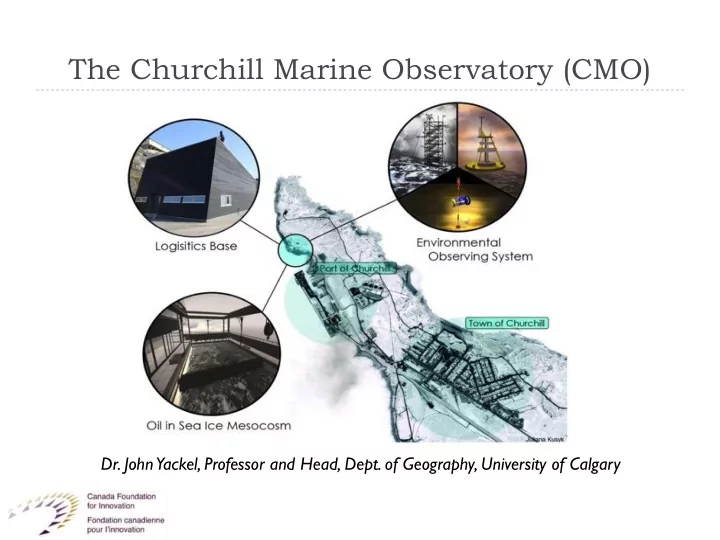
The Churchill Marine Observatory (CMO) Dr. John Yackel, Professor - - PowerPoint PPT Presentation
The Churchill Marine Observatory (CMO) Dr. John Yackel, Professor and Head, Dept. of Geography, University of Calgary The Churchill Marine Observatory (CMO) A concept whose time has come! Sea ice Area (million km 2 ) Sea ice reduction Oil in
Yackel, Professor and Head, Dept. of Geography, University of Calgary
Year
Sea ice Area (million km2)
Sea ice reduction
Oil in sea ice Question of when not if.
Hydrocarbon resources Marine Transportation
Zones of marine activity (map) - From ArcticData Download by Arctic Council CAFF/PAME. (Downloaded 19 May 2011)
Transits through the Northwest Passage by type of ship. Source: NORDREG; Data complete for 2014.
Currently, Canada has a world-leading system to ensure that
ships entering its Arctic waters are capable of safe operations in the ice conditions being encountered (Arctic Ice Regime Shipping System under the regulations of the Arctic Waters Pollution Prevention Act).
In addition, the National Energy Board completed an extensive
review of Arctic offshore drilling practices and regulatory requirements in 2011 and is moving to enact those recommendations and apply them to new development
Despite these developments, there are knowledge gaps
regarding how to safely increase Arctic development and shipping, and a very limited capacity to respond in the event of a spill.
Oil behaviour in ice-affected water (Allen, 2008).
SOURCE: Modified from Daling et al. (1990) and A. Allen
Oil in Sea Ice
Mesocosm (OSIM)
labs
Environmental
Observatory (EO)
Atmosphere Ocean
Contaminants Freshwater
Marina/Wharf
Garage
OSIM process studies Scaling Arctic wide through EO system, CHARS, and international field programs
A concept to allow controlled
testing of the ocean, sea ice system response to oil, LNG, and contaminants.
Science would concentrate on
Detection (of oil in sea ice) Impacts (of oil spills on marine
ecosystems)
Mitigation (of oil spills in sea ice
using both genomics‐enhanced bioremediation technologies and conventional techniques)
16
First experimental sea-ice
facility in Canada
Equipped with a movable roof
to control snow cover and ice growth, and various sensors and instruments to allow real-time monitoring
17
Polarimetric scatterometer
investigation
Mobile ‘oil tub’
18 (Photos by Dr. Fei Wang)
Wet, dry, and cold labs would
support on-site processing of samples
Data Acquisition room for
On-site storage facility for
equipment.
19
Estuary Ocean Atmosphere CHARS
20
Ocean Observatory
Cable network for real
time measurements (CTD, IPS, ice mass balance,
Atmosphere Observatory
Cable network for real
time measurements (atmospheric LiDAR, cloud ceilometers, microwave profiler, …)
Real time satellite
calibration
Courtesy: ASL Services
21
22
Ecosystem Observatory
Whale active acoustic
system
Lower trophic levels
Freshwater Observatory
Cable network for real
time measurements (turbidity, chlorophyll, nutrients,….
Contaminant
Observatory
Cable network for real
time measurements (Mercury, POPS, PAHs).
A weather-protected site for
launching, fueling and mooring of small craft adjacent to the Port wharf
Support direct access to estuary,
and Bay for collection of samples, maintenance of monitoring equipment
Storage and workshop
23
Oil and Gas Marine Shipping OSIM process studies Scaling Arctic wide through EO system and international field programs
Link to priorities
echnology and Energy Innovation strategic research theme
Victoria: Environment, Oceans and Climate research theme
Commitments
2 technicians based in Churchill; $30k annual operating cost
25
UM Facilities:
grad students
sq.ft) Previous CFI investment:
SERF (only sea-ice research facility in Canada) Amundsen Sea ice, meteorology, oceanographic, contaminants
UM Facilities:
grad students
sq.ft) Previous CFI investment:
SERF (only sea-ice research facility in Canada) Amundsen Sea ice, meteorology, oceanographic, contaminants
Barber, David – P
.I. University of Manitoba, Centre for Earth Observation Science
Babin, Marcel - Université Laval, Faculté des sciences et de génie Deming, Jody - University of Washington, School of Oceanography Hubert, Casey - University of Calgary, Biological Sciences Mundy, Christopher - University of Manitoba, Centre for Earth
Observation Science
Rysgaard, Søren - University of Manitoba, Geological Sciences Shafai, Lotfollah - University of Manitoba, Electrical and Computer
Engineering
Stern, Gary - University of Manitoba, Centre for Earth Observation
Science
Wang, Feiyue - University of Manitoba, Environment and Geography Yackel, John - University of Calgary, Geography
The CMO is proposed as a national facility, serving
national and international needs
Gathering over 170 researchers from six Canadian
universities, three international universities (Aarhus, Denmark; Greenland Climate Research Centre, Greenland; and University of Washington, Seattle, Washington),
10 government departments, and 10 private sector
partners.
This facility will present an exceptional opportunity to
train a new generation of experts on Arctic sustainable development.
CMO will lead direct integration of industry, government
and academic interests, and ensure an ability to forge and foster productive, value-added partnerships within and among institutions, sectors and disciplines.
Industry and government members of a CMO Board of
Directors will be able to capitalize on scientific knowledge from academic members, allowing them to commercialize technologies and techniques first developed in CMO.
Pre-competitive research will focus around detection,
impacts and mitigation of oil in ice technologies.
31
32 Board of Directors (BOD) OSIM chief scientist EO chief scientist Research Management Committee (RMC) Vision, Strategy, decisions Management Programming, recommend
33
34 Salt Water Marina Logistics Base Oil in Sea Ice Mesocosm (OSIM)
40 – 40 – 20 funding model
Environmental Observatory (EO)
Endowment fund
Endowed Chairs Two technical support staff In Churchill
NSERC Industrial Chairs
Three chairs Three technical support staff In Churchill
Indirect costs from CFI
Five technical staff at CEOS (5 years only)
User fees (OSIM)
Technical support staff and instrument maintenance $X per week
35
37
1. provide leading edge transformative research 2. invent ground-breaking technologies 3. assist companies to innovate through science 4. train the next generation of HQP 5. assist Inuit, governments and industry in regulation and co-management 6. be led by a team with international excellence and a proven track record 7. provide significant scientific, technological and economic benefits for Canada 8. be globally unique
38
1. Finalizing partnership funding a. CHARS, Denmark, Laval, Dalhousie, equip matches, ARF, IRC’s, EO position (completed) b. Provincial matches (in process) 2. Environmental Assessment (MB to determine) 3. RFP for build (in process) 4. Omnitrax role minimized but not removed (Access to Estuary for Dock/Utilidor, coastal ship). 5. Road access and power to site (in process) 6. Community Engagement and announcement 7. Build-start May-Oct 2016; complete 2017
DRAFT 39
National Research Council Conseil national de recherches