
SLIDE 1
Resource Kit
Setting the Stage for Participation and Global Citizenship
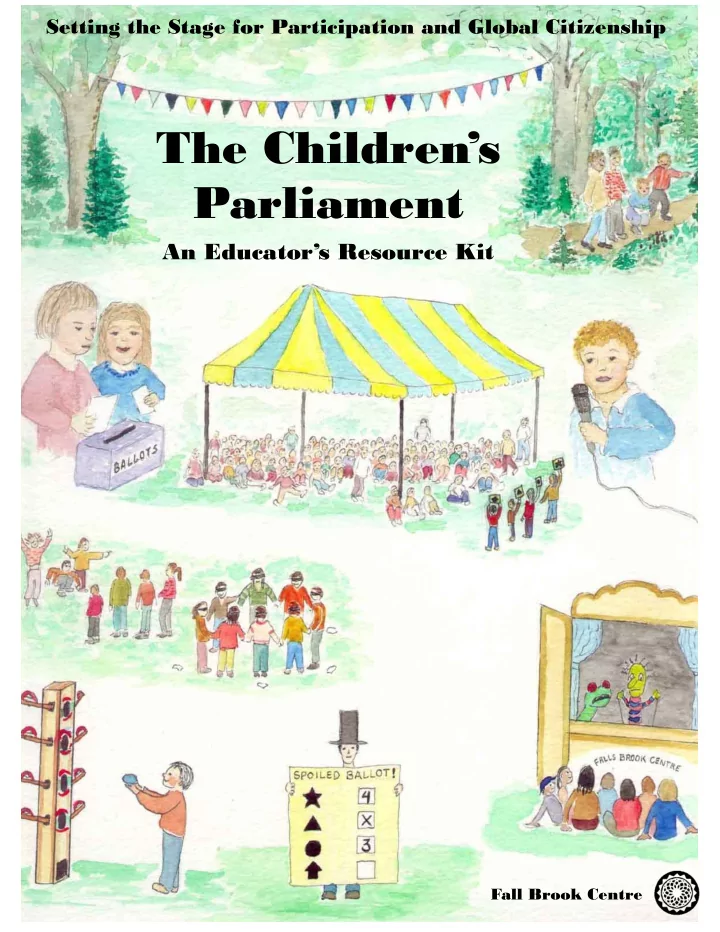
The Children’s Parliament
An Educator’s Resource Kit
Fall Brook Centre
The Childrens Parliament An Educators Resource Kit Resource Kit - - PDF document
Setting the Stage for Participation and Global Citizenship The Childrens Parliament An Educators Resource Kit Resource Kit Fall Brook Centre Childrens Parliament The Childrens Parliament An educators resource kit Table of
Resource Kit
Setting the Stage for Participation and Global Citizenship
An Educator’s Resource Kit
Fall Brook Centre
Children’s Parliament
Resource Kit
An educator’s resource kit
Introduction ...................................................................................................................2 Section I: Getting Started ............................................................................................3 Section II: Children’s Fair ...........................................................................................5 Morning Activities ...................................................................................................5 Afternoon Activities .................................................................................................8 Section III: In Session ................................................................................................10
........................................................10
........................................................................................................10
Section IV: Responsibilities and Rewards .......................... ..................................20 Conclusion ................................................................................ ..................................22 Appendix A: Activities ..............................................................................................22 About Me .................................................................................................................22 Action Plan Calendar .............................................................................................22 Children’s Rights and Environment ...................................................................23 Classroom Water Activity .....................................................................................23 Global Issues—Cultural Events ...........................................................................25 Icebreakers ...............................................................................................................26 Needs and Wants ....................................................................................................27 Neighborhood Links ..............................................................................................27 Tree Activity ............................................................................................................27 Yarn Friendship Activity .......................................................................................27 Appendix B: Sample Handouts ................................................................................28 Constitution and Bylaws .......................................................................................29 Member of Parliament Candidate Application Form 1 ....................................30 Member of Parliament Candidate Application Form 2 ....................................31 Report of Recognition Form .................................................................................32 Falls Brook Centre Educational Resources .............................................................33 1
Children’s Parliament
In 2002 Falls Brook Centre and New Brunswick School District 14 collaborated to help students learn about democracy and citizenship. A group of grade 3-5 students from schools throughout Carleton County became MPs in an assembly modelled after the Canadian Parliamentary system. The Children’s Parliament is an official forum for students to look at local and global problems, and come up with their own solutions. The aim of the project is to inform youth about political processes and get them involved in their schools and communities. Students learn how decisions are made and are also responsible for making some decisions themselves. Through the Chil- dren’s Parliament program, student organize a variety of social and educational activities in their schools including health and fitness events, toy collections for kids in need, and drawing ex- changes with children in India and Nicaragua. The model for this program is the Children’s Parliament created by the Social Work Research Centre in India (www.barefootcollege.org). The first Parliament was such an interesting and enjoyable experience that we hope more teachers and students will become involved. This guide is designed to help you to organize a Children’s Parliament within a group of schools in your area. Included are descriptions
sion, and hopefully everything you will need to get started in your community. Our schedule of activities for the year involves a Children’s Fair, an evening social gath- ering for elected members of parliament and their parents, five parliamentary ses- sions with elected students, and a trip to the Provincial Legislative Assembly. This series of activities works well but all activities and meetings can and should be tailored to the needs of your area. The Children’s Parliament was organized through the Falls Brook Centre. Falls Brook Centre is a sustainable community demonstration and training centre in rural New Brunswick. Located in Knowlesville on 400 acres of forest and farmland, the centre aims to show that it is possible to live more lightly on our environment while contributing to the local
systems, a small conference centre, herbariums, tree nurseries, and non- timber forest product plantings. Visitors and school groups come to the centre throughout the year to attend workshops and educational programs. The Centre also works with international partners in Mexico, Nicaragua, and India.
2
Resource Kit
Beginning a project like the Children’s Parliament requires a lot of organization and preparation before the fun and learning can begin. Having enthusiastic and dedicated people involved makes the project much easier and more enjoyable for everyone. It is virtually essential to involve grade 3-5 teachers in your area who are interested in participating with their
schools are good ways to let people know that the project is beginning. Once you have heard from interested teachers, you can start with the formal application process. Teachers apply to have their class participate in the Parliament and also need the support of their principal. Sample application forms can be found in Appendix B. Once you have enough schools or classes signed up, you can begin to solicit the help of students, parents and volunteers.
It is important to inform participants of their role in the Children’s Parliament. Outlined below are some of the major duties of participants in the Children’s Parliament - there may be more. Clearly specifying responsibilities and expectations in advance helps those interested in participating know which positions would best suit their abilities, interests and available time.
Role of the School District or School Board
Having the School District on side aids in facilitating the process
presentations to the School District in order to solicit their
form of covering the cost of buses and the supply days needed for accompanying teachers to the Children’s Parliament sessions.
Role of Organizer
This is you! Your role is to liaise with teachers, principals and volunteers regarding the events, and to provide materials and protocol for running of the Children’s Parliament.
Role of the Principal
Principals provide teachers and students with the support needed to fully participate in all activities and to encourage students to organize special events for their constituents (their schoolmates).
3
Children’s Parliament Role of Teachers
Interested teachers must apply for their classes to participate, bring students to attend a Fair, accompany delegates to Parliamentary Sessions, help delegates to
about activities. They need to implement the election process, provide ongoing support of the MP students, and ensure that one teacher or parent volunteer is responsible for transporting MPs to each Children’s Parliament Session.
Role of Volunteers
Additional volunteers will be necessary for running the Fair, Sessions, and any socials or trips. The workload of the organizer is reduced with the assistance of volunteers to help with the planning and facilitation of various elements of the Children’s
parents, high school students or members of service
can include setting the agendas, taking notes at the Sessions, preparing snacks, transporting MPs the to Sessions, making name tags, counting the ballots of the elections, and assisting the MPs in arranging specific school activities.
Role of Delegates
Students elected as delegates are expected to participate in the Sessions, complete assigned work before meetings, solicit input and suggestions from fellow students and help to develop and organize activities within their schools.
Role of Classes
Participating classes support their elected MPs, help in the organization of events, and participate in school activities.
Role of Parents
Parents of MPs will help delegates with their work at home, encourage them to be prepared for meetings and school events, and arrange transportation to meetings.
4
Resource Kit
The Children’s Fair launches the Children’s Parliament for the school year. It is a chance to introduce some of the ideas involved in the Parliament to all the students in participating classes in a fun and educational
grounds or at a local park, or even in a gymnasium. This event provides an opportunity for children to get to know each other and the Parliament organizers. The activities at the Fair include a mock election. The real candidates are not selected at this time; students are given an opportunity to simulate the real election that will take place within their school.
This station includes extensive discussion about democracy. One way to make this session more fun is to include a visit by Spoiled Ballot (see page 7).
Clapping Game
Explain that this game shows the meaning of democracy. Students stand in a circle and
No- because not everyone is participating. In order for a democracy to work, everyone needs to participate. This is the reason for the Children’s Parliament.
Needs and Wants
Prepare a poster or series of cards with the following items and corresponding pictures. Items: candy, healthy food, shelter, clean water, VCR and movies, your own computer, money, books that teach you, medical supplies, toys, friends, someone to love and care for you, nice clothes, a personal stereo, and the chance to say what you think and have someone listen to you.
The Fair features three activities focussing on the themes of democracy, communication, and the
5
Children’s Parliament Our Village
You will need a piece of flipchart paper and several volunteers for this game. The first time through you will need five students to come up to the front to draw. The rest of the group will be asked to think of as many things as possible that they would want in an ideal village. They can think back to the ideas from the wants and needs activities and then shout out these activities to the five students with markers. The five volunteers will be drawing as many of the ideas as they can without talking to each other or coming up with their own
if anything important is missing. Try this activity a second time with one more volunteer to act as a go-between. This child will be responsible for taking the ideas from the class in an orderly manner (with hands up) and designating one of the student to draw that picture. Give the group one minute to do the activity again. When they finish compare the first picture to the second. Which is better? Ask the volunteers and the audience how they felt the first round compared to the second. When did the audience feel that their ideas were being heard? As they answer this they should see the importance of the role of the go-between. An elected representative should do the same thing: take the ideas of the class and share them with the Children’s
Spoiled Ballot
One of the highlights of the Fair is the introduction of the character ‘Spoiled Ballot’ who is always a big hit with kids. This costume can be as simple or as elaborate as you want. Basically, it is a ballot which has been incorrectly marked. Spoiled Ballot is grumpy and whiny as his title indicates. Spoiled Ballot shows students how not to vote (letters, numbers circles etc.) and how to vote properly (with an X in the box of the candidate that they have chosen). Students can sing songs to try to ‘unspoil’ the Spoiled Ballot during the democracy activity. Students must determine whether each of the items is a need or a want. If there are discrepancies, have the group vote. Why is it important to know the difference? This is a good way to reflect on the roles of an elected representative and the difference between rights, responsibility and privileges. In our experience it was good to relate stories about children in other areas in the world where meeting basic survival needs are still daily struggles. The idea of global responsibility to other children around the world is introduced here and then expanded upon with specific activities during the school year.
Morning Activities Continued...
6
Resource Kit
Group leaders take students on a short nature walk where they discuss environmental issues such as forest health, clean water, and climate change. Each class plants a tree or shrub during this session as a concrete action towards restoration of the environment.
Choosing a Candidate
During this session, children can nominate fellow students for the mock election candidate list. Generally kids are extremely excited to volunteer for even a mock election so for simplicity spin a pointer around in the circle (which can be a marker) and let it choose the closest nominated candidate. Keep track of the names of those nominated for the election that will occur later. If there is time, talk about the types of things that they would like to hear in a speech and emphasize that they need to keep it realistic.
This game outlines some of the difficulties that can come when communicating with people who have disabilities or speak different languages. It is a lot of fun to watch and play. To set up the game you will need three objects and blindfolds. Divide students into three equal groups. Each group will be given instructions separately because none of the groups will know what the other is doing at the beginning.
and will need to gesture to communicate. They will know that they need to direct Group 3 to pick up the three objects.
can talk and will be doing the communication between Groups 1 and 3.
They are able to talk and move around the playing area. Put the objects out one at a time and let members of group 3 work together to pick up each object. You may need to encourage groups to stay calm and to remember the rules. If Group 3 is becoming nervous or taking a long time, you can freeze the game for a moment to see how everyone is feeling. They may be quite uncomfortable and feel that they might hurt themselves. You can also check in on the other groups to see if they are discouraged or frustrated. At the end of the game, take the time to discuss how each group felt during the game. Determine if they see similarities between their difficulties and the difficulties felt by other people. Did they feel it was their own fault that they couldn’t understand or did they feel frustrated with other people in the game when they couldn’t understand? Let them know that cross-cultural communication is also difficult and they have used some of the strategies that might be useful for talking to people with whom they don’t share a language.
7
Children’s Parliament
Materials: 4 buckets (garbage, compost, recycling, other), a pile of items which can be sorted into these 4 categories including batteries. Quickly go over the 4 buckets and their purpose, but do not go over where each item will go. Set up the 4 buckets in a line a few metres in front of the students. Arrange the students into 3 lines and have one member of each team run to the pile of garbage and put one piece in the appropriate bin. Someone will need to watch the containers to see that students have chosen the correct bin. Remove any incorrectly placed item. The game is over when all of the items have been properly sorted. At the end of the activity, there is an opportunity to discuss any questions about where waste should go and how to reduce the amount of waste that they put in each of the piles. You can dump out the recycling container and see if any of the items can be reused and explain that it is better to reuse something rather than to throw it in the garbage or recycling bin. This is a good time to share some facts about garbage, like those outlined on the previous page. In the end tell students that they have won points towards saving the earth.
This is an activity to show students how their actions affect the health of the planet. Two sets of cards,
model garbage reduction. Outcomes – use less trees, save water, create less air pollution, create less garbage, etc. Actions – buy organic food, walk to school, buy second-hand books, take a cloth bag to lunch, reuse your paper, take shorter showers, use low flow toilet, turn the tap off when you brush your teeth, buy products with little packaging, take your bike instead of a car, buy local foods, grow a garden, build a solar shower, have a yard sale, trade toys with a friend, share a board game, etc. One of the leaders acts as a scorekeeper in this activity. Kids are split into two teams. The scorekeeper picks one Outcome card and reads it to the group and then, each of the kids picks up one action card from the pile. The object is to have each team show how doing the action on their card will lead to the outcome. The teams take turns presenting ideas and get a point for each correct match. The afternoon features a second circuit of activities which focus on the
they can do to save their own.
Facts about Garbage:
Shack and should not be put in the garbage- the metals etc. in the batteries can leak and pollute soil and water in your area.
8
Resource Kit
Facts about energy consumption:
less pollution.
computer system.
Materials: class lists, ballots, hand stamps, privacy screens, pens and pencils If possible, have students from local elementary school councils give speeches about participating in school councils or in the Children’s Parlia- ment to help set the tone before the voting. The candidates selected in the morning are announced and each candidate states their name and delivers a very brief speech. Give candidates symbols (like those depicted on Spoiled Ballot’s costume) to represent each of them on the ballot. This allows you to make up ballots ahead of time without needing to know each candidate’s name. Try to make the process as official as possible using printed ballots, voter lists (class lists), hand stamps, voting screens, and ballot boxes. Have Poll- ing Officers to supervise each of the stations and stamp the hand of children who have cast their vote, as well as an Elections Officer to whom each sta- tion will submit their results. Spoiled Ballot can help to supervise elections and keep students laughing and interested during the whole process. He or she can also remind them how to properly fill out a ballot. After the election, you may wish to organize another short activity or game with students before the results are announced. The final event of the day is the announcement of the winners of the mock elections. Students can then be encouraged to become candidates for the real elections, which are to be held within their respective school or class.
The leaders can share facts about pollution during the game (like those on the following page). Do 3 or 4 different Outcome cards and total up the score at the end. Add both teams scores together to show the total number of points they have earned towards saving the planet. The model for the Children’s Fair outlined here is a day-long event. Obviously, the event can be manipu- lated as needed, be it shortened or rearranged to span several days. The Children’s Fair serves as the basis for extending the democracy education beyond the elected members of the Parliament. The activities this event incorporates serve to broaden the perspective and worldview of all students. Activities and lessons from the Fair can be drawn upon throughout the school year. If a class or group of students has a decision to make or a problem to resolve their teacher can remind them of the value of democracy highlighted at the Children’s Fair. When discussing current political events or an upcoming election, teachers can refer to some of the concepts derived from the Fair.
9
Children’s Parliament
Students involved in the Children’s Parliament work closely with each other over the year but may not have met prior to the first Session. Having a social event to allow participants to get to know one another helps them to relax and feel more comfortable at the first official
picnic or an informal night of introductions for parents and delegates and can incorporate some of the activities listed in Appendix A. An event like this helps to start the Sessions with a focus on business and fun, rather than introductions. An initial social event is also helpful to give parents and students an
Parliament and its work.
Parents working on an activity during the social
The delegates who represent their schools at the Children’s Parliament will be chosen by their respective
delegates from each school is determined according to the relative size of student body at each school. For example, larger schools send four delegates, while smaller schools send two. It is a good idea to send no fewer than two students, even from the smallest schools, to ensure that delegates do not feel
County Children’s Parliament 27 students from nine schools took part, but these numbers may be adjusted according to your needs. Teachers inform students in participating classes that they are all eligible to run for the Parliament and discuss with them the responsibilities that come with being a delegate. The interested students fill out a nomination form and have it signed by their parents and teacher (See Appendix B). These nomination forms let the candidates and their families know what is expected of them
Once candidates are determined campaigning can begin. Each candidates makes a brief speech to the participating classes at their school, highlighting why they should be elected. Once campaigning is complete a secret ballot vote is held to choose
‘official’ the ballot boxes can be sealed and delivered to the Principal
candidates be contacted by telephone on election night to be informed of the results. It is important to reassure all candidates that all students involved in the election are very competent and any one of them would be an excellent member of the Children’s
reminded that students not elected may need some support to deal with their disappointment. The elected delegate’s first duty could be the announcement of the candidates from other schools and a thank you to their electors.
10
Resource Kit
Student Information Packages
Each delegate receives a binder of information at the first Session. They will need to bring this with them to each meeting. These binders include the following items: The Children’s Parliament involves five Sessions over the course of a year, one every two months. Dates are tentatively scheduled at the beginning of the year and moved in order to accommodate other activities if needed. A morning or afternoon session of about two hours should be enough time to go through the business of a meeting. You may wish to rotate meeting locations through each of the schools that are
chance to play host and tour guide to the other delegates.
Setting Up the Room
Tables and chairs are set up in a horseshoe shape for the delegates so that all MPs can see one another throughout the meeting. The Executive sit at one end of the horseshoe with the Ministries seated together around the rest of the table. You can arrange chairs for volunteers, parents and guests facing the horseshoe. A flipchart should be set up so that both the delegates and a volunteer note taker can see it.
Voting Card System
Members of the Children's Parliament make decisions by voting on one another’s proposals. Each delegate will have a red, yellow, and green card with which to vote. Instead of aiming for a majority win, the emphasis is on building a consensus through negotiations. Students vote according to their feelings on each proposal: green for agree, yellow for needs some changes, red for disagree. For an idea to be adopted it needs to receive 75% of the vote. Students may work to get a larger proportion of green votes by discussing and changing the proposal in order to bring in more support. Those voting yellow and red are encouraged to ask questions and discuss their reasons for voting as they did. The length of time spent building consensus depends on how much time is available for discussion.
Materials you will need:
accompanying teachers
delegates’ voices but is not essential
delegate (voting cards)
they wait for others (crossword)
6 Ministries
to write names of other delegates they will need to contact over the year
11
Children’s Parliament
Prime Minster, Deputy Prime Minister, Speaker of the House*, Secretary*, Treasurer* Ministry of the Environment Ministry of Social Planning Ministry of the Multiculturalism Ministry of Foreign Affairs Ministry of Education Ministry of Health and Fitness
Executive Ministries
Each delegate plays a role as the Parliament is made up of the Executive Council and the six Ministries as outlined in the chart below. All of these positions work together on developing projects and ideas, rather than acting in a typical government-opposition format. These roles are chosen through internal elections carried out during the first
this election takes place. Outlined below is a model for elections that work quickly and allow the children to have some choice in their position. Members of the executive are chosen first. Each school will have at least
this candidate. Of this pool of executive candidates, each one gives a short speech on why they want to be in a position of leadership within the Parliament. Executive positions, beginning with the Prime Minister and Deputy Minister will be chosen from this group. Anyone interested in these positions steps forward and, using a secret ballot, each delegate votes for one candidate. The one receiving the most votes is Prime Minister, while the second highest is Deputy Prime Minister. Votes for all of the other Executive Positions follow one at a time. Depending on the total number of delegates there can be two students selected to be Secretaries, Speakers of the House and Treasurers. The remaining students will choose their Ministries by raising their
popular choices (often Health and Fitness, and Environment). There should be an equal number of students in each Ministry. Having students from different schools in each of the Ministries is a good way to have students mix.
*these roles can be shared by more than one student
12
Resource Kit Your responsibilities:
representative for the Children’s Parliament
announcements
guests
and projects
schools about their specific ideas and concerns
all representatives
debates and votes
postcards to MLAs and MPs at the end of each Session, and sign each postcard
Ideas for activities and projects that you could help organize with the Executive Council:
clothing (eg. T-shirts, sweatshirts, or baseball hats)
Children’s Parliament members
meetings
events
them to participate in the Children’s Parliament next year
Jelly Bean Jar Count Guessing Contest, or Hat Days
volunteers that it needs
Parliament is all about
Children’s Parliament is doing
Your responsibilities:
the Prime Minister is absent
representative for the Children’s Parliament
make special announcements
presentations to guests
projects
scrapbook
votes
MLAs and MPs at the end of each Session
Ideas for activities and projects that you could help
sweatshirts, or baseball hats)
members
countries!
in the Children’s Parliament next year
Candygrams, Flower Deliveries, Jelly Bean Jar Guessing Contest, or Hat Days
funds, and/or volunteers that it needs
Children’s Parliament is all about
the Children’s Parliament is doing
13
Children’s Parliament Ideas for activities and projects that you could help organize with the Executive Council:
Design and order Children’s Parliament clothing (eg. T-shirts, sweatshirts,
Plan field trip or special events for Children’s Parliament members Invite special guests or guest speakers to meetings Pen pal connections between schools, cities, provinces, even countries! Visit schools between Sessions for special events Write invitations to other schools inviting them to participate in the Children’s Parliament next year Fundraisers like Popcorn or Cookie Sales, Raffles, Candygrams, Flower Deliveries, Jelly Bean Jar Guessing Contest, or Hat Days “Adopt” a local charity and work to gather the resources, funds, and/or volunteers that it needs Write articles for local newspapers explaining what the Children’s Parliament is all about Organize presentations for classes to update students on what the Children’s Parliament is doing
Ideas for activities and projects that you could help organize with the Executive Council:
Design and order Children’s Parliament clothing (eg. T-shirts, sweatshirts, or baseball hats) Plan field trip or special events for Children’s Parliament members Invite special guests or guest speakers to Sessions Visit schools between Sessions for special events Write to other schools inviting them to participate in the Children’s Parliament next year Hold fundraisers like Popcorn or Cookie Sales, Raffles, Candygrams, Jelly Bean Jar Guessing Contest, or Hat Days “Adopt” a local charity and work to gather the resources, funds, and/or volunteers that it needs Write articles for local newspapers explaining what the Children’s Parliament is all about Organize presentations for classes to update students on what the Children’s Parliament is doing
Your responsibilities:
Council
Speaker with one other MP
debates when acting as Speaker
Parliaments meetings
announce agenda items
debates
when necessary
MLAs at the end of each meeting
Your responsibilities:
Council
for the Children’s Parliament
report and give accounting information
fundraising plans and dates
participate in debates and votes
write out postcards to MPs and MLAs at the end of each Session
14
Resource Kit Ideas for activities and projects that you could help
Environment:
efficient light bulbs
servation, biodiversity, or climate change
members and/or your schools about environmental topics
Your responsibilities:
Parliament environmental activities
and votes
to MLAs and MPs at the end of each meeting
Your responsibilities:
previous Sessions
needed
Parliament contact list
polls
and votes
postcards to MLAs and MPs at the end of each meeting
Ideas for activities and projects that you could help
sweatshirts, or baseball hats)
members
Children’s Parliament next year
Candygrams, Jelly Bean Jar Guessing Contest, or Hat Days
and/or volunteers that it needs
Children’s Parliament is all about
the Children’s Parliament is doing
15
Children’s Parliament Your responsibilities
for all Children’s Parliament educational activities
participate in debates and votes
text for postcards sent to MLAs and MPs at the end
Ideas for activities and projects that you could help organize as a member of the Ministry of Education:
students who can help with school work and can also help to make school a less intimidating place
ute them to kids in need
scientists, politicians, or teachers
most wanted field trips, and funny school memories
ment and/or to your schools
Ideas for activities and projects that you could help organize as a member of the Ministry of Health and Fitness:
Organize a Sports Day, within schools and between schools Plan a “snack potluck” by classes where each student brings a healthy snack to school to share with classmates Take part in a skip-a-thon to raise money for the Heart and Stroke Foundation Hold a sports equipment drive to go towards local charities that can distribute the items to kids in need Put together a fun-filled week of events and activities about nutrition Plant vegetables and fruit trees on school grounds (with permission, of course!) that students can care for and harvest Organize lunch hour activities that encourage physical activity Hold “Mystery Vegetable” contests every month where students must guess what the mystery vegetable is based on a series of clues Put up displays in schools that explain the importance of good nutrition and physical fitness Invite local people who know a lot about health or nutrition to speak at schools - athletes, nurses, doctors, or nutritionists etc. Have students write out their favourite healthy recipes and put together a school cookbook
Your responsibilities:
Children’s Parliament health and fitness activities
debates and votes
postcards sent to MLAs and MPs at the end of each
16
Resource Kit
Ideas for activities and projects that you could help organize as a member of the Ministry of Multiculturalism:
backgrounds, dress in clothes from different parts of the world, and demonstrate tra- ditional songs and dances
week to be learnt and featured in schools
they, or their ancestors, come from
country, practicing its popular songs, learning about the language, people, and land- scape
Your responsibilities:
all Children’s Parliament multiculturalism activities
participate in debates and votes
text for postcards sent to MLAs and MPs at the end of each Session
Your responsibilities:
all Children’s Parliament social activities
participate in debates and votes
text for postcards sent to MLAs and MPs at the end
Ideas for activities and projects that you could help organize as a member
Hold a winter festival featuring activities like snowman building, ornament making, carol singing, snow angel creating, snowshoe races, snowflake making, and hot chocolate brewing Mount a multi-school talent show Hold a pumpkin carving contest Organize an egg drop challenge or an egg- decorating contest Plan a community family picnic Organize special potluck dinners to celebrate holidays Plan theme days like pajama day, silly hat day, cartoon character day, or backwards day
entertainment
17
Children’s Parliament Ideas for activities and projects that you could help organize as a member
different parts of the world - even if you can’t speak or write the same language, you can use drawings to communicate!
projects overseas
Jeopardy” game with questions on news and events from all over the globe
country of your choice - share your findings with the school through stories, skits, songs, dance, or art
explaining an event or situation happening in another part of the world
Your responsibilities:
all Children’s Parliament foreign affairs activities
participate in debates and votes
text for postcards sent to MLAs and MPs at the end
Each Session is different and the agenda for each is set according to your needs. The following is a sample agenda on which you can model your own Sessions. The first Session is different as electing delegates to positions and reviewing the Constitution are the major events. Later Sessions place a greater emphasis on business.
18
Resource Kit
Opening Speaker stands “Welcome Members of the Children’s Parliament. This meeting is now in order.” Introduction of Special Guests/ Welcome from Host School Review of Agenda Secretary reads the Agenda for the meeting Announcements
Working with Ministries and Executive
their Ministry (ex. Foreign Affairs wants to have a class letter exchange with India).
Reports for Recognition Delegates announce the projects they have carried out at their school that deserve recognition. The report is reviewed by the appropriate ministry and, once approved by that ministry, a sticker is awarded in the relevant category. This process can be streamlined with the use of the Reports of Recognition form for students to fill out (Appendix B). Theme Activity A fun learning activity is featured after the business of the meeting is completed. The activity should fit in with the themes being promoted by the six Ministries. There are sample of these ideas
Water Global Issues – Cultural Events Journey to a New Planet Tree Planting Activity Closing Activity Yarn Activity works well (see Appendix A) Closing Speaker stands “Thank you for coming. This meeting of the Children’s Parliament is now over.” Don’t forget to schedule a break halfway through your meetings. This gives everyone a chance to stretch and have a healthy snack in order to keep going for the second part of the meeting.
Sample Agenda
19
Children’s Parliament
Organizing Activities at Your School
Ideas and proposals drawn up at the meeting can be taken back to schools by the delegates. Delegates and teachers work together to organize these activities with other classes and students. As school years are already very busy, it is a good idea to combine these activities with other regular school events such as Winter Fairs or Holiday Events. This cuts back on some of the work involved for all participants. Examples: One school organized a multi sport day under the category of health and fitness. Students were given time to follow a circuit in the schoolyard to learn several different sports. Organizers chose the sports and helped to organize the set up of the day. There was also co-operation between all schools for a final event. All schools worked together to put on a multicultural fashion show in the evening. Students researched clothing through family, books, and the Internet before they put together costumes celebrating multiculturalism.
Achievement Certificates
As students work on school projects, they are rewarded with stickers for their School Certificates (See Appendix B). Schools earn stickers or stamps for completing an activity that falls within the themes of the six Ministries. For example, a school receives a sticker in Education for organizing a read-a-thon. Delegates from each school will present their activity at the Sessions and ask the Parliament to reward them. If the members of the appropriate Ministry approve the activity, they will receive the sticker/stamp. The Certificates are returned to the schools and hung in prominent places, so that all students can see what has been accomplished.
Invitations to Dignitaries
Students may wish to show off their Parliament to special guests of their choice. Encourage MPs to choose others involved in politics or leadership roles to attend a Session. MLAs and MPs from the local area are good choices. Students themselves write letters to their chosen visitors and present their responses to the Parliament. Students should also be responsible for writing thank you letters to those who are able to visit. The 2002/3 Children’s Parliament was determined to invite the Queen. Unfortunately, she was unable to attend, but did send a nice letter.
Involvement in Local Issues
Encourage students to get informed about local issues and get involved in local events and
local issues
20
Resource Kit Field Trip!
Students in the Carleton County Children’s Parliament were able to finish the year with a trip to the New Brunswick Legislature and Lieutenant Governor’s residence in Fredericton. This allowed them to see another example of democracy in
last year for the children, and was a valuable learning experience. Be sure to contact your local representatives prior to the visit. They may also be able to assist in covering some of the costs of the trip. If a trip to the Provincial capital is not possible, students may be able to visit a local Council meeting or even a Parent-Teacher Association meeting in your school.
Other Rewards
It is nice to have a special event or ceremony at the final Session of the Children’s Parliament. For example have the final Session feature an activity looking at the importance of trees. Following this, students plant a tree to celebrate the work they accomplished. This offers a concrete lesson about the environment while giving the children a means to remember all of their work. Printing T-Shirts featuring the Children’s Parliament logo is another way to reward the MPs. Students are pleased to have shirts featuring their
know about their Parliament. The Children’s Parliament is a means for students to learn about democracy and begin participating in school decisions. They learn a lot and find themselves busy in their schools, but the whole experience must also be enjoyable for the
hard work and given lots of fun activities to do. Organizers, teachers and parents can also have fun taking part in activities and seeing how much students can learn through this process.
Contacts:
Office of the Lieutenant-Governor of New Brunswick P.O. Box 6000 Fredericton, NB E3B 5H1 Tel: (506) 453-2505 Fax: (506) 444-5280 Tour Coordinator Legislative Assembly Complex P.O. Box 6000 Fredericton, N.B. E3B 5H1 Tel: (506) 453-2527 Fax: (506) 453-7154 http://www.gnb.ca/legis/education/visit/tour-e.asp
21
Children’s Parliament
Activities are listed in alphabetical order. These can either be carried out at a Children’s Parliament Session or in the classroom. This activity would ideally be done at the beginning of the project so students can get to know each
present to the others. Students can use this within their own schools to come up with a plan of activities that they want to hold during the year. A sheet should be divided into the 10 months of the school year and ideas for school activities should be written in for each month. Supervisors should keep copies of these to see how students are progressing on their plans throughout the year. These can be referred to throughout the year as a record of their progress.
So there you have it! Hopefully the directions and suggestions in the previous pages and the activities and forms in the following Appendices will come in handy as you develop a model democracy in your community. We fully encourage you to adapt this model to your local circumstances. The more locally relevant the project is, the more engaging it will be for the students and the broader community. Feel free to give us your feedback on this resource. Contact Falls Brook Centre’s Education Department to tell us what you found useful and what did or didn’t work for you. We would also like to hear about your Chil- dren’s Parliament! If you start a Children’s Parliament in your school or community tell us your story!
22
Resource Kit
Global Water Use
A water conservation exercise comparing household water use by in Canada and India.
How Rebecca and Ramu Use Water
Adapted from “You are the Earth” by David Suzuki and Kathy Vanderlinden
Rebecca
Ramu Rebecca lives in Woodstock New Brunswick, Canada. Ramu lives in Mamomi, Rajasthan, India. Here’s how she might use water on a typical day. Here’s how he might use water in a day. Water use varies greatly from country to country. Canadians each use an average of up to 1000 liters of water every day. In India, many people get by on only 6 liters a day.
What is it With Water?
Did you know that next to air, water is your body’s most important need? If you were lost in a desert without any water, you wouldn’t last more than a few days. The earth has plenty of water, but most of it (97%) is found in the salty oceans. What humans and most
washing, and irrigating our food crops. Supplies of fresh water vary enormously in different parts of the
water is scarce.
23
Children’s Parliament
People in North America, especially, use water as if it will never run out. Since many people here have never experienced a severe drought, and most of us can just turn on the tap any time we are thirsty, we
this world is as lucky as we are! Whether you live in a town, on a farm, or in a big city; whether your home is on a lake, in the prairies or in the desert; whether you are a human, an animal or a plant you all need water to live! Water is a pre- cious gift we must care for if we care for ourselves.
What Does This Have to do With Children’s Rights?
The United Nations Convention on the Rights of the Child states the following in regards to children and the use of water: Article 6: You have the right to be alive. Article 24: You have the right to the best health care possible, safe water to drink, nutritious food, a clean and safe environment, and information to help you stay well. Article 27: You have the right to food, clothing, a safe place to live and to have your basic needs met. You should not be disadvantaged so that you can’t do many
Article 29: Your education should help you use and develop your talents and abilities. It should also help you learn to live peacefully, protect the environment and respect
According to these articles every child in the world has the right to clean, safe drinking water that will meet our basic needs and allow us to live. We also have the right to respect other people, who may not have as much free access to fresh water as we do. And we have the right to protect the environment, in- cluding all of the animals, fish and plants that use the same water resources as we do. This means we have an obligation to keep our water clean and to not waste the precious water that we do have!
Keeping Track of Water: The Classroom Challenge!!!
For one full week, each student can keep track of the amount of water they use each day. Keep a calen- dar and simply record each time you noticed yourself using water. At the end of every day you can add up the approximate amount of water you used to find out how many litres per day it totals (it might be helpful to remember that there are approximately 5 metric cups in 1 litre). When the week is over, add up the total number of litres of water used each day. This will give you the total number of litres of wa- ter that you used in one week. Why not share this information with other students in your class and compare your totals? In fact, your class could then make a grand total of the amount of water used by its students in one week. Now, as a class, discuss whether or not you think this is a lot of water being used and if there are any ways in which you could all reduce the amount of water you use. Reducing your amount of water con- sumption does not mean you should stop drinking water altogether or quit your swimming lessons or re- fuse to wash your hands! It means to take a good look at the amount of water that you do use or your
24
Resource Kit
This is an activity to examine cultural differences.
Part A: Questions for students
Do you know that each one of you is very special? And that each one of you is unique? This means you are different from each other. You may even see things in a different way from other people. See example in Box 1.
Part B: Communication
Without using words, how do you tell someone “No”? (shake head) Again without using words, how do you tell someone “Yes”? (nod) Do you know how they show the sign for “Yes” in India? (rock head side to side) Share other ideas and head nodding/shaking gestures. The kids loved to try these out. When you meet someone, how do you greet them? (shake hands) Do you know how people greet each other in France? (with a kiss on each cheek) Do you know how people greet each other in Mexico? (hand shake and kiss on left cheek) Do you know how people greet each other in parts of Africa? (with a hug) So you see, different people from different places around the world do things in slightly different ways. family uses or your classroom uses or your school uses. Do you think that all of the water you use is necessary? Maybe you have a leaky faucet that continuously drips and wastes water? Perhaps your best friend leaves the tap running after washing his/her hands? As a classroom (even all the classrooms of your school can get involved), try to come up with a list of suggestions of ways that you can conserve or save water. Bring these lists to your next Children’s Par- liament meeting so that you can share your ideas with students from other schools and report back with new ideas to your home school.
Now the Big Challenge:
Start to make the changes you, your fellow classmates, and students from other schools have suggested! Let the Children’s Parliament know how your class liked this activity and if your class has any more suggestions or concerns that they would like to share with other students on water conservation.
Box 1. What does it mean to you? Draw plus sign on the flipchart in red Ask students what does this sign mean to you?
What else can it be?
people around the world that are in need of food and medicine and shelter)
background, white cross)
So you can see how this symbol can mean different things to different people. Not only did it mean something different to each of you, but imagine if you came from different parts of the world, imagine if each of you were from a different culture.
25
Children’s Parliament
Part C: Culture
Sometimes just because someone does something differ- ently than us, we think it is a bad thing, or it is wrong, or it is funny, or it is weird. But we have to realize that these people grew up in a different culture than us, and as long as they are not hurting anyone else, there is nothing wrong with what they are doing. Can someone tell me what the word culture means? Write on the flipchart
Culture is the way of life of a group of people – the behaviours, beliefs, values, religion, the symbols they accept - usually without even thinking about
Can you think of something that is part of your own culture? Write on the flipchart: -fish, agriculture, warm clothing, music… Why is it nice that people share their cultures with one another?
Part D: Global Links and Similarities
No matter where we live in this world, we are all linked to everyone else in the world.
We are often more similar than we even realize. We like to draw and play games and sing songs and go to school and eat our favourite foods and be with our families and share our thoughts with other people. And we can share our ideas with each other, learn new things and make new friends. These are good activities to get the students interacting.
Rainbow- have students line up in a rainbow according to the colour of their clothing. Birthdays- have students line up according to when their birthdays are during a year, they can try this without talking for a real challenge Last Names – have students line up with all of their last names in alphabetical order Introductions – have each person think of an animal that they can compare themselves to and why. The first person can introduce themselves by saying “My name is Jane and if I were an animal, I’d be a hyena because I like to laugh a lot.” The next person introduces themselves and the person who spoke before them. By the time you get around the circle most students should have a better idea of the others’ names. Dots – using small coloured dot stickers in four or five different colours, place one on the foreheads of each student. Students can not look at their own colour and can not speak, but through gestures and facial expressions form a group with all students who have the same colour.
26
Resource Kit
Adapted from In the Global Classroom by Graham Pike and David Selby
This game can be used at both the Children’s Fair and the Children’s Parliament. Using either large pictures on a flipchart, or copies of the pictures on cards for each student, ask children which
important to have there. See the Children’s Fair section for a more detailed description. From Education for Development: A Teacher’s Resource for Global Learning by SusanFountain Purpose: to show the interdependence that exists in our world Materials: 10 balls of string or yarn, preferably multicoloured, chart paper, nametags Have students make a list of people they see as part of their country: farmers, children, teachers
circle with the end of their ball of yarn tied around their waists. Students must now try to dis- cover links between themselves and other players. For example, the farmer might depend on the construction worker to build her a new barn and the construction worker might depend on the farmer to produce meat for him to eat. Students must figure out how each is dependent upon the
Try to create as many connections as possible in this web. They need to be creative to come up with some of the links. Take a few moments at the end to discuss which players had the most connections, why it is important to know that we are connected with others in our towns and in
The actual planting of the tree was the major event in this activity. You may also wish to ask students why they like trees, why trees are important, and why it is a good idea to plant a tree. You will need to find a tree and a few shovels for this activity. This is a nice activity for closing meetings. Each student has a short piece of coloured
something nice about them. This should follow the semi circle of their desks so that, every student receives a piece of yarn.
27
Children’s Parliament
The following pages consist of a series of sample forms that may be useful in organizing and administering a Children’s Parliament including:
These forms need to be altered to suit your local circumstances. Since these forms were used for the Carle- ton County Children’s Parliament specific terms such as “Carleton County” or “Falls Brook Centre” will have to be replaced accordingly.
Children’s Parliament Constitution and Bylaws
Article 1: The name of this organization is the Children’s Parliament. The Children’s Parliament is a competent group of children, elected by their schoolmates in local elementary schools, that provide students in this area a voice in affairs through impartial representation. This organization must have the respect and confidence of the students they represent, the staff of participating schools and the School District administration to be effective. The Children’s Parliament should work to understand the attitudes, beliefs and aspirations of the students. Article 2: The purpose of the Children’s Parliament is to:
staff, the School District administration and local community groups
Article 3: Social and Environmental activities provide opportunities for students to become better acquainted and to form school ties. Trainings will be given to the members of the Children’s Parliament to give them the tools and resources to run school wide projects. The Children’s Parliament will have the goal to promote school-wide activities at each of the participating schools. Some suggestions of activities are included in each student kit. Article 4: The Children’s Parliament is made up of 6 Ministries and the Executive Council (Prime Minister, Deputy Prime Minister, Parliamentary Secretary, and two alternating Speakers of the House). All MPs are responsible for getting input from their schoolmates and taking back information to their schools. Article 5: Members of the Children’s Parliament will at all times try to promote and maintain respect for
respecting other students, adults, and high school volunteers.
28
Resource Kit C Children’s Parliament hildren’s Parliament MEMBER OF PARLIAMENT CANDIDATE APPLICATION FORM MEMBER OF PARLIAMENT CANDIDATE APPLICATION FORM
Dear Parents, This fall the local school district is launching a new initiative: the Children’s Parliament. This will be for grade 3 to 5 students of participating Elementary schools and ________________ Elementary has decided to be one of the pilot schools. The purpose of the Children’s Parliament is to promote the growth of student participation and leadership, to foster school projects and to develop the ability to present student ideas effectively and appropriately. It is an excellent enrichment opportunity. Background on the Children’s Parliament Concept The Children’s Parliament will teach democracy and citizenry skills to children while giving them an official forum to voice their own concerns and solutions to local and global issues. The Parliament will be modeled after the Canadian democratic system, with 27 members of parliament representing 9 schools in the district. The Children’s Parliament will help children learn about their rights and responsibilities as citizens of the world. Running as a Candidate for the Children’s Parliament Students may run for a position of leadership if they meet academic requirements and have parental and teacher permission. All candidates should be competent in language arts and basic math skills as indicated in their last report card. All candidate application forms must be in by _________________ - firm. Sorry, no late applications will be accepted. Campaigning and Elections A full list of accepted candidates will be posted in the classroom and school bulletin board on ____________ . Candidates will be given guidelines by their teacher as to what size of posters are allowed and where they can be posted in the school during the campaign. Candidates may begin campaigning on __________________ (posters, etc.). On _______________ candi- dates will need to give a one-minute speech addressing the student body as to why they should be elected. They are not to slander any other student but should tell why they are the best student to be elected. Cam- paigning ends (all posters must be taken down) by the end of the school day on ____________________. Elections will take place ___________________ by secret ballot in participating classes. On ____________________ the members of parliament for your school will be announced. Unfortunately not everyone who runs will receive a position on the Children’s Parliament. All students involved in the election are very competent students and any one of them would be an excellent member of the Children’s
the “true to life” democratic process. We believe this is an excellent enrichment opportunity and wish we could place all these students on the Children’s Parliament. All candidates will be contacted by telephone on election night to be informed of the vote. Children’s Parliament Sessions: Once elected, members of parliament will miss half a day of school every two months to attend multi-school Children’s Parliament Sessions that will be hosted at different participating schools. It is the responsibility
We welcome any comments, suggestions or questions at anytime during this pilot year. Please feel free to contact the organizers or the school district with any questions or comments. Thank you for all your support. Sincerely,
29
Children’s Parliament
MEMBER OF PARLIAMENT CANDIDATE APPLICATION FORM MEMBER OF PARLIAMENT CANDIDATE APPLICATION FORM
Name: Class: _ Home Address: ____________________________________ Phone Number: ___________________ ____________________________________ ____________________________________ What would make you a good candidate for student leadership? ________________________________________________________________________________________ _________________________________________________________________________________________ _________________________________________________________________________________________ _________________________________________________________________________________________ What will you do if elected? How will you go about doing it?
I hereby give my permission for ____________________________ to participate in the Children’s Parliament. I understand the important commitment that is being asked for and realize that extra effort may be needed to get caught up on missed work. I support my child in this endeavour and understand that my child’s teacher must give consent in missing class time. I agree to all the procedures outlined in the information letter regarding election expectations and will help discuss any possible disappointment that may be felt after the election. __________________________________ ____________________________________ Parent’s signature Teacher’s signature ___________________________________ ___________________________________ Student’s signature Principal’s signature **Please remember that the APPLICATION DEADLINE is ___________________________**
30
Resource Kit
On behalf of the Children’s Parliament we would like to congratulate Southern rn Ca Carl rleton E Elementary for their outstanding achievements this year. Sincerely, _____________________ , ______________________ (The Children’s Parliament Executive).
31
Children’s Parliament REPORT OF RECOGNITION
Ministry: Name of Theme Activity: Short Description of Event: Name of School: (please draw or include a picture of your event on the reverse side)
REPORT OF RECOGNITION
Ministry:
Name of Theme Activity: Short Description of Event: Name of School: (please draw or include a picture of your event on the reverse side)
REPORT OF RECOGNITION
Ministry:
Name of Theme Activity: Short Description of Event: Name of School: (please draw or include a picture of your event on the reverse side)
REPORT OF RECOGNITION
Ministry:
Name of Theme Activity: Short Description of Event: Name of School: (please draw or include a picture of your event on the reverse side)
32
Resource Kit
Other Educational Resources Produced by Falls Brook Centre
Videos
Big Steps Little Feet Kids on opposite sides of the world are taking big steps! Discover how the Children’s Parliament model spread from India to New Brunswick. This video is the perfect accompaniment to a Children’s Parliament project. The package includes a colourful Teacher’s Guide with discussion questions, class activities, background information and more. On the Path to Participation Youth addressing the right to survival during drought in Rajasthan, India. In 2002, communities in northwest India were dying of starvation, following years of drought, a fact initially denied by their government. The film shows how youth themselves were key participants in advocating for their right to food, work and survival in a time of crisis by raising national and international attention to a drought. When Earth Meets the Sun Landmine survivors in Nicaragua becoming solar-panel technicians and de- velop solar and wind powered communities.
Online Resources www.fallsbrookcentre.ca/Global/home.htm
At FBC, we have compiled all of our global education resources into a comprehensive
world to access to a variety of Global Education lesson plans, teacher’s guides and re- source kits. Find information on our educational resources, access our interactive web units for free, or purchase items from the Resource Store.
Journey to India's Night Schools A virtual journey to the In- dia night schools of Rajasthan, tour the village, learn to write your name in Hindi, and build an electric solar system! A Day in the Mexican Countryside Includes tour of a rural Mexican village, learning how coffee is produced, and finding
in the South and the North. In the Garden Includes tour
den's Project, designing your
more!
Multi Media
Interactive Global Web Units facilitate virtual journeys which enable students to understand the links be- tween their own lives and those of people throughout the world. Available for free on-line and purchasable as a set of CD-ROM, FBC’s interactive curriculum units brings Global Education to life.
33 Print Materials
Rural Classrooms with Global Vision: a Teacher’s Global Classroom Resource Package which includes 10 curriculum units on issues of sustainable development, child rights and global issues, 4 global case studies on community development initia- tives in Nicaragua, Mexico and India, sample lesson plans, and the educational CD- Rom.
Children’s Parliament
with the support of the Government of Canada through the Canadian International Development Agency (CIDA).