
SLIDE 1
25th February 2019 Dr Ally Daubney & Duncan Mackrill
Centre for Teaching and Learning Research (CTLR)
The Tinder Box? – Music Education in England
@AllyDaubney @d_mackrill
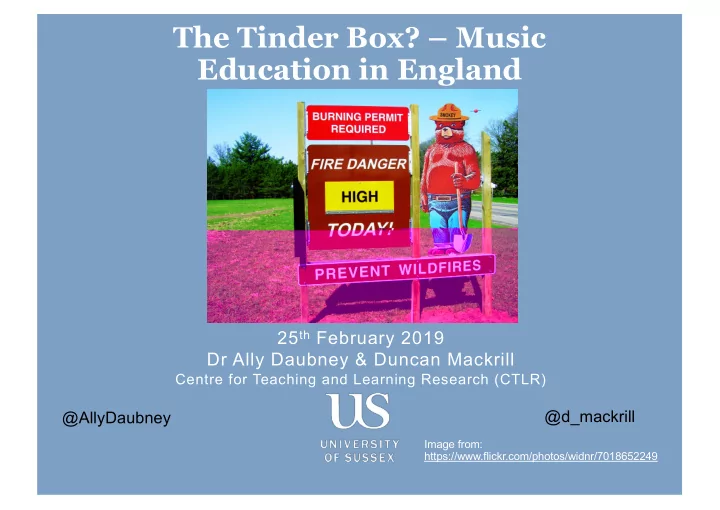
Image from: https://www.flickr.com/photos/widnr/7018652249
The Tinder Box? Music Education in England 25 th February 2019 Dr - - PowerPoint PPT Presentation
The Tinder Box? Music Education in England 25 th February 2019 Dr Ally Daubney & Duncan Mackrill Centre for Teaching and Learning Research (CTLR) @d_mackrill @AllyDaubney Image from: https://www.flickr.com/photos/widnr/7018652249 A
25th February 2019 Dr Ally Daubney & Duncan Mackrill
Centre for Teaching and Learning Research (CTLR)
@AllyDaubney @d_mackrill
Image from: https://www.flickr.com/photos/widnr/7018652249
DfE & Minster fail to accept negative impact on Music due to EBacc (2016-19) Further fragmentation across music education providers following introduction of MEHs Dramatic increase in academisation, particularly secondary schools Key Stage 4 overhaul & new GCSE qualifications introduced (2016 for music) Reduction in ITE Music target numbers and Music staff 2010-2018
Ofsted - Subject Lead & Triennial reports stop. Focus on EBacc subjects (2012-18)
Music not in Russell Group list of ‘facilitating subjects’ EBacc (re)introduced (2012) with Progress 8 (2016) Expert Subject Advisory Group for Music established National Curriculum revised 2012/13 Music Education Hubs introduced (2012) Henley Review and National Music Plan for Education established (2010-12)
This National Plan provides a flexible template for high quality music provision throughout a pupil’s education. It aims for equality of opportunity for all pupils, regardless of race; gender; where they live; their levels of musical talent; parental income; whether they have special educational needs
All schools should provide high quality music education as part of a broad and balanced curriculum.
Download from: https://www.ism.org/news/the- ism-releases-report-on-the- future-of-music-education Download from: https://www.ism.org/news/new-music- education-report-state-of-the-nation- released
Reduction of Key Stage 3 …pupils did not have any opportunity to study a language or some arts subjects, as the school directed them onto a pathway that excluded the subject as an option, in some cases from the age of 12. It is a risk to social mobility if pupils miss out on opportunities to study subjects and gain knowledge that could be valuable in subsequent stages of education or in later life. Restricted subject choice for low-attaining pupils disproportionately affects pupils from low income backgrounds. Amanda Spielman’s (Ofsted) speech 11 Oct 2017: ps://www.gov.uk/government/speeches/hmcis-commentary-october- 2017
Margot James, Senior Minister DCMS talking about the EBacc and the impact on Music (2018)
“I appreciate that there is a lot of concern, and real concern and legitimate concern about the narrowing of the curriculum, especially for arts, but not only for arts, but especially for arts. What I’d say about it and I’m sure there will be lots of questions and concerns noted, is the Department [of Education] is really keen, really wants all pupils to experience a high-quality arts education, we can disagree about the impact of what we’re doing, but that’s absolutely our intention.”
Josh Beattie, Assistant Director, Curriculum Division. DFE (2018)
Susan Aykin, Ofsted National Lead for Visual and Performing Arts (2018)
Music teacher, Sussex 2016-2018 study
12 students had opted for GCSE Music before the option was removed. The KS4 course was dropped without consultation due to funding issues. …headteachers are running scared from Whitehall with pressure for students to study more STEM than Arts
containing arts subjects pitted against each other so a student cannot take music, art and drama. they have to do something which contributes to the school's 'progress 8' data - more meaningless jargon. We have less pupils having instrumental / vocal lessons than in past years. 5 years ago we had 200 having instrumental/vocal lessons every week in school. This number is closer to 110 now.
compulsory, despite the promises of the National Curriculum:
curriculum subject.
0% 10% 20% 30% 40% 50% 60% 70% 80% 90%
2012/13 2018/19
84% 47.5%
Compulsory Year 9 Music
Number of responses 50 100 150 200 250 300 Positive Neutral Negative
2.5% 37.5% 60%
Are any changes to the provision / uptake of music in your school (within and beyond the curriculum) as a result of the introduction of the English Baccalaureate (EBacc) performance measure, positive, neutral, or negative?
Music teacher, Sussex University 2016-18 study
0% 10% 20% 30% 40% 50% 60% 70% 80% 90% GCSE BTEC level 2 Music NCFE Music Technology Rock School (RSL) 83% 16% 4% 8%
Music is the fastest disappearing A Level subject: ASCL research shows that the number of schools and colleges offering A Level music between September 2016 and September 2018 dropped by 38%. A large drop in A Level music entries: These have dropped by over 38% since 2010. In 2018 there were just 5,440 entries in total. In 2017 A Levels were ‘de-coupled’ from AS levels, making them a stand- alone 2-year qualification. Edexcel (Pearson) recently announced that they will be dropping AS level music from the suite of subjects they offer. Music Technology A Level entries are also falling: Our Sussex research shows that the number of centres offering A Level Music Technology for students beginning courses in September 2018 fell by 31.7%, with a 10.6% drop in the number of students recruited.
In terms of ABRSM exams, the difference between 2012 and 2017 equates to 42,000 less students in 2017 than 2012. There is also a 14% drop in the number of students taking ABRSM Grade 5 theory 2012-17. This potentially inhibits the progression routes of certain
partially made up by the other exam boards.
In 2017, only 3.5% (15 students from a cohort of 430) of entrants to UK music conservatoires were from Quintile 1 backgrounds (a drop of 1.7% from the previous year) compared to 39.5% from Quintile 5. The data from UCAS shows that there is a direct correlation between socio- economic grouping and likelihood gaining a place to study music at a conservatoire.
Applications to conservatoires 2017 using deprivation index figures from UCAS
Quintile1 Quintile2 Quintile3 Quintile4 Quintile5 Not assigned
Top sets guided towards eBacc. Lower sets guided to college applications. Due to change in exams - GCSE is now much much harder - which is making it harder for lower students to access. Decimated GCSE numbers, which together with changes to AS, have also now decimated previously healthy A level numbers. Emphasis placed on the core subjects which result in lots of students thinking that the arts are less important. Maths and English forced intervention after school impacts on the arts.
Music teacher, Sussex 2016-2018 study
24% 27% 32%
0% 5% 10% 15% 20% 25% 30% 35%
2016-17 2017-18 2018-19
2018/19.
some point since 2016
100 200 300 400 500 600 700 2010/11 2011/12 2012/13 2013/14 2014/15 2015/16 2016/17 2017/18 Target Recruited
2010/11 = 694
2017/18 = 393 and is a reduction of 43.4%
teachers from targets
teachers from the much higher target of 2010-11
Data from: https://www.gov.uk/education/initial-teacher-training-itt
Role made redundant / academy needs to save money so subjects (Music) have been cut. Part time member of staff left and was not
per fortnight to save money on staffing. 2nd in dept also taught drama and was full time but was made redundant this year. Following my return from maternity leave, we were unable to successfully recruit a new teacher so both music and music technology were cut at A-level.
“Primary liaison is very important in generating confident musicians who want to continue at secondary school. Big Sings,
cannot be measured exactly but it is vital. Working with the music service and any local groups to promote music in the community builds reputation and expectation and seems to future proof the music provision. We have had very vocal parents support our provision to ensure that all stakeholders are aware of it's value and this has helped prevent some bigger losses. “
Music teacher, Sussex 2016-2018 study
Hubs will augment and support music teaching in schools so that more children experience a combination of classroom teaching, instrumental and vocal tuition and input from professional musicians. Hubs will be able to deliver an offer to children that reaches beyond school boundaries and draws in the expertise of a range of education and arts partners, such as local orchestras, ensembles, charities and other music groups. (DfE & DCMS, 2011 p.10)
Music teacher, Sussex 2016-2018 study
Music teacher, Sussex 2016-2018 study
“There is absolutely no question that music teachers in and out of schools are going above and beyond the call of duty to deliver music education in spite of the significant challenges they currently
down the country share the government’s aspiration for a strong and sustained music education for all. The music education workforce supports the position of music in the curriculum for all children up to the end of Key Stage 3 to be at the heart of this, as cemented by music’s place as a statutory subject within the National Curriculum. They are keen to find solutions to the issues, and highlight the vulnerable position of the workforce as a threat to this.” ISM Future of Music Education report, Dec 2018
1. Pupils increasingly come to secondary school with less than one term of Whole Class music (a 41.97% rise in the past four years). How can Hubs better support sustained instrumental learning (in line with their core role) so that more children have more experience when they arrive in secondary school? 2. The most recently published ACE data returns for MEH demonstrate that a smaller percentage of pupils with SEN or in receipt of Pupil Premium are involved in WCIVT. This potentially exacerbates the situation seen in uptake at Key Stage 4 and runs counter to our collective aspirations of inclusivity and access for all. What can be done to reverse this situation? 3. What can every Hub and organisation do in their role to augment and support music education so that ALL children have access to a high quality and sustained music education throughout Key Stages 1, 2 and 3 and to make all schools the thriving musical communities we all want to see? 4. What can schools do to support Hubs to do this?