School Music Education Plan THAMES Guidance for Schools Music in - - PDF document

school music education plan thames guidance for schools
SMART_READER_LITE
LIVE PREVIEW

School Music Education Plan THAMES Guidance for Schools Music in - - PDF document

School Music Education Plan THAMES Guidance for Schools Music in Schools - Introducing School Music Education Plans As a result of the Ofsted report, Music in schools: what hubs must do, (Nov 2013) Music Education Hubs in England have


slide-1
SLIDE 1

School Music Education Plan –THAMES Guidance for Schools

Music in Schools - Introducing School Music Education Plans

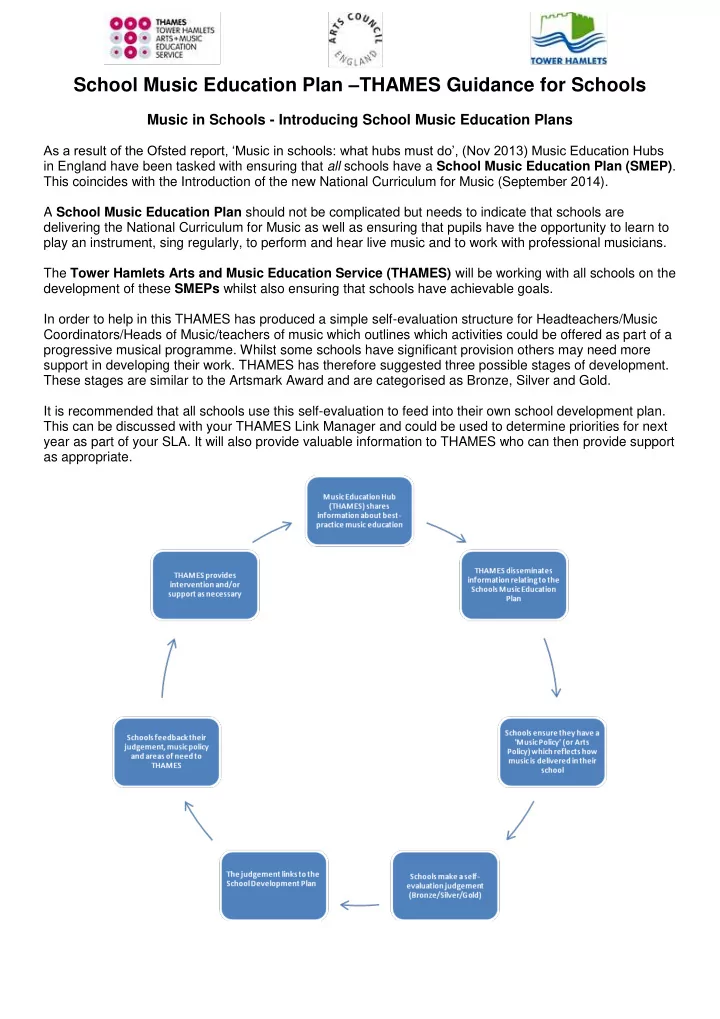
As a result of the Ofsted report, ‘Music in schools: what hubs must do’, (Nov 2013) Music Education Hubs in England have been tasked with ensuring that all schools have a School Music Education Plan (SMEP). This coincides with the Introduction of the new National Curriculum for Music (September 2014). A School Music Education Plan should not be complicated but needs to indicate that schools are delivering the National Curriculum for Music as well as ensuring that pupils have the opportunity to learn to play an instrument, sing regularly, to perform and hear live music and to work with professional musicians. The Tower Hamlets Arts and Music Education Service (THAMES) will be working with all schools on the development of these SMEPs whilst also ensuring that schools have achievable goals. In order to help in this THAMES has produced a simple self-evaluation structure for Headteachers/Music Coordinators/Heads of Music/teachers of music which outlines which activities could be offered as part of a progressive musical programme. Whilst some schools have significant provision others may need more support in developing their work. THAMES has therefore suggested three possible stages of development. These stages are similar to the Artsmark Award and are categorised as Bronze, Silver and Gold. It is recommended that all schools use this self-evaluation to feed into their own school development plan. This can be discussed with your THAMES Link Manager and could be used to determine priorities for next year as part of your SLA. It will also provide valuable information to THAMES who can then provide support as appropriate.

slide-2
SLIDE 2
slide-3
SLIDE 3

A Self Evaluation Tool for Schools in Tower Hamlets Nursery (Nursery & Reception) Primary (KS1/KS2) Secondary (KS3/KS4/Post-16) Bronze (standard expectation for all schools)

  • 1. Reasonable adjustments are made to ensure

that music making activities are accessible and enjoyable for all children

  • 2. Music activities are assessed using appropriate

framework

  • 3. Children actively engage with music, movement

and dance through play

  • 4. There is an assigned music co-ordinatorwho

can access CPD opportunities

  • 5. Some additional external projects may happen

in school

  • 6. A school music policy that is inclusive of all

children

  • 7. Performance opportunities in/out of school
  • 1. Appropriate measures are taken to ensure that

all music activities are accessible to all children

  • 2. National Curriculum music is taught every

week* at KS1 (min 30 mins) and KS2 (min 45mins) using appropriate Scheme of Work

  • 3. Music activities are assessed
  • 4. At least one whole school, key stage or phase

weekly singing assembly, (or elements of singing within an assembly) which all children can access and engage with

  • 5. There is an assigned music co-ordinator
  • 6. Some additional external projects may take

place

  • 7. A school music policy that is inclusive of all

children *or evidence of sustained musical experiences each week.

  • 1. Appropriate measures are taken to ensure that

all music activities are accessible to all children

  • 2. KS3 National Curriculum music builds on KS2

experience and attainment using appropriate Scheme of Work

  • 3. Lessons are progressive, challenging and

developmental across all genres

  • 4. Music activities are assessed
  • 5. There is an assigned lead person who is

responsible for music

  • 6. At least one weekly school choir or ensemble is

run by a member of music department staff

  • 7. Some additional external projects may take

place

  • 8. A school music policy that is inclusive of all

children

  • 9. Post KS3 offer for music (e.g. GCSE/BTEC)

where appropriate (Music Hubs should signpost Special Schools to accessible Assessment and Accreditation

  • pportunities i.e. via the Drake Music DM

Education webpages)

slide-4
SLIDE 4

Silver (builds upon bronze)

In addition:

  • 1. Every child is sustained in meaningful musical

activities

  • 2. Singing and dance is encouraged through all

activities and is used as a tool to aid language development, self-confidence, communication and positive relationships

  • 3. An assigned music co-ordinator who links with

the local music education hub

  • 4. The School engages with the Music Hub and

school CPD opportunities

  • 5. Performance opportunities in/out of school
  • 6. External projects which will help support music

and the arts

  • 7. There is an assigned Governor with

responsibility for Music In addition:

  • 1. Every child is sustained in meaningful musical

activities

  • 2. A regular weekly choir and/or ensemble(s); or

an accessible extra-curricular music opportunity

  • 3. Regular weekly instrumental lessons open to all

pupils either as whole class or in small groups

  • 4. An assigned music co-ordinator who links with

the local music education hub

  • 5. The School engages with the Music Hub and

School CPD opportunities

  • 6. Performance opportunities in/out of school
  • 7. External projects which will help support

National Curriculum music and the arts

  • 8. There is an assigned Governor with

responsibility for Music In addition:

  • 1. Every child is sustained in meaningful musical

activities

  • 2. Good take up of GCSE/BTEC, (and A Level, if

appropriate) courses

  • 3. Regular weekly instrumental lessons open to all

pupils in small groups, pairs or individually

  • 4. A range of regular weekly school-based

choirs/ensembles; or an accessible extra- curricular music opportunity

  • 5. A lead member of staff who links with the local

music education hub

  • 6. The School engages with the Music Hub and

School CPD opportunities

  • 7. Performance opportunities in/out of school
  • 8. External projects which will help support

National Curriculum music and the arts

  • 9. There is an assigned Governor with

responsibility for Music

slide-5
SLIDE 5

This judgement should link to your School Development Plan. How do you know provision meets its target; and what is the impact on teaching and learning?

Nursery (Nursery & Reception) Primary (KS1/KS2) Secondary (KS3/KS4/Post-16) Gold (builds upon bronze and silver)

In addition:

  • 1. Music is embedded in the whole school
  • 2. School is actively involved with the local music

education hub and helps drive change

  • 3. School engages and/or leads CPD opportunities

in/out of school and supports other schools

  • 4. Regular performance opportunities in/out of

school

  • 5. All additional external projects are linked to the

music map

  • 6. All musical activities have clear outcomes with

tangible evidence of their impact across the breadth of the EYFS curriculum

  • 7. Music making across the school is of a high

qualitywith informal monitoring systems in place to support good practice. Dispositions:

  • ability to concentrate, engage enthusiastically

and confidently; Skills:

  • listening and responding, conducting and

performing, handling instruments effectively, making marks to represent sound, linking movement to sound; Knowledge:

  • begin to understand different ways of creating

sound: blowing, percussion, string (plucking). In addition:

  • 1. Music is embedded in the whole school (e.g.

music can be offered in the morning not just the afternoon)

  • 2. School is actively involved with the local music

education hub and helps drive change

  • 3. School engages and/or leads CPD opportunities

in/out of school and supports other schools

  • 4. Regular performance opportunities in/out of

school

  • 5. All additional external projects are linked to the

curriculum and music map

  • 6. All musical activities have clear outcomes with

tangible evidence of their impact

  • 7. Music making across the school is of a high

quality with formalmonitoring systems in place to support good practice.

  • 8. Children are able to communicateabout music

using appropriate vocabulary in a meaningful way; and/or can share and express their feelings through music In addition:

  • 1. Music is embedded in the whole school (e.g.

students are released from other curriculum lessons to attend instrumental/vocal lessons)

  • 2. School is actively involved with the local music

education hub and helps drive change

  • 3. School engages and/or leads CPD opportunities

in/out of school and supports other schools

  • 4. Regular performance opportunities in/out of

school

  • 5. All additional external projects are linked to the

curriculum and music map

  • 6. All musical activities have clear outcomes with

tangible evidence of their impact

  • 7. Music making across the school is of a high

quality with formalmonitoring systems in place to support good practice.

  • 8. Pupils are able to communicateabout music

using appropriate vocabulary in a meaningful way; and/or can share and express their feelings through music

slide-6
SLIDE 6

Schools Music Education Plan Key Milestones Progress milestone / what are we going to do? Deadline for the milestone Lead person responsible for delivery Key Performance Indicator Risks / Issues 1 - all schools receive the initial SMEP information by second half of the spring term 2014, via Heads Bulletin; Link Manager emails; and Termly Music Forums March2014 Senior Manager 100% of schools receive SMEP information via information channels Information is not shared with Music Coordinators/ Head of Music 2 - all school visits to have taken place by end of spring term. Discussions between Heads and THAMES about music in school and how the SMEP will help target areas for development. April 2014 Senior Manager 85% of all SLA schools have engaged in either a face-to-face or phone conversation about music provision Some schools will not have capacity for a meeting 3 - signed and completed SLAs returned by start of summer term May 2014 Senior Manager 95% of previous SLA schools retain or increase their provision with THAMES Some schools may not know their provision until later 4 – Schools (voluntarily)submit their ‘Music Policy’ and ‘self-assessment’ of their standing in the gold/silver/bronze categories to THAMES.

  • Schools understand the targets for

development within their school development plan; and the positive impact the National Plan for Music Education has on the whole school and in developing music. October 2014 Head of THAMES 80% of schools provide their self-evaluation data Some schools may not want to share their self- assessment or music policy 5 – THAMES analyses school data/information returns December 2014 Head of THAMES 100% of returns are analysed for action and next steps Work-load pressures may prevent this happening 6 - THAMES works with schools who are identified as requiring support for music provision by the end of spring term 2015 April 2015 Head of THAMES 100% of schools needing support have received THAMES input in some form Co-ordination of support may prove challenging 7- THAMES engages schools with SMEP process July 2015 Head of THAMES 90% of all schools engage with the SMEP process Some schools may not opt to engage with the process as they have their own systems for reporting For further information please do not hesitate to contact Karen Brock (Head of THAMES)

  • n 0207 364 0431 or karen.brock@towerhamlets.gov.uk
slide-7
SLIDE 7

Appendix A - School Music Policy, Guidance

You should have a School Music Policy which outlines how music is delivered in your school, how music relates to your school’s values and how it is structured and delivered. It should not be long and should be reviewed every two years (or earlier as appropriate). Nursery (3-5) Primary (5-11) Secondary (11-18) This document should include:

a) Who teaches music in your school? b) How is music timetabled weekly? c) What is the provision for singing? d) Are there any external music organisations

who regularly work in school?

e) Is there an assigned lead person for music? f) Does the school link with the local Music

Education Hub?

g) How often are there performances in the

school?

h) Cross curricular links i) How inclusive is your music provision; and how

do you cater for all children? This document should include:

a) Who teaches the National Curriculum Music

lessons?

b) How is music timetabled weekly? c) Is there assessed musical progression? d) What is the provision for singing?

  • is there a regular weekly whole school

singing opportunity?

  • is there a school choir?
  • is there a regular accessible music
  • pportunity?

e) Are there instrumental and/or extra-curricular

learning opportunities? What are these and when do they happen?

f) Are there any external music organisations

who regularly work in school?

  • If so, who are the organisations and

what is their remit in the school?

g) Is there an assigned music co-ordinator? h) Does the school link with the local Music

Education Hub?

i) How often are there performances in the

school?

j) Cross curricular links k) How inclusive is your music provision; and how

do you cater for all children? This document should include:

a) How is music delivered across KS3? b) How does KS3 provision build upon KS2 prior

attainment?

c) Is there an assigned lead for music in the

school?

d) What provision is offered post KS3 (e.g.

GCSE/BTEC or other)?

  • If so, which course and which Exam board?
  • How many students are taking the exams in

each year?

e) Is there assessed musical progression? f) What is your staffing for class music? What are

their roles?

g) Is there a regular weekly school choir? h) Are there regular and/or extra-curricular weekly

ensembles?

i) Are there instrumental learning opportunities?

If so, what are these?

  • Are they progressive, developmental and

sustainable?

j) Are there any external music organisations

who regularly work in school?

  • If so, who are the organisations and what is

their remit in the school?

k) Does the school link to the local Music

Education Hub?

l) How often are there performances in school? m) Cross curricular links n) How inclusive is your music provision; and how

do you cater for all children?

slide-8
SLIDE 8