The Algol Family and ML Lisp Algol 60 Algol 68 John Mitchell - - PDF document

the algol family and ml
SMART_READER_LITE
LIVE PREVIEW

The Algol Family and ML Lisp Algol 60 Algol 68 John Mitchell - - PDF document

CS 242 Language Sequence The Algol Family and ML Lisp Algol 60 Algol 68 John Mitchell Pascal ML Modula Many other languages: Algol 58, Algol W, Euclid, EL1, Mesa (PARC), Modula-2, Oberon, Modula-3 (DEC) Algol 60 Algol 60 Sample


slide-1
SLIDE 1

1 The Algol Family and ML

John Mitchell

CS 242

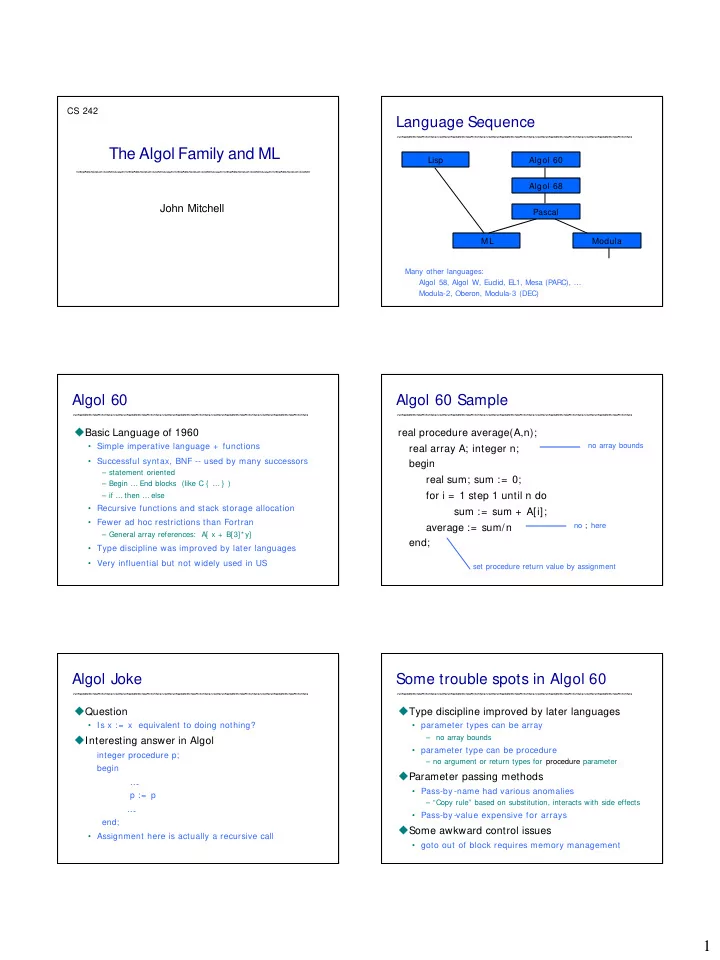
Language Sequence

Algol 60 Algol 68 Pascal ML Modula Lisp

Many other languages: Algol 58, Algol W, Euclid, EL1, Mesa (PARC), … Modula-2, Oberon, Modula-3 (DEC)

Algol 60

Basic Language of 1960

  • Simple imperative language + functions
  • Successful syntax, BNF -- used by many successors

– statement oriented – Begin … End blocks (like C { … } ) – if … then … else

  • Recursive functions and stack storage allocation
  • Fewer ad hoc restrictions than Fortran

– General array references: A[ x + B[3]* y]

  • Type discipline was improved by later languages
  • Very influential but not widely used in US

Algol 60 Sample

real procedure average(A,n); real array A; integer n; begin real sum; sum := 0; for i = 1 step 1 until n do sum := sum + A[i]; average := sum/n end;

no ; here no array bounds set procedure return value by assignment

Algol Joke

Question

  • Is x := x equivalent to doing nothing?

Interesting answer in Algol

integer procedure p; begin … . p := p … . end;

  • Assignment here is actually a recursive call

Some trouble spots in Algol 60

Type discipline improved by later languages

  • parameter types can be array

– no array bounds

  • parameter type can be procedure

– no argument or return types for procedure parameter

Parameter passing methods

  • Pass-by -name had various anomalies

– “Copy rule” based on substitution, interacts with side effects

  • Pass-by -value expensive for arrays

Some awkward control issues

  • goto out of block requires memory management
slide-2
SLIDE 2

2

Algol 60 Pass-by-name

Substitute text of actual parameter

  • Unpredictable with side effects!

Example

procedure inc2(i, j); integer i, j; begin i := i+ 1; j := j+ 1 end; inc2 (k, A[k]); begin k := k+ 1; A[ k] := A[ k] + 1 end; Is this what you expected?

Algol 68

Considered difficult to understand

  • Idiosyncratic terminology

– types were called “modes” – arrays were called “multiple values”

  • v W grammars instead of BNF

– context-sensitive grammar invented by A. van Wijngaarden

  • Elaborate type system
  • Complicated type conversions

Fixed some problems of Algol 60

  • Eliminated pass-by -name

Not widely adopted

Algol 68 Modes

Primitive modes

  • int
  • real
  • char
  • bool
  • string
  • compl

(complex)

  • bits
  • bytes
  • sema

(semaphore)

  • format (I / O)
  • file

Compound modes

  • arrays
  • structures
  • procedures
  • sets
  • pointers

Rich and structured type system is a major contribution of Algol 68

Other features of Algol 68

Storage management

  • Local storage on stack
  • Heap storage, explicit alloc and garbage collection

Parameter passing

  • Pass-by -value
  • Use pointer types to obtain Pass-by -reference

Assignable procedure variables

  • Follow “orthogonality ” principle rigorously

Source: Tanenbaum , Computing Surveys

Pascal

Revised type system of Algol

  • Good data-structuring concepts

– records, variants, subranges

  • More restrictive than Algol 60/68

– Procedure parameters cannot have procedure parameters

Popular teaching language Simple one-pass compiler

Limitations of Pascal

Array bounds part of type

procedure p(a : array [1..10] of integer) procedure p(n: integer, a : array [1..n] of integer) illegal

  • Attempt at orthogonal design backfires

– parameter must be given a type – type cannot contain variables How could this have happened? Emphasis on teaching

Not successful for “industrial-strength” projects

  • Kernighan -- Why Pascal is not my favorite language
  • Left niche for C; niche has expanded!!
slide-3
SLIDE 3

3

ML

Typed programming language Intended for interactive use Combination of Lisp and Algol- like features

  • Expression-oriented
  • Higher-order functions
  • Garbage collection
  • Abstract data types
  • Module system
  • Exceptions

General purpose non-C-like, not OO language

Goals in study of ML

Survey a modern procedural language Discuss general programming languages issues

  • Types and type checking

– General issues in static/dynamic typing – Type inference – Polymorphism and Generic Programming

  • Memory management

– Static scope and block structure – Function activation records, higher-order functions

  • Control

– Force and delay – Exceptions – Tail recursion and continuations

History of ML

Robin Milner Logic for Computable Functions

  • Stanford 1970-71
  • Edinburgh 1972 -1995

Meta-Language of the LCF system

  • Theorem proving
  • Type system
  • Higher-order functions

Logic for Computable Functions

Dana Scott, 1969

  • Formulate logic for proving properties of typed

functional programs

Milner

  • Project to automate logic
  • Notation for programs
  • Notation for assertions and proofs
  • Need to write programs that find proofs

– Too much work to construct full formal proof by hand

  • Make sure proofs are correct

LCF proof search

Tactic: function that tries to find proof

succeed and return proof tactic(formula) = search forever fail

Express tactics in the Meta-Language (ML) Use type system to facilitate correctness

Tactics in ML type system

Tactic has a functional type

tactic : formula → proof

Type system must allow “failure”

succeed and return proof tactic(formula) = search forever fail and raise exception

slide-4
SLIDE 4

4

Function types in ML

f : A → B means

for every x ∈ A, some element y= f(x) ∈ B f(x) = run forever terminate by raising an exception

In words, “if f(x) terminates normally, then f(x)∈ B.” Addition never occurs in f(x)+ 3 if f(x) raises exception. This form of function type arises directly from motivating application for ML. Integration of type system and exception mechanism mentioned in Milner’s 1991 Turing Award.

Higher-Order Functions

Tactic is a function Method for combining tactics is a function on functions Example:

f(tactic1, tactic 2) = λ formula. try tactic1(formula) else tactic2 (formula)

Basic Overview of ML

Interactive compiler: read-eval-print

  • Compiler infers type before compiling or executing

Type system does not allow casts or other loopholes.

Examples

  • (5+ 3)-2;

> val it = 6 : int

  • if 5> 3 then “Bob” else “Fido” ;

> val it = “Bob” : string

  • 5= 4;

> val it = false : bool

Overview by Type

Booleans

  • true, false : bool
  • if … then … else … (types must match)

Integers

  • 0, 1, 2, … : int
  • + , * , … : int * int → int

and so on …

Strings

  • “Austin Powers”

Reals

  • 1.0, 2.2, 3.14159, …

decimal point used to disambiguate

Compound Types

Tuples

  • (4, 5, “noxious”) : int * int * string

Lists

  • nil
  • 1 :: [2, 3, 4] infix cons notation

Records

  • { name = “Fido”, hungry= true}

: { name : string, hungry : bool}

Patterns and Declarations

Patterns can be used in place of variables

< pat> ::= < var> | <tuple> | < cons> | < record> …

Value declarations

  • General form

val < pat> = < exp>

  • Examples

val myTuple = (“Conrad”, “Lorenz”); val (x,y) = myTuple; val myList = [1, 2, 3, 4]; val x::rest = myList;

  • Local declarations

let val x = 2+3 in x*4 end;

slide-5
SLIDE 5

5

Functions and Pattern Matching

Anonymous function

  • fn x = > x+ 1; like Lisp lambda

Declaration form

  • fun < name> < pat 1> = < exp1>

| < name> < pat 2> = < exp2> … | < name> < patn> = < expn> …

Examples

  • fun f (x,y) = x+ y; actual par must match pattern (x,y)
  • fun length nil = 0

| length (x::s) = 1 + length(s);

Map function on lists

Apply function to every element of list

fun map (f, nil) = nil | map (f, x::xs) = f(x) :: map (f,xs) ; map (fn x = > x+ 1, [1,2,3]); [2,3,4]

Compare to Lisp

(define map (lambda (f xs) (if (eq? xs ()) () (cons (f (car xs)) (map f (cdr xs))) )))

More functions on lists

Reverse a list

fun reverse nil = nil | reverse (x::xs) = append ((reverse xs), [x]);

Append lists

fun append(nil, y s) = y s | append(x::xs, y s) = x :: append(xs, y s);

Questions

  • How efficient is reverse?
  • Can you do this with only one pass through list?

More efficient reverse function

fun reverse xs = let fun rev (nil, z) = (nil, z) | rev(y::ys , z) = rev(ys , y::z) val (u,v) = rev(xs,nil) in v end; 1 2 3 1 2 3 1 2 3 1 2 3

Datatype Declarations

General form

datatype < name> = < clause> | … | < clause> < clause> ::= < constructor> | < contructor> of < type>

Examples

  • datatype color = red | yellow | blue

– elements are red, yellow, blue

  • datatype atom = atm of string | nmbr of int

– elements are atm(“A”), atm(“B”), … , nmbr(0), nmbr(1), ...

  • datatype list = nil | cons of atom* list

– elements are nil, cons(atm(“A”), nil), … cons(nmbr(2), cons(atm(“ugh”), nil)), ...

Datatype and pattern matching

Recursively defined data structure

datatype tree = leaf of int | node of int* tree* tree

node(4, node(3,leaf(1), leaf(2)), node(5,leaf(6), leaf(7)) )

Recursive function

fun sum (leaf n) = n | sum (node(n,t1,t2)) = n + sum(t1) + sum(t2)

4 5 7 6 3 2 1

slide-6
SLIDE 6

6

Example: Evaluating Expressions

Define datatype of expressions

datatype exp = Var of int | Const of int | Plus of exp* exp; Write (x+ 3)+ y as Plus(Plus(Var(1),Const(3)), Var(2))

Evaluation function

fun ev(Var(n)) = Var(n) | ev(Const(n)) = Const(n) | ev(Plus(e1,e2)) = … Examples ev(Plus(Const(3),Const(2))) Const(5) ev(Plus(Var(1),Plus(Const(2),Const(3)))) ev(Plus(Var(1), Const(5))

Case expression

Datatype

datatype exp = Var of int | Const of int | Plus of exp* exp;

Case expression

case e of Var(n) = > … | Const(n) = > …. | Plus(e1,e2) = > …

Evaluation by cases

datatype exp = Var of int | Const of int | Plus of exp* exp; fun ev(Var(n)) = Var(n) | ev(Const(n)) = Const(n) | ev(Plus(e1,e2)) = (case ev(e1) of Var(n) = > Plus(Var(n),ev(e2)) | Const(n) = > (case ev(e2) of Var(m ) = > Plus(Const(n),Var(m )) | Const(m ) = > Const(n+ m) | Plus(e3,e4) = > Plus(Const(n),Plus(e3,e4)) ) | Plus(e3,e4) = > Plus(Plus(e3,e4),ev(e2)) ) ;

Core ML

Basic Types

  • Unit
  • Booleans
  • Integers
  • Strings
  • Reals
  • Tuples
  • Lists
  • Records

Patterns Declarations Functions Polymorphism Overloading Type declarations Exceptions Reference Cells

Variables and assignment

General terminology: L-values and R-values

  • Assignment y := x+ 3

– Identifier on left refers to a memory location, called L-value – Identifier on right refers to contents, called R-value

Variables

  • Basic properties

– A variable names a storage location – Contents of location can be read, can be changed

  • ML

– A variable is another type of value – Explicit operations to read contents or change contents – Separates naming (declaration of identifiers) from “variables”

ML imperative constructs

ML reference cells

  • Different types for location and contents

x : int non-assignable integer value y : int ref location whose contents must be integer !y the contents of location y ref x expression creating new cell initialized to x

  • ML assignment
  • perator := applied to memory cell and new contents
  • Examples

y := x+ 3 place value of x+ 3 in cell y; requires x:int y := !y + 3 add 3 to contents of y and store in location y

slide-7
SLIDE 7

7

ML examples

Create cell and change contents

val x = ref “Bob”; x := “Bill”;

Create cell and increment

val y = ref 0; y := !y + 1;

While loop

val i = ref 0; while !i < 10 do i := !i + 1; !i;