
SLIDE 1
10/21/08 1
Kathleen Fisher
cs242 Reading: “Concepts in Programming Languages” Chapter 5 except 5.4.5 “Real World Haskell”, Chapter 0 and Chapter 1 (http:/ /book.realworldhaskell.org/) Thanks to John Mitchell and Simon Peyton Jones for some of these slides.
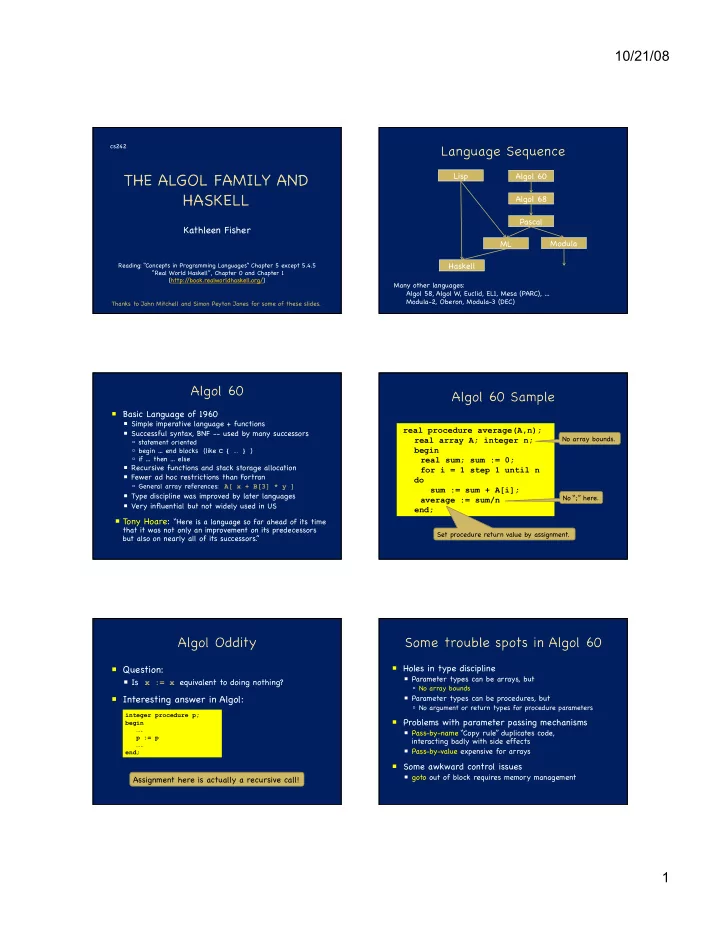
Algol 60 Algol 68 ML Modula Lisp
Many other languages: Algol 58, Algol W, Euclid, EL1, Mesa (PARC), … Modula-2, Oberon, Modula-3 (DEC)
Pascal Haskell
Basic Language of 1960
Simple imperative language + functions Successful syntax, BNF -- used by many successors
statement oriented begin … end blocks (like C { … } ) if … then … else
Recursive functions and stack storage allocation Fewer ad hoc restrictions than Fortran
General array references: A[ x + B[3] * y ]
Type discipline was improved by later languages Very influential but not widely used in US
Tony Hoare: “Here is a language so far ahead of its time
that it was not only an improvement on its predecessors but also on nearly all of its successors. ”
real procedure average(A,n); real array A; integer n; begin real sum; sum := 0; for i = 1 step 1 until n do sum := sum + A[i]; average := sum/n end;
No array bounds. No “;” here. Set procedure return value by assignment.
Question:
Is x := x equivalent to doing nothing?
Interesting answer in Algol:
integer procedure p; begin …. p := p …. end;
Assignment here is actually a recursive call!
Holes in type discipline
Parameter types can be arrays, but
No array bounds
Parameter types can be procedures, but
No argument or return types for procedure parameters