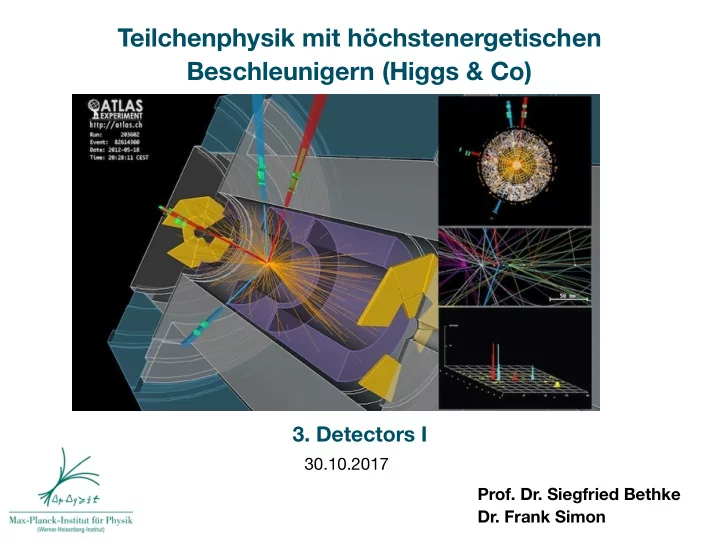
Teilchenphysik mit hchstenergetischen Beschleunigern (Higgs & - - PowerPoint PPT Presentation

teilchenphysik mit h chstenergetischen beschleunigern
SMART_READER_LITE
LIVE PREVIEW

Teilchenphysik mit hchstenergetischen Beschleunigern (Higgs & - - PowerPoint PPT Presentation

Teilchenphysik mit hchstenergetischen Beschleunigern (Higgs & Co) 3. Detectors I 30.10.2017 Prof. Dr. Siegfried Bethke Dr. Frank Simon Detectors: Overview Lecture Detectors I Introduction, overall detector concepts Detector


slide-1
SLIDE 1
  • Prof. Dr. Siegfried Bethke
  • Dr. Frank Simon

Teilchenphysik mit höchstenergetischen Beschleunigern (Higgs & Co)

30.10.2017

  • 3. Detectors I
slide-2
SLIDE 2

Frank Simon (fsimon@mpp.mpg.de) Teilchenphysik mit höchstenergetischen Beschleunigern: WS 17/18, 03: Detectors I

Detectors: Overview

  • Lecture Detectors I
  • Introduction, overall detector concepts
  • Detector systems at hadron colliders
  • Basics of particle detection: Interaction with matter
  • Methods for particle detection
  • Lecture Detectors II
  • Tracking detectors: Basics
  • Semiconductor trackers
  • Calorimeters
  • Muon systems

2

slide-3
SLIDE 3

Frank Simon (fsimon@mpp.mpg.de)

Introduction, Overall Concepts

3

Teilchenphysik mit höchstenergetischen Beschleunigern: WS 17/18, 03: Detectors I

slide-4
SLIDE 4

σ(t¯ t)/σtot ∼ 10−8 σ(H, MH = 150 GeV)/σtot ∼ 10−10

Frank Simon (fsimon@mpp.mpg.de) Teilchenphysik mit höchstenergetischen Beschleunigern: WS 17/18, 03: Detectors I

The Conditions at Hadron Colliders

  • Interesting processes are rare

compared to the overall cross section:

4

  • G. Weiglein et al.


Physics Reports 426 (2006) 47–358

slide-5
SLIDE 5

σ(t¯ t)/σtot ∼ 10−8 σ(H, MH = 150 GeV)/σtot ∼ 10−10

Frank Simon (fsimon@mpp.mpg.de) Teilchenphysik mit höchstenergetischen Beschleunigern: WS 17/18, 03: Detectors I

The Conditions at Hadron Colliders

  • Interesting processes are rare

compared to the overall cross section:

4

  • G. Weiglein et al.


Physics Reports 426 (2006) 47–358

  • Very high event rates required!
slide-6
SLIDE 6

σ(t¯ t)/σtot ∼ 10−8 σ(H, MH = 150 GeV)/σtot ∼ 10−10

Frank Simon (fsimon@mpp.mpg.de) Teilchenphysik mit höchstenergetischen Beschleunigern: WS 17/18, 03: Detectors I

The Conditions at Hadron Colliders

  • Interesting processes are rare

compared to the overall cross section:

4

  • G. Weiglein et al.


Physics Reports 426 (2006) 47–358

  • Very high event rates required!
  • Detectors have to be able to cope with

high particle rates and corresponding large amounts of data

  • They have to be able to select (“trigger
  • n”) interesting events
slide-7
SLIDE 7

L = 1034cm−2s−1 σpp ≈ 100 mb = 10−25 cm2

Frank Simon (fsimon@mpp.mpg.de) Teilchenphysik mit höchstenergetischen Beschleunigern: WS 17/18, 03: Detectors I

Detector Requirements

  • Conditions at LHC:
  • Bunch crossing rate: 40 MHz (each 25 ns)
  • Design Luminosity:
  • pp - cross section:

5

slide-8
SLIDE 8

L = 1034cm−2s−1 σpp ≈ 100 mb = 10−25 cm2

Frank Simon (fsimon@mpp.mpg.de) Teilchenphysik mit höchstenergetischen Beschleunigern: WS 17/18, 03: Detectors I

Detector Requirements

  • Conditions at LHC:
  • Bunch crossing rate: 40 MHz (each 25 ns)
  • Design Luminosity:
  • pp - cross section:

5

➠ Interaction rate ~ 1 GHz, approx. 25 p+p - reactions per bunch-crossing

slide-9
SLIDE 9

L = 1034cm−2s−1 σpp ≈ 100 mb = 10−25 cm2

Frank Simon (fsimon@mpp.mpg.de) Teilchenphysik mit höchstenergetischen Beschleunigern: WS 17/18, 03: Detectors I

Detector Requirements

  • Conditions at LHC:
  • Bunch crossing rate: 40 MHz (each 25 ns)
  • Design Luminosity:
  • pp - cross section:

5

➠ Interaction rate ~ 1 GHz, approx. 25 p+p - reactions per bunch-crossing

  • Detector requirements:
  • high granularity to resolve high particle density
  • Fast readout, data buffering directly on detector (“pipelines”), typically

128 BX deep

  • Needs a fast decision, if an event is interesting and should be read out for

further processing: a maximum of 3.2 µs to decide

  • High granularity results in high data volume: Maximum rate that can be

stored ~ 100 Hz ➠ Trigger and DAQ later in the series!

slide-10
SLIDE 10

Frank Simon (fsimon@mpp.mpg.de) Teilchenphysik mit höchstenergetischen Beschleunigern: WS 17/18, 03: Detectors I

LHC: Extreme Conditions

6

Z -> μμ ... and 25 other collisions

slide-11
SLIDE 11

Frank Simon (fsimon@mpp.mpg.de) Teilchenphysik mit höchstenergetischen Beschleunigern: WS 17/18, 03: Detectors I

LHC: Extreme Conditions

6

Z -> μμ ... and 25 other collisions Normal LHC conditions in 2012 data taking - will get more in the future!

slide-12
SLIDE 12

Frank Simon (fsimon@mpp.mpg.de) Teilchenphysik mit höchstenergetischen Beschleunigern: WS 17/18, 03: Detectors I

Collider Detectors

  • Detection of the final-state particles of the interaction
  • Signals generated via electromagnetic interaction with the detector material

7

slide-13
SLIDE 13

Frank Simon (fsimon@mpp.mpg.de) Teilchenphysik mit höchstenergetischen Beschleunigern: WS 17/18, 03: Detectors I

Collider Detectors

  • Detection of the final-state particles of the interaction
  • Signals generated via electromagnetic interaction with the detector material

7

Tracker: Momentum of charged particles via precise measurement of deflection in magnetic field

slide-14
SLIDE 14

Frank Simon (fsimon@mpp.mpg.de) Teilchenphysik mit höchstenergetischen Beschleunigern: WS 17/18, 03: Detectors I

Collider Detectors

  • Detection of the final-state particles of the interaction
  • Signals generated via electromagnetic interaction with the detector material

7

Tracker: Momentum of charged particles via precise measurement of deflection in magnetic field Calorimeters: Energy measurement for photons, electrons and hadrons by total absorption

slide-15
SLIDE 15

Frank Simon (fsimon@mpp.mpg.de) Teilchenphysik mit höchstenergetischen Beschleunigern: WS 17/18, 03: Detectors I

Collider Detectors

  • Detection of the final-state particles of the interaction
  • Signals generated via electromagnetic interaction with the detector material

7

Tracker: Momentum of charged particles via precise measurement of deflection in magnetic field Calorimeters: Energy measurement for photons, electrons and hadrons by total absorption Muon detectors: Identification and precise momentum measurement outside

  • f the main magnet
slide-16
SLIDE 16

Frank Simon (fsimon@mpp.mpg.de) Teilchenphysik mit höchstenergetischen Beschleunigern: WS 17/18, 03: Detectors I

Generic Detector Construction Guide

8

slide-17
SLIDE 17

Frank Simon (fsimon@mpp.mpg.de) Teilchenphysik mit höchstenergetischen Beschleunigern: WS 17/18, 03: Detectors I

Generic Detector Construction Guide

1.Vertex Tracker as close as possible to interaction point: Identification of secondary decays, for example from b-Quarks

8

slide-18
SLIDE 18

Frank Simon (fsimon@mpp.mpg.de) Teilchenphysik mit höchstenergetischen Beschleunigern: WS 17/18, 03: Detectors I

Generic Detector Construction Guide

1.Vertex Tracker as close as possible to interaction point: Identification of secondary decays, for example from b-Quarks 2.Main Tracker: Measurement of location and momentum of all charged particles, some times also with particle ID

8

slide-19
SLIDE 19

Frank Simon (fsimon@mpp.mpg.de) Teilchenphysik mit höchstenergetischen Beschleunigern: WS 17/18, 03: Detectors I

Generic Detector Construction Guide

1.Vertex Tracker as close as possible to interaction point: Identification of secondary decays, for example from b-Quarks 2.Main Tracker: Measurement of location and momentum of all charged particles, some times also with particle ID 3.Particle ID: Time-of-flight measurement, Cherenkov detectors,... (optional)

8

slide-20
SLIDE 20

Frank Simon (fsimon@mpp.mpg.de) Teilchenphysik mit höchstenergetischen Beschleunigern: WS 17/18, 03: Detectors I

Generic Detector Construction Guide

1.Vertex Tracker as close as possible to interaction point: Identification of secondary decays, for example from b-Quarks 2.Main Tracker: Measurement of location and momentum of all charged particles, some times also with particle ID 3.Particle ID: Time-of-flight measurement, Cherenkov detectors,... (optional) 4.Calorimeter (electromagnetic, hadronic): Energy measurement of charged and neutral particles

8

slide-21
SLIDE 21

Frank Simon (fsimon@mpp.mpg.de) Teilchenphysik mit höchstenergetischen Beschleunigern: WS 17/18, 03: Detectors I

Generic Detector Construction Guide

1.Vertex Tracker as close as possible to interaction point: Identification of secondary decays, for example from b-Quarks 2.Main Tracker: Measurement of location and momentum of all charged particles, some times also with particle ID 3.Particle ID: Time-of-flight measurement, Cherenkov detectors,... (optional) 4.Calorimeter (electromagnetic, hadronic): Energy measurement of charged and neutral particles 5.Muon Detectors: Improved tracking and identification of muons

8

slide-22
SLIDE 22

Frank Simon (fsimon@mpp.mpg.de) Teilchenphysik mit höchstenergetischen Beschleunigern: WS 17/18, 03: Detectors I

Generic Detector Construction Guide

1.Vertex Tracker as close as possible to interaction point: Identification of secondary decays, for example from b-Quarks 2.Main Tracker: Measurement of location and momentum of all charged particles, some times also with particle ID 3.Particle ID: Time-of-flight measurement, Cherenkov detectors,... (optional) 4.Calorimeter (electromagnetic, hadronic): Energy measurement of charged and neutral particles 5.Muon Detectors: Improved tracking and identification of muons

  • 1. - 3. have to be inside of a magnet to measure momentum

8

slide-23
SLIDE 23

Frank Simon (fsimon@mpp.mpg.de) Teilchenphysik mit höchstenergetischen Beschleunigern: WS 17/18, 03: Detectors I

Generic Detector Construction Guide

1.Vertex Tracker as close as possible to interaction point: Identification of secondary decays, for example from b-Quarks 2.Main Tracker: Measurement of location and momentum of all charged particles, some times also with particle ID 3.Particle ID: Time-of-flight measurement, Cherenkov detectors,... (optional) 4.Calorimeter (electromagnetic, hadronic): Energy measurement of charged and neutral particles 5.Muon Detectors: Improved tracking and identification of muons

  • 1. - 3. have to be inside of a magnet to measure momentum
  • Ideally also include the calorimeters inside of the magnet to limit (dead)

material in front of the detectors

8

slide-24
SLIDE 24

Frank Simon (fsimon@mpp.mpg.de) Teilchenphysik mit höchstenergetischen Beschleunigern: WS 17/18, 03: Detectors I

Generic Detector Construction Guide

1.Vertex Tracker as close as possible to interaction point: Identification of secondary decays, for example from b-Quarks 2.Main Tracker: Measurement of location and momentum of all charged particles, some times also with particle ID 3.Particle ID: Time-of-flight measurement, Cherenkov detectors,... (optional) 4.Calorimeter (electromagnetic, hadronic): Energy measurement of charged and neutral particles 5.Muon Detectors: Improved tracking and identification of muons

  • 1. - 3. have to be inside of a magnet to measure momentum
  • Ideally also include the calorimeters inside of the magnet to limit (dead)

material in front of the detectors

  • 6. A big (and strong) magnet!

8

slide-25
SLIDE 25

Frank Simon (fsimon@mpp.mpg.de)

Detector Systems at Hadron Colliders

9

Teilchenphysik mit höchstenergetischen Beschleunigern: WS 17/18, 03: Detectors I

slide-26
SLIDE 26

Frank Simon (fsimon@mpp.mpg.de) Teilchenphysik mit höchstenergetischen Beschleunigern: WS 17/18, 03: Detectors I

Collider Detectors: Cross Section [CMS]

  • The high energies require high magnetic fields and large detectors
  • Here: CMS, where the “C” is for “compact”

10

slide-27
SLIDE 27

Frank Simon (fsimon@mpp.mpg.de) Teilchenphysik mit höchstenergetischen Beschleunigern: WS 17/18, 03: Detectors I

CMS: The Heavy Weight

11

Weight: 12 500 T Length: 21.5 m Diameter: 15 m Solenoidal field: 4 T

slide-28
SLIDE 28

Frank Simon (fsimon@mpp.mpg.de) Teilchenphysik mit höchstenergetischen Beschleunigern: WS 17/18, 03: Detectors I

CMS

12

Photo: CERN

slide-29
SLIDE 29

Frank Simon (fsimon@mpp.mpg.de) Teilchenphysik mit höchstenergetischen Beschleunigern: WS 17/18, 03: Detectors I

Particles in ATLAS

13

slide-30
SLIDE 30

Frank Simon (fsimon@mpp.mpg.de) Teilchenphysik mit höchstenergetischen Beschleunigern: WS 17/18, 03: Detectors I

ATLAS: The biggest Detector in Particle Physics

14

Illustration: CERN

4 6 m 25 m Weight: 7 000 t Central Solenoid: 2 T Muon Toroid: 4 T

slide-31
SLIDE 31

Frank Simon (fsimon@mpp.mpg.de) Teilchenphysik mit höchstenergetischen Beschleunigern: WS 17/18, 03: Detectors I

ATLAS

15

Photo: CERN

slide-32
SLIDE 32

Frank Simon (fsimon@mpp.mpg.de)

Basics of Particle Detection: Interaction with Matter

16

Teilchenphysik mit höchstenergetischen Beschleunigern: WS 17/18, 03: Detectors I

slide-33
SLIDE 33

Frank Simon (fsimon@mpp.mpg.de) Teilchenphysik mit höchstenergetischen Beschleunigern: WS 17/18, 03: Detectors I

Energy Loss in Matter: Bethe-Bloch

  • Applicable in intermediate

energy range

  • Atomic effects at low

energies and Bremsstrahlung at high energies separately

  • Z/A dependence: large energy

loss in H

  • 1/β2 at low momenta: Heavy

particles loose more energy

  • Minimum at p/m ~ 3-4:

minimum ionizing particle MIP

  • logarithmic rise for high

momentum

  • Density effect due to

polarization of medium

17

  • The Bethe-Bloch Formula describes energy loss by ionization
slide-34
SLIDE 34

Frank Simon (fsimon@mpp.mpg.de) Teilchenphysik mit höchstenergetischen Beschleunigern: WS 17/18, 03: Detectors I

Material Dependence of Energy Loss

  • Simple approximation: Energy loss of 


MIPs (βγ ~ 3):
 1-2 MeV g-1 cm2 (exception: H)

18

Zabsorber

slide-35
SLIDE 35

Frank Simon (fsimon@mpp.mpg.de) Teilchenphysik mit höchstenergetischen Beschleunigern: WS 17/18, 03: Detectors I

Energy Loss: A Closer Look

  • Bethe-Bloch only gives the mean value!
  • Energy loss is a statistical process

19

slide-36
SLIDE 36

Frank Simon (fsimon@mpp.mpg.de) Teilchenphysik mit höchstenergetischen Beschleunigern: WS 17/18, 03: Detectors I

Energy Loss: A Closer Look

  • Bethe-Bloch only gives the mean value!
  • Energy loss is a statistical process

19

On the microscopic level: discrete scatterings, leading to ionization
 ➫ Depending on the momentum transfer, a single or multiple free electrons are 
 created

slide-37
SLIDE 37

Frank Simon (fsimon@mpp.mpg.de) Teilchenphysik mit höchstenergetischen Beschleunigern: WS 17/18, 03: Detectors I

Energy Loss: A Closer Look

  • Bethe-Bloch only gives the mean value!
  • Energy loss is a statistical process

19

On the microscopic level: discrete scatterings, leading to ionization
 ➫ Depending on the momentum transfer, a single or multiple free electrons are 
 created ➫ Distinguishing primary and secondary ionization:

primary ionization

  • Poissonian distributed

per unit length

  • Large fluctuations of

energy loss per collision

secondary ionization

  • originating from high-energy

primary electrons

  • Sometimes the energy is

sufficient for a clearly visible secondary track: δ electron

slide-38
SLIDE 38

Frank Simon (fsimon@mpp.mpg.de) Teilchenphysik mit höchstenergetischen Beschleunigern: WS 17/18, 03: Detectors I

Energy Loss: A Closer Look

  • Bethe-Bloch only gives the mean value!
  • Energy loss is a statistical process

19

On the microscopic level: discrete scatterings, leading to ionization
 ➫ Depending on the momentum transfer, a single or multiple free electrons are 
 created ➫ Distinguishing primary and secondary ionization:

primary ionization

  • Poissonian distributed

per unit length

  • Large fluctuations of

energy loss per collision

secondary ionization

  • originating from high-energy

primary electrons

  • Sometimes the energy is

sufficient for a clearly visible secondary track: δ electron

total ionization =primary ionization + secondary ionization In gases (STP) typically 30 primary reactions per cm, 90 electrons per cm

slide-39
SLIDE 39

Frank Simon (fsimon@mpp.mpg.de) Teilchenphysik mit höchstenergetischen Beschleunigern: WS 17/18, 03: Detectors I

Energy Loss: A Closer Look

  • Example for a delta electron in a bubble

chamber: clearly visible range!

20

slide-40
SLIDE 40

Frank Simon (fsimon@mpp.mpg.de) Teilchenphysik mit höchstenergetischen Beschleunigern: WS 17/18, 03: Detectors I

Energy Loss in Thin Layers

  • The large range of the energy loss in individual reactions results in large

variations of the energy loss in thin detectors:

  • A broad maximum: Collisions with relatively small energy loss
  • A long tail to high energy loss: few collisions with large energy loss, δ electrons

21

slide-41
SLIDE 41

Thin absorber: <ΔE> < ~ 10 Tmax The energy loss in thin layers was first described by Landau: Landau distribution For 500 MeV pions: Tmax ~ 9 MeV (Mean energy loss in 9 mm of Si)

Frank Simon (fsimon@mpp.mpg.de) Teilchenphysik mit höchstenergetischen Beschleunigern: WS 17/18, 03: Detectors I

Energy Loss in Thin Layers

  • The large range of the energy loss in individual reactions results in large

variations of the energy loss in thin detectors:

  • A broad maximum: Collisions with relatively small energy loss
  • A long tail to high energy loss: few collisions with large energy loss, δ electrons

21

slide-42
SLIDE 42

Frank Simon (fsimon@mpp.mpg.de) Teilchenphysik mit höchstenergetischen Beschleunigern: WS 17/18, 03: Detectors I

Photons: Interactions

22

ν ν’ e- ν ν’ e- e- e+ nucleus photo effect Compton scattering pair creation energy threshold: 2 me = ~1.022 MeV

slide-43
SLIDE 43

Frank Simon (fsimon@mpp.mpg.de) Teilchenphysik mit höchstenergetischen Beschleunigern: WS 17/18, 03: Detectors I

Photons: Interactions

  • In contrast to dE/dx for charged particles:


“All or nothing” reactions

22

ν ν’ e- ν ν’ e- e- e+ nucleus photo effect Compton scattering pair creation energy threshold: 2 me = ~1.022 MeV

slide-44
SLIDE 44

Frank Simon (fsimon@mpp.mpg.de) Teilchenphysik mit höchstenergetischen Beschleunigern: WS 17/18, 03: Detectors I

Photons: Interactions

  • In contrast to dE/dx for charged particles:


“All or nothing” reactions

22

ν ν’ e- ν ν’ e- e- e+ nucleus photo effect Compton scattering pair creation energy threshold: 2 me = ~1.022 MeV

I(x) = I0e−µx

➫ Reduction of photon intensity when traversing matter:

slide-45
SLIDE 45

Frank Simon (fsimon@mpp.mpg.de) Teilchenphysik mit höchstenergetischen Beschleunigern: WS 17/18, 03: Detectors I

Photons in Matter

  • At high energies pair creation dominates by far
  • Low energies:
  • photoelectric effect
  • Coherent scattering: Rayleigh scattering
  • Compton scattering
  • nuclear excitation

23

pair creation in nuclear field pair creation in 
 electron field giant dipole
 resonance

slide-46
SLIDE 46

Frank Simon (fsimon@mpp.mpg.de) Teilchenphysik mit höchstenergetischen Beschleunigern: WS 17/18, 03: Detectors I

Electrons: Energy Loss

  • Bremsstrahlung dominates at

high energies

  • At low energy: Ionization,

scattering

24

  • Critical energy: The energy where

ionization energy loss equals radiative losses through Bremsstrahlung

slide-47
SLIDE 47

Frank Simon (fsimon@mpp.mpg.de) Teilchenphysik mit höchstenergetischen Beschleunigern: WS 17/18, 03: Detectors I

Electrons and Photons: Radiation Length

  • The relevant length scale: one radiation length
  • Describes high-energy electrons and photons (Energy loss via Bremsstrahlung
  • and. e+e- - pair creation, respectively)

25

slide-48
SLIDE 48

Frank Simon (fsimon@mpp.mpg.de) Teilchenphysik mit höchstenergetischen Beschleunigern: WS 17/18, 03: Detectors I

Electrons and Photons: Radiation Length

  • The relevant length scale: one radiation length
  • Describes high-energy electrons and photons (Energy loss via Bremsstrahlung
  • and. e+e- - pair creation, respectively)

25

  • Defined as the amount of matter that has to be traversed such that
  • an electron loses all but 1/e of its energy via Bremsstrahlung
  • 7/9 of the mean free path for pair creation for high-energy photons
slide-49
SLIDE 49

Frank Simon (fsimon@mpp.mpg.de) Teilchenphysik mit höchstenergetischen Beschleunigern: WS 17/18, 03: Detectors I

Electrons and Photons: Radiation Length

  • The relevant length scale: one radiation length
  • Describes high-energy electrons and photons (Energy loss via Bremsstrahlung
  • and. e+e- - pair creation, respectively)

25

  • Defined as the amount of matter that has to be traversed such that
  • an electron loses all but 1/e of its energy via Bremsstrahlung
  • 7/9 of the mean free path for pair creation for high-energy photons

X0 =

716.4 A Z(1+Z) ln(287/ √ Z) g cm2 ∝ A Z2

empirical:

slide-50
SLIDE 50

Frank Simon (fsimon@mpp.mpg.de) Teilchenphysik mit höchstenergetischen Beschleunigern: WS 17/18, 03: Detectors I

Electrons and Photons: Radiation Length

  • The relevant length scale: one radiation length
  • Describes high-energy electrons and photons (Energy loss via Bremsstrahlung
  • and. e+e- - pair creation, respectively)

25

  • Defined as the amount of matter that has to be traversed such that
  • an electron loses all but 1/e of its energy via Bremsstrahlung
  • 7/9 of the mean free path for pair creation for high-energy photons
  • Also relevant for the description of multiple coulomb scattering

X0 =

716.4 A Z(1+Z) ln(287/ √ Z) g cm2 ∝ A Z2

empirical:

slide-51
SLIDE 51

Frank Simon (fsimon@mpp.mpg.de) Teilchenphysik mit höchstenergetischen Beschleunigern: WS 17/18, 03: Detectors I

Electrons and Photons: Radiation Length

  • The relevant length scale: one radiation length
  • Describes high-energy electrons and photons (Energy loss via Bremsstrahlung
  • and. e+e- - pair creation, respectively)

25

  • Defined as the amount of matter that has to be traversed such that
  • an electron loses all but 1/e of its energy via Bremsstrahlung
  • 7/9 of the mean free path for pair creation for high-energy photons
  • Also relevant for the description of multiple coulomb scattering
  • Is usually given in g/cm2, typical values:
  • Air: 36.66 g/cm2, corresponds to ~ 300 m
  • Water: 36.08 g/cm2, corresponds to ~ 36 cm
  • Aluminium: 24.01 g/cm2, corresponds to 8.9 cm
  • Tungsten: 6.76 g/cm2, corresponds to 0.35 cm

X0 =

716.4 A Z(1+Z) ln(287/ √ Z) g cm2 ∝ A Z2

empirical:

slide-52
SLIDE 52

Frank Simon (fsimon@mpp.mpg.de)

Methods of Particle Detection

26

Teilchenphysik mit höchstenergetischen Beschleunigern: WS 17/18, 03: Detectors I

slide-53
SLIDE 53

Frank Simon (fsimon@mpp.mpg.de) Teilchenphysik mit höchstenergetischen Beschleunigern: WS 17/18, 03: Detectors I

Ionization Chamber: A Classic

  • Particles create electron-ion pairs in

gas volume

  • Electrons are accelerated in strong

electric field, resulting in avalanche amplification

  • Depending on the applied voltage the

signal is proportional to the deposited energy or saturates

27

slide-54
SLIDE 54

Frank Simon (fsimon@mpp.mpg.de) Teilchenphysik mit höchstenergetischen Beschleunigern: WS 17/18, 03: Detectors I

Spatial Resolution

  • Multi-Wire

Proportional Counter MWPC

  • G. Charpak 1968 


(NP 1992)

28

slide-55
SLIDE 55

Frank Simon (fsimon@mpp.mpg.de) Teilchenphysik mit höchstenergetischen Beschleunigern: WS 17/18, 03: Detectors I

Spatial Information through Timing: Drift Chamber

  • If the time of passage of a particle is known from external measurements

(trigger!) one can determine the location based on the arrival time of the charge cloud at the anode wire

  • Prerequisite: Field distribution, and through that also drift velocity profile in

gas volume well known

29

slide-56
SLIDE 56

Frank Simon (fsimon@mpp.mpg.de) Teilchenphysik mit höchstenergetischen Beschleunigern: WS 17/18, 03: Detectors I

Cylindrical Drift Chamber for Collider Detectors

  • Solenoidal magnetic

field for momentum measurement parallel to chamber wires

30

slide-57
SLIDE 57

Frank Simon (fsimon@mpp.mpg.de) Teilchenphysik mit höchstenergetischen Beschleunigern: WS 17/18, 03: Detectors I

Semiconductor Detectors: PN Junction

  • By combining silicon with different dopants you get a PN junction
  • Donor (e.g. Phosphorus) provides electrons: n-doping
  • Aceptor (e.g. Boron) provides holes: p-doping
  • The charge excess gets neutralized on contact, a depletion zone and a

corresponding electric field develops at the junction

31

slide-58
SLIDE 58

Frank Simon (fsimon@mpp.mpg.de) Teilchenphysik mit höchstenergetischen Beschleunigern: WS 17/18, 03: Detectors I

Semiconductor Detectors: Charge Collection

  • An external bias voltage

increases the depletion zone by removing all charge carriers

  • Created electrons and holes

move to the contacts without recombining with the Si: development of a signal

32

  • Through-going particles produce electron-hole pairs (in Si: 3.6 eV required

per pair, for comparison: 20 eV - 40 eV in gas)

  • The high density and low ionization threshold allows to build compact

detectors with excellent spatial resolution

slide-59
SLIDE 59

Frank Simon (fsimon@mpp.mpg.de) Teilchenphysik mit höchstenergetischen Beschleunigern: WS 17/18, 03: Detectors I

Semiconductor Strip Detectors

33

slide-60
SLIDE 60

Frank Simon (fsimon@mpp.mpg.de) Teilchenphysik mit höchstenergetischen Beschleunigern: WS 17/18, 03: Detectors I

Scintillators

34

  • Scintillators emit light when

traversed by ionizing particles

  • Excitation of metastable

states (organic scintillators)

  • r


Defects in Crystals (inorganic scintillators)


  • rganic

inorganic:

slide-61
SLIDE 61

Frank Simon (fsimon@mpp.mpg.de) Teilchenphysik mit höchstenergetischen Beschleunigern: WS 17/18, 03: Detectors I

Scintillation Detectors

  • Classical principle: Detection of scintillation light

with photo multipliers

  • today these are more and more replaced by

silicon-based photon detectors

  • Scintillators (in particular plastic scintillators)

provide a fast signal, ideal for trigger detectors

35

slide-62
SLIDE 62

Frank Simon (fsimon@mpp.mpg.de) Teilchenphysik mit höchstenergetischen Beschleunigern: WS 17/18, 03: Detectors I

Silicon-Based Photon Detection

36

  • Silicon detectors can also be used to detect visible photons, but:
  • Photo effect only creates a single electron-hole pair (very different from the

situation with charged particles): Amplification is crucial!

  • The usual charge amplification of up to ~100 reachable in silicon is insufficient to

detect single photons with high efficiency n

slide-63
SLIDE 63

Frank Simon (fsimon@mpp.mpg.de) Teilchenphysik mit höchstenergetischen Beschleunigern: WS 17/18, 03: Detectors I

Silicon-Based Photon Detection

36

  • Silicon detectors can also be used to detect visible photons, but:
  • Photo effect only creates a single electron-hole pair (very different from the

situation with charged particles): Amplification is crucial!

  • The usual charge amplification of up to ~100 reachable in silicon is insufficient to

detect single photons with high efficiency n

Gain ~ 100 No Gain

Avalanche Photo Diode APD

slide-64
SLIDE 64

Frank Simon (fsimon@mpp.mpg.de) Teilchenphysik mit höchstenergetischen Beschleunigern: WS 17/18, 03: Detectors I

New Photon Sensors: Silicon Photomultipliers

37

  • Highest amplification (~ 106) by running APDs in Geiger mode: a single

photon triggers a discharge, the diode operates in digital mode: Yes/No, no dependence of the current on the number of photons

slide-65
SLIDE 65

Frank Simon (fsimon@mpp.mpg.de) Teilchenphysik mit höchstenergetischen Beschleunigern: WS 17/18, 03: Detectors I

New Photon Sensors: Silicon Photomultipliers

37

  • Highest amplification (~ 106) by running APDs in Geiger mode: a single

photon triggers a discharge, the diode operates in digital mode: Yes/No, no dependence of the current on the number of photons

  • The trick: Put many small APDs on a chip, read out the summed-up signal
  • Easy handling: Only one channel (as a PMT, hence the name)
  • Extreme amplification: Detection of single photons not a problem!

N x

slide-66
SLIDE 66

Frank Simon (fsimon@mpp.mpg.de) Teilchenphysik mit höchstenergetischen Beschleunigern: WS 17/18, 03: Detectors I

Silicon Photomultiplier (SiPM)

  • 10 years ago still “exotic”: CALICE the first HEP instrumentation collaboration

to adopt these devices (more next week)

  • Today: Well-established manufactures, wide use also outside of HEP

38

slide-67
SLIDE 67

Frank Simon (fsimon@mpp.mpg.de) Teilchenphysik mit höchstenergetischen Beschleunigern: WS 17/18, 03: Detectors I

SiPM Signals

39

Single photons can be resolved low light intensity higher light intensity

slide-68
SLIDE 68

Frank Simon (fsimon@mpp.mpg.de) Teilchenphysik mit höchstenergetischen Beschleunigern: WS 17/18, 03: Detectors I

Other Methods for Particle Detection

  • Almost no limit for your creativity
  • Various effects originating from

the interaction of particles with matter can be exploited:

  • Cherenkov light for the accurate

measurement of particle velocity

  • Transition radiation for velocity

measurement

  • ...

40

slide-69
SLIDE 69

Frank Simon (fsimon@mpp.mpg.de) Teilchenphysik mit höchstenergetischen Beschleunigern: WS 17/18, 03: Detectors I

Summary

  • Detector systems at colliders detect stable and long-lived particles

Observables are energy, momentum, time of flight; tracks and secondary vertices and particle identification

  • A central component of all detectors is the magnetic field - Solenoids are

standard, but other solutions are used as well

  • The most commonly used mechanism is ionization by charged particles
  • Described by the Bethe-Bloch Equation
  • Many different techniques are used for particle detection
  • Gas-filled ionization chambers, multi-wire chambers and drift chambers
  • Semiconductor detectors
  • Scintillators with suitable photon detectors
  • Transition radiation detectors, Cherenkov detectors, ...

41

Attention: No Lecture Next Week!

slide-70
SLIDE 70

Frank Simon (fsimon@mpp.mpg.de) Teilchenphysik mit höchstenergetischen Beschleunigern: WS 17/18, 03: Detectors I

Summary

  • Detector systems at colliders detect stable and long-lived particles

Observables are energy, momentum, time of flight; tracks and secondary vertices and particle identification

  • A central component of all detectors is the magnetic field - Solenoids are

standard, but other solutions are used as well

  • The most commonly used mechanism is ionization by charged particles
  • Described by the Bethe-Bloch Equation
  • Many different techniques are used for particle detection
  • Gas-filled ionization chambers, multi-wire chambers and drift chambers
  • Semiconductor detectors
  • Scintillators with suitable photon detectors
  • Transition radiation detectors, Cherenkov detectors, ...

41

Next Lecture: Detectors II, F . Simon, 14.11.2016

Attention: No Lecture Next Week!

slide-71
SLIDE 71

Frank Simon (fsimon@mpp.mpg.de) Teilchenphysik mit höchstenergetischen Beschleunigern: WS 17/18, 03: Detectors I

Schedule

42

1. Introduction 16.10. 2. Accelerators 23.10. 3. Particle Detectors I 30.10.

  • ---------- no lecture -------------

06.11. 4. Particle Detectors II 13.11. 5. Monte Carlo Generators and Detector Simulation 20.11. 6. Trigger, Data Acquisition, Computing 27.11. 7. QCD, Jets, Proton Structure 04.12. 8. Top Physics 11.12 9. Topic Open - Wishes, Ideas? 18.12.

  • ---------- Christmas ---------------------

10. Tests of the Standard Model 08.01. 11. Higgs Physics I 15.01. 12. Higgs Physics II 22.01. 13. Physics beyond the SM 29.01. 14. LHC Outlook & Future Collider Projects 05.02.