Teilchenphysik mit hchstenergetischen Beschleunigern (Higgs & - - PowerPoint PPT Presentation

teilchenphysik mit h chstenergetischen beschleunigern
SMART_READER_LITE
LIVE PREVIEW

Teilchenphysik mit hchstenergetischen Beschleunigern (Higgs & - - PowerPoint PPT Presentation

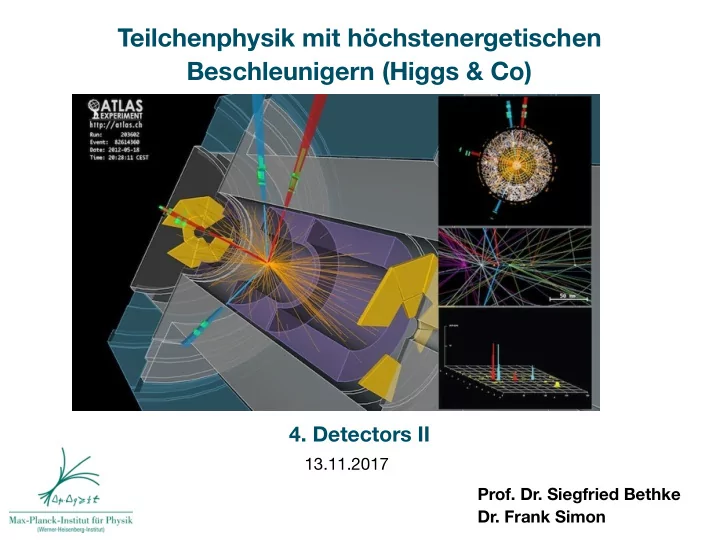
Teilchenphysik mit hchstenergetischen Beschleunigern (Higgs & Co) 4. Detectors II 13.11.2017 Prof. Dr. Siegfried Bethke Dr. Frank Simon Detectors: Overview Lecture Detectors I Introduction, overall detector concepts Detector


slide-1
SLIDE 1
  • Prof. Dr. Siegfried Bethke
  • Dr. Frank Simon

Teilchenphysik mit höchstenergetischen Beschleunigern (Higgs & Co)

13.11.2017

  • 4. Detectors II
slide-2
SLIDE 2

Frank Simon (fsimon@mpp.mpg.de) Teilchenphysik mit höchstenergetischen Beschleunigern: WS 17/18, 04: Detectors II

Detectors: Overview

  • Lecture Detectors I
  • Introduction, overall detector concepts
  • Detector systems at hadron colliders
  • Basics of particle detection: Interaction with matter
  • Methods for particle detection
  • Lecture Detectors II
  • Tracking detectors: Basics
  • Semiconductor trackers
  • Calorimeters

2

slide-3
SLIDE 3

Frank Simon (fsimon@mpp.mpg.de)

Momentum Measurement with Trackers

3

Teilchenphysik mit höchstenergetischen Beschleunigern: WS 17/18, 04: Detectors II

slide-4
SLIDE 4

Frank Simon (fsimon@mpp.mpg.de) Teilchenphysik mit höchstenergetischen Beschleunigern: WS 17/18, 04: Detectors II

Tracking: Momentum Measurement in B-Field

4

  • Charged particles are deflected in magnetic field
  • only acts on the component transverse to the field

The radius of the trajectory gives transverse momentum:

pT GeV/c = 0.3 B T r m

Example:
 45 GeV µ, 4 T field:
 r = 37.5 m

slide-5
SLIDE 5

Frank Simon (fsimon@mpp.mpg.de) Teilchenphysik mit höchstenergetischen Beschleunigern: WS 17/18, 04: Detectors II

Tracking: Momentum Measurement in B-Field

4

  • Charged particles are deflected in magnetic field
  • only acts on the component transverse to the field

The radius of the trajectory gives transverse momentum:

pT GeV/c = 0.3 B T r m

magnetic field

➫ the particle moves on a helix given by field and pT

  • parallel to the field there is no deflection

Example:
 45 GeV µ, 4 T field:
 r = 37.5 m

slide-6
SLIDE 6

Frank Simon (fsimon@mpp.mpg.de) Teilchenphysik mit höchstenergetischen Beschleunigern: WS 17/18, 04: Detectors II

Tracking: Momentum Measurement in B-Field

4

  • Charged particles are deflected in magnetic field
  • only acts on the component transverse to the field

The radius of the trajectory gives transverse momentum:

pT GeV/c = 0.3 B T r m

magnetic field

➫ the particle moves on a helix given by field and pT

  • parallel to the field there is no deflection

The total momentum is determined with the “dip angle” in addition to pT:

pL pT p λ p = pT/sinλ

Example:
 45 GeV µ, 4 T field:
 r = 37.5 m

slide-7
SLIDE 7

Frank Simon (fsimon@mpp.mpg.de) Teilchenphysik mit höchstenergetischen Beschleunigern: WS 17/18, 04: Detectors II

Momentum Measurement in B-Field II

  • In real-world applications one does not

measure a full circle, but just a slightly bent track segment

  • Characteristic variable: sagitta

5

slide-8
SLIDE 8

Frank Simon (fsimon@mpp.mpg.de) Teilchenphysik mit höchstenergetischen Beschleunigern: WS 17/18, 04: Detectors II

Momentum Measurement in B-Field II

  • In real-world applications one does not

measure a full circle, but just a slightly bent track segment

  • Characteristic variable: sagitta

5

s = r −

  • r2 − L2

4

⇤ r =

s 2 + L2 8s

  • L2

8s (s ⇥ L)

Mathematical calculation:

slide-9
SLIDE 9

Frank Simon (fsimon@mpp.mpg.de) Teilchenphysik mit höchstenergetischen Beschleunigern: WS 17/18, 04: Detectors II

Momentum Measurement in B-Field II

  • In real-world applications one does not

measure a full circle, but just a slightly bent track segment

  • Characteristic variable: sagitta

5

s = r −

  • r2 − L2

4

⇤ r =

s 2 + L2 8s

  • L2

8s (s ⇥ L)

Mathematical calculation:

r =

pT 0.3 B ⇒ s = 0.3 B L2 8 pT

Taking the relation of radius, momentum and B-field gives:

slide-10
SLIDE 10

σ2(s) =

1 N−1 N

  • i=1

σ2(x)

σ(s) Sagitta − Fehler, σ(x) Messfehler eines Punktes

Frank Simon (fsimon@mpp.mpg.de) Teilchenphysik mit höchstenergetischen Beschleunigern: WS 17/18, 04: Detectors II

Momentum Measurement in B-Field III

  • A minimum of 3 points are required to determine the sagitta
  • Taking into account the point-by-point measurement uncertainty:

6

für N = 3 there are 2 degrees of freedom sagitta error uncertainty of a single point

slide-11
SLIDE 11

σ2(s) =

1 N−1 N

  • i=1

σ2(x)

σ(s) Sagitta − Fehler, σ(x) Messfehler eines Punktes

Frank Simon (fsimon@mpp.mpg.de) Teilchenphysik mit höchstenergetischen Beschleunigern: WS 17/18, 04: Detectors II

Momentum Measurement in B-Field III

  • A minimum of 3 points are required to determine the sagitta
  • Taking into account the point-by-point measurement uncertainty:

6

für N = 3 there are 2 degrees of freedom

σ(s) =

  • 3

2 σ(x) ⇒ σ(pT ) pT

=

σ(s) s

= √

3 2 σ(x) 8 pT

0.3 B L2

pT =

0.3 B L2 8 s

with sagitta error uncertainty of a single point

slide-12
SLIDE 12

σ2(s) =

1 N−1 N

  • i=1

σ2(x)

σ(s) Sagitta − Fehler, σ(x) Messfehler eines Punktes

Frank Simon (fsimon@mpp.mpg.de) Teilchenphysik mit höchstenergetischen Beschleunigern: WS 17/18, 04: Detectors II

Momentum Measurement in B-Field III

  • A minimum of 3 points are required to determine the sagitta
  • Taking into account the point-by-point measurement uncertainty:

6

für N = 3 there are 2 degrees of freedom

σ(s) =

  • 3

2 σ(x) ⇒ σ(pT ) pT

=

σ(s) s

= √

3 2 σ(x) 8 pT

0.3 B L2

pT =

0.3 B L2 8 s

with

σ(pT ) pT

=

σ(x) 0.3 B L2

  • 720/(N + 4) pT

generalization to an arbitrary number of points:

R.L. Gluckstern, NIM 24, 381 (1963)

sagitta error uncertainty of a single point

slide-13
SLIDE 13

σ2(s) =

1 N−1 N

  • i=1

σ2(x)

σ(s) Sagitta − Fehler, σ(x) Messfehler eines Punktes

Frank Simon (fsimon@mpp.mpg.de) Teilchenphysik mit höchstenergetischen Beschleunigern: WS 17/18, 04: Detectors II

Momentum Measurement in B-Field III

  • A minimum of 3 points are required to determine the sagitta
  • Taking into account the point-by-point measurement uncertainty:

6

für N = 3 there are 2 degrees of freedom

σ(s) =

  • 3

2 σ(x) ⇒ σ(pT ) pT

=

σ(s) s

= √

3 2 σ(x) 8 pT

0.3 B L2

pT =

0.3 B L2 8 s

with ➠ The bigger B, lever arm L and the number of measurements and the better the spatial resolution, the higher is the accuracy of the momentum measurement
 example (ATLAS Si-Tracker): N =7, L = 0.5, B = 2T, σ(x) = 20 µm, pt = 5 GeV/c:
 Δpt /pt = 0.5 %, r = 8.3 m, s = 3.75 mm


σ(pT ) pT

=

σ(x) 0.3 B L2

  • 720/(N + 4) pT

generalization to an arbitrary number of points:

R.L. Gluckstern, NIM 24, 381 (1963)

sagitta error uncertainty of a single point

slide-14
SLIDE 14

θ0 = θrms

plane =

1 √ 2θrms

space

θ0 = 13.6 MeV β c p z

  • x/X0 [1 + 0.038 ln(x/X0)]

Frank Simon (fsimon@mpp.mpg.de) Teilchenphysik mit höchstenergetischen Beschleunigern: WS 17/18, 04: Detectors II

Conflicting Effect: Multiple Scattering

  • Charged particles are deflected when traversing matter: 


Multiple scattering via Coulomb interaction

7

  • valid for relativistic particles (β = 1), the central 98% of the distribution, for

layer thicknesses from 10-3 X0 to 100 X0 with an accuracy of better than 11%

slide-15
SLIDE 15

σ(pT ) ∝ pT

Frank Simon (fsimon@mpp.mpg.de) Teilchenphysik mit höchstenergetischen Beschleunigern: WS 17/18, 04: Detectors II

Multiple Scattering vs Spatial Resolution

  • Two effects influence the momentum resolution σ(pT)/pT

  • f tracking systems:

8

  • Momentum resolution of the tracker:
slide-16
SLIDE 16

σ(pT ) ∝ pT

Frank Simon (fsimon@mpp.mpg.de) Teilchenphysik mit höchstenergetischen Beschleunigern: WS 17/18, 04: Detectors II

Multiple Scattering vs Spatial Resolution

  • Two effects influence the momentum resolution σ(pT)/pT

  • f tracking systems:

8

  • Momentum resolution of the tracker:

θ ∝ 1 p σ(x)MS ∝ 1 p

  • Influence of multiple scattering

and with that also the spatial
 inaccuracy due to scattering:

slide-17
SLIDE 17

σ(pT ) ∝ pT

Frank Simon (fsimon@mpp.mpg.de) Teilchenphysik mit höchstenergetischen Beschleunigern: WS 17/18, 04: Detectors II

Multiple Scattering vs Spatial Resolution

  • Two effects influence the momentum resolution σ(pT)/pT

  • f tracking systems:

8

  • Momentum resolution of the tracker:

θ ∝ 1 p σ(x)MS ∝ 1 p

  • Influence of multiple scattering

and with that also the spatial
 inaccuracy due to scattering:

σ(pT ) pT ∝ σ(x)MS × pT σ(pT ) pT

  • MS

= const

We know: and with that:

(taking the spread induced by multiple scattering as a “spatial resolution”)

slide-18
SLIDE 18

σ(pT ) ∝ pT

Frank Simon (fsimon@mpp.mpg.de) Teilchenphysik mit höchstenergetischen Beschleunigern: WS 17/18, 04: Detectors II

Multiple Scattering vs Spatial Resolution

  • Two effects influence the momentum resolution σ(pT)/pT

  • f tracking systems:

8

  • Momentum resolution of the tracker:

θ ∝ 1 p σ(x)MS ∝ 1 p

  • Influence of multiple scattering

and with that also the spatial
 inaccuracy due to scattering:

The measurement of low-momentum particles is limited by multiple scattering! At higher momenta the intrinsic resolution of the detector dominates.

σ(pT ) pT ∝ σ(x)MS × pT σ(pT ) pT

  • MS

= const

We know: and with that:

(taking the spread induced by multiple scattering as a “spatial resolution”)

slide-19
SLIDE 19

Frank Simon (fsimon@mpp.mpg.de) Teilchenphysik mit höchstenergetischen Beschleunigern: WS 17/18, 04: Detectors II

Multiple Scattering vs Spatial Resolution

  • An optimisation question:
  • Intrinsic resolution:

9

σ(pT ) pT

=

σ(x) 0.3 B L2

  • 720/(N + 4) pT

number of layers in the detector

θ0 = 13.6 MeV β c p z

  • x/X0 [1 + 0.038 ln(x/X0)]

~ 1/√N

  • Multiple scattering:

σ(pT ) pT ∝ σ(x)MS × pT

multiple scattering spread: ~ 1/p, ~ √x , x ~ N !

slide-20
SLIDE 20

Frank Simon (fsimon@mpp.mpg.de) Teilchenphysik mit höchstenergetischen Beschleunigern: WS 17/18, 04: Detectors II

Multiple Scattering vs Spatial Resolution

  • An optimisation question:
  • Intrinsic resolution:

9

σ(pT ) pT

=

σ(x) 0.3 B L2

  • 720/(N + 4) pT

number of layers in the detector

θ0 = 13.6 MeV β c p z

  • x/X0 [1 + 0.038 ln(x/X0)]

~ 1/√N

  • Multiple scattering:

σ(pT ) pT ∝ σ(x)MS × pT

multiple scattering spread: ~ 1/p, ~ √x , x ~ N !

  • Multiple scattering and intrinsic resolution are competing effects: More tracking

layers improve the intrinsic resolution, but at the same time lead to more scattering -> Optimisation depends on “target” momentum!

slide-21
SLIDE 21

Frank Simon (fsimon@mpp.mpg.de) Teilchenphysik mit höchstenergetischen Beschleunigern: WS 17/18, 04: Detectors II

Spatial Resolution of Tracking Detectors

  • Depends on detector geometry and charge collection:
  • distance between strips
  • charge sharing between neighboring strips

10

slide-22
SLIDE 22

Frank Simon (fsimon@mpp.mpg.de) Teilchenphysik mit höchstenergetischen Beschleunigern: WS 17/18, 04: Detectors II

Spatial Resolution of Tracking Detectors

  • Depends on detector geometry and charge collection:
  • distance between strips
  • charge sharing between neighboring strips

10

Easiest case: The full charge is collected on a single strip:

slide-23
SLIDE 23

Frank Simon (fsimon@mpp.mpg.de) Teilchenphysik mit höchstenergetischen Beschleunigern: WS 17/18, 04: Detectors II

Spatial Resolution of Tracking Detectors

  • Depends on detector geometry and charge collection:
  • distance between strips
  • charge sharing between neighboring strips

10

Easiest case: The full charge is collected on a single strip:

P(x) = 1 d ⇒ d/2

−d/2

P(x) dx = 1

  • Particle impact generates a signal in the hit strip
  • The response does not depend on impact point, no

point on the strip is “special”

  • Equal probability distribution for particle position:
slide-24
SLIDE 24

Frank Simon (fsimon@mpp.mpg.de) Teilchenphysik mit höchstenergetischen Beschleunigern: WS 17/18, 04: Detectors II

Spatial Resolution of Tracking Detectors

  • Depends on detector geometry and charge collection:
  • distance between strips
  • charge sharing between neighboring strips

10

Easiest case: The full charge is collected on a single strip:

P(x) = 1 d ⇒ d/2

−d/2

P(x) dx = 1

  • Particle impact generates a signal in the hit strip
  • The response does not depend on impact point, no

point on the strip is “special”

  • Equal probability distribution for particle position:

x⇥ = d/2

−d/2

x P(x) dx = 0

The reconstructed impact position is always the strip center:

slide-25
SLIDE 25

σ2

x =

  • (x ⇥x⇤)2⇥

= ⇤ d/2

−d/2

x2 P(x) dx = d2 12

Frank Simon (fsimon@mpp.mpg.de) Teilchenphysik mit höchstenergetischen Beschleunigern: WS 17/18, 04: Detectors II

Spatial Resolution of Tracking Detectors II

  • The spatial resolution orthogonal to the strip direction is thus:

11

slide-26
SLIDE 26

σ2

x =

  • (x ⇥x⇤)2⇥

= ⇤ d/2

−d/2

x2 P(x) dx = d2 12

Frank Simon (fsimon@mpp.mpg.de) Teilchenphysik mit höchstenergetischen Beschleunigern: WS 17/18, 04: Detectors II

Spatial Resolution of Tracking Detectors II

  • The spatial resolution orthogonal to the strip direction is thus:

11

σ = d √ 12

  • General law for tracking detectors (also applies to wire chambers, pixels, ...)

without signal sharing across several channels:

slide-27
SLIDE 27

σ2

x =

  • (x ⇥x⇤)2⇥

= ⇤ d/2

−d/2

x2 P(x) dx = d2 12

Frank Simon (fsimon@mpp.mpg.de) Teilchenphysik mit höchstenergetischen Beschleunigern: WS 17/18, 04: Detectors II

Spatial Resolution of Tracking Detectors II

  • The spatial resolution orthogonal to the strip direction is thus:

11

σ = d √ 12

  • General law for tracking detectors (also applies to wire chambers, pixels, ...)

without signal sharing across several channels:

  • For silicon detectors with a strip pitch of 80 µm (ATLAS) the minimum

resolution is ~ 23 µm

  • If the charge is collected by more than one strip, and if the charge sharing

depends on the position of the particle impact the resolution can be substantially improved by calculating the center of gravity of the total signal

slide-28
SLIDE 28

Frank Simon (fsimon@mpp.mpg.de)

Tracker Technologies Gas Detectors

12

Teilchenphysik mit höchstenergetischen Beschleunigern: WS 17/18, 04: Detectors II

slide-29
SLIDE 29

Frank Simon (fsimon@mpp.mpg.de) Teilchenphysik mit höchstenergetischen Beschleunigern: WS 17/18, 04: Detectors II

Reminder: The Classic Ionization Chamber

  • Particles create electron-ion pairs in

gas volume

  • Electrons are accelerated in strong

electric field, resulting in avalanche multiplication

  • Depending on the applied voltage,

the signal is proportional to the

  • riginal energy deposition or goes

into saturation

13

+ +

  • +
  • +

+ + + + +

slide-30
SLIDE 30

Frank Simon (fsimon@mpp.mpg.de) Teilchenphysik mit höchstenergetischen Beschleunigern: WS 17/18, 04: Detectors II

A Common Technique: Drift Tubes

  • For example: ATLAS muon system

14

Measurement of the drift time: gives smallest distance to wire ➫ Left/right ambiguity: Several staggered layers are required ➫ Typical spatial resolution ~100 µm

slide-31
SLIDE 31

Frank Simon (fsimon@mpp.mpg.de) Teilchenphysik mit höchstenergetischen Beschleunigern: WS 17/18, 04: Detectors II

A Common Technique: Drift Tubes

  • For example: ATLAS muon system

14

Measurement of the drift time: gives smallest distance to wire ➫ Left/right ambiguity: Several staggered layers are required ➫ Typical spatial resolution ~100 µm

Foto: CERN

slide-32
SLIDE 32

Frank Simon (fsimon@mpp.mpg.de) Teilchenphysik mit höchstenergetischen Beschleunigern: WS 17/18, 04: Detectors II

TPC: 3D Track Reconstruction

  • The drift chamber idea - pushed further: Combination of 2D spatial

information and time into real 3D point reconstruction

15

readout at the anode typically with MWPCs, newer technologies increasingly common

slide-33
SLIDE 33

Frank Simon (fsimon@mpp.mpg.de) Teilchenphysik mit höchstenergetischen Beschleunigern: WS 17/18, 04: Detectors II

TPCs in Real Life: STAR

  • 4 m diameter, 4.2 m long

16

Foto: LBL

Events with low track multiplicity Au+Au collisions at 9.2 GeV/nucleon

slide-34
SLIDE 34

Frank Simon (fsimon@mpp.mpg.de) Teilchenphysik mit höchstenergetischen Beschleunigern: WS 17/18, 04: Detectors II

TPCs in Real Life: STAR

  • 4 m diameter, 4.2 m long

16

Foto: LBL

Events with low track multiplicity Au+Au collisions at 9.2 GeV/nucleon Particle identivication vie specific energy loss dE/dx (pion ID also works at high energy!)

slide-35
SLIDE 35

Frank Simon (fsimon@mpp.mpg.de) Teilchenphysik mit höchstenergetischen Beschleunigern: WS 17/18, 04: Detectors II

STAR TPC: Central Au+Au Collisions at 200 GeV

  • TPCs can reconstruct complex events with many particles - several 1000

tracks

  • The limitation: Long readout times due to the drift time of electrons: ~ 40 µs

17

slide-36
SLIDE 36

Frank Simon (fsimon@mpp.mpg.de) Teilchenphysik mit höchstenergetischen Beschleunigern: WS 17/18, 04: Detectors II

The biggest TPC: ALICE

  • 4.9 m diameter, 5 m length

18

Image: CERN

Pb-Pb collisions at 2.76 TeV/ nucleon - many thousand tracks per event!

slide-37
SLIDE 37

Frank Simon (fsimon@mpp.mpg.de)

Tracker Technology: Semiconductor Detectors

19

Teilchenphysik mit höchstenergetischen Beschleunigern: WS 17/18, 04: Detectors II

slide-38
SLIDE 38

Frank Simon (fsimon@mpp.mpg.de) Teilchenphysik mit höchstenergetischen Beschleunigern: WS 17/18, 04: Detectors II

Spatial Resolution: Strip Detectors

20

  • Silicon allows very fine

structures - ideal for high spatial resoluton

  • typical strip-to-strip distance


~ 50 µm

  • The price to pay: Very high

channel counts - Requires highly integrated electronics

slide-39
SLIDE 39
  • 2D resolution can be provided

by collection of electrons and holes on oposite sides of the sensor

Frank Simon (fsimon@mpp.mpg.de) Teilchenphysik mit höchstenergetischen Beschleunigern: WS 17/18, 04: Detectors II

2D - Resolution with Silicon

21

  • Caveat: The electronics on
  • ne side has to be on high

voltage instead of ground, due to the bias voltage across the sensor

  • Complicates the detector

infrastructure considerably,

  • ften avoided by using

several single-sided layers with different strip

  • rientation
slide-40
SLIDE 40

Frank Simon (fsimon@mpp.mpg.de) Teilchenphysik mit höchstenergetischen Beschleunigern: WS 17/18, 04: Detectors II

The Limits of Strip Detectors

  • For high particle densities there

are ambiguities when going from 1D hits to 2D points: Track reconstruction collapses at some point

22

  • Also: Spatial resolution

typically only good in one coordinate (orthogonal to strip) - Insufficient to reconstruct secondary vertices

slide-41
SLIDE 41

Frank Simon (fsimon@mpp.mpg.de) Teilchenphysik mit höchstenergetischen Beschleunigern: WS 17/18, 04: Detectors II

Pixel Detectors - The Principle

  • Pixel-detectors allow tracking in environments with high particle density without

ambiguities

  • Good spatial resolution in two coordinates with a single layer (depending on pixel size

and charge sharing between pixels)

  • Very high channel count -> Challenging readout, in particular if it needs to be fast

23

CMS pixel scheme

  • CMS Pixels: ~65 M channels


150 x 150 µm

  • ATLAS Pixels: ~80 M channels


50 x 400 µm (long in z or r) “Hybrid Pixels”

slide-42
SLIDE 42

Frank Simon (fsimon@mpp.mpg.de) Teilchenphysik mit höchstenergetischen Beschleunigern: WS 17/18, 04: Detectors II

Pixel Detectors - The Principle

  • Pixel-detectors allow tracking in environments with high particle density without

ambiguities

  • Good spatial resolution in two coordinates with a single layer (depending on pixel size

and charge sharing between pixels)

  • Very high channel count -> Challenging readout, in particular if it needs to be fast

23

CMS pixel scheme

  • CMS Pixels: ~65 M channels


150 x 150 µm

  • ATLAS Pixels: ~80 M channels


50 x 400 µm (long in z or r)

... relatively high material budgets with fast readout: separate electronics layer!

“Hybrid Pixels”

slide-43
SLIDE 43

Frank Simon (fsimon@mpp.mpg.de) Teilchenphysik mit höchstenergetischen Beschleunigern: WS 17/18, 04: Detectors II

ATLAS Pixels: A Closer Look

24

slide-44
SLIDE 44

Frank Simon (fsimon@mpp.mpg.de) Teilchenphysik mit höchstenergetischen Beschleunigern: WS 17/18, 04: Detectors II

Technologies for the Future: 3D Silicon

  • The dream: All on a single chip
  • sensitive detector
  • analog pulse shaping
  • digitization
  • communication and control

25

slide-45
SLIDE 45

Frank Simon (fsimon@mpp.mpg.de) Teilchenphysik mit höchstenergetischen Beschleunigern: WS 17/18, 04: Detectors II

Technologies for the Future: 3D Silicon

  • The dream: All on a single chip
  • sensitive detector
  • analog pulse shaping
  • digitization
  • communication and control

25

  • Use of several thin Si layers

which can be based on different processing technologies

  • Important: The electrical

connection between the different layers

At the moment different technologies are being developed and tested...

slide-46
SLIDE 46

Frank Simon (fsimon@mpp.mpg.de)

Calorimetry: Energy Measurement

26

Teilchenphysik mit höchstenergetischen Beschleunigern: WS 17/18, 04: Detectors II

slide-47
SLIDE 47

Frank Simon (fsimon@mpp.mpg.de) Teilchenphysik mit höchstenergetischen Beschleunigern: WS 17/18, 04: Detectors II

The Concept

27

  • Originally from chemistry: Measurement of

the released heat by a chemical reaction: Here increase of temperature of a well- known amount of water

  • For elementary particles:


Measurement of the energy of a particle by total absorption

  • 1 cal = 107 TeV: Very small energies, no

temperature increase!

  • Somewhat more sophisticated strategy for

energy measurement needed

slide-48
SLIDE 48

Frank Simon (fsimon@mpp.mpg.de) Teilchenphysik mit höchstenergetischen Beschleunigern: WS 17/18, 04: Detectors II

Particle Showers

  • Measurement of highly energetic particles: Showers
  • Electromagnetic: Successive pair creation / Bremsstrahlung

28

  • Hadronic: Hadronic cascade with hadronic and em content
slide-49
SLIDE 49

Frank Simon (fsimon@mpp.mpg.de) Teilchenphysik mit höchstenergetischen Beschleunigern: WS 17/18, 04: Detectors II

Measuring Energy with a Calorimeter

  • Convert the energy of the incident particle to a detector response
  • Choose something that is easily detectable also for “small” energies
  • Electric charge
  • Photons (in or close to visible range)

29

slide-50
SLIDE 50

Frank Simon (fsimon@mpp.mpg.de) Teilchenphysik mit höchstenergetischen Beschleunigern: WS 17/18, 04: Detectors II

Measuring Energy with a Calorimeter

  • Convert the energy of the incident particle to a detector response
  • Choose something that is easily detectable also for “small” energies
  • Electric charge
  • Photons (in or close to visible range)

29

N.B.: Also other channels are used - thermal for example in cryogenic 
 DM-search experiments, acoustic measurements, ... Not covered here!

slide-51
SLIDE 51

Frank Simon (fsimon@mpp.mpg.de) Teilchenphysik mit höchstenergetischen Beschleunigern: WS 17/18, 04: Detectors II

Measuring Energy with a Calorimeter

  • Calorimetric processes are stochastic:
  • Counting of photons / created charge carriers
  • Number of secondary particles in showers induced by high-energy particles

30

σ E = a √ E ⊕ b E ⊕ c

  • Three components:
  • a: The stochastic term: The counting aspect of the measurement: Simple

statistical error: scales with the square root of the number of particles
 ➫ Resolution term scales with 1/√E

  • b: The noise term: Constant, energy-independent noise contribution to the signal -

➫ Resolution term scales with 1/E

  • c: The constant term: Contributions that scale with energy: Influence of

inhomogeneities in the detector material, un-instrumented or dead regions, ...
 ➫ Resolution term is independent of energy

Energy resolution often well-described by

slide-52
SLIDE 52

Frank Simon (fsimon@mpp.mpg.de) Teilchenphysik mit höchstenergetischen Beschleunigern: WS 17/18, 04: Detectors II

Calorimeter Types

  • The dream: Contain the full energy of one particle, convert all energy into a

measurable signal which is linear to the deposited energy

  • Reality is often different, in particular when measuring hadrons

31

Two types: homogeneous calorimeters and sampling calorimeters readout

absorber + detector sufficiently deep to absorb the shower particles

  • The shower develops in the sensitive medium
  • Potentially optimal energy resolution: Complete energy deposit is measured
  • Challenging readout: No passive readout structures in detector volume

crystals as active medium

slide-53
SLIDE 53

Frank Simon (fsimon@mpp.mpg.de) Teilchenphysik mit höchstenergetischen Beschleunigern: WS 17/18, 04: Detectors II

Calorimeter Types

  • The dream: Contain the full energy of one particle, convert all energy into a

measurable signal which is linear to the deposited energy

  • Reality is often different, in particular when measuring hadrons

32

Two types: homogeneous calorimeters and sampling calorimeters

  • The shower develops (mostly) in dense absorber medium, particles are

detected in interleaved active structures

  • Potentially reduced energy resolution: Only a fraction of the deposited

energy is detected readout

sufficiently deep to absorb the shower particles

highly flexible in choice of absorbers and active medium

slide-54
SLIDE 54

Frank Simon (fsimon@mpp.mpg.de) Teilchenphysik mit höchstenergetischen Beschleunigern: WS 17/18, 04: Detectors II

Characteristic Parameters of Showers - EM

  • Longitudinal development described by X0
  • Lateral shower size given by Moliere Radius ρM (also depends on X0)


90% of all energy is contained in a cylinder with a radius of 1 ρM around the shower axis

  • Shower maximum: Depth where number of particles in the shower is maximal


33

  • tmax ~ ln(E0/ε) + t0 in X0, with t0 = -0.5 für e-, +0.5 für γ
slide-55
SLIDE 55

Frank Simon (fsimon@mpp.mpg.de) Teilchenphysik mit höchstenergetischen Beschleunigern: WS 17/18, 04: Detectors II

Characteristic Parameters of Showers - Hadronic

  • The length scale of hadronic showers is given by the 


nuclear interaction length λI (mean free path between hadronic interactions)

34

λI > X0 for all materials with Z > 4

λI

X0

Polystyrene 81.7 cm 43.8 cm PbWO 20.2 cm 0.9 cm Fe 16.7 cm 1.8 cm W 9.9 cm 0.35 cm

Hadronic showers are complicated:

  • Relativistic hadrons created in interactions with

nuclei, carry a sizeable fraction of momentum of

  • riginal particle [O GeV]
  • About 1/3 of all pions created are π0:

instantaneous decay to photons, em subshower

  • Neutrons created in evaporation/spallation,

photons from neutron capture -> MeV (or lower)

  • Energy loss due to binding energy, ...
slide-56
SLIDE 56

Frank Simon (fsimon@mpp.mpg.de) Teilchenphysik mit höchstenergetischen Beschleunigern: WS 17/18, 04: Detectors II

Homogeneous ECAL: Inorganic Crystals

  • High purity: good transmission of scintillation light
  • High density: Drives the depth of the calorimeter

35

Example: CMS ECAL

  • PbWO4: Fast, high-density scintillator
  • Density ~ 8.3 g/cm3 (!)
  • ρM 2.2 cm, X0 0.89 cm
  • low light yield: ~ 100 photons / MeV, temperature dependent: -2%/℃
slide-57
SLIDE 57

Frank Simon (fsimon@mpp.mpg.de) Teilchenphysik mit höchstenergetischen Beschleunigern: WS 17/18, 04: Detectors II

Sampling Calorimeter: STAR ECAL

36

  • Plastic scintillator plates between lead absorbers
  • The light is collected in each plate by wavelength-shifting fibers
  • The fibers guide the light outside of the magnetic field, where it

is concentrated per “tower” and read out with a PMT

slide-58
SLIDE 58

Frank Simon (fsimon@mpp.mpg.de) Teilchenphysik mit höchstenergetischen Beschleunigern: WS 17/18, 04: Detectors II

Homogeneous vs Sampling: Resolution!

  • Stochastic Term:
  • STAR: ~ 14%
  • CMS: 2.8%

37

Neutral pions

STAR CMS

20GeV beam

π0 η0

slide-59
SLIDE 59

Frank Simon (fsimon@mpp.mpg.de) Teilchenphysik mit höchstenergetischen Beschleunigern: WS 17/18, 04: Detectors II

Homogeneous vs Sampling: Resolution!

  • Stochastic Term:
  • STAR: ~ 14%
  • CMS: 2.8%

37

Neutral pions

STAR CMS But: Crystals are very expensive! And: In combination with hadron calorimeters they provide often a very poor hadronic energy resolution

20GeV beam

π0 η0

slide-60
SLIDE 60

Frank Simon (fsimon@mpp.mpg.de) Teilchenphysik mit höchstenergetischen Beschleunigern: WS 17/18, 04: Detectors II

Alternative Technology: ATLAS Liquid Argon

  • Barrel EMC
  • (The ATLAS barrel HCAL uses steel +

plastic scintillator)

  • Endcap - EMC and HCAL
  • ECAL: Pb-LAr, with “accordeon

geometry”

38

slide-61
SLIDE 61

Frank Simon (fsimon@mpp.mpg.de) Teilchenphysik mit höchstenergetischen Beschleunigern: WS 17/18, 04: Detectors II

LAr Calorimeters

  • LAr: Density 1.4 g/cm3, X0 14 cm
  • relatively high sampling fraction
  • Charge is produced by through-

going particles

  • Charge collection on electrons

(no amplification!)

  • high purity of cryogenic liquid

required - but then (with constant filtering) the active medium is indestructible also by high radiation levels

  • accordeon geometry simplifies

readout, minimizes drift length and thus allows high rates

39

slide-62
SLIDE 62

Frank Simon (fsimon@mpp.mpg.de) Teilchenphysik mit höchstenergetischen Beschleunigern: WS 17/18, 04: Detectors II

Resolution of Hadronic Calorimeters

40

  • C. Fabjan, F

. Gianotti, Rev. Mod. Phys. 75, 1243 (2003)

  • The general considerations for calorimeters apply also here
  • stochastic, constant and noise term
  • but: Typically the detector responds differently to pure hadronic sub-showers and

electromagnetic components (due to different length scale of interactions and “invisible” losses in hadronic reactions): e/π > 1

  • Fluctuations of electromagnetic fraction deteriorate resolution and result in non-

linearities: deviations from expected 1/√E behaviour

concrete example: em: σ/E = 0.1/√E had: σ/E = 0.5/√E e/π = 1.4

slide-63
SLIDE 63

Frank Simon (fsimon@mpp.mpg.de) Teilchenphysik mit höchstenergetischen Beschleunigern: WS 17/18, 04: Detectors II

Resolution of Hadronic Calorimeters

40

  • C. Fabjan, F

. Gianotti, Rev. Mod. Phys. 75, 1243 (2003)

  • The general considerations for calorimeters apply also here
  • stochastic, constant and noise term
  • but: Typically the detector responds differently to pure hadronic sub-showers and

electromagnetic components (due to different length scale of interactions and “invisible” losses in hadronic reactions): e/π > 1

  • Fluctuations of electromagnetic fraction deteriorate resolution and result in non-

linearities: deviations from expected 1/√E behaviour can be fixed with “compensating calorimeters”
 e/π = 1 - But requires very specific geometries, for best results the use of Uranium absorbers and provides rather poor electromagnetic performance


concrete example: em: σ/E = 0.1/√E had: σ/E = 0.5/√E e/π = 1.4

slide-64
SLIDE 64

Frank Simon (fsimon@mpp.mpg.de) Teilchenphysik mit höchstenergetischen Beschleunigern: WS 17/18, 04: Detectors II

ATLAS Barrel HCAL

  • Stainless steel / scintillator
  • Scintillator cells parallel to particle incidence -

works since most particles are low energy and travel at larger angles

  • Readout with two fibers per tile
  • 3 longitudinal segments, fibers are bundled for

each segment and read out with a PMT outside magnet

41

tiles fiber

slide-65
SLIDE 65

Frank Simon (fsimon@mpp.mpg.de) Teilchenphysik mit höchstenergetischen Beschleunigern: WS 17/18, 04: Detectors II

Global Performance for Hadrons - CMS

  • A state of the art system: CMS

42

  • A fantastic ECAL - PbWO4

crystals with APD readout

  • EM energy resolution


~ 2.8%/√E

  • The price to pay: Single hadron

stochastic term ~93%

slide-66
SLIDE 66

Frank Simon (fsimon@mpp.mpg.de) Teilchenphysik mit höchstenergetischen Beschleunigern: WS 17/18, 04: Detectors II

Global Performance for Hadrons - ATLAS

  • A state of the art system: ATLAS

43

  • LAr ECAL, Scintillator HCAL in Barrel


both longitudinally segmented

  • EM resolution ~9%/√E
  • Single hadron stochastic term ~42%

(with software “compensation” making use of segmentation)

slide-67
SLIDE 67

Frank Simon (fsimon@mpp.mpg.de) Teilchenphysik mit höchstenergetischen Beschleunigern: WS 17/18, 04: Detectors II

Important Measurement: Missing Energy

  • Is used to reconstruct “invisible” particles
  • Neutrinos, for example in the decay of W bosons
  • New particles, for example possible dark matter particles
  • An indispensable tool to search for New Physics
  • Calorimeter measure the energy of all particles (except muons) - The most

crucial system for total energy measurements

44

slide-68
SLIDE 68

Frank Simon (fsimon@mpp.mpg.de) Teilchenphysik mit höchstenergetischen Beschleunigern: WS 17/18, 04: Detectors II

Particle Flow - Jets from Individual Particles

45

  • Improve jet energy reconstruction by measuring each particle in the jet with best

possible precision

  • Measure all charged particles in the tracker (remember, 60% charged hadrons!)
  • Significantly reduce the impact of hadron calorimeter performance: Only for neutral

hadrons

  • Measure only 10% of the jet energy with the HCAL, the “weakest” detector:

significant improvement in resolution

PFA

EJET = EECAL + EHCAL EJET = ETRACK + Eγ + En n π+ γ γ

slide-69
SLIDE 69

Frank Simon (fsimon@mpp.mpg.de) Teilchenphysik mit höchstenergetischen Beschleunigern: WS 17/18, 04: Detectors II

Imaging Calorimeters: Making PFA Happen

  • For best results: High granularity in 3D - Separation
  • f individual particle showers
  • Granularity more important than energy resolution!
  • Lateral granularity below Moliere radius in ECAL &

HCAL

  • In particular in the ECAL: Small Moliere radius to

provide good two-shower separation - Tungsten absorbers

  • Highest possible density: Silicon active elements -

Thin scintillators also a possibility

  • And: Sophisticated software!

46

slide-70
SLIDE 70

Frank Simon (fsimon@mpp.mpg.de) Teilchenphysik mit höchstenergetischen Beschleunigern: WS 17/18, 04: Detectors II

Imaging Calorimeters: Making PFA Happen

  • For best results: High granularity in 3D - Separation
  • f individual particle showers
  • Granularity more important than energy resolution!
  • Lateral granularity below Moliere radius in ECAL &

HCAL

  • In particular in the ECAL: Small Moliere radius to

provide good two-shower separation - Tungsten absorbers

  • Highest possible density: Silicon active elements -

Thin scintillators also a possibility

  • And: Sophisticated software!

46

Extensively developed & studied for Linear Collider Detectors: Jet energy resolution goals (3% - 4% or better for energies from 45 GeV to 500 GeV) can be met. Also very interesting in the LHC environment: Granularity helps to suppress background and pileup!

slide-71
SLIDE 71

Frank Simon (fsimon@mpp.mpg.de) Teilchenphysik mit höchstenergetischen Beschleunigern: WS 17/18, 04: Detectors II

Imaging Calorimeters: Now “Main Stream”

  • In spring 2015, CMS has selected the “High Granular Calorimeter” HGCAL for

the HL-LHC upgrade of its forward calorimeters

47 HGCAL Back Hadron Calorimeter (Brass+Scintillators)

HGC-ECAL HGC-HCAL

2015 Revue Synthétique du Projet HGCAL Méca

HGC-ECAL:
 Silicon sensors Tungsten / Copper absorber HGC-HCAL:
 Silicon sensors Brass absorbers

slide-72
SLIDE 72

Frank Simon (fsimon@mpp.mpg.de) Teilchenphysik mit höchstenergetischen Beschleunigern: WS 17/18, 04: Detectors II

Summary

  • Event reconstruction with collider detectors:
  • Tracking detectors to measure the momentum of charged particles - Via track

curvature in magnetic field

  • Technology: Mostly semi-conductor or gaseous detectors
  • Calorimeters to measure the energy of (almost) all particles
  • Subdivided into
  • Electromagnetic and hadronic calorimeters
  • Homogeneous and sampling calorimeters
  • Reconstruction of invisible particles by the measurement of the total event

energy (and of missing energy by applying momentum conservation)

48

slide-73
SLIDE 73

Frank Simon (fsimon@mpp.mpg.de) Teilchenphysik mit höchstenergetischen Beschleunigern: WS 17/18, 04: Detectors II

Summary

  • Event reconstruction with collider detectors:
  • Tracking detectors to measure the momentum of charged particles - Via track

curvature in magnetic field

  • Technology: Mostly semi-conductor or gaseous detectors
  • Calorimeters to measure the energy of (almost) all particles
  • Subdivided into
  • Electromagnetic and hadronic calorimeters
  • Homogeneous and sampling calorimeters
  • Reconstruction of invisible particles by the measurement of the total event

energy (and of missing energy by applying momentum conservation)

48

Next Lecture: 
 Event Generators & Detector Simulations - F . Simon, 20.11.2017

slide-74
SLIDE 74

Frank Simon (fsimon@mpp.mpg.de) Teilchenphysik mit höchstenergetischen Beschleunigern: WS 17/18, 04: Detectors II

Schedule

49

1. Introduction 16.10. 2. Accelerators 23.10. 3. Particle Detectors I 30.10.

  • ---------- no lecture -------------

06.11. 4. Particle Detectors II 13.11. 5. Monte Carlo Generators and Detector Simulation 20.11. 6. Trigger, Data Acquisition, Computing 27.11. 7. QCD, Jets, Proton Structure 04.12. 8. Top Physics 11.12 9. Topic Open - Wishes, Ideas? 18.12.

  • ---------- Christmas ---------------------

10. Tests of the Standard Model 08.01. 11. Higgs Physics I 15.01. 12. Higgs Physics II 22.01. 13. Physics beyond the SM 29.01. 14. LHC Outlook & Future Collider Projects 05.02.

slide-75
SLIDE 75

Frank Simon (fsimon@mpp.mpg.de)

Extra Material

50

Teilchenphysik mit höchstenergetischen Beschleunigern: WS 17/18, 04: Detectors II

slide-76
SLIDE 76

Frank Simon (fsimon@mpp.mpg.de) Teilchenphysik mit höchstenergetischen Beschleunigern: WS 17/18, 04: Detectors II

Verbesserte Energieauflösung: Kompensation

  • Der Detektor-Parameter e/π wird durch die Geometrie und Materialien bestimmt
  • Um e/π = 1 (Kompensation) zu erreichen, muss das Signal des Kalorimeters für

Hadronen erhöht werden,

  • Aktives Material mit Sensitivität für langsame Neutronen: Plastik-Szintillator mit H
  • möglich: Erhöhung der Neutronenaktivität durch bestimmte Absorber, zB Uran

51

  • Kompensation ist bei geeigneter

Wahl des Sampling-Verhältnisses möglich

slide-77
SLIDE 77

Frank Simon (fsimon@mpp.mpg.de) Teilchenphysik mit höchstenergetischen Beschleunigern: WS 17/18, 04: Detectors II

Verbesserte Energieauflösung: Kompensation

  • Der Detektor-Parameter e/π wird durch die Geometrie und Materialien bestimmt
  • Um e/π = 1 (Kompensation) zu erreichen, muss das Signal des Kalorimeters für

Hadronen erhöht werden,

  • Aktives Material mit Sensitivität für langsame Neutronen: Plastik-Szintillator mit H
  • möglich: Erhöhung der Neutronenaktivität durch bestimmte Absorber, zB Uran

51

  • Kompensation ist bei geeigneter

Wahl des Sampling-Verhältnisses möglich Aber:

  • kein (oder fast kein) Material vor

dem Kalorimeter!

  • Kleine Sampling-Verhältnisse

(Absorber mit kleinem X0):
 ➠ Schlechte EM-Auflösung