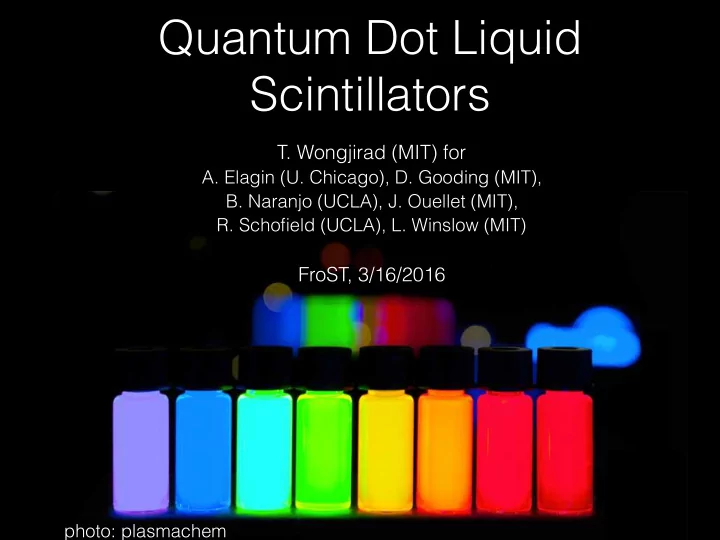
Quantum Dot Liquid Scintillators T. Wongjirad (MIT) for A. Elagin - - PowerPoint PPT Presentation

quantum dot liquid scintillators
SMART_READER_LITE
LIVE PREVIEW

Quantum Dot Liquid Scintillators T. Wongjirad (MIT) for A. Elagin - - PowerPoint PPT Presentation

Quantum Dot Liquid Scintillators T. Wongjirad (MIT) for A. Elagin (U. Chicago), D. Gooding (MIT), B. Naranjo (UCLA), J. Ouellet (MIT), R. Schofield (UCLA), L. Winslow (MIT) FroST, 3/16/2016 1 photo: plasmachem Introduction Outline


slide-1
SLIDE 1

Quantum Dot Liquid Scintillators

photo: plasmachem

  • T. Wongjirad (MIT) for
  • A. Elagin (U. Chicago), D. Gooding (MIT), 

  • B. Naranjo (UCLA), J. Ouellet (MIT),
  • R. Schofield (UCLA), L. Winslow (MIT)

FroST, 3/16/2016

1

slide-2
SLIDE 2
  • Quantum dot nanocrystal are an

intriguing material for the use in scintillator experiments

  • Controllable optical properties
  • Can be suspended in both water

and organic scintillator

  • Made out of elements that can

be used in neutrino-less double beta decay searches

Outline

Introduction

2

FroST 2016

  • T. Wongjirad (MIT)
slide-3
SLIDE 3
  • What are quantum dot nanocrystals?
  • Past and current work on quantum dot liquid

scintillators (QD LS)

  • NuDot — a prototype directional liquid scintillator

detector for R&D on LS such as including a QD LS

3

FroST 2016

  • T. Wongjirad (MIT)

3

Outline

Introduction

slide-4
SLIDE 4

4

FroST 2016

  • T. Wongjirad (MIT)

4

Outline

Quantum Dots

  • Quantum dots are nanometer-scale

crystals of semi-conductor with interesting optical properties

  • They are suspended in both organic

solvents and water through the use of surface coordinating ligands

  • These ligands are also 


critical in the synthesis of the QDs

slide-5
SLIDE 5

5

FroST 2016

  • T. Wongjirad (MIT)

5

Outline

Growing Quantum Dots

Cd

MeCd + TOPSe →CdSe + monomers

Inject TOPSe into hot (225⁰C) MeCd solution

  • QDs made by

growing crystals in solution

  • Start by mixing

metal components and capping ligands

capping ligand

capping ligand

slide-6
SLIDE 6

6

FroST 2016

  • T. Wongjirad (MIT)

6

Outline

Growing Quantum Dots

Cd

MeCd + TOPSe →CdSe + monomers

  • Metals nucleate

and begin forming a crystal

  • Capping ligands

coordinate on the surface, controlling the reaction rate, preventing agglomeration, and keeping the crystal in suspension

slide-7
SLIDE 7

7

FroST 2016

  • T. Wongjirad (MIT)

7

Outline

QDs made of 0νββ Isotopes

  • Elements used to make

QDs are also elements with which to look for neutrino-less double beta decay

  • QD Examples:
  • CdSe/ZnS
  • CdTe
  • Nd2O3
  • ZrO
  • QDs are a way to load

scintillator, but also come with great optical properties that we can take advantage of!

Isotope Endpoint Abundance

48Ca

4.271 MeV 0.187%

150Nd

3.367 MeV 5.6%

96Zr

3.350 MeV 2.8%

100Mo

3.034 MeV 9.6%

82Se

2.995 MeV 9.2%

116Cd

2.802 MeV 7.5%

130Te

2.533 MeV 34.5%

136Xe

2.479 MeV 8.9%

76Ge

2.039 MeV 7.8%

128Te

0.868 MeV 31.7%

slide-8
SLIDE 8

8

FroST 2016

  • T. Wongjirad (MIT)

8

Outline

Optical Properties

  • Like bulk semiconductor, QDs

can absorb/emit photons through the creation/ annihilation of an exciton

  • But because crystals are

small, the exciton’s wave function is confined - similar to a particle in a box

  • confinement separates energy

levels and widens band gap (compared to bulk crystal)

slide-9
SLIDE 9

9

FroST 2016

  • T. Wongjirad (MIT)

9

Outline

Optical Properties

  • result: QDs absorb broadly in the UV and emit in a

narrow band of wavelengths blue curve: absorption red curve: emission

slide-10
SLIDE 10
  • Furthermore, because
  • f the confinement

effect, the color emitted is directly dependent on the size

  • f the QD

10

FroST 2016

  • T. Wongjirad (MIT)

10

Outline

Optical Properties

slide-11
SLIDE 11

11

FroST 2016

  • T. Wongjirad (MIT)

11

Outline

Optical Properties

duration

  • f synthesis

time

  • The size to which they

grow can be controlled

  • Can make the QDs

that best fit your goals!

slide-12
SLIDE 12

12

FroST 2016

  • T. Wongjirad (MIT)

12

Outline

QD Uses

  • QDs are used in
  • Biological labeling
  • Improved solar cells
  • TVs
  • Admittedly, QDs are still

expensive ($100 to $10K per gram), but with commercial uses, there is hope that production increases and prices goes down

slide-13
SLIDE 13

13

FroST 2016

  • T. Wongjirad (MIT)

13

Outline

QDs for Detectors

  • How do QDs help scintillators (apart from loading

metal)?

  • One way is that it could help in the gathering of

directional information in large-scale scintillator detectors

slide-14
SLIDE 14

14

FroST 2016

  • T. Wongjirad (MIT)

14

Outline

Directional Information

Number of Cherenkov Photons for a 1MeV e-

absorbed by scintillator

  • Cherenkov

photons provide info on direction of particles that can be used to separate signal and background

  • However, only long

wavelengths can avoid absorption by the scintillator

JINST 7 (2012) P07010

slide-15
SLIDE 15

15

FroST 2016

  • T. Wongjirad (MIT)

15

Outline

Directional Information

Number of Cherenkov Photons for a 1MeV e-

absorbed by scintillator

  • Still, there is

some region where Cherenkov photons can escape and still be detected

JINST 7 (2012) P07010

slide-16
SLIDE 16

16

FroST 2016

  • T. Wongjirad (MIT)

16

Outline

Directional Information

  • Quantum Dots have a tunable absorption and emission spectra
  • Want a narrow emission spectra and absorption spectra that

ends at low wavelengths allowing more long-wavelength Cherenkov photons to pass

emission [a.u.]

20 40 60 80 100 120 140

wavelength [nm]

200 300 400 500 600 700

(DC T arget) KamLAND (emission.dat) normalized at peak to KamLAND emission.dat normalized and shifted by 80nm

KamLAND emission spectrum QD Cytodiagnostics spectrum (peak at 461nm) same as red, shifted by -77nm

slide-17
SLIDE 17

17

FroST 2016

  • T. Wongjirad (MIT)

17

Outline

Directional Information

  • With fast enough electronics, one could identify

Cherenkov from Scintillation photons

Rc/s = 0.86

JINST 9 (2014) P06012

assuming 0.1 ns resolution

black: Cherenkov photons red: scintillation photons

slide-18
SLIDE 18

18

FroST 2016

  • T. Wongjirad (MIT)

18

Outline

Work in Progress

  • Work is being done to explore using directionality and

QDs in LS. Past published results can be found here:

  • Some quick highlights

JINST 8 (2013) P10015 arXiv:1307.4742 JINST 7 (2012) P07010 arXiv:1202.4733 JINST 9 (2014) P06012 arXiv:1307.5813

slide-19
SLIDE 19

19

FroST 2016

  • T. Wongjirad (MIT)

19

Outline

Past Measurements

JINST 8 (2013) P10015 arXiv:1307.4742

emission [a.u.]

20,000 40,000 60,000 80,000 100,000 120,000

wavelength [nm]

350 400 450 500 550 600 650

CdS400 CdS400 + 5g/l PPO T

  • luene + 5g/l PPO

emission [a.u.]

50,000 100,000 150,000

wavelength [nm]

350 400 450 500 550 600 650

Trilite450 Trilite450 + 5g/l PPO T

  • luene + 5g/l PPO
  • Demonstrated QDs act as tertiary wavelength shifter

addition of PPO as intermediate wavelength-shifter helps light yield

slide-20
SLIDE 20

20

FroST 2016

  • T. Wongjirad (MIT)

20

Outline

Past Measurements

emission [a.u.]

1e+06 2e+06 3e+06 4e+06

wavelength [nm]

400 500 600 700

CdS400 (exc. at 360 nm) Trilite450 (exc. at 425 nm) CdS380 S1 (exc. at 360 nm) CdS380 S1 (exc. at 360 nm) with Fluoromax 3

  • Emission spectra varies on type of dots and who made

them — we want as narrow as possible

  • state-of-the-art are core/shell QDs with high quantum yield

and smaller long wavelength emission tail (QYs > 0.7)

JINST 8 (2013) P10015 arXiv:1307.4742

Trilite is a core/shell QD

Shell of different semi-conductor elements shields core’s surface and improves stability, QY

Rest are core-only

slide-21
SLIDE 21

21

FroST 2016

  • T. Wongjirad (MIT)

21

Outline

Past Measurements

absorbance

0.2 0.4 0.6

wavelength [nm]

400 500 600 700 800

2 2

CdS380 S1 (June 18, 2013) CdS380 S1 (June 18, 2013) filtered

absorbance

0.05 0.1 0.15

wavelength [nm]

400 500 600 700

CdS380 S1 (March 13, 2013) CdS380 S1 (March 25, 2013) CdS380 S1 (June 11, 2013) CdS380 S1 (June 18, 2013) CdS380 S1 (June 18, 2013) filtered CdS380 S2 (June 11, 2013)

= 0.54 m

= 1.08 m L L

  • Absorbance tail at long wavelengths can grow
  • ver time — but can be cleaned up via filtering
slide-22
SLIDE 22

22

FroST 2016

  • T. Wongjirad (MIT)

22

Outline

Current Measurements

  • Avoiding overlap

between the absorbance and emission spectra is important in maximizing light yield

The overlap of the the absorption spectrum

  • f quantum dots and the emission spectrum
  • f quantum dots in toluene doped with 2.0

[g/L] of PPO. (Left) The area of the overlap vs light yield of the quantum dots. (Above)

(this and other studies in preparation for publication)

slide-23
SLIDE 23

23

FroST 2016

  • T. Wongjirad (MIT)

23

Outline

Further R&D

  • Many open questions still. Some examples:
  • What is the absolute light yield for a sizable

detector?

  • What is the absorption and scattering lengths at

different wavelengths?

  • Will new types of QDs improve the above?
  • How to work with QD LS (e.g. purification)?
slide-24
SLIDE 24

24

FroST 2016

  • T. Wongjirad (MIT)

24

Outline

Synthesis

We’re starting to learn how synthesize our own dots in

  • rder to have samples for testing

Diana Gooding, trained chemist turned physicist

Our first batch of QDs

slide-25
SLIDE 25

25

FroST 2016

  • T. Wongjirad (MIT)

25

Outline

BG Rejection using Topology

  • f Cherenkov/Scintillation Photons

Simulation details

l 6.5m radius detector, scintillator model from KamLAND simulation l TTS=100 ps, 100% area coverage, QE 12-23% l Light within a pre-defined time window to capture early light

Key parameters determining separation of 0νββ-decay from 8B:

l Scintillator properties (narrow spectrum, slow rise time) l Photo-detector properties (fast, large-area, high QE)

Cherenkov PEs Scintillation PEs

two-tracks (double-beta decay signal) vs single-track (8B solar neutrino background)

Single 2.53 MeV electron Differences that are hardly seen by eye can be reconstructed by pattern recognition e.g. spherical harmonics analysis

Power spectrum (rotation invariant: works well in spherical geometry e.g., SNO+, KamLAND )

(Publication in preparation)

slide-26
SLIDE 26

26

FroST 2016

  • T. Wongjirad (MIT)

26

Outline

Further R&D

NuDot: A Prototype Directional Liquid Scintillator

slide-27
SLIDE 27

27

FroST 2016

  • T. Wongjirad (MIT)

27

Outline

NuDot

  • A 1 m3 scale tank of scintillator

surrounded by PMTs

  • Readout by PSEC4:


10 GS/s, 1.5 GHz bandwidth

  • Goals:
  • study scintillators, including

QD LS

  • measure two-neutrino

double-beta decay

2.17 meters

slide-28
SLIDE 28

28

FroST 2016

  • T. Wongjirad (MIT)

28

Outline

Flat Dot

PMTs

15cm

Quartz Vial NaI Detector

Demonstration of Cherenkov/scintillation separation using tagged Compton source.

Also, system for testing new data acquisition system and small batches of different scintillator cocktails

slide-29
SLIDE 29

29

FroST 2016

  • T. Wongjirad (MIT)

29

Outline

PSEC4

30 Channel PSEC4 Card 10 GS/s digitization

Central Readout Card

slide-30
SLIDE 30

30

FroST 2016

  • T. Wongjirad (MIT)

30

Outline

Flat Dot

  • Setting up data acquisition
  • Testing PMTs
  • Balloon making

Built SiPM muon paddle

slide-31
SLIDE 31

31

FroST 2016

  • T. Wongjirad (MIT)

31

Outline

Summary

  • We’re exploring the use of colloidal quantum dot

nanocrystals as a new type of liquid scintillator — with an aim towards the search for neutrino-less double-beta decay

  • QDs can be made out of elements useful in neutrino-less

double beta decay search (Cd, Se, Te)

  • The absorption and emission spectra of QDs can be tuned
  • QDs a very active field — lots of different QDs to explore
  • Developing QD LS and other LS technology through a 1 m3

prototype, NuDot

slide-32
SLIDE 32

32

FroST 2016

  • T. Wongjirad (MIT)

32

Outline

Backup

slide-33
SLIDE 33

33

FroST 2016

  • T. Wongjirad (MIT)

33

Outline

Backup

slide-34
SLIDE 34

34

FroST 2016

  • T. Wongjirad (MIT)

34

Outline

Quantum Dots

  • Quantum dots are nanometer-scale crystals of semi-

conductor with interesting optical properties

not to scale

image credit: nanoaxis

slide-35
SLIDE 35

Ligands can be exchanged

35

FroST 2016

  • T. Wongjirad (MIT)

35

Outline

Growing Quantum Dots

  • Post-synthesis,

capping ligands passivate and protect the surface of the crystal, influencing stability and the quantum yield of the crystal

  • The ligands, being

loosely bound can be exchanged — in

  • rder to change

solvents, for example

Ligands protect the surface Ligands can be exchanged