SLIDE 1
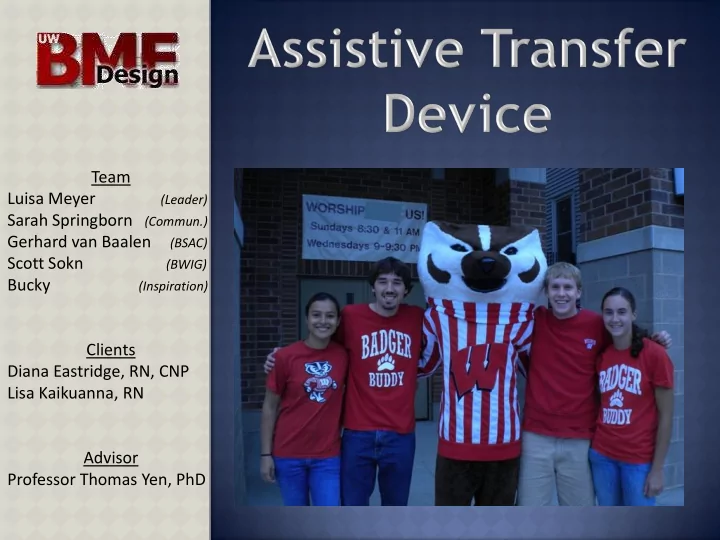
Team Luisa Meyer
(Leader)
Sarah Springborn
(Commun.)
Gerhard van Baalen
(BSAC)
Scott Sokn
(BWIG)
Bucky
(Inspiration)
Clients Diana Eastridge, RN, CNP Lisa Kaikuanna, RN Advisor Professor Thomas Yen, PhD
SLIDE 2
I.
Problem Statement
i.
Need for Device
II.
Design Specifications
i.
Background
III.
Review of Previous Design
i.
What went wrong?
ii.
Where can we improve?
IV.
Design Analyses
V.
Future Work
i.
Design/Fabrication
ii.
IRB
SLIDE 3
Safely transfer patients from
wheel chair to exam table
Patients should feel secure
while lifted
Reduce Physical exertion of
both patient and medical personnel
SLIDE 4 Manual Labor
Method
Assistant wraps arms around patient Holds patient while slowly rotating toward table Hoists patient onto exam table
Risks
Large effort from assistant Uncomfortable for patient and assistant Dependent on assistant strength
Hoyer Lift
Mostly for Wheelchair-bound patients Have to get sleeve underneath patient
http://www.corpmed.com/images/patient-transfer.jpg http://dehanmedequip.com/images/electric%20hoyer%20lift.jpg
SLIDE 5
Able to lift 300 lbs.
(Safety factor of 2x)
Lift 10-15 in. Rotate Patient Portable
(Device < 50 lbs. or on wheels)
Easy Storage
Under a bed/behind a door/ against a wall
Stable
SLIDE 6 Limitations
Can only help patients able to stand with
assistance of nurse or walker
Initial Step up is 3.5 in. Friction in joints require oiling Total Weight is 60 lbs.
Issues to improve
Mechanical advantage of actuator Reduce Extrusions (wheels and cylinder)
–ideally fitting both underneath device
General Stability during ascent and
descent
Binding issues of scissor-links
SLIDE 7
Reduces Step height Increases Mechanical advantage
5” 2” step
SLIDE 8
F F F F Last Year Double Whammy Flying Diamond Double Flying Diamond
SLIDE 9 Hydraulic Actuator Electric Motor - Drive Shaft Premade Electric Car Jack
http://www.m-99.co.uk/Electric_Car_Jack/electric_car_jack.html
SLIDE 10
Cost Feasibility (x2) Storage Design Variability (x2) Safety Total Hydraulics 1 4 4 5 4 18 Premade Electric Jack 4 8 1 4 4 21 Drive Shaft 2 5 4 8 4 23
SLIDE 11
Perform force calculations on SolidWorks
model
Calculate motor torque
Order Materials Fabricate Apply for IRB
SLIDE 12
Step Height
Stair heights range from 6 ½” to 9 ½” [4] Elderly women range of motion of about 59.23 ± 13.77° [2] Maximum knee flexion during an 8” step is 90.8° [5] A study showed that 80% of the women tested (ages 75-93)
were able to step up higher than 20 cm (7.87”)[1] Stance
Stance width ranges from 0.05 m to 0.29 m (2” to 11.4”)[3]
SLIDE 13
Target population: nursing homes Significance:
Maximum step height Stance Width
Social Science IRB Approval Survey for elderly people
Test different step heights Rate on comfort/difficulty
SLIDE 14
SLIDE 15
[1] Bergland A, Sylliaas H, Jarnlo GB, Wyller TB. Health, balance and walking as correlates of climbing stairs. J of Aging and Physical Activity, 2008;16:42-52. [2] Larsen AH, Sorensen H, Puggaard L, Aagaard P . “Biomechanical determinants of maximal stair climbing capacity in healthy elderly women.” Scandinavian J of Med & Science in Sports, 2009;19:678-686. [3] Mcllroy WE and Maki BE. “Preferred placement of the feet during quiet stance: development of a standardized foot placement for balance testing.” Clinical Biomechanics, 1997;12:66-70. [4] Occupational Safety and Health Administration. Standard 1910.24(e). <http://www.osha.gov/pls/oshaweb/owadisp.show_document?p_table=standards &p_id=9716>. [5] Smutnick JA, Bohannon RW. “Hip and knee flexion of lead and trail limbs during ascent of a step of different heights by normal adults.” Phys Ther, 2009;95:289- 293.