T Cell Receptor Gamma and Delta Gene T Cell Receptor Gamma and Delta - - PowerPoint PPT Presentation

t cell receptor gamma and delta gene t cell receptor
SMART_READER_LITE
LIVE PREVIEW

T Cell Receptor Gamma and Delta Gene T Cell Receptor Gamma and Delta - - PowerPoint PPT Presentation

T Cell Receptor Gamma and Delta Gene T Cell Receptor Gamma and Delta Gene Rearrangements in Rearrangements in Nature Precedings : doi:10.1038/npre.2010.5274.1 : Posted 17 Nov 2010 T-cell Acute Lymphoblastic Leukemia in cell Acute


slide-1
SLIDE 1

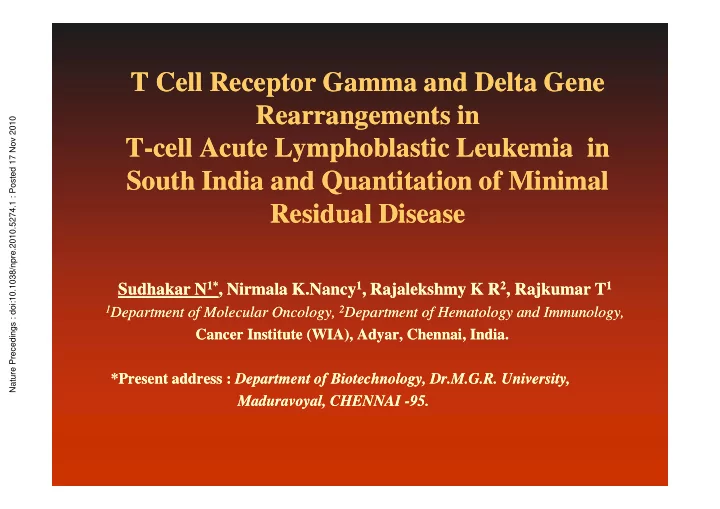
T Cell Receptor Gamma and Delta Gene T Cell Receptor Gamma and Delta Gene Rearrangements in Rearrangements in T-cell Acute Lymphoblastic Leukemia in cell Acute Lymphoblastic Leukemia in South India and Quantitation of Minimal South India and Quantitation of Minimal Residual Disease Residual Disease

Sudhakar N Sudhakar N1*

1*,

, Nirmala Nirmala K.Nancy K.Nancy1, , Rajalekshmy Rajalekshmy K R K R2

2,

, Rajkumar Rajkumar T T1

1

1Department of Molecular Oncology,

Department of Molecular Oncology, 2Department of Hematology and Immunology, Department of Hematology and Immunology, Cancer Cancer Institute Institute (WIA), (WIA), Adyar Adyar, Chennai, Chennai, India India. *Present *Present address address : Department Department of

  • f Biotechnology,

Biotechnology, Dr Dr.M.G.R. University, University, Maduravoyal, Maduravoyal, CHENNAI CHENNAI -95 95.

Nature Precedings : doi:10.1038/npre.2010.5274.1 : Posted 17 Nov 2010

slide-2
SLIDE 2

Objective of the Study Objective of the Study

To detect the T cell receptor Gamma and Delta gene rearrangements in T-cell Acute lymphoblastic Leukemia patients in South India To Quantitate the Minimal Residual Disease (MRD) in follow-up samples of ALL using Real-time PCR

Nature Precedings : doi:10.1038/npre.2010.5274.1 : Posted 17 Nov 2010

slide-3
SLIDE 3

TCR Gene Rearrangements TCR Gene Rearrangements

During early T cell differentiation, the germline encoded V, D and J gene segments of TCR gene complex rearrange Each lymphocyte gets a unique V-(D)-J segment that codes for the variable domain of TCR molecules Combinatorial diversity: By the number of possible Combinatorial diversity: By the number of possible combinations of V-(D)-J segments Junctional diversity: By the random insertion and deletion of nucleotides at the junction sites of V-(D)-J

  • segments. The junctional regions are unique

“fingerprint like sequences” different in each lymphoid clone

Nature Precedings : doi:10.1038/npre.2010.5274.1 : Posted 17 Nov 2010

slide-4
SLIDE 4

Patients and Methods Patients and Methods

Patients Patients 54 T-ALL Patients enrolled for MCP 841treatment protocol included for the study Methodology Methodology 10 ml of PB and 2 ml BM collected from the patients were used for study were used for study Isolation of DNA from mononuclear cells PCR Heteroduplex analysis Sequencing the Homoduplex PCR product to design Allele Specific Oligonucleotide primers (ASO) Real-time quantitative PCR

Nature Precedings : doi:10.1038/npre.2010.5274.1 : Posted 17 Nov 2010

slide-5
SLIDE 5

Homo-Heteroduplex Analysis

Monoclonal cells

1 2 3

dS DNA Monoclonal cells in polyclonal background Denaturation and Homoduplex Denaturation and renaturation of PCR product Heteroduplex 1,2 Clonal 3 PolyClonal

Nature Precedings : doi:10.1038/npre.2010.5274.1 : Posted 17 Nov 2010

slide-6
SLIDE 6

TCRG TCRG gene rearrangements in T gene rearrangements in T-ALL ALL

TCRG rearranged in 37 of 54 T-ALL cases (68.5%) VγI-Jγ1.3/2.3 more commonly rearranged in 29 cases (54%) VγII-Jγ1.3/2.3 rearranged in 29 cases (26%) VγII-Jγ1.3/2.3 rearranged in 29 cases (26%) VγIII-Jγ1.3/2.3 and VγIV-JγI.3/2.3 in 4 cases (7.4%) VγI-Jγ1.1/2.1 in 3 cases (5.5%) Junctional region sequence of TCRG ranged from 1 nucleotide to 11 nucleotides (average 7.6 nucleotides)

  • [Ref: Sudhakar et al, American Journal of Hematology 82: 215-221 (2007)]

Nature Precedings : doi:10.1038/npre.2010.5274.1 : Posted 17 Nov 2010

slide-7
SLIDE 7

TCRD TCRD gene rearrangements in T gene rearrangements in T-ALL ALL

TCRD rearranged in 16 of 54 cases (29.6%) Vδ1-Jδ1 rearranged in 9 cases (16.6%) Vδ2-Jδ1 and Vδ3-Jδ1 rearranged in one case each (1.8%) Vδ2-Dδ3 in 5 cases (9.25%) and Dδ2-Dδ3 in 4 cases Vδ2-Dδ3 in 5 cases (9.25%) and Dδ2-Dδ3 in 4 cases (7.4%) Junctional region sequence of TCRD (Vδ1-Jδ1, Vδ2- Jδ1 and Vδ3-Jδ1) ranged from 14 to 42 nucleotides (average 27 nucleotides)

  • [Ref: Sudhakar et al, American Journal of Hematology 82: 215-221 (2007)]

Nature Precedings : doi:10.1038/npre.2010.5274.1 : Posted 17 Nov 2010

slide-8
SLIDE 8

Real Real-time Quantitative PCR time Quantitative PCR

Quantitation of DNA using a control gene (RNAse P gene) Quantitation of MRD

  • Diagnosis DNA with almost 100% tumor cell

involvement was serially diluted (50 ng to 5 ng leukemic cells) in 500ng of polyclonal control DNA (105 cells) to give final concentrations of 10-1 to10-5 Serially diluted diagnosis DNA (duplicates) subjected to ASO-PCR together with follow-up samples (500ng in triplicates) and negative control MRD quantities divided by amplifiable DNA.

Nature Precedings : doi:10.1038/npre.2010.5274.1 : Posted 17 Nov 2010

slide-9
SLIDE 9

Amplification plot and Standard curve Amplification plot and Standard curve

Amplification plot Ct Standard curve

1L in 10 N 1L in 102 N 1L in 103 N 1L in 104 N

Cycle number Log CO Slope –3.631192 Intercept 38.376797 R2 = 0.962376

Nature Precedings : doi:10.1038/npre.2010.5274.1 : Posted 17 Nov 2010

slide-10
SLIDE 10

MRD Quantitation in ALL patients MRD Quantitation in ALL patients

RQ-PCR MRD in T-ALL 1 (Genotype VgIII-Jg1) 1 0.0038 0.00028 0.0003 0.0012 0.0001 0.001 0.01 0.1 1 I 1 RI 1 M 1 M 2 TREATMENT INTERVAL MRD RQ-PCR MRD IN CALLA-1 (Genotype VgII-Jg1) 1 0.00013 0.001 0.00037 0.0011 0.0001 0.001 0.01 0.1 1 20 DAYS I 1 I 2 M 2 MRD TREATMENT INTERVAL TREATMENT INTERVAL MRD in T-ALL 3 (Genotype Vd1-Jd1) 0.74 0.4 0.06 0.068 1

0.001 0.01 0.1 1

20 days End of RI 1 End of M 2 M 5 M 5

TREATMENT INTERVAL MRD

RQ-PCR MRD IN T-ALL 2

(Genotype VgII-Jg1)

1 0.00016 0.00016 0.00077 0.0056 0.0001 0.001 0.01 0.1 1 AFTER 20 DAYS I 1 I 2 M 1 TREATMENT INTERVAL MRD

Nature Precedings : doi:10.1038/npre.2010.5274.1 : Posted 17 Nov 2010

slide-11
SLIDE 11

Conclusion Conclusion

TCRG rearrangements were detected in 68.5% and TCRD in 29.6% of the patients After Induction therapy, in 3 of the 4 patients lesser than 2 leukemic cells in 103 normal cells were present and those patients are in clinical and hematological remission MRD quantitation with more number of samples before and after treatment are required to risk stratify the patients

  • Acknowledgements

Acknowledgements

  • Department of Science and Technology, New Delhi.
  • Lady Tata Memorial Trust, Mumbai and
  • Department of Medical Oncology, Cancer Institute.

Nature Precedings : doi:10.1038/npre.2010.5274.1 : Posted 17 Nov 2010