Symmetric Cauchy stresses do not imply symmetric Biot strains in - - PowerPoint PPT Presentation

symmetric cauchy stresses do not imply symmetric biot
SMART_READER_LITE
LIVE PREVIEW

Symmetric Cauchy stresses do not imply symmetric Biot strains in - - PowerPoint PPT Presentation

Symmetric Cauchy stresses do not imply symmetric Biot strains in weak formulations of isotropic hyperelasticity with rotational degrees of freedom. Andreas Fischle , Patrizio Neff and Ingo Mnch Universitt Duisburg-Essen ,


slide-1
SLIDE 1

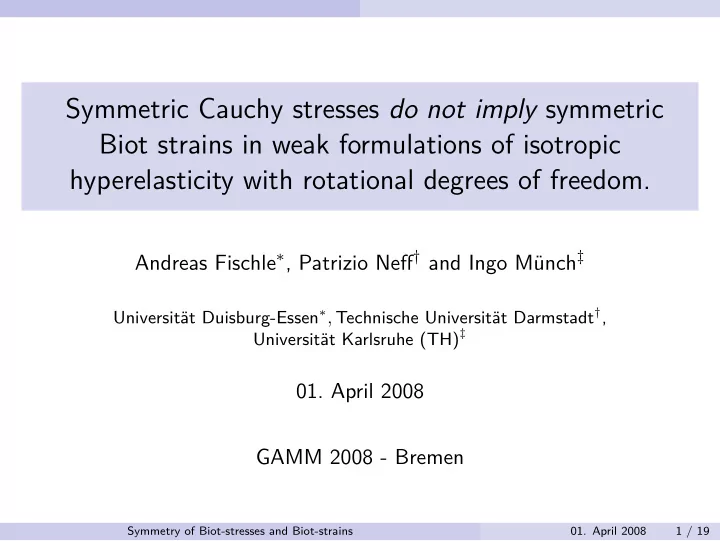
Symmetric Cauchy stresses do not imply symmetric Biot strains in weak formulations of isotropic hyperelasticity with rotational degrees of freedom.

Andreas Fischle∗, Patrizio Neff† and Ingo Münch‡

Universität Duisburg-Essen∗, Technische Universität Darmstadt†, Universität Karlsruhe (TH)‡

  • 01. April 2008

GAMM 2008 - Bremen

Symmetry of Biot-stresses and Biot-strains

  • 01. April 2008

1 / 19

slide-2
SLIDE 2

Introduction

Overview

Section

1 Introduction 2 From Biot to Cosserat 3 Symmetry of Cauchy-stresses and Biot-strains 4 Conclusions

Symmetry of Biot-stresses and Biot-strains

  • 01. April 2008

2 / 19

slide-3
SLIDE 3

Introduction

Notation

Deformation of a Body

  • Reference configuration: Ω ⊂ R3
  • Deformation ϕ : Ω → Ωdef ⊂ R3
  • Deformation gradient: F := ∇ϕ ∈ GL+(3)

Right Polar Decomposition: F = RU = polar(F)U

  • Polar rotation: R, polar(F) ∈ SO(3)

(exact rotation of R3)

  • Biot-stretch: U ∈ PSym(3)

(positive definite symmetric) A Crucial Identity

  • RTF = U =

√ F TF ∈ PSym(3)

Symmetry of Biot-stresses and Biot-strains

  • 01. April 2008

3 / 19

slide-4
SLIDE 4

Introduction

Hyperelasticity, Objectivity and Material Isotropy

Hyperelasticity - Minimizing total stored energy Find minimizers ϕmin of: I(ϕ) =

W (∇ ϕ) dV

  • Choice of W : M(3, R) → R is a constitutive assumption
  • Can apply various boundary conditions ...
  • Consider only zero body forces

Isotropy and Objectivity in terms of F := ∇ ϕ

  • W (F) is objective if

∀Q ∈ SO(3) : W (QF) = W (F)

  • W (F) is isotropic if

∀Q ∈ SO(3) : W (FQ) = W (F)

Objectivity of W (F) ⇒ ∃W ♯ : PSym(3) → R s. th. W (F) = W ♯(U(F))

Symmetry of Biot-stresses and Biot-strains

  • 01. April 2008

4 / 19

slide-5
SLIDE 5

From Biot to Cosserat

Overview

Section

1 Introduction 2 From Biot to Cosserat 3 Symmetry of Cauchy-stresses and Biot-strains 4 Conclusions

Symmetry of Biot-stresses and Biot-strains

  • 01. April 2008

5 / 19

slide-6
SLIDE 6

From Biot to Cosserat

The isotropic Biot-model - Standard version

Basic constitutive assumptions

  • Objectivity: W (F) = W ♯(U), where U := RTF =

√ F TF ∈ PSym

  • Isotropy: ∀Q ∈ SO(3) : W (FQ) = W (F) ⇐

⇒ W ♯(QTUQ) = W ♯(U)

Example: Most general isotropic quadratic energy in U W ♯(U) = µ U − 12 + λ 2 tr [U − 1]2 , U := √ F TF

  • Linearization equivalent to classical isotropic linear elasticity
  • µ, λ the standard Lamé moduli

Biot approach is intrinsically based on a formulation in U = √ F TF

  • Have to take derivatives of U, i.e., of a matrix square root
  • Numerical relaxation U := R

TF seems to be convenient

Symmetry of Biot-stresses and Biot-strains

  • 01. April 2008

6 / 19

slide-7
SLIDE 7

From Biot to Cosserat

Euler-Lagrange equations for the Biot-model

Free variation w.r.t. to ϕ

0 = d dt

  • t=0

I(ϕ + t v) =

DF W (∇ ϕ), ∇v dV =

DF [W ♯(U(F))], ∇v dV =

DUW ♯(U), DF U(F).∇v dV =

DUW ♯(U), DF [R(F)T F].∇v dV = . . . =

R(F) DUW ♯(U), ∇v =

Div[R(F) DUW ♯(U)], v dV , ∀ v ∈ C∞ (Ω, R3) .

Strong form of the equilibrium equation 0 = Div[R(F) DUW ♯(U)], R(F) = polar(F) A weaker form of the equilibrium equation 0 = Div[R(F) DUW ♯(R(F)TF)], R(F)TF ∈ Sym

Symmetry of Biot-stresses and Biot-strains

  • 01. April 2008

7 / 19

slide-8
SLIDE 8

From Biot to Cosserat

Euler-Lagrange equations for the Biot-model

Free variation w.r.t. to ϕ

0 = d dt

  • t=0

I(ϕ + t v) =

DF W (∇ ϕ), ∇v dV =

DF [W ♯(U(F))], ∇v dV =

DUW ♯(U), DF U(F).∇v dV =

DUW ♯(U), DF [R(F)T F].∇v dV = . . . =

R(F) DUW ♯(U), ∇v =

Div[R(F) DUW ♯(U)], v dV , ∀ v ∈ C∞ (Ω, R3) .

Strong form of the equilibrium equation 0 = Div[R(F) DUW ♯(U)], R(F) = polar(F) A weaker form of the equilibrium equation 0 = Div[R(F) DUW ♯(R(F)TF)], R(F)TF ∈ Sym

  • Weaker means: R

TF ∈ Sym

⇒ U = R

TF ∈ PSym

Symmetry of Biot-stresses and Biot-strains

  • 01. April 2008

7 / 19

slide-9
SLIDE 9

From Biot to Cosserat

Numerical Relaxation

Idea - Generalize a classical model, but preserve its solutions

  • U := RTF = polar(F)TF =

√ F TF constrains rotation Relaxation of the constraint

  • Independent rotations R : Ω → SO(3)

(no physics involved!)

  • Yields relaxed Biot-stretch U := R

TF

(usually not symmetric)

  • Fixing R = polar(F) recovers the non-relaxed Biot-case

Consequences

  • Can define relaxed energies W ♯(U) = W (F, R)
  • Relaxation gets rid of U but introduces R ∈ SO(3)
  • One obtains a 2-field model!

Symmetry of Biot-stresses and Biot-strains

  • 01. April 2008

8 / 19

slide-10
SLIDE 10

From Biot to Cosserat

The relaxed isotropic Biot-model is a Cosserat-model

Hyperelastic Cosserat-model (Neff, 2006)

I(ϕ, R) :=

Wmp(F(x), R(x)) + Wcurv(R(x), DxR(x)) dV → min. w.r.t. (ϕ, R)

Definition of the energetic components: Isotropic case

Wmp(U) := Wshear(U) + Wvol(det[U]) Wshear(U) := µ sym (U − 1)2 + µc skew (U − 1)2 Wvol(det[U]) := λ 4

  • (det[U] − 1)2 + (det[U]

−1 − 1)2

Wcurv(R, DxR) := µ L2

c R TDxR 2

Notation U := R

TF,

F := ∇ϕ, DxR :=

  • ∇(R.e1), ∇(R.e2), ∇(R.e3)
  • Symmetry of Biot-stresses and Biot-strains
  • 01. April 2008

9 / 19

slide-11
SLIDE 11

From Biot to Cosserat

The relaxed isotropic Biot-model is a Cosserat-model

Hyperelastic Cosserat-model without curvature energy ˆ = Lc = 0

I(ϕ, R) :=

Wmp(F(x), R(x)) +✘✘

✘ ❳❳ ❳

Wcurv(R(x), DxR(x)) dV → min. w.r.t. (ϕ, R)

Definition of the energetic components: Isotropic case

Wmp(U) := Wshear(U) + Wvol(det[U]) Wshear(U) := µ sym (U − 1)2 + µc skew (U − 1)2 Wvol(det[U]) := λ 4

  • (det[U] − 1)2 + (det[U]

−1 − 1)2

Wcurv(R, DxR) := µ L2

c R TDxR 2

← Wcurv is absent if Lc = 0

Notation U := R

TF,

F := ∇ϕ, DxR :=

  • ∇(R.e1), ∇(R.e2), ∇(R.e3)
  • Symmetry of Biot-stresses and Biot-strains
  • 01. April 2008

9 / 19

slide-12
SLIDE 12

From Biot to Cosserat

The relaxed isotropic Biot-model is a Cosserat-model

Hyperelastic Cosserat-model without curvature energy ˆ = Lc = 0

I(ϕ, R) :=

Wshear(F, R) + Wvol(F, R) dV → min. w.r.t. (ϕ, R)

Definition of the energetic components: Isotropic case

Wmp(U) := Wshear(U) + Wvol(det[U]) Wshear(U) := µ sym (U − 1)2 + µc skew (U − 1)2 Wvol(det[U]) := λ 4

  • (det[U] − 1)2 + (det[U]

−1 − 1)2

← constant w.r.t. R Wcurv(R, DxR) := µ L2

c R TDxR 2

← Wcurv is absent if Lc = 0

Notation U := R

TF,

F := ∇ϕ, DxR :=

  • ∇(R.e1), ∇(R.e2), ∇(R.e3)
  • Symmetry of Biot-stresses and Biot-strains
  • 01. April 2008

9 / 19

slide-13
SLIDE 13

From Biot to Cosserat

The relaxed isotropic Biot-model is a Cosserat-model

Hyperelastic Cosserat-model with Lc = 0 and ✟✟

✟ ❍❍ ❍

Wvol

I(ϕ, R) :=

µ sym (R

TF − 1)2 + µc skew (R TF − 1)2 dV → min. w.r.t. (ϕ, R)

Definition of the energetic components: Isotropic case

Wmp(U) := Wshear(U) + Wvol(det[U]) Wshear(U) := µ sym (U − 1)2 + µc skew (U − 1)2 Wvol(det[U]) := λ 4

  • (det[U] − 1)2 + (det[U]

−1 − 1)2

← constant w.r.t. R Wcurv(R, DxR) := µ L2

c R TDxR 2

← Wcurv is absent if Lc = 0

Notation U := R

TF,

F := ∇ϕ, DxR :=

  • ∇(R.e1), ∇(R.e2), ∇(R.e3)
  • Symmetry of Biot-stresses and Biot-strains
  • 01. April 2008

9 / 19

slide-14
SLIDE 14

From Biot to Cosserat

The linear setting - σ ∈ Sym ⇐ ⇒ skew(∇u − A) = 0

Linearizations of the fields

  • F = 1 + ∇u, ∇u ≪ 1
  • R ≈ 1 + A,

where A ∈ so(3)

  • U − 1 ≈ ∇u − A
  • polar(F) ≈ 1 + skew(∇u)

Linearized “constraint”

  • Finite: R = polar(F)
  • Linear: A = skew(∇u)

Definition of W ♯ - Cosserat without curvature

W ♯(U) := µ sym(U − 1)2 + µc skew(U − 1)2 + λ 4

  • (det[U] − 1)2 + (

1 det[U] − 1)2

  • Symmetry of Biot-stresses and Biot-strains
  • 01. April 2008

10 / 19

slide-15
SLIDE 15

From Biot to Cosserat

The linear setting - σ ∈ Sym ⇐ ⇒ skew(∇u − A) = 0

Linearizations of the fields

  • F = 1 + ∇u, ∇u ≪ 1
  • R ≈ 1 + A,

where A ∈ so(3)

  • U − 1 ≈ ∇u − A
  • polar(F) ≈ 1 + skew(∇u)

Linearized “constraint”

  • Finite: R = polar(F)
  • Linear: A = skew(∇u)

W ♯

quad - Quadratic approximation of W ♯

W ♯

quad(∇u − A) := µ sym(∇u − A)2 + µc skew(∇u − A)2 + λ

2 tr

  • ∇u − A

2

Linear case µc > 0 : σ ∈ Sym ⇐ ⇒ skew(∇u − A) = 0 σ = D∇uW ♯

quad = 2µ sym(∇u) + 2µc skew(∇u − A) + λ tr [∇u] 1

Symmetry of Biot-stresses and Biot-strains

  • 01. April 2008

10 / 19

slide-16
SLIDE 16

From Biot to Cosserat

The linear setting - σ ∈ Sym ⇐ ⇒ skew(∇u − A) = 0

Linearizations of the fields

  • F = 1 + ∇u, ∇u ≪ 1
  • R ≈ 1 + A,

where A ∈ so(3)

  • U − 1 ≈ ∇u − A
  • polar(F) ≈ 1 + skew(∇u)

Linearized “constraint”

  • Finite: R = polar(F)
  • Linear: A = skew(∇u)

W ♯

quad - Quadratic approximation of W ♯

W ♯

quad(∇u − A) := µ sym(∇u − A)2 + µc skew(∇u − A)2 + λ

2 tr

  • ∇u − A

2

Linear case µc = 0 : σ ∈ Sym is independent of A σ = D∇uW ♯

quad = 2µ sym(∇u) + λ tr [∇u] · 1

Symmetry of Biot-stresses and Biot-strains

  • 01. April 2008

10 / 19

slide-17
SLIDE 17

From Biot to Cosserat

The linear setting - σ ∈ Sym ⇐ ⇒ skew(∇u − A) = 0

Linearizations of the fields

  • F = 1 + ∇u, ∇u ≪ 1
  • R ≈ 1 + A,

where A ∈ so(3)

  • U − 1 ≈ ∇u − A
  • polar(F) ≈ 1 + skew(∇u)

Linearized “constraint”

  • Finite: R = polar(F)
  • Linear: A = skew(∇u)

W ♯

quad - Quadratic approximation of W ♯

W ♯

quad(∇u − A) := µ sym(∇u − A)2 + µc skew(∇u − A)2 + λ

2 tr

  • ∇u − A

2

Linear case - Equivalence of Symmetry σ ∈ Sym ⇐ ⇒ skew(∇u − A) = 0 ⇐ ⇒ Linearized U ∈ Sym

Symmetry of Biot-stresses and Biot-strains

  • 01. April 2008

10 / 19

slide-18
SLIDE 18

From Biot to Cosserat

Cauchy-stress and balance of angular momentum in continuum theories with rotational degrees of freedom

Generalized stress tensors in theories with relaxed rotations R

  • 1st Piola-Kirchhoff: S1(F, R) := DFW (F, R) = R DUW ♯(U)
  • Cauchy: σ :=

1 det[F] S1(F, R) F T = 1 det[F] R DUW ♯(U)F T

  • σ ∈ Sym ⇐

⇒ R

TσR ∈ Sym

Symmetry of Biot-stresses and Biot-strains

  • 01. April 2008

11 / 19

slide-19
SLIDE 19

From Biot to Cosserat

Cauchy-stress and balance of angular momentum in continuum theories with rotational degrees of freedom

Generalized stress tensors in theories with relaxed rotations R

  • 1st Piola-Kirchhoff: S1(F, R) := DFW (F, R) = R DUW ♯(U)
  • Cauchy: σ :=

1 det[F] S1(F, R) F T = 1 det[F] R DUW ♯(U)F T

  • σ ∈ Sym ⇐

⇒ R

TRDUW ♯(U)F TR ∈ Sym

Symmetry of Biot-stresses and Biot-strains

  • 01. April 2008

11 / 19

slide-20
SLIDE 20

From Biot to Cosserat

Cauchy-stress and balance of angular momentum in continuum theories with rotational degrees of freedom

Generalized stress tensors in theories with relaxed rotations R

  • 1st Piola-Kirchhoff: S1(F, R) := DFW (F, R) = R DUW ♯(U)
  • Cauchy: σ :=

1 det[F] S1(F, R) F T = 1 det[F] R DUW ♯(U)F T

  • σ ∈ Sym ⇐

⇒ 1DUW ♯(U)(R

TF)T ∈ Sym

Symmetry of Biot-stresses and Biot-strains

  • 01. April 2008

11 / 19

slide-21
SLIDE 21

From Biot to Cosserat

Cauchy-stress and balance of angular momentum in continuum theories with rotational degrees of freedom

Generalized stress tensors in theories with relaxed rotations R

  • 1st Piola-Kirchhoff: S1(F, R) := DFW (F, R) = R DUW ♯(U)
  • Cauchy: σ :=

1 det[F] S1(F, R) F T = 1 det[F] R DUW ♯(U)F T

  • σ ∈ Sym ⇐

⇒ DUW ♯(U)U

T∈ Sym

Symmetry of Biot-stresses and Biot-strains

  • 01. April 2008

11 / 19

slide-22
SLIDE 22

From Biot to Cosserat

Cauchy-stress and balance of angular momentum in continuum theories with rotational degrees of freedom

Generalized stress tensors in theories with relaxed rotations R

  • 1st Piola-Kirchhoff: S1(F, R) := DFW (F, R) = R DUW ♯(U)
  • Cauchy: σ :=

1 det[F] S1(F, R) F T = 1 det[F] R DUW ♯(U)F T

  • σ ∈ Sym ⇐

⇒ DUW ♯(U)U

T∈ Sym ⇐

⇒ Balance of angular momentum Theorem (Objectivity of W ♯ implies σ ∈ Sym) Let W ♯ = W (F, R) be differentiable and objective, then the associated Cauchy stress tensor σ is symmetric.

Symmetry of Biot-stresses and Biot-strains

  • 01. April 2008

11 / 19

slide-23
SLIDE 23

From Biot to Cosserat

Cauchy-stress and balance of angular momentum in continuum theories with rotational degrees of freedom Question: Does isotropy of W ♯

quad imply Ulin ∈ Sym?

Symmetry of Biot-stresses and Biot-strains

  • 01. April 2008

11 / 19

slide-24
SLIDE 24

From Biot to Cosserat

Cauchy-stress and balance of angular momentum in continuum theories with rotational degrees of freedom Question: Does isotropy of W ♯

quad imply Ulin ∈ Sym?

Answer: Yes (Shown on the previous slide)

Symmetry of Biot-stresses and Biot-strains

  • 01. April 2008

11 / 19

slide-25
SLIDE 25

From Biot to Cosserat

Cauchy-stress and balance of angular momentum in continuum theories with rotational degrees of freedom Question: Does isotropy of W ♯ imply U ∈ Sym?

Symmetry of Biot-stresses and Biot-strains

  • 01. April 2008

11 / 19

slide-26
SLIDE 26

From Biot to Cosserat

Cauchy-stress and balance of angular momentum in continuum theories with rotational degrees of freedom Question: Does isotropy of W ♯ imply U ∈ Sym? Answer: No (Neff, Fischle, Münch - 2007)

Symmetry of Biot-stresses and Biot-strains

  • 01. April 2008

11 / 19

slide-27
SLIDE 27

From Biot to Cosserat

Balance of Angular Momentum

Geometrically exact volume terms are irrelevant

  • det[U] = det[R

TF] is independent of R

  • Volume term of W ♯ is irrelevant

Consider W ♯(U) := µ sym(U − 1)2 + µc skew(U − 1)2

σ ∈ Sym ⇐ ⇒ DUW ♯(U) U

T ∈ Sym

⇐ ⇒

  • 2µ (sym(U − 1)) + 2µc skew U
  • U

T ∈ Sym

⇐ ⇒

  • µ (U + U

T − 2 1) + µc(U − U T)

  • U

T ∈ Sym

⇐ ⇒ (µ − µc) U U − 2µ U ∈ Sym

Equilibrium equation (for angular momentum)

(µ − µc) [U

2 − U T,2] − 2µ [U − U T] = 0

Symmetry of Biot-stresses and Biot-strains

  • 01. April 2008

12 / 19

slide-28
SLIDE 28

Symmetry of Cauchy-stresses and Biot-strains

Overview

Section

1 Introduction 2 From Biot to Cosserat 3 Symmetry of Cauchy-stresses and Biot-strains 4 Conclusions

Symmetry of Biot-stresses and Biot-strains

  • 01. April 2008

13 / 19

slide-29
SLIDE 29

Symmetry of Cauchy-stresses and Biot-strains

Example I - Assumptions and Definitions

Assumptions on the structure

  • f F and R

F :=

  • λ1

λ2 1

  • ,

λ1, λ2 > 0 R :=

  • cos α

− sin α sin α cos α 1

  • Choose further
  • ρ :=

2 µ µ−µc ,

0 ≤ µc < µ

  • λ1 + λ2 > ρ
  • α := arccos
  • ρ

λ1+λ2

  • 0, π

2

  • Symmetry of Biot-stresses and Biot-strains
  • 01. April 2008

14 / 19

slide-30
SLIDE 30

Symmetry of Cauchy-stresses and Biot-strains

Example I - Assumptions and Definitions

Assumptions on the structure

  • f F and R

F :=

  • λ1

λ2 1

  • ,

λ1, λ2 > 0 R :=

  • cos α

− sin α sin α cos α 1

  • Choose further
  • ρ :=

2 µ µ−µc ,

0 ≤ µc < µ

  • λ1 + λ2 > ρ
  • α := arccos
  • ρ

λ1+λ2

  • 0, π

2

  • =

⇒ Particular forms for R and U

Symmetry of Biot-stresses and Biot-strains

  • 01. April 2008

14 / 19

slide-31
SLIDE 31

Symmetry of Cauchy-stresses and Biot-strains

Example I - Assumptions and Definitions

Assumptions on the structure

  • f F and R

F :=

  • λ1

λ2 1

  • ,

λ1, λ2 > 0 R :=

  • cos α

− sin α sin α cos α 1

  • Choose further
  • ρ :=

2 µ µ−µc ,

0 ≤ µc < µ

  • λ1 + λ2 > ρ
  • α := arccos
  • ρ

λ1+λ2

  • 0, π

2

  • =

⇒ Particular forms for R and U

R is given by

  

ρ λ1+λ2

  • 1 −

ρ2 (λ1+λ2)2

  • 1 −

ρ2 (λ1+λ2)2 ρ λ1+λ2

1

  

U := R

TF

(relaxed Biot-stretch)

  

ρ λ1 λ1+λ2

λ2

  • 1 −

ρ2 (λ1+λ2)2

−λ1

  • 1 −

ρ2 (λ1+λ2)2 ρ λ2 λ1+λ2

1

  

Symmetry of Biot-stresses and Biot-strains

  • 01. April 2008

14 / 19

slide-32
SLIDE 32

Symmetry of Cauchy-stresses and Biot-strains

Example I - Assumptions and Definitions

Assumptions on the structure

  • f F and R

F :=

  • λ1

λ2 1

  • ,

λ1, λ2 > 0 R :=

  • cos α

− sin α sin α cos α 1

  • Choose further
  • ρ :=

2 µ µ−µc ,

0 ≤ µc < µ

  • λ1 + λ2 > ρ
  • α := arccos
  • ρ

λ1+λ2

  • 0, π

2

  • =

⇒ Particular forms for R and U Note that U need not be symmetric!

R is given by

  

ρ λ1+λ2

  • 1 −

ρ2 (λ1+λ2)2

  • 1 −

ρ2 (λ1+λ2)2 ρ λ1+λ2

1

  

U := R

TF

(relaxed Biot-stretch)

  

ρ λ1 λ1+λ2

λ2

  • 1 −

ρ2 (λ1+λ2)2

−λ1

  • 1 −

ρ2 (λ1+λ2)2 ρ λ2 λ1+λ2

1

  

Symmetry of Biot-stresses and Biot-strains

  • 01. April 2008

14 / 19

slide-33
SLIDE 33

Symmetry of Cauchy-stresses and Biot-strains

Example II - Identities

An easy computation U − U

T =

  

(λ1 + λ2)

  • 1 −

ρ2 (λ1+λ2)2

−(λ1 + λ2)

  • 1 −

ρ2 (λ1+λ2)2

  

U

2 − U T,2 =

  

ρ (λ1 + λ2)

  • 1 −

ρ2 (λ1+λ2)2

−ρ (λ1 + λ2)

  • 1 −

ρ2 (λ1+λ2)2

  

Symmetry of Biot-stresses and Biot-strains

  • 01. April 2008

15 / 19

slide-34
SLIDE 34

Symmetry of Cauchy-stresses and Biot-strains

Example II - Identities

An easy computation U − U

T =

  

(λ1 + λ2)

  • 1 −

ρ2 (λ1+λ2)2

−(λ1 + λ2)

  • 1 −

ρ2 (λ1+λ2)2

  

U

2 − U T,2 =

  

ρ (λ1 + λ2)

  • 1 −

ρ2 (λ1+λ2)2

−ρ (λ1 + λ2)

  • 1 −

ρ2 (λ1+λ2)2

  

allows us to infer

U

2 − U T,2 = ρ (U − U T) =

2µ µ − µc (U − U

T)

⇐ ⇒ (µ − µc) (U

2 − U T,2) − 2µ (U − U T) = 0

⇐ ⇒ DUW ♯(U) U

T ∈ Sym

⇐ ⇒ σ ∈ Sym

Symmetry of Biot-stresses and Biot-strains

  • 01. April 2008

15 / 19

slide-35
SLIDE 35

Conclusions

Overview

Section

1 Introduction 2 From Biot to Cosserat 3 Symmetry of Cauchy-stresses and Biot-strains 4 Conclusions

Symmetry of Biot-stresses and Biot-strains

  • 01. April 2008

16 / 19

slide-36
SLIDE 36

Conclusions

Conclusions and Future Work

The finite Cosserat model and relaxed Biot model

  • Absence of Cosserat curvature ⇒ “Cosserat = relaxed Biot”
  • Isotropy does not imply classical, symmetric Biot-stretches

Influence of µc as a penalization parameter

  • µc < µ: Asymmetric Biot-stretches with symmetric σ
  • µc ≥ µ: Exact symmetry of the Biot stretch tensor

Further Research Characterize a sufficiently large class of isotropic free energies such that moment equilibrium in the relaxed Biot formulation automatically implies the symmetry of the relaxed Biot stretch U.

Symmetry of Biot-stresses and Biot-strains

  • 01. April 2008

17 / 19

slide-37
SLIDE 37

Conclusions

Selected References

  • P. Neff, A. Fischle and I. Münch.

Symmetric Cauchy stresses do not imply symmetric Biot strains in weak formulations of isotropic hyperelasticity with rotational degrees of freedom. Acta Mechanica, 2007, published online

  • H. Bufler.

On drilling degrees of freedom in nonlinear elasticity and a hyperelastic material description in terms of the stretch tensor. Part I: Theory. Acta Mech. 113: 21-35, 1995.

  • P. Neff.

The Cosserat couple modulus for continuous solids is zero viz the linearized Cauchy-stress tensor is symmetric. Preprint 2409 (available online), Zeitschrift f. Angewandte Mathematik Mechanik (ZAMM), 86(DOI 10.1002/zamm.200510281):892–912, 2006.

  • P. Neff.

A finite-strain elastic-plastic Cosserat theory for polycrystals with grain rotations.

  • Int. J. Eng. Sci., DOI 10.1016/j.ijengsci.2006.04.002, 44:574–594, 2006.

Symmetry of Biot-stresses and Biot-strains

  • 01. April 2008

18 / 19

slide-38
SLIDE 38

Conclusions

Thank you

  • The End -

Thank you for your attention!

Symmetry of Biot-stresses and Biot-strains

  • 01. April 2008

19 / 19