Contact Stresses and Deformations ME EN 7960 Precision Machine - - PDF document

contact stresses and deformations
SMART_READER_LITE
LIVE PREVIEW

Contact Stresses and Deformations ME EN 7960 Precision Machine - - PDF document

Contact Stresses and Deformations ME EN 7960 Precision Machine Design Topic 7 ME EN 7960 Precision Machine Design Contact Stresses and Deformations 7-1 Curved Surfaces in Contact The theoretical contact area of two spheres is a


slide-1
SLIDE 1

1

ME EN 7960 – Precision Machine Design – Contact Stresses and Deformations 7-1

Contact Stresses and Deformations

ME EN 7960 – Precision Machine Design Topic 7

ME EN 7960 – Precision Machine Design – Contact Stresses and Deformations 7-2

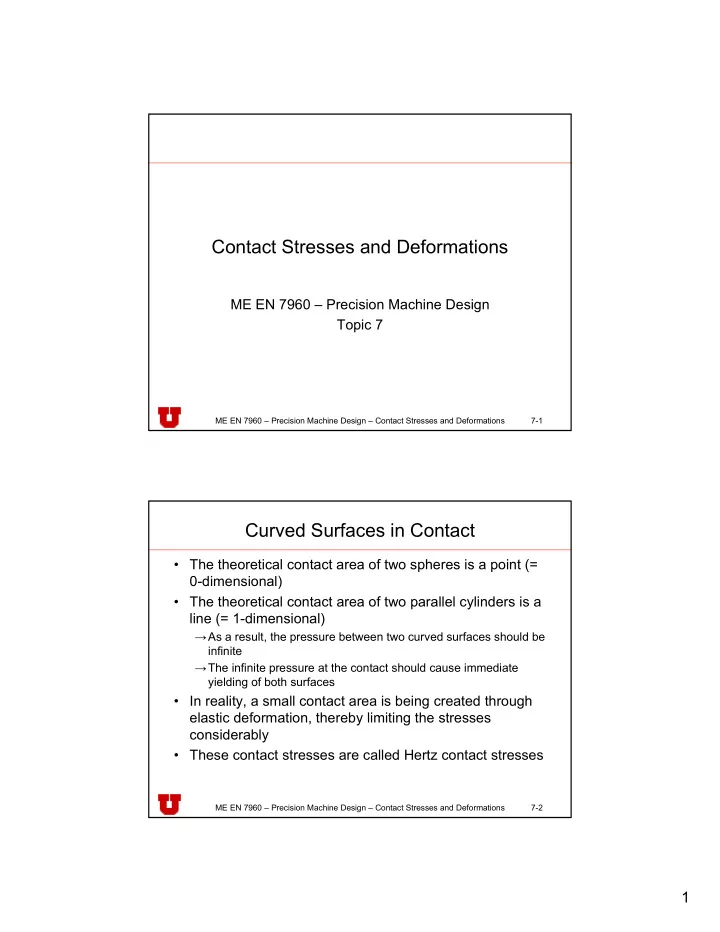
Curved Surfaces in Contact

  • The theoretical contact area of two spheres is a point (=

0-dimensional)

  • The theoretical contact area of two parallel cylinders is a

line (= 1-dimensional)

→As a result, the pressure between two curved surfaces should be infinite →The infinite pressure at the contact should cause immediate yielding of both surfaces

  • In reality, a small contact area is being created through

elastic deformation, thereby limiting the stresses considerably

  • These contact stresses are called Hertz contact stresses
slide-2
SLIDE 2

2

ME EN 7960 – Precision Machine Design – Contact Stresses and Deformations 7-3

Curved Surfaces in Contact – Examples

Rotary ball bearing Rotary roller bearing Linear bearings (ball and rollers)

ME EN 7960 – Precision Machine Design – Contact Stresses and Deformations 7-4

Curved Surfaces in Contact – Examples (contd.)

Ball screw Gears

slide-3
SLIDE 3

3

ME EN 7960 – Precision Machine Design – Contact Stresses and Deformations 7-5

Spheres in Contact

3 2 1 2 2 2 1 2 1

1 1 4 1 1 3 ⎟ ⎟ ⎠ ⎞ ⎜ ⎜ ⎝ ⎛ + ⎥ ⎦ ⎤ ⎢ ⎣ ⎡ − + − = R R E E F a ν ν

The radius of the contact area is given by: Where E1 and E2 are the moduli of elasticity for spheres 1 and 2 and ν1 and ν2 are the Poisson’s ratios, respectively The maximum contact pressure at the center of the circular contact area is:

2 max

2 3 a F p π =

R1 R2 E2,

2

E1,

1

F F y z x Sphere 2 Sphere 1 2a

pmax

Circular contact area, resulting in a semi-elliptic pressure distribution Z = 0: x y

pmax

2a

ME EN 7960 – Precision Machine Design – Contact Stresses and Deformations 7-6

Spheres in Contact (contd.)

  • The equations for two spheres in contact are also valid

for:

– Sphere on a flat plate (a flat plate is a sphere with an infinitely large radius) – Sphere in a spherical groove (a spherical groove is a sphere with a negative radius)

R1 E1,

1

y 2a x F z E2, 2 Flat plate (R2 = ∞) Z = 0: x y

pmax

2a

slide-4
SLIDE 4

4

ME EN 7960 – Precision Machine Design – Contact Stresses and Deformations 7-7

Spheres in Contact – Principal Stresses

The principal stresses σ1, σ2, and σ3 are generated on the z-axis:

( )

⎥ ⎥ ⎥ ⎥ ⎦ ⎤ ⎢ ⎢ ⎢ ⎢ ⎣ ⎡ ⎟ ⎟ ⎠ ⎞ ⎜ ⎜ ⎝ ⎛ + − ⎟ ⎟ ⎠ ⎞ ⎜ ⎜ ⎝ ⎛ − + − = = = = 1 2 1 arctan 1 1

2 2 max 2 1

a z z a a z p

y x

ν σ σ σ σ

1 2 2 max 3

1

⎟ ⎟ ⎠ ⎞ ⎜ ⎜ ⎝ ⎛ + − = = a z p

z

σ σ

The principal shear stresses are found as:

2

3 1 max 2 1

σ σ τ τ τ − = = =

3 =

τ

ME EN 7960 – Precision Machine Design – Contact Stresses and Deformations 7-8

Spheres in Contact – Vertical Stress Distribution at Center of Contact Area

Plot shows material with Poisson’s ratio ν = 0.3

0.5a a 1.5a 2a 2.5a 3a

σz σX, σy τmax σ, τ z

Von Mises 0.2 0.4 0.6 0.8 1 Depth below contact area Ratio of stress to pmax

  • The maximum shear and Von Mises stress are reached below the contact

area

  • This causes pitting where little pieces of material break out of the surface
slide-5
SLIDE 5

5

ME EN 7960 – Precision Machine Design – Contact Stresses and Deformations 7-9

Cylinders in Contact

The half-width b of the rectangular contact area of two parallel cylinders is found as:

⎟ ⎟ ⎠ ⎞ ⎜ ⎜ ⎝ ⎛ + ⎥ ⎦ ⎤ ⎢ ⎣ ⎡ − + − =

2 1 2 2 2 1 2 1

1 1 1 1 4 R R L E E F b π ν ν

Where E1 and E2 are the moduli of elasticity for cylinders 1 and 2 and ν1 and ν2 are the Poisson’s ratios,

  • respectively. L is the length of contact.

The maximum contact pressure along the center line of the rectangular contact area is:

bL F p π 2

max = x y z

F F

2b E2, ν2 E1, ν1 R2 R1 pmax L

Rectangular contact area with semi-elliptical pressure distribution ME EN 7960 – Precision Machine Design – Contact Stresses and Deformations 7-10

Cylinders in Contact (contd.)

  • The equations for two cylinders in contact are also valid

for:

– Cylinder on a flat plate (a flat plate is a cylinder with an infinitely large radius) – Cylinder in a cylindrical groove (a cylindrical groove is a cylinder with a negative radius)

x y z

F F

2b E2, ν2 E1, ν1 R1 pmax L

Rectangular contact area with semi

  • elliptical pressure

distribution

Flat plate (R2 = ? ) x y z

F F

2b E2, ν2 E1, ν1 R1 pmax L

Rectangular contact area with semi

  • elliptical

pressure distribution Cylindrical groove (R2 = -Rg)

Rg

slide-6
SLIDE 6

6

ME EN 7960 – Precision Machine Design – Contact Stresses and Deformations 7-11

Cylinders in Contact – Principal Stresses

The principal stresses σ1, σ2, and σ3 are generated on the z-axis:

⎥ ⎥ ⎦ ⎤ ⎢ ⎢ ⎣ ⎡ − + − = = b z b z p

x

1 2

2 2 max 1

ν σ σ ⎥ ⎥ ⎦ ⎤ ⎢ ⎢ ⎣ ⎡ − + ⎟ ⎟ ⎠ ⎞ ⎜ ⎜ ⎝ ⎛ ⎟ ⎟ ⎠ ⎞ ⎜ ⎜ ⎝ ⎛ + − − = =

b z b z b z p

y

2 1 1 2

2 2 1 2 2 max 2

σ σ

1 2 2 max 3

1

⎥ ⎥ ⎦ ⎤ ⎢ ⎢ ⎣ ⎡ + − = = b z p

z

σ σ

2 , 2 , 2

2 1 3 3 1 2 3 2 1

σ σ τ σ σ τ σ σ τ − = − = − =

ME EN 7960 – Precision Machine Design – Contact Stresses and Deformations 7-12

Cylinders in Contact – Vertical Stress Distribution along Centerline of Contact Area

  • The maximum shear and Von Mises stress are reached below the contact

area

  • This causes pitting where little pieces of material break out of the surface

Plot shows material with Poisson’s ratio ν = 0.3

Depth below contact area Ratio of stress to pmax 0.5b b 1.5b 2b 2.5b 3b σx σy σz τ1 Von Mises z σ, τ 0.2 0.4 0.6 0.8 1

slide-7
SLIDE 7

7

ME EN 7960 – Precision Machine Design – Contact Stresses and Deformations 7-13

Sphere vs. Cylinder – Von Mises Stress

  • The Von Mises stress does not increase linearly with the contact force
  • The point contact of a sphere creates significantly larger stresses than the

line contact of a cylinder

20 40 60 80 100 5 .108 1 .109 1.5 .109 2 .109 2.5 .109 Dia 10 mm sphere (steel) on flat plate (steel) Dia 10 mm x 0.5 mm cylinder on flat plate (steel) Dia 10 mm sphere (steel) on flat plate (steel) Dia 10 mm x 0.5 mm cylinder on flat plate (steel) Sphere vs. Cylinder - Von Mises Stress Contact Force [N] Von Mises Stress [Pa]

ME EN 7960 – Precision Machine Design – Contact Stresses and Deformations 7-14

Effects of Contact Stresses - Fatigue

slide-8
SLIDE 8

8

ME EN 7960 – Precision Machine Design – Contact Stresses and Deformations 7-15

Elastic Deformation of Curved Surfaces

3 1 2 1 3 2 2 2 2 1 2 1

1 1 2 1 1 1 04 . 1 ⎥ ⎦ ⎤ ⎢ ⎣ ⎡ ⎟ ⎟ ⎠ ⎞ ⎜ ⎜ ⎝ ⎛ + ⎥ ⎦ ⎤ ⎢ ⎣ ⎡ ⎟ ⎟ ⎠ ⎞ ⎜ ⎜ ⎝ ⎛ − + − = R R E E F

s

ν ν δ

The displacement of the centers of two spheres is given by: The displacement of the centers of two cylinders is given by: With ν1 = ν2 = ν, and E1 = E2 = E:

( )

⎟ ⎠ ⎞ ⎜ ⎝ ⎛ + + − = b R b R LE F

c 2 1 2

4 ln 4 ln 3 2 1 2 π ν δ

Note that the center displacements are highly nonlinear functions of the load

ME EN 7960 – Precision Machine Design – Contact Stresses and Deformations 7-16

Sphere vs. Cylinder – Center Displacement

  • The point contact of a sphere creates significantly larger

center displacements than the line contact of a cylinder

20 40 60 80 100 1 .10 6 2 .10 6 3 .10 6 4 .10 6 5 .10 6 Dia 10 mm sphere (steel) on flat plate (steel) Dia 10 mm x 0.5 mm cylinder (steel) on flat plate (steel) Dia 10 mm sphere (steel) on flat plate (steel) Dia 10 mm x 0.5 mm cylinder (steel) on flat plate (steel) Sphere vs. Cylinder - Center Displacement Contact Force [N] Center Displacement [m]

slide-9
SLIDE 9

9

ME EN 7960 – Precision Machine Design – Contact Stresses and Deformations 7-17

Sphere vs. Cylinder – Stiffness

  • The point contact of a sphere creates significantly lower

stiffness than the line contact of a cylinder

20 40 60 80 100 1 .107 2 .107 3 .107 4 .107 Dia 10 mm sphere (steel) on flat plate (steel) Dia 10 mm x 0.5 mm cylinder (steel) on flat plate (steel) Dia 10 mm sphere (steel) on flat plate (steel) Dia 10 mm x 0.5 mm cylinder (steel) on flat plate (steel) Sphere vs. Cylinder - Stiffness Contact Force [N] Stiffness [N/m]

ME EN 7960 – Precision Machine Design – Contact Stresses and Deformations 7-18

Effects of Material Combinations

  • The maximum contact pressure between two curved

surfaces depends on:

– Type of curvature (sphere vs. cylinder) – Radius of curvature – Magnitude of contact force – Elastic modulus and Poisson’s ratio of contact surfaces

  • Through careful material pairing, contact stresses may

be lowered

slide-10
SLIDE 10

10

ME EN 7960 – Precision Machine Design – Contact Stresses and Deformations 7-19

Contact Pressure Depending on Material Combination

  • Materials with a lower modulus will experience larger

deformations, resulting in a lower contact pressure

10 20 30 40 50 60 70 80 90 100 5.108 1.109 1.5.109 2.109 10 mm Sphere on Flat Plate (Steel) Contact force [N] Maximum pressure [Pa] Tungsten (E = 655 GPa, ν = 0.2) Steel (E = 207 GPa, ν = 0.3) Bronze (E = 117 GPa, ν = 0.35) Titanium (E = 110 GPa, ν = 0.31) Aluminum (E = 71 GPa, ν = 0.33) Acrylic Thermoplastic (E = 2.8 GPa, ν = 0.4)

ME EN 7960 – Precision Machine Design – Contact Stresses and Deformations 7-20

Center Displacement Depending on Material Combination

10 20 30 40 50 60 70 80 90 100 1 .10 5 2 .10 5 3 .10 5 4 .10 5 10 mm Sphere on Flat Plate (Steel) Contact force [N] Center Displacement [m] Tungsten (E = 655 GPa, ν = 0.2) Steel (E = 207 GPa, ν = 0.3) Bronze (E = 117 GPa, ν = 0.35) Titanium (E = 110 GPa, ν = 0.31) Aluminum (E = 71 GPa, ν = 0.33) Acrylic Thermoplastic (E = 2.8 GPa, ν = 0.4)