Swarm Technology and Real- Time Drain Water Management ACES - - PowerPoint PPT Presentation

swarm technology and real time drain water management
SMART_READER_LITE
LIVE PREVIEW

Swarm Technology and Real- Time Drain Water Management ACES - - PowerPoint PPT Presentation

Swarm Technology and Real- Time Drain Water Management ACES Conference December 2014 Dennis McGrath Dir., Great Lakes The Nature Conservancy Goal: Manage Ag Watershed Hydrology to Improve Ecosystem Services PARTNERS Ecosystem Services


slide-1
SLIDE 1

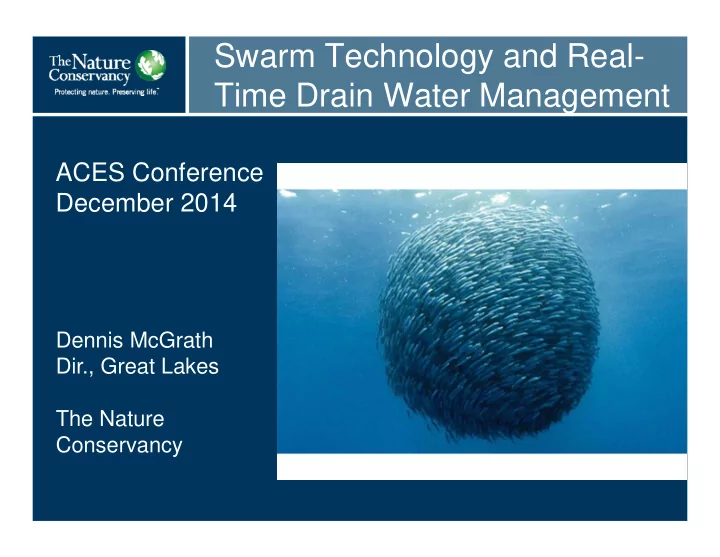
Swarm Technology and Real- Time Drain Water Management

ACES Conference December 2014

Dennis McGrath Dir., Great Lakes The Nature Conservancy

slide-2
SLIDE 2

Goal: Manage Ag Watershed Hydrology to Improve Ecosystem Services

PARTNERS

  • Ecosystem Services Exchange
  • Agri Drain Corporation
  • EmNet
  • Great Lakes Protection Fund
  • Kieser & Associates, LLC
  • Nicholas H2O
  • Reetz Agronomics
  • The Nature Conservancy
  • University of Notre Dame
slide-3
SLIDE 3

Ag Nutrient/Water Problems

  • System: Aquatic ecosystems (streams, rivers,

lakes, coastal waters

  • Stress: Nutrient pollution
  • Source of Stress: Fertilizer/Manure via runoff,

tiles

  • Strategy: Improve water flows by optimizing

drainage for agriculture and clean water

slide-4
SLIDE 4

Western Lake Erie Basin: 7.2MM acres 600K miles tile; 15K miles ditches

Intense Concentrations Large Scale Impact

slide-5
SLIDE 5

Water Flow “Drives” the Agronomic and Aquatic Systems

  • WLEB 2011

– Record Algal Blooms/Record Spring Rains

  • WLEB 2012

– No Algal Blooms/Very Dry Spring

slide-6
SLIDE 6

Causes of Loss for Iowa Corn 1948-2010 Causes of Loss for Iowa Soy, 1955-2010

Drought 40% Excess Moisture 27% Excess Moisture 27% Drought 28%

Charts courtesy of Chad Hart, Managing Risk in Agriculture, Iowa State University, June 2013

slide-7
SLIDE 7

Drainage Water Management (Real Time)

Seasonal Schedule Winter Spring Summer Fall

slide-8
SLIDE 8
  • Proven conservation practice
  • Not yet widely adopted
  • Not managed to agronomic or environmental

potential

(Vast majority of today’s tile system is still free‐flow)

Drain Water Management

slide-9
SLIDE 9

Have you wondered why……? Advantages to Collective Behavior

slide-10
SLIDE 10

“Swarm” Technology

  • Processing many signals

simultaneously to reach some collective, optimum outcome

–Medicine –Water Utility Storm Systems

slide-11
SLIDE 11

What if ……?

Swarm Technology + Real‐Time Drain Water Management

* Improve environmental performance * Improve crop production/ROI * Manage risk

slide-12
SLIDE 12

“Swarm” RT DWM Application in Ag Watersheds

Agronomic and Environmental Desired Conditions established Anticipates, Measures, Integrates, Distributes Information Manage Network of Tile Drain Outlets Farm field‐ to Watershed‐Scales Optimizes Agronomic and Ecosystem Conditions

slide-13
SLIDE 13

“Swarm” RT DWM Components

  • Real‐time Sensors (soil moisture, water levels,

nutrients

  • Real‐time Drain Control Structures (remotely

controlled drain tile units)

  • Optimization Program (“swarm” data

processing)

  • Wireless Communication Network (knits

together flow of information to structures)

slide-14
SLIDE 14

Quantification

  • Optimization decisions determined by

agronomic and environmental goals

  • Quantification allows for transactions (e.g.

nutrient trading)

  • Quantifiable goals inform management

decisions

slide-15
SLIDE 15

Last Word

  • Field Testing

– Technology – Behaviors – Agronomic and Environmental Impact (“Move the needle”?)

  • Scaling

– Significant scale potential – Anticipate phased adoption over long‐term – Not silver bullet; couple with other BMP