Particle Swarm Optimization Presented by: Yubo Paul Yang Motivation: - - PowerPoint PPT Presentation

particle swarm optimization
SMART_READER_LITE
LIVE PREVIEW

Particle Swarm Optimization Presented by: Yubo Paul Yang Motivation: - - PowerPoint PPT Presentation

Particle Swarm Optimization Presented by: Yubo Paul Yang Motivation: Swarm Intelligence Consider birds looking for food. Initially they search blindly. Motivation: Swarm Intelligence Consider birds looking for food. Initially they search


slide-1
SLIDE 1

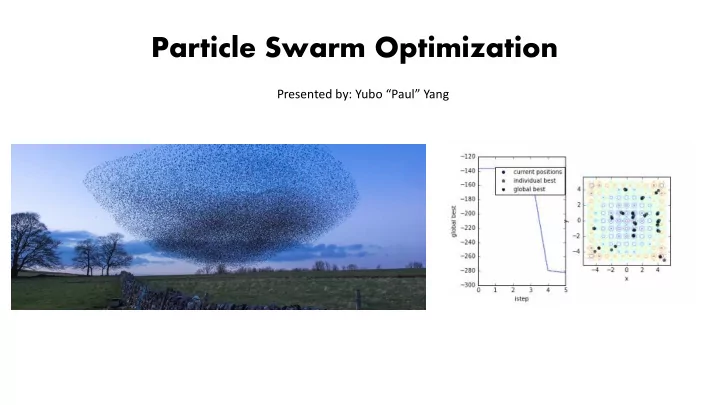
Particle Swarm Optimization

Presented by: Yubo “Paul” Yang
slide-2
SLIDE 2

Motivation: Swarm Intelligence

Consider birds looking for food. Initially they search blindly.

slide-3
SLIDE 3

Motivation: Swarm Intelligence

Consider birds looking for food. Initially they search blindly.

slide-4
SLIDE 4

Motivation: Swarm Intelligence

As soon as one of them find food, it circles the food, and maybe yell and get fatter. Food here!

slide-5
SLIDE 5

Motivation: Swarm Intelligence

Other birds then flock towards the noisy fat birdy. Food here!

slide-6
SLIDE 6

Motivation: Swarm Intelligence

On their way, they may find even more food. Food here!

slide-7
SLIDE 7

Motivation: Swarm Intelligence

Thus they become fatter and louder. Food here! Food here!

YOLO!

slide-8
SLIDE 8

Motivation: Swarm Intelligence

Eventually, everyone flocks to the big food. Food here! Food here!

YOLO!

slide-9
SLIDE 9

Algorithm: Flock to Past Best

  • 1. Initialize a number of samples from solution space.
  • 2. Before some termination criteria is met:
  • 1. Evaluate “fitness” of each sample.
  • 2. Register “individual best” solutions.
  • 3. Select “global best” solution.
  • 4. Update each sample according to its individual best, the global best or a

linear combination.

  • 5. Check convergence criteria.
slide-10
SLIDE 10

Algorithm: Individual vs. Global Best

Follow own experience Follow flock leader

  • c1 is the degree of individuality of each particle/sample - loner cowboy behavior
  • c2 is the degree of submissiveness of each particle/sample - mindless minion behavior
slide-11
SLIDE 11

Example: Minimize 2D Rastrigin Function

  • The Rastrigin function is multimodal and highly oscillatory function
  • Global minimum is at (0,0) with a value of 0
  • Many local minima surround the global minimum.
slide-12
SLIDE 12

Example: Minimize 2D Rastrigin Function

It’s better than random!

slide-13
SLIDE 13

Why Particle Swarm Optimization (PSO) ?

  • Easy to implement
  • Does not require gradient
  • Less likely to get stuck in a local minimum than deterministic algorithms

Example: Conjugate Gradient gets stuck in a local minimum of the 2D Rastrigin function.

slide-14
SLIDE 14

Gotcha! How to Determine Convergence?

Is this converged?

slide-15
SLIDE 15

Gotcha! How to Determine Convergence?

Psyche! No! Is this converged?

slide-16
SLIDE 16

Gotcha! How to Determine Convergence?

Is this converged?

slide-17
SLIDE 17

How to Determine Convergence? Sign Test? Hop Trace?

Feed global best trace into a sign test

Kwok et. al., IEEE, CEC (2007) This basically counts the number of times global best is not improved.

Calculate moving correlation for average hop trace

Yang (2016) ?

slide-18
SLIDE 18

Application to the Bin Packing Problem Ingredients in PSO: naïve application

  • Population of Solutions  : a collection of greedy solutions
  • Individual and Global Best  : highest packing fraction solution
  • Hopping update ???? : How to hop “towards” individual or global best?
slide-19
SLIDE 19

Application to the Bin Packing Problem Ingredients in PSO: modified PSO

  • Population of Solutions  : a collection of greedy solutions
  • Individual and Global Best  : highest packing fraction bin
  • Hopping update: Liu et. al., IEEE, CEC (2006)

Hop towards individual best: use best bin from personal history Hop towards global best: use best bin from global history

slide-20
SLIDE 20

Application to the Bin Packing Problem

slide-21
SLIDE 21

Real World Applications:

  • Antenna Array Design
  • Biomedical
  • Communication Networks
  • Clustering and Classification
  • Combinatorial Optimization
  • Distribution Networks
  • Electronics and Electromagnetics
  • Engines and Motors Efficiency Optimization
  • Fuzzy and Neurofuzzy: fuzzy control, fuzzy classification
  • Graphics and Visualization
  • Scheduling

Poli, JAEA, 2008, 685175 (2008)

slide-22
SLIDE 22

Conclusions:

  • PSO is a nature (swarm intelligence) inspired optimization algorithm

nature algorithm

  • PSO is easy to implement, requires no gradient, and tend to get out of local minima
  • PSO has many applications and enjoys a rising level of interest