02/09/2018 IS IT TIME TO GET OFF THE PARADIGM METHODOLOGICAL - - PDF document

02 09 2018
SMART_READER_LITE
LIVE PREVIEW

02/09/2018 IS IT TIME TO GET OFF THE PARADIGM METHODOLOGICAL - - PDF document

02/09/2018 IS IT TIME TO GET OFF THE PARADIGM METHODOLOGICAL PLURALISM MERRY-GO-ROUND? DEVALUING NEWNESS, CREATIVITY, OPENNESS, AND DIVERSITY My focus is on the diversity of approach to be found in most fields of social,


slide-1
SLIDE 1

02/09/2018 1

IS IT TIME TO GET OFF THE PARADIGM MERRY-GO-ROUND? DEVALUING NEWNESS, CREATIVITY, OPENNESS, AND DIVERSITY

Martyn Hammersley The Open University, UK [Personal website: http://martynhammersley.wordpress.com/] EARLI SIG 17 and 25 Conference, Dialogue between Ontology and Epistemology, University of Cambridge, August 2018

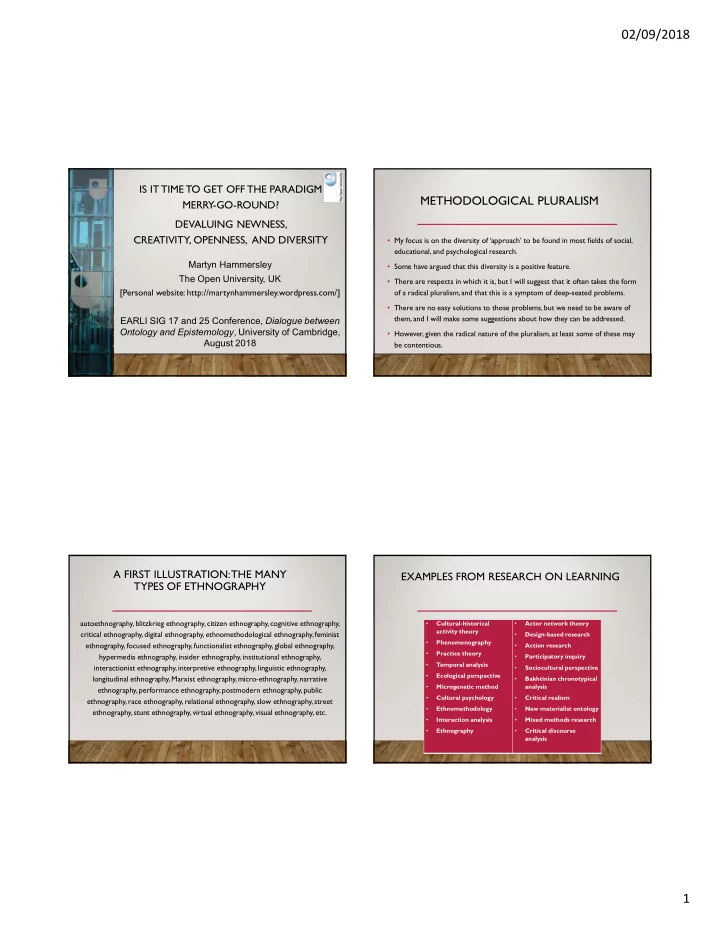
METHODOLOGICAL PLURALISM

  • My focus is on the diversity of ‘approach’ to be found in most fields of social,

educational, and psychological research.

  • Some have argued that this diversity is a positive feature.
  • There are respects in which it is, but I will suggest that it often takes the form
  • f a radical pluralism, and that this is a symptom of deep-seated problems.
  • There are no easy solutions to those problems, but we need to be aware of

them, and I will make some suggestions about how they can be addressed.

  • However, given the radical nature of the pluralism, at least some of these may

be contentious.

A FIRST ILLUSTRATION: THE MANY TYPES OF ETHNOGRAPHY

autoethnography, blitzkrieg ethnography, citizen ethnography, cognitive ethnography, critical ethnography, digital ethnography, ethnomethodological ethnography, feminist ethnography, focused ethnography, functionalist ethnography, global ethnography, hypermedia ethnography, insider ethnography, institutional ethnography, interactionist ethnography, interpretive ethnography, linguistic ethnography, longitudinal ethnography, Marxist ethnography, micro-ethnography, narrative ethnography, performance ethnography, postmodern ethnography, public ethnography, race ethnography, relational ethnography, slow ethnography, street ethnography, stunt ethnography, virtual ethnography, visual ethnography, etc.

EXAMPLES FROM RESEARCH ON LEARNING

  • Cultural-historical

activity theory

  • Phenomenography
  • Practice theory
  • Temporal analysis
  • Ecological perspective
  • Microgenetic method
  • Cultural psychology
  • Ethnomethodology
  • Interaction analysis
  • Ethnography
  • Actor network theory
  • Design-based research
  • Action research
  • Participatory inquiry
  • Sociocultural perspective
  • Bakhtinian chronotypical

analysis

  • Critical realism
  • New materialist ontology
  • Mixed methods research
  • Critical discourse

analysis

slide-2
SLIDE 2

02/09/2018 2

SOME APPROACHES IN EDUCATIONAL RESEARCH ARE DUPLEX

  • There are approaches to research on learning that are closely associated with

advocacy of distinctive approaches to education. For instance, the promotion of RCTs is linked with Outcome-based Education, while (even more obviously) Dialogical Research is often closely connected to Dialogical Pedagogy.

  • Indeed, some approaches seek to integrate research with educational practice,
  • r at least with professional development. Examples include: classroom action

research and design-based research.

  • Whether desirable or not, duplexity further complicates methodological

pluralism.

IS PLURALISM PROGRESSIVE?

  • Historically, in many fields we find there has been an

increasing proliferation of approaches over time. In what sense could this be progress?

  • At the beginning of this century,

Wilfried Decoo put forward an interesting account of changes in the field of second language teaching. The lesson from this could be applied to many research fields, as well as to other areas of educational innovation.

DECOO’S DECEIT

‘A number of years ago, our methods experienced a sweeping change. Up to then, more grammatical approaches had been used, with word-lists and translation, and an emphasis on writing. The critique against this approach started in the sixties when the communicative nature of language was stressed. Since then the movement became all encompassing […]. As Schweitzer and Simmonot wrote at the turn of the century in their Méthodologie des langues vivantes: "No period in the history of living languages has shown as noticeable progress as the last few

  • years. Everywhere, under the impetus of the necessities of modern life, the

teaching of foreign languages has undergone profound reforms, whose happy results can now be seen". Indeed, what a movement of change and reform it was!’ (Decoo 2001:2-3)

CHANGES IN APPROACH TO SECOND LANGUAGE TEACHING 1900s Natural: immediate contact with the target language, lively interaction, no translation, no word-lists, inductive rule-formation for grammar, emphasis on oral use. 1930s Reading Method: Intensive reading of graded readers strongly recommended. 1940s-50s Audio-lingual: U.S. the Army Method: a rigid, drill and practice approach. 1965-69 Cognitive: This term signals aim of restoring the importance of the mind against presumed mindless drilling. It tried to restore the value of reading and writing, translation, and grammatical clarifications. 1968 Translation: Starts in the mother tongue. Gradually words in the foreign language, carefully selected, are introduced 1970s Communicative approach: very comparable to what had happened in the 1860s and 1870s Loosely based in Decoo 2001, as summarized at: http://www.languageteachingideas.com/page5.htm

slide-3
SLIDE 3

02/09/2018 3

THE HISTORY OF EDUCATIONAL RESEARCH: NOT SO MUCH ESCALATOR AS MERRY

  • GO-

ROUND!

OR PERHAPS IT’S MORE LIKE THIS?

From Penrose and Penrose (1958:32)

THE RADICAL CHARACTER OF METHODOLOGICAL PLURALISM

Very often new approaches break with the ontological, epistemological, and/or axiological assumptions of previous ones. For example, it may be argued that:

  • what have previously been treated as individual psychological characteristics are

in fact social phenomena (ontological difference)

  • learning cannot be understood via measurement and the control of variables, but
  • nly via a more phenomenological orientation (epistemological difference)
  • the task must be to improve pedagogy not simply to provide knowledge about

the nature and conditions of learning (axiological difference) Such differences in fundamental assumption tend to be treated as fixed, ideological commitments, making dialogue across ‘paradigms’ very difficult.

THREE ATTITUDES TOWARDS RADICAL PLURALISM

1. Pragmatist denial of the relevance of philosophical assumptions. 2. Insistence that one’s own assumptions are obviously true or that their validity has been demonstrated by empirical or logical means. 3. A declaration that paradigms are incommensurable, so that commitment to them is a matter of personal preference, political strategy, epistemological faith,

  • etc. In some forms this third option values diversity itself and, I suggest,

encourages an excessive valuation of newness and creativity. In my view all of these attitudes must be rejected: each can be shown to be defective, and all of them have the effect of blocking the road of progressive inquiry.

slide-4
SLIDE 4

02/09/2018 4

WHAT IS TO BE DONE?

  • Even if the proliferation of new paradigms – along with the valuing of diversity,

creativity, and openness – is excessive, it nevertheless reflects genuine problems.

  • Given this, how should we address the methodological pluralism that prevails,

and the radical character that it frequently takes?

  • I will suggest that we cannot ignore the differences in philosophical assumption

that underpin radical pluralism: Pandora’s Box has been opened.

  • Nor should we simply adopt the purported policy of Chairman Mao: ‘let a

thousand flowers bloom’, or that very English notion of ‘live and let live’.

  • We must treat the differences seriously, but as far as possible not as matters of

ideological commitment.

TWO NECESSARY VIRTUES: PRAGMATISM AND A COMMITMENT TO DIALOGUE

  • Pragmatism retained: in part, we ought to judge the philosophical

assumptions underpinning different approaches by their fruits – they should be tried out, and the results compared and assessed.

  • Equally important is to encourage dialogue across paradigms, and I will
  • utline what this entails. Though I will also suggest that there are limits

to it.

  • So, a balance between pragmatism and dialogue is required, but this will

vary as regards ontological, epistemological, and axiological assumptions.

EPISTEMOLOGY: DIALECTIC AS THE BASIS FOR RESEARCH COMMUNITIES?

  • ‘The traditional and orthodox emphasis on […] How can I be certain? invites us to

forget the social nature of the ground rules of probative reasoning – their rooting in the issue of: How can we go about convincing one another?’ (Rescher 1977:xii)

  • ‘The life-blood of philosophy is argument and counter-argument. Plato and

Aristotle thought of this occurring in what they called dialectic – discussion.’ (Hamlyn 1988:333) Elsewhere, I have argued for the importance of this sort of dialectic, dialogue, or discussion in social research (Hammersley 2011:ch7). The problem with radical pluralism is that it tends to restrict discussion to within paradigms, with either antagonism or mutual toleration being the predominant relationship outside of them.

INITIAL REQUIREMENTS FOR DIALOGUE

The ‘ground rules’ appropriate here are similar to those intrinsic to dialogical pedagogy (see Mercer et al forthcoming; Wegerif 2013). We must also:

  • Recognize our own problematic or contentious philosophical assumptions, using

criticisms from outside our own ‘paradigm’ to identify these.

  • Seek to explicate and justify them in terms that are sufficiently clear for others to

understand, including those who have sharply different views.

  • Resist our own tendency to stereotype others’ positions.
  • Recognise that dialogue is not easy and may not resolve disagreements.
  • Nevertheless, insist that philosophical assumptions are susceptible to mutual

understanding and reasonable argument, despite being relatively refractory.

slide-5
SLIDE 5

02/09/2018 5

RESEARCH QUESTIONS AND CLARIFYING CONCEPTS

  • So, for me, as for some others, dialogue – actual and anticipatory – is

central to the research process.

  • Equally important, in my view, is to insist that the task of inquiry is not

to capture the intrinsic nature of phenomena, but rather to answer specific research questions.

  • There are reasons to think that this is especially true of social and

educational research.

  • This makes it essential that there is careful explication of the concepts

built into the questions being addressed.

ONTOLOGICAL ASSUMPTIONS: LEARNING IS NOT ONE THING

What counts as a learning process? This is not always clearly defined by researchers. The meaning of the term ‘learning’ is relational: we learn about some topic, or to do something in particular. There is no such thing as learning in itself. At the most basic level we must ask: Does ‘learning’ mean: 1. Any change in behaviour? or 2. The realisation of an intended change? or 3. The occurrence of a type of change that is judged to be of value? Of course, it is also necessary to distinguish between the phenomenon being studied and the indicators used to document it.

EXPLICATING THE VALUES UNDERPINNING ASSUMPTIONS ABOUT LEARNING

In most usage, the concept of learning is value-based: it refers to how some process

  • r outcome in the world has been judged. So, we need to make explicit the value

framework on which we are relying. Learning as ‘valuable cognitive or behavioural change’ could be defined in terms of: a) Institutionally defined curricular objectives; b) Societal needs, as interpreted by the researcher or someone else; or c) Some conception of the person, as defined by the researcher or others. In each case we need to indicate the value assumptions underpinning any definition: the value of particular substantive knowledge/skills, of acquiring the capability of learning to learn, or of autonomous learning, or whatever.

ADDRESSING THE PROBLEM OF AXIOLOGY

When we talk to one another about the nature of research, significantly different goals are often assumed. These are not necessarily incompatible:

  • 1. Different types of research: academic research aimed at building discipline-specific

knowledge differs from applied research aimed at informing the work of practitioners.

  • 2. Different fields in social, psychological, and educational research address different

types of problem and must therefore adopt somewhat different assumptions. However, there are ideological issues: to illustrate, in my view we must sharply distinguish research from other activities, whether pedagogy, professional and personal development, or educational policymaking.

slide-6
SLIDE 6

02/09/2018 6

THE CONTENTIOUS CHARACTER OF AXIOLOGICAL ASSUMPTIONS

  • Should the goal of educational research be solely to produce factual knowledge, or

does it/must it produce value conclusions? [MH: The only goal is factual knowledge, even though our motives for being researchers often depend upon practical values]

  • Given that publishing research findings can have practical consequences, does this

mean that researchers must try to control these to ensure they are ‘desirable’? [MH: No, though they may do this in some other role]

  • Is the first responsibility of an educational researcher to do research in such a way as

to improve education or to serve some other practical goal, such as countering social injustice? [MH: No, the only responsibility is to work as effectively as possible to produce sound, value-relevant knowledge, this is a difficult enough task.]

AXIOLOGICAL CONFLICT: A FUNDAMENTAL DIVISION

Value-relevant versus evaluative, ‘critical’, or ‘engaged’ research.

  • Value-relevant studies relying on different value frameworks are not in conflict

with one another, they may even be complementary.

  • Conflict can arise, however, if value frameworks are treated as the basis for

drawing evaluative conclusions and/or for engaging in ‘research-based action’.

  • In practice, conflict is often avoided or minimised because of the relatively

narrow range of ideological viewpoints represented within research communities, segmentation of those communities, and the vagueness with which value principles are expressed: who could be opposed to ‘maximising achievement’, ‘school improvement’, or serving ‘social justice’.

DIALOGUE, AXIOLOGY AND IDEOLOGY

  • Views about the proper goal of research depend on both value judgments and

factual assumptions: concerning the good life, personhood, the nature of education, the character of modern societies, the role of universities, and so on.

  • The conflict in orientations here is such that paradigm war or some kind of détente
  • r mutual accommodation is usually the result, rather than dialogue.
  • Aside from this there is the question of whether all axiological positions can or

should be tolerated. Here we reach the limits of pragmatism and dialogue: the role of ideology, strategic action, and power becomes dominant or at least most evident.

  • Nevertheless, I think we must try to push dialogue as far as it will go.

CONCLUSION

I have suggested that there is a problem of radical pluralism in social, educational and psychological research. But the solution is not as simple as stepping off a carousel and

  • n to an escalator. In my view, the best we can do is:
  • Aim at sufficient clarity about the axiological, ontological and epistemological

assumptions on which we are relying, including the value framework within which concepts like ‘learning’ are framed – and be prepared to discuss these;

  • Approach ontological and methodological issues instrumentally, trying out different

assumptions and methods to find out what they can produce;

  • Resist the tendency to treat axiological assumptions as either apodictic or fideistic;
  • But recognize the limits to the capabilities of pragmatism and dialogue.
slide-7
SLIDE 7

02/09/2018 7

REFERENCES

Decoo,

  • W. (2001) ‘On the mortality of language learning methods’, James L. Barker lecture, Brigham

Y

  • ung

University. Hammersley, M. (2003) ‘Can and should educational research be educative?’, Oxford Review of Education, 29, 1, pp3- 25. Hammersley, M. (2004) ‘Action research: a contradiction in terms?’, Oxford Review of Education, 30, 2, pp165-81. Hammersley, M. (2011) Methodology, Who Needs It?, London, Sage. Mercer, N., Hennessy, S., and Warwick, P . (in press) ‘Dialogue, thinking together and digital technology in the classroom: Some educational implications of a continuing line of inquiry’, International Journal of Educational Research. Available at: https://www-sciencedirect-com.libezproxy.open.ac.uk/science/article/pii/S0883035517303877 Penrose, L. S. and R. (1958) ‘Impossible objects: a special type of visual illusion’, British Journal of Psychology, 49, 1, pp31-3. Wegerif, R. (2013) Dialogic: Education for the internet age, London, Routledge.