SLIDE 1
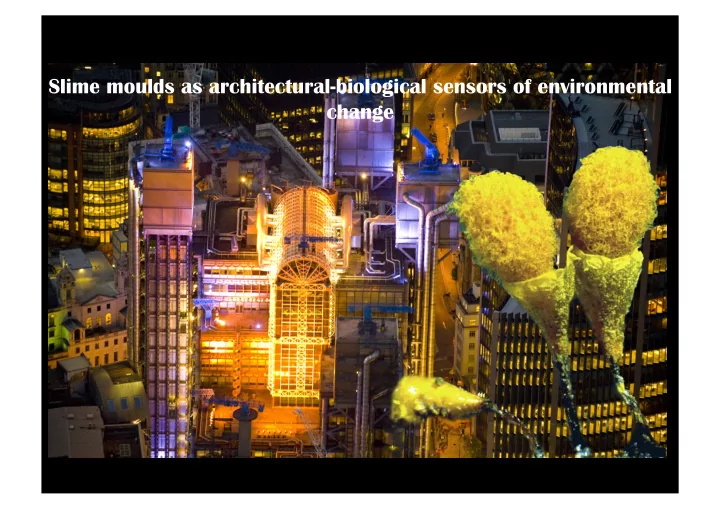
Slime moulds as architectural-biological sensors of environmental change
SLIDE 2
Co-investigators: Dr Sylvia Nagl, Head of Complex Systems Science, Cancer Institute Dr Rachel Armstrong, Researcher, AVATAR Group, Bartlett School of Architecture In collaboration with Dr Klaus-Peter Zauner, Science and Engineering of Natural Systems, School of Electronics and Computer Science, University of Southampton
SLIDE 3
“Designers who embrace concepts of emergence, self-organisation and self-assembly, increasingly sound like biologists” William Mitchell, ME ++ (2003) Bio-engineers and systems biologists who are situated within the paradigm of complexity from which these concepts originate, come across as a new breed of designers
SLIDE 4
semi-biotic systems animate-artificial sustainable cities
SLIDE 5 Mindless creatures acting ‘mindfully’
Nakagaki et al. (2000). "Intelligence: Maze-solving by an amoeboid organism". Nature 407: 470.
SLIDE 6 Mindless creatures acting ‘mindfully’
Nakagaki et al. (2000). "Intelligence: Maze-solving by an amoeboid organism". Nature 407: 470.
SLIDE 7 Mindless creatures acting ‘mindfully’
“The sharp boundary separating the animate from the inanimate world is about to blur with the advent of engineered systems that incorporate functional biological components such as molecules, cells and tissues.” Klaus-Peter Zauner
physarum biosensor chip
- interface device using electrical impedance spectroscopy (EIS) to access
the molecular computing processes
- the slime mould, Physaurm polycephalum, is interfaced to the EIS hardware,
together with the microfluidic system monitoring
system
for
the
cell's
reactions
to
external
signals
SLIDE 8
flows of information between architecture and biosphere information processing systems/synthetic biology cellular automata agent-based modelling
living technologies
architectural-biological sensors of environmental change