
SLIDE 1
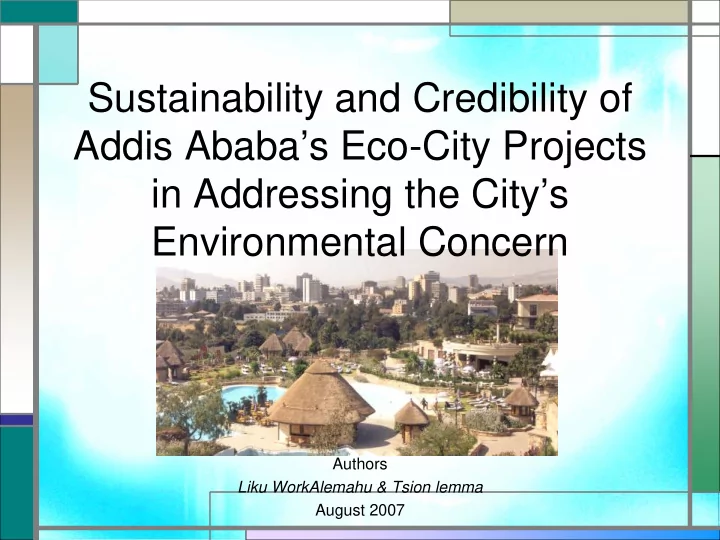
Sustainability and Credibility of Addis Ababa’s Eco-City Projects in Addressing the City’s Environmental Concern
Authors Liku WorkAlemahu & Tsion lemma August 2007
Sustainability and Credibility of Addis Ababas Eco-City Projects in - - PowerPoint PPT Presentation
Sustainability and Credibility of Addis Ababas Eco-City Projects in Addressing the Citys Environmental Concern Authors Liku WorkAlemahu & Tsion lemma August 2007 Content of presentation Introduction Background
Authors Liku WorkAlemahu & Tsion lemma August 2007
71.2% hh do not have adequate sanitation (UN-Habitat 2004) Only 9% of households are connected with sewer line (UN-Habitat 2006) 33.6% of hh share toilet facility with six or more families (UN-Habitat 2004) Only 52.8% solid waste is collected by government, and a very small proportion by private the rest is thrown to the streets and rivers (UN- Habitat 2004)
Currently poverty reduction and slum upgrading programs are being undertaken based on National and Urban policies Development actors are undertaking the interventions particularly upgrading, however, the interventions are integrated neither spatially nor institutionally lacking sustainability On the other hand, Agenda 21 puts sustainable development as a way to reverse poverty
and adopted the Eco-City concept for its holistic approach and sustainability focusing on environment
Comprehensive urban development system (Coordinated intervention) through community participation Sustainable Development through implementing environmental measures
Sanitation in terms of sewerage disposal, solid waste management Accessibility in terms of mobility and infrastructure provision Open spaces and green areas Social service (health and education facilities) Economic activities
Relevant to low income groups Take account of the existing situation Replicable Sustainable
The programme was initiated at city level Steering & technique committees were organized and leading the project Kebeles that are in need of immediate intervention and believed to be exemplary to adjacent kebeles were selected for the projects 1st phase 10 model kebeles and 2nd phase additional 50 kebeles were selected and studied for eco- city projects
Widening of roads; market area and open space development; provision of communal toilets and street lighting; Detail design and implementation of biogas and composting solid waste Employment opportunities Clearing and redevelopment of cemeteries
Gulele Sub-city kebele 18 Eco-City project
communal and 457 private toilets for more than 35,000 people)
Currently the unit is functioning as a model but Women and Youths are organized for solid waste collection A number of families are beneficiaries of the public toilet The biogas is being used as a model for lighting and cooking
Located on the northern part of the city where there is high topography, natural forest development and a number of historical churches Taking the potentials of the area Design of footpath to the historical site with the scenery down to the city Design of shopping and display areas for the communities’ products (pottery and traditional clothes) along the trail to the historical sites
Introduced wider neighborhood development approach creating sustainable development directions The inclusion of environmental issues in the city development plan It was possible to exchange ideas, practices and knowledge among different actors
Lack of common understanding of the concept Lack of integration between the eco-city projects and other projects Organizational problems - no proper accountability Launching of many projects at the same time Poor managing and financing mechanisms
Create awareness and reach to common ground and develop shared understanding on eco-city concept Develop long & medium term eco-city development programs and design short & successive and interlinked short term projects in
Allocate the mandate and accountability of leading and coordination
Establish or enhance the existing kebele development committees to be able to incorporate needs of local community Devise and search different financial sources or financing mechanisms in addition to regular budgeting of the projects It is fundamental to incorporate sustainable environmental measures as a local policy; expand the scope and inculcate the concept into citywide development plan and various sector development programs of the city