Determination of Heavy Metals in Canned Dry-Milk and Fish from - - PowerPoint PPT Presentation

determination of heavy metals in canned dry milk and fish
SMART_READER_LITE
LIVE PREVIEW

Determination of Heavy Metals in Canned Dry-Milk and Fish from - - PowerPoint PPT Presentation

Determination of Heavy Metals in Canned Dry-Milk and Fish from Supermarkets in Addis Ababa, Ethiopia Kefyalew Muleta Tetemke Mehari (PhD) 1 PRESENTATION OUT LINE Introduction Objective Material and Methods Results and

slide-1
SLIDE 1

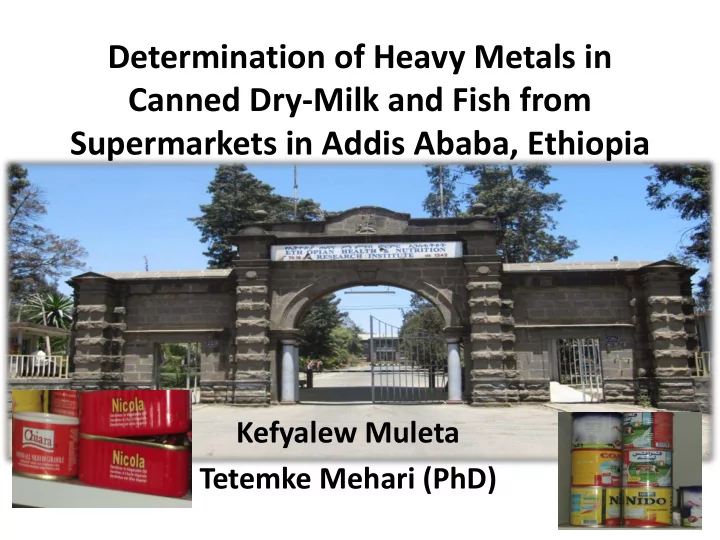
Determination of Heavy Metals in Canned Dry-Milk and Fish from Supermarkets in Addis Ababa, Ethiopia

Kefyalew Muleta Tetemke Mehari (PhD)

1

slide-2
SLIDE 2

PRESENTATION OUT LINE

  • Introduction
  • Objective
  • Material and Methods
  • Results and Discussion
  • Conclusion and Recommendation
  • Acknowledgment

2

slide-3
SLIDE 3

1. Background

  • Food quality depends on the composition and chemical

nature of its components (McElhatton, 2007).

  • Minerals such as Cu and Zn which are required up to a

limits.

  • The metals Cd and Pb enter food as a result of human

activities, can be harmful to health (Neustacdt et al., 2007).

3

slide-4
SLIDE 4
  • Milk and fish might be contaminated due to:
  • Feeding of cattle on contaminated feed (for milk)

(Miranda et al., 2005)

  • Food processing equipments and canning processing
  • Storage condition might favors the leakage of heavy

metal to the foods (Buldini et al., 2002)

4

Background cont…

slide-5
SLIDE 5

More than 9 thousands tons of canned fish and 2 thousands tons of canned powder milk are imported to Ethiopia in a year. More than 200 supermarkets commercialize canned dry-milk and fish in Addis Ababa (AABT, 2013). But no evidence of chemical safety of canned foods.

5

Background cont…

slide-6
SLIDE 6

Objective of the Study

  • 1. To determine the concentration of Cadmium, Copper,

Lead and Zinc residues in four brands of canned dry- milk.

  • 2. To determine the concentration of Cadmium, Copper,

Lead and Zinc residues in four brands of canned fish.

  • 3. To compare the labeled nutritional information to

determined values of the foods.

6

slide-7
SLIDE 7
  • 2. MATERIALS AND METHODS
  • The study was conducted on canned dry-milk and fish

from supermarkets in Addis Ababa from February to march, 2013

  • Laboratory based cross-sectional study design
  • Heavy metals (Cd, Cu, Pb and Zn) and proximate

analysis were done.

7

slide-8
SLIDE 8

Sampling Design

Canned foods

Canned dry milk Abay milk Coast milk Nido milk France lait Canned fish Chiara tonno fish Delight fish Diamond fish Nicola fish

8

slide-9
SLIDE 9

Canned Dry-Milk Sample

The following four brands of canned dry-milk:

9

No Dry-Milk Brand Code 1 Abay milk AM 2 Coast Milk CM 3 France Lait FM 4 Nido Milk NM

slide-10
SLIDE 10

Canned Fish-Sample

The following four brands of canned fish:

10

No Fish Brand Code 1 Chiara Tonno CF 2 Delight DF 3 Diamond DIF 4 Nicola NF

slide-11
SLIDE 11

Metal Extraction Procedure (Wet Digestion)

Double cans of each brands

Homogenized by stainless homogenizer

Duplicate of 2.00 ± 0.01 g milk sample Duplicate of 5.00 ± 0.01 g fish sample

Mixture of HNO3 and H2O2 in 5:1 ratio

Digested on hot plate at 240 ºc for 4 hours for canned fish 300 ºc for 6 hours for dry-milk

Blank, and Pb and Cd Spiked were run to evaluate the reliability of the procedures (AOAC, 1990). Cooled, filtered by whatt-man filter paper and made-up to 50mL volume

11

slide-12
SLIDE 12

Proximate Analysis

  • Protein, fat, ash, moisture content analysis were done

according to the AOAC, 2000.;

  • Carbohydrate for canned dry-milk were determined by

difference method.

12

slide-13
SLIDE 13

Statistical Analysis

  • Data analysis was computed using version 20 SPSS

and Microsoft Office Excel 2009 software.

  • Range, mean ± SD was used to express the

concentration of each heavy metals and proximate value.

13

slide-14
SLIDE 14

Cont… Statistical Analysis

  • Two-side student t-test was used to compare the

nutritional label value to determined once.

  • One-way ANOVA was used to test the variability

samples among brands, at 95% confidence level.

14

slide-15
SLIDE 15

Instrumental (AAS) Analysis

  • All the samples were analyzed for their Cd, Cu, Pb,

and Zn residue level using Flame Atomic Absorption Spectrophotometer (FAAS) at Debrezeit ARC, ECAE, and AAEPA.

15

slide-16
SLIDE 16

Table 2:The following wave lengths were used for each metals Heavy Metals Cd Zn Cu Pb Wavelength (nm) 228.8 213.9 324.8 217 Slit width (nm) 0.5 1.0 1.0 1.0 Coefficient of determination (R2) 0.99 0.99 0.99 0.99

16

slide-17
SLIDE 17

Cont… AAS Analysis

  • Concentration

working standards were used to calibrate the AAS at:

  • 0.25, 0.5, 1 and 2 mg/L for Cu, Cd and Zn
  • 0, 0.5, 1, 2, and4 mg/L were used for Pb

17

slide-18
SLIDE 18

18

y = 0.0556x - 0.0161 R² = 0.9919 y = 0.1001x - 0.0183 R² = 0.987 y = 0.042x + 0.0064 R² = 0.997

  • 0.05

0.05 0.1 0.15 0.2

1 2 3

Absorbance Concentration Fig 3: FAAS Calibration Curve for Cd, Cu and Zn Cd Cu Zn y = 0.0244x + 0.0011 R² = 0.9943 0.02 0.04 0.06 0.08 0.1 0.12 2 4 6 Absorbance Concentration Fig 4: Calibration Standard Curve for Pb

They obey beer’s law. Instrument calibration for each metals

slide-19
SLIDE 19

Table 3: Limit

  • f

detection (LOD) and limit

  • f

quantification (LOQ) in mg/g

19

Blank code Cu Zn Cd LOD 0.27 5.19 0.23 LOQ 0.91 17.33 0.76

slide-20
SLIDE 20
  • 3. RESULTS AND DISCUSSION

Table 1: General information of sampled canned dry-milk from supermarkets in Addis Ababa, 2013.

Brand Code Country of

  • rigin

net wet (g) Fat Protein CHO Energy Yield (Kcal/KJ) AM Ethiopia 400 28.8 24.5 38.3 510/2130 CM Holland 400 28 26 37.2 510/2140 NM Netherland 400 28.2 24 37.4 508/2120 FM France 375 26.2 26 38.6 494/2067

CHO: Carbohydrate in g/100g

20

slide-21
SLIDE 21

Table 4: Comparison of level of heavy metals in four brands of canned dry-milk from supermarkets in Addis Ababa, 2013.

21

Brand code Level of heavy metal in canned dry-milk brands (mg/g in wet-base) Cu Zn Cd Pb AM 1.053±0.314ab 21.307±8.796a 0.202±0.309b 5.374±2.048a CM 1.512±0.954a 17.039±3.335a 1.991±0.47a 8.077±2.094a FM 0.88±0.769ab 16.177±1.528a 1.885±0.336c 5.921±5.045a NM 0.094±0.074b 23.679±1.359a 1.114±0.878abc 15.999±8.392a AML 10 150 0.2 1.5

ND: Not Detected AML: Allowable Maximum Limit according to FAO/WHO, 1984 in ppm At each level of parameter, the mean with different superscript in the same column are significantly different at P=0.05 level.

slide-22
SLIDE 22

Cont……

  • The lowest Cd level (0.202 ± 0.309 mg/g) in AM milk

branded is comparable with the values of Cd contents (0.2± 0.008 mg/g) in four brands of unlacquered canned milk studied in Nigeria by Adams and Happiness (2010) .

  • The lowest Pb level (5.921±5.045mg/g) of AM milk brand

from France was lower than Pb value (11.2 + 0.48 mg/g) by Adams and Happiness, (2010) in Nigeria.

22

slide-23
SLIDE 23
  • The concentration of Zn, Cd and Pb in all the milk

brands of this study were four to six folds higher than mean level, 4.92, 0.1, and 0.99 mg/g respectively, in cow’s whole milk from different areas in Addis Ababa studied by Gashu et al., 2010).

23

slide-24
SLIDE 24

Table 5: Comparison of labeled and observed nutritional value in percent (wet-base) (mean ± SD in %) of dry-milk from supermarkets in Addis Ababa, 2013.

Brand code Fat Protein Carbohydrate Determined Labeled Determined Labeled Determined Labeled AM 5.125 ± 2.136a 28.8b 16.635 ± 5.393a 24.5a 70.516 ± 5.607r 38.3s CM 2.715 ± 0.257h 28b 8.021 ± 0.199b 26c 88.530 ± 4.212t 37.2a FM 3.625 ± 1.25m 26.2n 17.133 ± 1.753d 26e 73.523 ± 2.818b 38.6c NM 3.375 ± 2.213p 28.2q 16.327 ± 4.267f 24g 73.877 ± 6.237d 37.4e

At each level of parameter means in the same row with the different superscripts are different at 0.05 significantly level.

24

slide-25
SLIDE 25

Table 6: Comparison of labeled and observed energy value (wet- base) (mean+SD) of dry-milk from supermarkets in Addis Ababa,2013.

Dry-Brand code Energy yield in kcal/g Percent difference Determined Labeled AM 394.730 ± 10.201

a

510.

b

22.602 CM 410.635 ± 15.998

c

510

d

19.483 FM 395.248 ± 7.503

e

494

f

19.990 NM 391.191 ± 11.732

b

508

a

22.994

Mean values with different superscript in same row are significantly different at 95%.

25

slide-26
SLIDE 26

Table 12: General information of the sampled canned fish from

supermarkets in Addis Ababa, 2013.

  • No. Brand

Code

  • No. of can

Country of origin Packed in Net wet(g) 1 CF 2 Spain Sunflower oil 80 2 DF 2 Vietnam Brine 170 3 DIF 2 Thailand Sunflower oil 185 4 NF 2 Indonesia Vegetable oil 125

26

slide-27
SLIDE 27
  • All the cans have manufacture and expiration date.
  • Three cans were well labeled for their nutritional

values but the DF brand, packed in brine, imported from Vietnam don’t have labeling for their nutritional values.

  • One of the CF brand packed in sunflower oil

imported from Spain was dented at its sides.

27

slide-28
SLIDE 28

Table 13: Concentration of heavy metals (mean± SD and range) in wet weight base in canned fish from supermarkets in Addis Ababa, 2013.

28 Samp le Code Packed in

Level (mg/g) Cd Cu Pb Zn CF Sunflower oil 3.541±2.467a 3.004±1.809a

6.574±2.899a

33.897±3.670a DF Brine 1.863±0.243a 0.68±0.449b ND 4.447±1.087a DIF Sunflower oil 2.174±0.559a 0.319±0.232b

5.185±0.000a

1.976±0.868a NF Vegetable oil 0.381±0.274a 0.864±0.1ab

1.791±0.275a

0.08±.004a

MTL 0.2 10 1.5 150 In each level of parameter the means with different superscript are significantly different at the 0.05 level. ND: Not Detected MTL: Maximum Tolerable Limit according to FAO/WHO 1984.

slide-29
SLIDE 29
  • The levels of Cd in the four brands of fish were higher than:

– (0.13 ± 0.04 mg/kg) in canned Bluefin tuna Thailand and – (0.053±0.005 mg/kg) in canned Bluefin tuna Korea, study by Islam et al., 2010

  • But Cd level in all the fish (except the CF) were lower than:

20 mg/g, a study by Tuzen, 2003 in fish from Turkey; Canned tuna from US (1.9 mgg-1), study in India by Balakrishnan et al., 2011.

29

slide-30
SLIDE 30
  • The lowest level of Pb (1.791±0.275mg/g) in NF fish

brand from Indonesia which is lower than:

  • Pb level (2.9 mg/g) in canned tuna fish from Libya

(Voegborlo et al., 1999), and

  • 1.95 mg/g in canned fish from Turkey (Celik and

Oehlenschlager, 2006).

30

slide-31
SLIDE 31
  • The levels of Cd (1.13 mg/kg) and Pb (2.20mg/kg) in fish

from Hawassa and Ziway lakes (Kiflom, 2011) were higher than the NF brand from Indonesia.

  • The levels of the four heavy metals in CF brand packed

in sunflower oil were relatively higher than the other three brands.

  • This might be due to the dented can may leak heavy

metals to the food.

31

slide-32
SLIDE 32

Table 15: Fat, protein (g/g) and energy yield (kcal) content in gram (mean± SD) (wet-base) of canned fish from supermarkets in Addis Ababa, 2013

Samp le ID sample Fat content Protein content Energy value Determined Labeled Determined Labeled Determined Labeled CF 2 32.845 ± 5.909a 21b 6.245 ±1.486a 22.5b 320.659 ±4.773a 279a DIF 2 18.472 ± 0.555c 9d 12.333±1.234i 27.1j 215.578 ±5.504a 189b NF 2 21.570 ± 1.530e 18f 5.441 ±0.868a 23b 215.896 ±12.54c 254d

At each level of parameter the mean with different superscript in the same row are significant different at 0.05 levels.

32

slide-33
SLIDE 33
  • 5. CONCLUSIONS AND RECOMMENDATIONS

From this study, it can be concluded that:

  • 1. The canned dry-milk brands determine level of Cd and

Cu residues significantly vary among.

  • 2. All brands were not safe in their Pb level.
  • 3. Only, the AM milk brand from Ethiopia was safe in Cd

level.

33

slide-34
SLIDE 34

Cont……. Conclusions

  • 4. The levels of Cu residue s vary among brands of canned fish.
  • 5. The three fish brands, CF, DF and DIF were not safe in their

Cd residue level.

  • 6. But the Cd and Pb level in the NF fish brands and the Pb level

in DF brand were safe.

  • 7. Canned dry-milks were good sources of Zn than canned fish.
  • 8. Labeled and determined nutritional values of NF and DIF fish

brands, and all canned dry-milk brands were different.

34

slide-35
SLIDE 35

Recommendations

  • Determining the concentration of heavy metals and

nutritional values in canned dry-milk and fish should be done periodically by the responsible organization to make sure that imported foods are safe for the public.

35

slide-36
SLIDE 36

Acknowledgment

  • Addis Ababa University, Center for Food Science and

Nutrition,

  • Debrezeit Agricultural Research Center,
  • Ethiopian Public Health Institute

36

slide-37
SLIDE 37

Thank You !

37

http://waset.org/abstracts/33636