2016
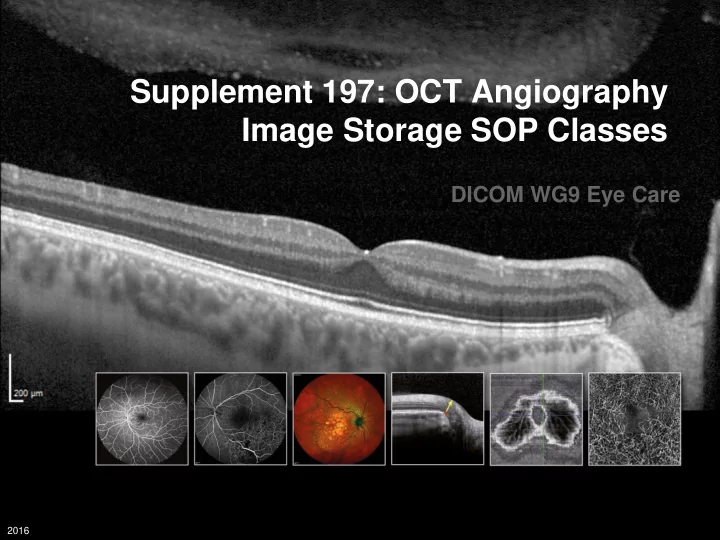
Supplement 197: OCT Angiography Image Storage SOP Classes DICOM WG9 - - PowerPoint PPT Presentation
Supplement 197: OCT Angiography Image Storage SOP Classes DICOM WG9 Eye Care 2016 OCT-A Separating Vascular Networks 2016 OCT-Angiography - Outcome Clinicians typically make their assessment based on the OCT En face images derived from OCT
SLIDE 1
SLIDE 2
2016
Separating Vascular Networks
OCT-A
SLIDE 3
2016
OCT-Angiography - Outcome
Clinicians typically make their assessment based on the OCT En face images derived from OCT structure and/or flow volumetric data.
SLIDE 4
2016
OCT-A
- Separating Vascular Networks
- Fluorescence angiography – typically using
fluorescein (FA) or indocyanine green (ICG) as the fluorescent contrast agent – has been the standard method, but both have disadvantages:
- nausea and allergic reactions
- patients have to be prepared before the procedure,
monitored afterwards, and the contrast agent isn’t free
- f charge
- OCT-A will not replace the above for all cases – e.g.
it’s not able to capture leakages
SLIDE 5
2016
OCT-A
Patient with mCNV. FA/ICGA images (top) show capillary leakage; OCT-A (bottom) provides a superior visualization of the newly formed vessels and depth-resolved resolution of vascular perfusion – neovascularization is clearly visible in deeper layers (right) than in superficial layers (left).
SLIDE 6
2016
Vascular Network of the Posterior Segment
- Superficial Vascular Plexus (SP)
- Large Vessels
- Observable with
- phthalmoscope
- Deep Vascular Plexus (DP)
- Fine network of small sized
capillaries
- Choroid
- Choroiocapillaris
SLIDE 7
2016
Layers of the Vascular Network
Perifoveal Arcade Retinal Nerve Fiber Layer
SLIDE 8
2016
Superficial Capillary Plexus & Perifoveal Arcade Ganglion Cell Layer
SLIDE 9
2016
Superficial Capillary Plexus (& Perifoveal Arcade) Inner Plexiform Layer
SLIDE 10
2016
Deep Capillary Plexus Inner Nuclear Layer
SLIDE 11
2016
Deep Capillary Plexus Outer Plexiform Layer
SLIDE 12
2016
Avascular Layer & copy of superficial vascular plexus Bruch’s Membrane - RPE
SLIDE 13
2016
Choriocapillaris 5µm distance (BM) 5µm thickness
SLIDE 14
2016
Sattler’s Layer 20µm distance (BM) 10µm thickness
14
SLIDE 15
2016
15
Haller’s Layer 40µm distance (BM) 15µm thickness
SLIDE 16
2016
HOW DOES OCT-A WORK IN PRINCIPLE?
SLIDE 17
2016
OCT-Angiography
A sequence of B-scans is acquired at a fixed retinal location. Changes in OCT images reflect blood flow.
SLIDE 18
2016
OCT-Angiography
Segmentation of retinal layers to define OCT slab. Summation of flow signal within an OCT slab, multiple frames are acquired at each B-scan location OCT angiography B-scan
SLIDE 19
2016
Image Process Performed to Generate En face Images
Structural Volume Flow Volume En Face Raw multiple B-Scans
SLIDE 20
2016
OCT-A
- Stage 1 – OCT “raw data” acquires volumetric data set of
mulitple B-scans in a proprietary format (may be stored using DICOM Raw Data SOP Class)
- Stage 2 – OCT “raw data” analyzed to derive two DICOM
standard volumetric SOP Instances
- Structural OCT image stored in the OPT SOP Class
(OCT surface segmentation included)
- Differences in signal between B-scans produces OCT angiographic
flow volume information (stored in the newly defined Ophthalmic Tomography Angiographic Adjunctive Image Storage SOP Class)
- Stage 3 – Analysis of the above two SOP Instances enables
generation of multiple en face images showing structural and/or angiographic flow images (stored in the newly defined En face Image Storage SOP Class)
SLIDE 21
2016
Relationships Between DICOM OCT-A Based SOP Instances
SLIDE 22
2016
En Face Image
- OCT angiography provides information about the
vascular flow
- Layers of the vascular architecture can be separated
SLIDE 23
2016