Inflammation and The Anti- Inflammatory Diet Through A Cancer Lens - - PowerPoint PPT Presentation

inflammation and the anti inflammatory diet through a
SMART_READER_LITE
LIVE PREVIEW

Inflammation and The Anti- Inflammatory Diet Through A Cancer Lens - - PowerPoint PPT Presentation

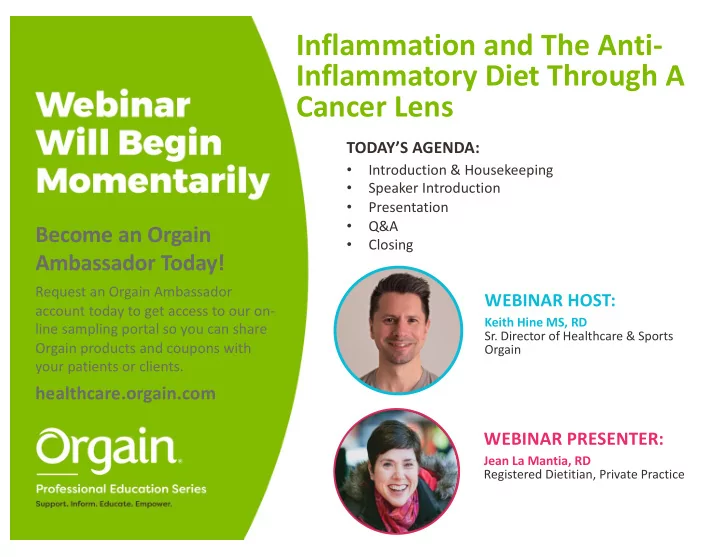
Inflammation and The Anti- Inflammatory Diet Through A Cancer Lens TODAYS AGENDA: Introduction & Housekeeping Speaker Introduction Presentation Q&A Become an Orgain Closing Ambassador Today! Request an


slide-1
SLIDE 1

Inflammation and The Anti- Inflammatory Diet Through A Cancer Lens

TODAY’S AGENDA:

  • Introduction & Housekeeping
  • Speaker Introduction
  • Presentation
  • Q&A
  • Closing

Become an Orgain Ambassador Today!

Request an Orgain Ambassador account today to get access to our on- line sampling portal so you can share Orgain products and coupons with your patients or clients.

healthcare.orgain.com WEBINAR HOST:

Keith Hine MS, RD

  • Sr. Director of Healthcare & Sports

Orgain

WEBINAR PRESENTER:

Jean La Mantia, RD Registered Dietitian, Private Practice

slide-2
SLIDE 2

Jean LaMantia

Dietitian | Survivor | Speaker

THE

COMPLETE

MANAGEMENT AND NUTRITION GUIDE

JEAN LAMANTIA, RD

AND ANN DIMENNA, PT, CDT

With foreword by EWA SZUMACHER, MD, FRCP(C), MEd

Empowering Strategies, Supporting Recipes & Therapeutic Exercises

LYMPHEDEMA

www.jeanlamantia.com

Disclosures

slide-3
SLIDE 3

Agenda

  • Helping your clients understand inflammation
  • Inflammation through a cancer lens
  • Inflammation, cancer and;

– Arthritis – COPD – GERD – Others

  • Blood tests for inflammation
  • Anti-inflammatory foods
  • Inflammatory foods
  • Anti-inflammatory meal pattern
  • Practical tools
  • PDF download

www.jeanlamantia.com

slide-4
SLIDE 4

Inflammation – A Hot Topic

F e b 2 3 , 2 4

slide-5
SLIDE 5

Understanding Inflammation

www.jeanlamantia.com

slide-6
SLIDE 6

www.jeanlamantia.com

The 5 Pillars of Inflammation

slide-7
SLIDE 7

Why Does Inflammation Become Chronic?

Associated with:

  • Exposure to irritants

– in the environment – in our bodies e.g. bile acid

  • Lack of physical activity
  • Obesity
  • Poor diet

www.jeanlamantia.com

slide-8
SLIDE 8

www.JeanLamantia.com

AND…IMMUNE SYSTEM IS COMPROMISED ADD INFLAMMATION AND…

slide-9
SLIDE 9

“Persistent inflammation gives rise to increased release of pro-inflammatory mediators including cytokines, chemokines, prostaglandins and reactive

  • xygen/nitrogen species. Many such

mediators are found to promote cell growth and invasion, to induce mutagenesis and to increase angiogenicity”

  • Mohammed Abdel-Latif et al

Department of Clinical Medicine St James Hospital, Ireland

Abdel-Latif M. Inflammation and Esophageal Carcinogenesis. Current Opinion in Pharm. 2009. 9:396-404.

slide-10
SLIDE 10

Chronic Disease, Inflammation and Cancer

slide-11
SLIDE 11

www.jeanlamantia.com

slide-12
SLIDE 12

Arthritis

Rheumatoid Arthritis (RA)

  • Chronic inflammatory disorder
  • Affects joints and other body systems
  • Autoimmune disease

www.jeanlamantia.com

slide-13
SLIDE 13

Arthritis and Cancer

2008 Literature Review

  • 21 Publications
  • Rheumatoid Arthritis and risk of:
  • Overall malignancy
  • Lymphoma
  • Lung
  • Colorectal
  • Breast
  • Standardized Incidence Ratio (SIR)
  • Divide observed number of cases by the

expected number

www.jeanlamantia.com

Smitten, A. A meta- analysis of the incidence

  • f malignancy in adult

patients with rheumatoid arthritis. Arthritis Res Ther 10, R45 2008

slide-14
SLIDE 14

Arthritis and Cancer Risk

Lymphoma Compared to general population:

  • 2 x risk of lymphoma
  • More Hodgkin’s than non-Hodgkin’s

Lung Cancer

  • 1.63 x risk of lung cancer

www.jeanlamantia.com

slide-15
SLIDE 15

Arthritis and Cancer Risk

Results Compared to general population:

  • 0.77 colorectal cancer
  • 0.84 breast cancer

www.jeanlamantia.com

slide-16
SLIDE 16

Conclusions about RA, Inflammation and Cancer

www.jeanlamantia.com RA and Lymphoma

  • Inflammation is believed to play a key role in lymphoma
  • Higher inflammatory activity is a major risk for lymphoma

RA and Lung Cancer

  • A 10 year observational cohort study reported that CRP was significantly

associated with lung cancer, independent of smoking

  • RA has been shown to affect the lungs

RA and Colorectal Cancer

  • The reduced risk is most likely due to use of non-steroidal anti-

inflammatories RA and Breast Cancer

  • No Discussion
slide-17
SLIDE 17

www.jeanlamantia.com

slide-18
SLIDE 18

COPD

  • Progressive airflow obstruction
  • Abnormal chronic inflammatory

response to particles and gases

www.jeanlamantia.com

slide-19
SLIDE 19

Lung Cancer

Lung Cancer

  • The most commonly diagnosed form of cancer
  • Responsible for the most cancer deaths
  • Small cell
  • Non small cell (NSCLC) 80-85%
  • Can occur in non-smokers

www.jeanlamantia.com

Image by truthseeker08 from Pixabay

slide-20
SLIDE 20

Lung Cancer

“Chronic obstructive lung disease (COPD), a

lung disease with long-standing inflammation, is a risk factor for lung cancer and inflammation in the lungs contributes to both the susceptibility and progression to lung cancer”

  • Bozinovski et al, 2016

www.jeanlamantia.com

Bozinovski, S et al. COPD and squamous cell lung cancer: aberrant inflammation and immunity is the common link. British J of Pharm.

  • 2016. 173;635-648.
slide-21
SLIDE 21

www.jeanlamantia.com

slide-22
SLIDE 22

GERD

  • Erosion of the esophagus by:
  • Acid reflux
  • Bile reflux

www.jeanlamantia.com

Abdel-LatifM. Inflammation and Esophageal

  • Carcinogenesis. Current

Opinion in Pharm. 2009. 9:396-404.

slide-23
SLIDE 23

Esophageal Cancer

  • 10-20% of people with GERD develop

Barrett’s esophagus

  • The squamous epithelium of the

distal esophagus are replaced by columnar epithelium and mucus- secreting goblet cells

  • Incidence of esophageal cancer with

Barrett’s esophagus is 30-125 x that of the general population

www.jeanlamantia.com

Abdel-LatifM. Inflammation and Esophageal Carcinogenesis. Current Opinion in

  • Pharm. 2009. 9:396-

404.

slide-24
SLIDE 24

GERD and Esophageal Cancer

  • Bile acids are important in the

development of Barrett’s esophagus

  • Bile acid exposure = esophageal

mucosal damage

  • High fat diet = more bile acid
  • Bile salt, bile acid or gastric acid

exposure = esophageal injury and chronic inflammation

www.jeanlamantia.com

Abdel-LatifM. Inflammation and Esophageal

  • Carcinogenesis. Current

Opinion in Pharm. 2009. 9:396-404.

slide-25
SLIDE 25

“It is clear that chronic inflammation plays a key role in the initial development of Barrett’s esophagus. Inflammatory signaling is also involved in the promotion of tumorigenesis from the epithelial and immune cell sources.”

  • Abdel-Latif et al. 2009

www.jeanlamantia.com

Abdel-LatifM. Inflammation and Esophageal Carcinogenesis. Current Opinion in

  • Pharm. 2009. 9:396-

404.

slide-26
SLIDE 26

Other Conditions Linked to Cancer via Inflammation

  • Obesity
  • Metabolic syndrome
  • Inflammatory bowel disease
  • Hepatitis
  • Gallbladder stones
  • Pancreatitis
  • Psoriasis
slide-27
SLIDE 27

Measuring Inflammation

www.jeanlamantia.com

slide-28
SLIDE 28

How Do I Measure Inflammation?

  • High sensitivity C-Reactive Protein (hs-CRP)
  • C-Reactive Protein (CRP)
  • Erythrocyte sedimentation rate (ESR)
  • Plasma viscosity (PV)
  • TNF- ⍺ (tumor necrosis factor-alpha)
  • Interleukin biomarkers;
  • IL-1β
  • IL-4
  • IL-6
  • IL-10

Shivappa N, et al. Designing and developing a literature-derived, population-based dietary inflammatory

  • index. Public Health
  • Nutr. 2014

Aug;17(8):1689-96.

slide-29
SLIDE 29

Diet and Inflammation

www.jeanlamantia.com

slide-30
SLIDE 30

www.jeanlamantia.com

slide-31
SLIDE 31

Dietary Inflammatory Index

Goals:

  • 1. To define and validate a Dietary

Inflammatory Index

  • 2. Determine how well the DII predicts changes

in hs-CRP How the DII was developed

  • Examined peer-reviewed research from

1950-2007 that identified the role of specific foods and constituents on 6 inflammatory markers: IL-1β, IL-4, IL-6, IL-10, TNF⍺ and CRP

  • A score was given to the food and

constituent

  • The scores were combined into an index,

“The DII”

Cavicchia PP, Steck SE, Hurley TG, et al. A new dietary inflammatory index predicts interval changes in serum high-sensitivity C- reactive protein. J Nutr. 2009;139(12):2365-2372.

slide-32
SLIDE 32

Cavicchia PP, Steck SE, Hurley TG, et al. A new dietary inflammatory index predicts interval changes in serum high-sensitivity C- reactive protein. J Nutr. 2009;139(12):2365-2372.

Inflammatory Anti-Inflammatory

slide-33
SLIDE 33

Validation of the DII

  • 2015
  • FFQ from 2567

postmenopausal women

  • The DII was

significantly associated with inflammatory biomarkers

slide-34
SLIDE 34

DII and Colorectal Cancer Incidence

  • 2015
  • DII calculated

from food frequency questionnaires

  • 152, 536 women
  • More

inflammatory DII scores associated with increased risk of colorectal cancer

slide-35
SLIDE 35

DII and Postmenopausal Breast Cancer

  • 2018
  • 2150

postmenopausal women

  • FFQ 1.5 years after

dx of breast cancer

  • 13.3 years
  • Anti-inflammatory

diets associated with lower risk of CVD but not with breast cancer mortality

slide-36
SLIDE 36

DII and Metabolic Syndrome

  • 2019
  • 3733
  • verweight and
  • bese adults
  • 24 hour recalls
  • DII associated

with all cause mortality in adults with metabolic syndrome

slide-37
SLIDE 37

DII and Colorectal Cancer Survival

  • 2020
  • 463 women with

colorectal cancer

  • 11.6 years
  • Lowest tertile of

DII associated with significantly lower all cause mortality

slide-38
SLIDE 38

Healthy Dietary Patterns

slide-39
SLIDE 39

www.jeanlamantia.com

slide-40
SLIDE 40

Meta-Analysis: Can a Dietary Pattern Reduce Inflammation?

17 Clinical Trails examining, if a healthy dietary pattern can have an effect on:

  • Biomarkers of adiposity
  • Insulin resistance
  • Inflammation
  • C-reactive protein
  • Total adiponectin
  • Retinol binding protein 4
  • Tumor necrosis factor – alpha
  • Leptin
  • Resistin

Dietary Patterns:

  • Mediterranean diet
  • Nordic diet
  • Tibetan diet
  • DASH

Neale EP, et al. Consumption of a healthy dietary pattern results in significant reductions in C- reactive protein levels in adults: a meta-analysis. Nutr

  • Res. 2016

May;36(5):391-401.

slide-41
SLIDE 41

Results Dietary Pattern and Inflammation

  • 18 articles, describing 17 studies
  • CRP was the only biomarker with substantial evidence

for a relationship with healthy dietary patterns

  • Healthy dietary patterns reduced CRP compared to

control diets

  • Mediterranean diet demonstrated improvements

with interventions of 3 months or more

  • Consumption of a dietary patterns rich in fruits,

vegetables, wholegrains and with reduced intakes of red meat resulted in decreases in levels of CRP

Neale EP, et al. Consumption of a healthy dietary pattern results in significant reductions in C- reactive protein levels in adults: a meta-analysis. Nutr

  • Res. 2016

May;36(5):391-401.

slide-42
SLIDE 42

What Foods Are Anti-Inflammatory?

  • Antioxidant rich fruits and vegetables;
  • Berries
  • Melon
  • Citrus
  • Carrots
  • Squash
  • Sweet potato
  • Green leafy vegetables
  • Fibre
  • Fruits, vegetables
  • Legumes
  • Whole grains

Shivappa N, Designing and developing a literature-derived, population-based dietary inflammatory

  • index. Public Health
  • Nutr. 2014

Aug;17(8):1689-96 Ricker MA, et al. Anti-Inflammatory Diet in Clinical Practice: A Review. Nutr Clin Pract. 2017 Jun;32(3):318-325.

slide-43
SLIDE 43

Spices

  • Garlic
  • Ginger
  • Turmeric
  • Chillies
  • Saffron
  • Thyme
  • Oregano
  • Rosemary
  • Onion
  • Green and black tea

Shivappa N, Designing and developing a literature-derived, population-based dietary inflammatory

  • index. Public Health
  • Nutr. 2014

Aug;17(8):1689-96 Ricker MA, et al. Anti-Inflammatory Diet in Clinical Practice: A Review. Nutr Clin Pract. 2017 Jun;32(3):318-325.

slide-44
SLIDE 44

What Else?

  • Vitamins A, C, D and E
  • Niacin and Riboflavin
  • Zinc and Magnesium
  • Low Glycemic Index (GI)
  • Low Glycemic Load (GL)
  • Exercise
  • Whole foods
  • Plant-based foods
  • Rich in healthy fats
  • Rich in phytonutrients

Shivappa N, Designing and developing a literature-derived, population-based dietary inflammatory

  • index. Public Health
  • Nutr. 2014

Aug;17(8):1689-96 Ricker MA, et al. Anti-Inflammatory Diet in Clinical Practice: A Review. Nutr Clin Pract. 2017 Jun;32(3):318-325.

slide-45
SLIDE 45

Omega-3, 6 and 9

Omega 3 and 6 are both ESSENTIAL

  • Omega-3 is considered ANTI-inflammatory
  • Omega-6 is considered PRO-inflammatory
  • It is the RATIO that likely determines inflammation

levels

  • Omega-6: Omega3: 10:1 is PRO-inflammatory
  • Positive results in cardiovascular disease, rheumatoid

arthritis and asthma are achieved with a ratio of Omega-6: Omega 3 of <5:1 Omega-9

  • Non-essential
  • Oleic acid
  • Anti-inflammatory

Ricker MA, et al Anti- Inflammatory Diet in Clinical Practice: A

  • Review. Nutr Clin
  • Pract. 2017

Jun;32(3):318-325. Sales-Campos H, et

  • al. An overview of the

modulatory effects of

  • leic acid in health

and disease. Mini Rev Med Chem. 2013 Feb;13(2):201-10. PMID: 23278117.

slide-46
SLIDE 46

Seed Oil Variants

slide-47
SLIDE 47

Oil Oleic Acid (Omega-9) SUNFLOWER

  • 1. High linoleic

21%

  • 2. Mid-Oleic “NuSun”

65%

  • 3. High Oleic

82%

  • 4. High Stearic/High Oleic

72% (18% stearic) SAFFLOWER

  • 1. High linoleic

17%

  • 2. High oleic

70% CANOLA

  • 1. Commodity/classic

61%

  • 2. High oleic

70% SOYBEAN

  • 1. Conventional

23%

  • 2. Vistive Gold (GM)

72%

  • 3. Plenish high oleic (GM)

75% Foodservice Only Foodservice Only

Seed Oil Variants

PEANUT

  • 1. Regular 50%
  • 2. High oleic

Up to 80%

slide-48
SLIDE 48

www.jeanlamantia.com

“The U.S. Food and Drug Administration has determined that THERE IS CREDIBLE EVIDENCE TO SUPPORT A QUALIFIED HEALTH CLAIM that consuming OLEIC ACID in edible oils, such as olive oil, sunflower oil, or canola oil, may reduce the risk of coronary heart disease. After conducting a systematic review of the available scientific evidence, the FDA now intends to exercise enforcement discretion over the use of two qualified health claims characterizing the relationship between consumption of OLEIC ACID in edible oils (containing at least 70% OLEIC ACID PER SERVING) and reduced risk of coronary heart disease. Oleic acid is a monounsaturated fat which, when substituted for fats and is higher in saturated fat, may reduce the risk of coronary heart disease. Nov 19, 2018 https://www.fda.gov/

slide-49
SLIDE 49

www.jeanlamantia.com

slide-50
SLIDE 50

Reading Labels

slide-51
SLIDE 51

Practical Tools

https://inflammatio nfactor.com/if- rating-system/

A proprietary algorithm which used more than 20 different factors that affect a food’s inflammatory or anti- inflammatory potential, including:

  • Amount and type of fat
  • Essential fatty acids
  • Vitamins, minerals and

antioxidants

  • Glycemic index
  • Anti-inflammatory

compounds

slide-52
SLIDE 52

Summary

  • Inflammation is an environment inside

the body

  • Inflammation encourages more DNA

damage of cells (mutagenesis), promotes cancer cell growth and invasion, and increases angiogenesis

  • Inflammatory conditions like obesity,

IBD, GERD, rheumatoid arthritis, COPD, hepatitis, gallbladder disease, pancreatitis, and psoriasis are linked to cancer via inflammation

  • We can measure and track the

inflammation in the blood

  • We can affect inflammatory levels via our

diet and lifestyle

slide-53
SLIDE 53

Anti-Inflammatory Diet PDF Blog Post

https://jeanlamantia.com/cancer-bites-diet-blog/anti-inflammatory-diet/ Includes:

  • Downloadable PDF
  • References
slide-54
SLIDE 54

THANK YOU! Questions

www.JeanLamantia.com

THE

COMPLETE

MANAGEMENT AND NUTRITION GUIDE

JEAN LAMANTIA, RD

AND ANN DIMENNA, PT, CDT

With foreword by EWA SZUMACHER, MD, FRCP(C), MEd

Empowering Strategies, Supporting Recipes & Therapeutic Exercises

LYMPHEDEMA

slide-55
SLIDE 55

WEBINAR HOST:

Keith Hine MS, RD

  • Sr. Director of Healthcare & Sports

Orgain

GENERAL INQUIRIES OR TO REQUEST SAMPLES:

WEBINAR PRESENTER:

Jean La Mantia, RD Registered Dietitian, Private Practice

medinfo@orgain.com

keith.hine@orgain.com

jean@jeanlamantia.com