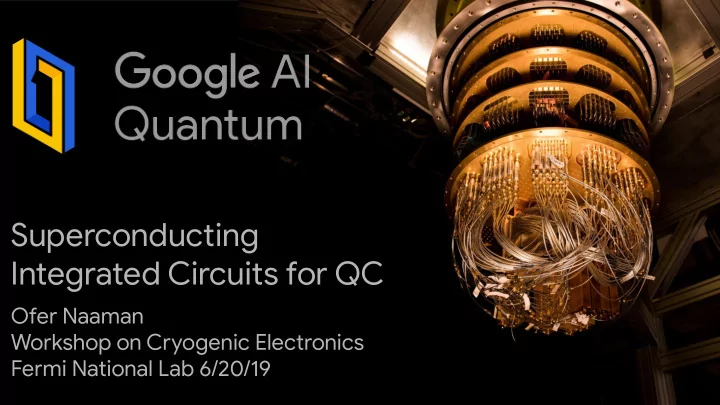
Superconducting Integrated Circuits for QC Ofer Naaman Workshop on - - PowerPoint PPT Presentation

β–Ά
superconducting integrated circuits for qc
SMART_READER_LITE
LIVE PREVIEW

Superconducting Integrated Circuits for QC Ofer Naaman Workshop on - - PowerPoint PPT Presentation

Superconducting Integrated Circuits for QC Ofer Naaman Workshop on Cryogenic Electronics Fermi National Lab 6/20/19 Near Term Gaps Wiring Signal integrity Passives Amplifjers Long Term Solutions Reduce I/O


slide-1
SLIDE 1

Superconducting Integrated Circuits for QC

Ofer Naaman Workshop on Cryogenic Electronics Fermi National Lab 6/20/19

slide-2
SLIDE 2

Near Term Gaps

  • Wiring
  • Signal integrity
  • Passives
  • Amplifjers

Long Term Solutions

  • Reduce I/O
  • Cryogenic control - CMOS and SC
  • Superconducting 𝜈wave

components

slide-3
SLIDE 3

Scale by Integrating Control Electronics

slide-4
SLIDE 4

Agenda

  • Aspects of superconducting IC design

β—‹ Lossless wiring β—‹ Active devices - Josephson junctions

  • Design examples

β—‹ Microwave switches β—‹ Mixers and modulators β—‹ Amplifjers and circulators

slide-5
SLIDE 5

Aspects of Superconducting IC Design

slide-6
SLIDE 6

Superconductors are Lossless

Implication:

  • Can use long, sub-micron wiring (eg. spiral inductor) at

microwave frequencies.

  • Compact transmission-line resonators with Q > 1M

But: watch for high Q parasitic resonances!

slide-7
SLIDE 7

Superconductors are Lossless

Implication:

  • Transformers work at DC

where 𝛸 is the fmux

NIST- F. Lecocq, Phys. Rev. Applied (2017)

But:

  • Stray magnetic fjelds generate DC current as well
  • Every SC loop can trap fmux
slide-8
SLIDE 8

Active Devices: Josephson Junctions

  • Tunnel junction between superconductors
  • Critical current Ic ∝ area

β—‹ 10’s nA - 𝜈A in qubit circuits β—‹ 𝜈A - 100’s 𝜈A in microwave and logic circuits

  • When I < Ic : lossless nonlinear inductor
  • Inductance is tunable if we control the current

β—‹ Two junctions in parallel: DC SQUID β—‹ One junction in parallel with inductor: RF SQUID 1 𝜈A β†’ 329 pH 100 𝜈m ~90 fF ~7.5 nH Lots of lossless inductance in small space

slide-9
SLIDE 9

Active Devices: Josephson Junctions

  • Tunnel junction between superconductors
  • Critical current Ic ∝ area

β—‹ 10’s nA - 𝜈A in qubit circuits β—‹ 𝜈A - 100’s 𝜈A in microwave and logic circuits

  • When I < Ic : lossless nonlinear inductor
  • Inductance is tunable if we control the current

β—‹ Two junctions in parallel: DC SQUID β—‹ One junction in parallel with inductor: RF SQUID 1 𝜈A β†’ 329 pH 100 𝜈m ~90 fF ~7.5 nH Lots of lossless inductance in small space

slide-10
SLIDE 10

Active Devices: Josephson Junctions

  • Tunnel junction between superconductors
  • Critical current Ic ∝ area

β—‹ 10’s nA - 𝜈A in qubit circuits β—‹ 𝜈A - 100’s 𝜈A in microwave and logic circuits

  • When I > Ic :

β—‹ dissipative current through shunt resistance β—‹ JJ is a pulsed voltage source - used for SFQ logic β—‹ SFQ pulse area 2mV Γ— 1 ps - fast and quantum accurate

Herr, J. Appl. Phys. (2011)

More on digital and SFQ - later today

slide-11
SLIDE 11

Scaling of SFQ Circuits for mK Integration

  • Power:

β—‹ SFQ junctions are typically critically damped β—‹ Ic ~ 100 𝜈A β—‹ Energy dissipated ~𝛸0Icfclk~ 0.2 nW per JJ at 10 GHz

  • Size:

β—‹ SFQ tech works at fjxed LIc ~ few fmux quanta β—‹ Maximum reliable Ic density ~ 20 kA/cm2

  • Scaling:

β—‹ Allow fjxed power density β—‹ High Ic: integration limited by max power β—‹ Low Ic: integration limited by inductor size

8b CPU ca. 2016 Noruhrop (RQL) ~17k JJ 8b CLA ca. 2011 Noruhrop (RQL) ~800 JJ

slide-12
SLIDE 12

Challenges in Superconductor Circuit Design

Semiconductor Superconductor Wiring R, C L, C (transmission lines) Traps Charge Charge + Flux Voltage / Current volt, milliamp microvolt, microamp Parasitic skin effect kinetic inductance Active device RON to open circuit, high Z gate Inductive, no open circuit, low Z gate

  • Advantages

β—‹ compact passives β—‹ Low loss β—‹ Low power dissipation β—‹ SFQ pulses - fast and accurate

  • Challenges

β—‹ No tunable open circuit β—‹ Typically low impedance to GND β—‹ Poor isolation, e.g. connecting to bus β—‹ Low power handling β—‹ Flux trapping β—‹ Foundries

slide-13
SLIDE 13

Superconducting IC Design Examples

slide-14
SLIDE 14

Microwave Switches for QC - Signal Routing

How to implement a microwave switch?

  • We don’t have a good switchable β€œopen circuit”
  • No power dissipation on chip
  • Low inseruion loss and wide-band

fmux ctrl.

M (𝛸)

πœ€0 Flux-controlled mutual inductance

slide-15
SLIDE 15

Microwave Switches for QC

How to implement a microwave switch, if active element necessitates inductive shorus to ground?

  • Use junction as tunable coupling
  • Embed in band-pass network

5 𝜈m ON OFF INV ON OFF INV

thru

Ξ¦e=0 Ξ¦e= Ξ¦0/2 S21 (dB) S21 (dB) in

  • ut

fmux

Northrop – APL 108, 112601 (2016)

simulation Data

slide-16
SLIDE 16

Microwave Switches for QC

Single-Pole Single Throw (SPST) Double-Pole Double Throw (DPDT) transfer Single-Pole Double Throw (SPDT)

ETH – Phys. Rev. Applied 6, 024009 (2016) JILA – APL 108, 222602 (2016)

βœ” Fast βœ” Non dissipative βœ” GHz bandwidth βœ” Flux control

Northrop – APL 108, 112601 (2016)

slide-17
SLIDE 17

Mixers and Modulators - Control Pulse Shaping

Analog signal processing with a Josephson double-balanced mixer

  • Wide-band, no dissipation on chip

LO RF

LPF

AWG - IF

LPF DC Flux bias

Northrop, JAP 121, 073904 (2017)

slide-18
SLIDE 18

Mixers and Modulators - Control Pulse Shaping

Analog signal processing with a Josephson double-balanced mixer

  • Wide-band, no dissipation on chip

LO RF

LPF

AWG - IF

LPF DC Flux bias

Northrop, JAP 121, 073904 (2017)

slide-19
SLIDE 19

Mixers and Modulators - Control Pulse Shaping

Analog signal processing with a Josephson double-balanced mixer

  • Wide-band, no dissipation on chip

LO RF

LPF

AWG - IF

LPF DC Flux bias

Northrop, JAP 121, 073904 (2017)

slide-20
SLIDE 20

Mixers and Modulators - Control Pulse Shaping

RF DC IF 7.5 GHz LO

  • Use Josephson junctions for tunable coupling

β—‹ Non-dissipative operation

  • Embed in band-pass network

β—‹ Deal with shunt inductors, ideally low IL, engineer bandwidth

  • SQUID design is imporuant

β—‹ Manage nonlinearity, saturation > 1 nW

Northrop, JAP 121, 073904 (2017)

slide-21
SLIDE 21

Active Superconducting Devices

Needed for qubit readout - amplifjcation & isolation Signal powers -130 dBm to -120 dBm per qubit

  • AC powered
  • Josephson junction active elements
  • Easy to modulate reactance
  • Use parametric amplifjcation and frequency

conversion processes

β—‹ Josephson parametric amplifjers β—‹ Traveling wave parametric amplifjers (next talk!) β—‹ Parametric circulators β—‹ Synthetic circulation

  • Challenges - bandwidth and saturation power

many circulators

slide-22
SLIDE 22

Josephson Parametric Amplifjers

Sundqvist and Delsing, 2013

Ysq(Ο‰s)

R3 C12 R2 Cp1/2 pump + DC flux SQUID array Ysq(Ο‰) Cp1/2 Cp1 R2 R3 C23 C23 C12 Signal in/out

Pump SQUID at twice the signal frequency Efgective admituance has negative real paru

  • Band-pass network for impedance match
  • SQUID array design for betuer saturation
  • Wide-band refmection gain

Noruhrop arXiv:1711.07549 (2017), IMS2019

slide-23
SLIDE 23

Josephson Parametric Amplifjers

Non-degenerate matched JPA

  • Transmission gain
  • Frequency converuing
  • Automated design via fjlter synthesis methods

𝛾23 𝛾12 𝛿A 𝛿B

  • 𝛾12
  • 𝛾23

𝛾PA A3 A2 A1

B1

✻

B2

✻

B3

✻

pump @ 2 GHz

gain (dB)

  • utput frequency (GHz)

refmection gain Poru 1 transmission gain Poru 2

slide-24
SLIDE 24

Synthetic and Parametric Circulators

Synthetic circulation

  • 2x IQ mixers (or H-bridges) + delay lines
  • Low inseruion loss, wide band

Synthetic circulator, JILA

  • PRX. 7, 041403 (2017)

JILA, PR Appl. 11, 044048 (2019)

Parametric circulation

  • Parametric conversion
  • 3 resonant modes share SQUID
  • Bandpass matching network

ADS HB simulation

slide-25
SLIDE 25

Conclusion

  • Superconducting IC’s complement cryo CMOS for qubit control

β—‹ Low power dissipation means we can integrate on the mix-plate β–  Simplify IO requirements β–  Good for signal integrity β—‹ Low loss superconducting wiring - more compact, effjcient passives. Good for microwaves.

  • Unique aspects of superconducting IC design

β—‹ Transformers work down to DC β—‹ No good β€œopen circuit” β—‹ Typical circuits present low impedance inductive shunts β—‹ Flux traps

  • Low power microwave and mixed-signal devices

β—‹ Switches and modulators β—‹ Amplifjers and circulators