
SLIDE 1
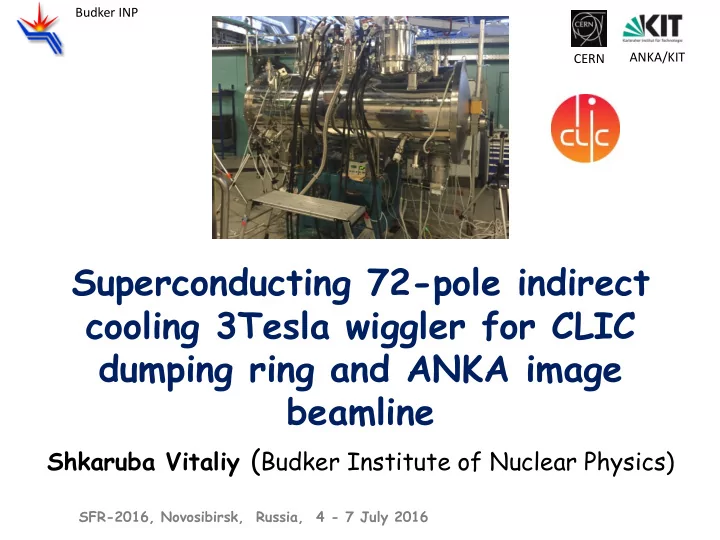
Superconducting 72-pole indirect cooling 3Tesla wiggler for CLIC dumping ring and ANKA image beamline
SFR-2016, Novosibirsk, Russia, 4 - 7 July 2016
Shkaruba Vitaliy (Budker Institute of Nuclear Physics)
Budker INP CERN ANKA/KIT
Superconducting 72-pole indirect cooling 3Tesla wiggler for CLIC - - PowerPoint PPT Presentation
Budker INP ANKA/KIT CERN Superconducting 72-pole indirect cooling 3Tesla wiggler for CLIC dumping ring and ANKA image beamline Shkaruba Vitaliy ( Budker Institute of Nuclear Physics) SFR-2016, Novosibirsk, Russia, 4 - 7 July 2016 Budker
SFR-2016, Novosibirsk, Russia, 4 - 7 July 2016
Shkaruba Vitaliy (Budker Institute of Nuclear Physics)
Budker INP CERN ANKA/KIT
Budker INP Storage ring, location Year Magnetic field, (BMax) Bwork, T Poles numbe r (main + side) Pole gap/bea m gap, mm Period mm LHe consumption, l/hour 3.5T wiggler BINP, Russia 1979 3.5 20 15 90 7.0T shifter PLS, Korea 1995 (7.68) 7.5 1+2 48(26)
7.0T shifter LSU-CAMD, USA 1998 (7.55) 7.0 1+2 51(32)
10.0T shifter SPring-8, Japan 2000 (10.3) 10.0 1+2 40(20)
7.0T shifter BESSY-II, Germany 2000 (7.5) 7.0 1+2 52(32)
7.0T shifter BESSY-II, Germany 2001 (7.5) 7.0 1+2 52(32)
7.0T wiggler BESSY-II, Germany 2002 (7.67) 7.0 13 + 4 19(13) 148 0.5 3.5T wiggler ELETTRA, Italy 2002 (3.7) 3.5 45 + 4 16.5(11) 64 0.4 2.0T wiggler CLS, Canada 2005 (2.2) 2.0 61 + 2 13.5(9.5) 34 <0.03 3.5T wiggler DLS, England 2006 (3.75) 3.5 45 + 4 16.5(11) 60 <0.03 7.5T wiggler SIBERIA-2, Russia 2007 (7.7) 7.5 19 + 2 19(14) 164 <0.03 4.2T wiggler CLS, Canada 2007 (4.34) 4.2 25 + 2 14.5(10) 48 <0.03 4.2T wiggler DLS, England 2009 (4.25) 4.2 45 + 4 13.8(10) 48 <0.03 4.1T wiggler LNLS, Brazil 2009 (4.19) 4.1 31 + 4 18.4(14) 60 <0.03 2.1T wiggler ALBA-CELLS, Spain 2009 (2.27)2.1 117 + 2 12.6(8.5) 30 <0.03 4.2T wiggler AS, Australia 2012 (4.5) 4.2 59+4 15.2(10) 50.5 <0 (-0.3 atm) 7.5T wiggler CAMD LSU, USA 2013 (7.75) 7.5 11+4 25.2(15) 193.4 <0 (-0.5 atm) 2.5T wiggler KIT, Germany 2013 (2.85) 2.5 36+4 19(15) 46.9 <0 (-0.7 atm)
List of SC insertion devices fabricated by Budker INP
SFR-2016, Novosibirsk, Russia, 4 - 7 July 2016
Budker INP Storage ring, location Magnetic field, (BMax) Bwork, T Poles number (main + side) Pole gap/beam gap, mm Period mm
Long period (High field) wigglers (B =7-7.5 T, λ ~150-200 mm): High radiated power and hard X-ray spectrum
7.0T wiggler BESSY-II, Germany (7.67) 7.0 13 + 4 19(13) 148 7.5T wiggler SIBERIA-2, Russia (7.7) 7.5 19 + 2 19(14) 164 7.5T wiggler CAMD LSU, USA (7.75) 7.5 11+4 25.2(15) 193.4
Three groups of multipole SC wigglers fabricated by Budker INP
SFR-2016, Novosibirsk, Russia, 4 - 7 July 2016
Medium period (Medium field) wigglers (B =3.5-4.2 T, λ~48-60 mm): High photon flux at 10 -100 KeV
3.5T wiggler ELETTRA, Italy (3.7) 3.5 45 + 4 16.5(11) 64 3.5T wiggler DLS, England (3.75) 3.5 45 + 4 16.5(11) 60 4.2T wiggler CLS, Canada (4.34) 4.2 25 + 2 14.5(10) 48 4.2T wiggler DLS, England (4.25) 4.2 45 + 4 13.8(10) 48 4.1T wiggler LNLS, Brazil (4.19) 4.1 31 + 4 18.4(14) 60 4.2T wiggler ASHo, Australia (4.5) 4.2 59+4 15.2(10) 50.5
Short period (Low field) wigglers (B =2-2.2 T, λ~30-34 mm): close to undulator
2.0T wiggler CLS, Canada (2.2) 2.0 61 + 2 13.5(9.5) 34 K ~6 2.1T wiggler ALBA-CELLS, Spain (2.27)2.1 117 + 2 12.6(8.5) 30 K ~ 6 2.5T wiggler KIT, Germany (2.85) 2.5 36+4 46.9 K ~ 11
Budker INP
Photos of SC multipole wigglers fabricated by Budker INP
SFR-2016, Novosibirsk, Russia, 4 - 7 July 2016
BESS
BESSY,Germany, 2002, 17-poles,7 T ELETTRA,Italy,2002 49-pole 3.5 T CLS,Canada,2004 63-pole 2 T DLS,England,2006 49-pole 3.5 T Moscow, Siberia-2, 2007 21-pole 7.5 T CLS,Canada,2007 27- poles 4 T DLS, England,2008 49-pole 4.2 T LNLS, Brazil,2009 35-pole 4.2 T ALBA, Spain, 2010 119-pole 2.1 T AS, Australia, 2012 63-pole 4.2 T LSU-CAMD,USA, 2013 15-pole 7.5 T ANKA-CATACT, Germany, 2013, 40-pole 2.5 T
Budker INP Storage ring, location Year Magnetic field, (BMax) Bwork, T Poles numbe r (main + side) Pole gap/bea m gap, mm Period mm LHe consumption, l/hour 3.5T wiggler BINP, Russia 1979 3.5 20 15 90
7.0T shifter PLS, Korea
1995
(7.68) 7.5 1+2 48(26)
7.0T shifter LSU-CAMD, USA
1998
(7.55) 7.0 1+2 51(32)
10.0T shifter SPring-8, Japan
2000
(10.3) 10.0 1+2 40(20)
7.0T shifter BESSY-II, Germany
2000
(7.5) 7.0 1+2 52(32)
7.0T shifter BESSY-II, Germany
2001
(7.5) 7.0 1+2 52(32)
7.0T wiggler BESSY-II, Germany
2002
(7.67) 7.0 13 + 4 19(13) 148
0.5
3.5T wiggler ELETTRA, Italy
2002
(3.7) 3.5 45 + 4 16.5(11) 64
0.4
2.0T wiggler CLS, Canada
2005
(2.2) 2.0 61 + 2 13.5(9.5) 34
<0.03
3.5T wiggler DLS, England
2006
(3.75) 3.5 45 + 4 16.5(11) 60
<0.03
7.5T wiggler SIBERIA-2, Russia
2007
(7.7) 7.5 19 + 2 19(14) 164
<0.03
4.2T wiggler CLS, Canada
2007
(4.34) 4.2 25 + 2 14.5(10) 48
<0.03
4.2T wiggler DLS, England
2009
(4.25) 4.2 45 + 4 13.8(10) 48
<0.03
4.1T wiggler LNLS, Brazil
2009
(4.19) 4.1 31 + 4 18.4(14) 60
<0.03
2.1T wiggler ALBA-CELLS, Spain
2009
(2.27)2.1 117 + 2 12.6(8.5) 30
<0.03
4.2T wiggler AS, Australia
2012
(4.5) 4.2 59+4 15.2(10) 50.5
<0 (-0.3 atm)
7.5T wiggler CAMD LSU, USA
2013
(7.75) 7.5 11+4 25.2(15) 193.4
<0 (-0.5 atm)
2.5T wiggler KIT, Germany
2013
(2.85) 2.5 36+4 19(15) 46.9
<0 (-0.7 atm)
List of SC insertion devices fabricated by Budker INP
SFR-2016, Novosibirsk, Russia, 4 - 7 July 2016
Budker INP
Required magnetic parameters of CLIC dumping wiggler
SFR-2016, Novosibirsk, Russia, 4 - 7 July 2016 Magnetic field 3 (2.95)* T Period 51 (51.4)* mm Magnetic gap 18 (17)* mm Beam gap 13 mm Number main poles 68 Side poles +¼,-¾, … ,+¾,-¼ *-real final parameters of BINP prototype
emittance due to emission of synchrotron radiation
for two dumping rings (DR)
< 500[nm∙rad] CERN ANKA/KIT
Budker INP
Choice between horizontal and vertical racetrack coils design
SFR-2016, Novosibirsk, Russia, 4 - 7 July 2016
Vertical racetrack coils Horizontal racetrack coils
Short SC wire is required Long SC wire is required (3-4 time more) Minimal stored magnetic energy and inductance Stored energy and inductance is more by 3 times Possibility of multi sections coils (+15% for two sections) No possibility to make multi section coils Possibility to replace of broken coils and easy mass production Need to replace the whole coils block Large number of splices for large number of poles Less number of splices
SC wires (R<10-12 Ohm)
coils with identical layer numbers. Due to feeding section with different currents the field value increases by 15 % (5.2T and 4.5T)
Budker INP
Magnetic system of CLIC dumping wiggler prototype
SFR-2016, Novosibirsk, Russia, 4 - 7 July 2016 Magnetic Field, T ≥ 3 Period, mm 51 Magnetic gap cold, mm 18 Vacuum gap cold, mm 13 Number of poles 68+4 Stored energy, kJ 60 Cold mass, kg 700 K < 16 Magnet length, mm 1836 Length flange to flange, mm 2590 Maximum ramping time, min < 5 Beam heat load (acceptable), W 50 Period for LHe refill with beam > 1 year LHe boil off for 1 quench, L < 15 Field stability for two weeks ±10-4
temperature (red). Blue dots – maximal field inside of outer and inner sections for 3.0 T magnetic field on the median plane for the wiggler period of 51 mm and the pole gap of 18 mm.
central pole with copper heat links
code) for optimization
CLIC dumping wiggler
Budker INP
Magnetic system of CLIC dumping wiggler prototype
SFR-2016, Novosibirsk, Russia, 4 - 7 July 2016
conductivity of applied materials. The coils (located in vacuum) are cooled by copper heat links from each core to copper heat distributer extended along the magnet.
chamber (wall of helium vessel) gives the possibility to increase
and supports of the vacuumchamber (for reliable positioning).
Budker INP
Testing of “Short prototype” CLIC wiggler with indirect cooling
SFR-2016, Novosibirsk, Russia, 4 - 7 July 2016
thermal links and cooled down to ~3K for ~2 days.
SRDK-408 D2 1W at 4.2K
22 23 24 50 100 150 200 250 Date, (December,2012) T, K TD1 TD7 TD3, TD18-TD23, TD4 TD2, TD8-TD11 TD5, TD12-TD17, TD6indirect cooled short prototype
prototype before assembling
short prototype down to ~3K
critical curve of SC wire.
Budker INP
Quenching of “Full Size” prototype of CLIC wiggler
SFR-2016, Novosibirsk, Russia, 4 - 7 July 2016
minutes to hours uncorrelated with the magnet temperature. The quenched coils are different.
stable 3.2T after training
no stable field after stopping ramping at > 2.7T
stable 3.2T without training
indirect cooling: field > 3.1T during ramping
Budker INP
Activities for troubleshooting of premature quenching before 3T
SFR-2016, Novosibirsk, Russia, 4 - 7 July 2016 Actions Results (stable level of magnetic field) Replace of often quenched coils 2.7T Additional heat links for interception of heat in-leaks through signal wires and elements of cryostat. Installation of additional sensors for monitoring of temperatures 2.7T Additional super-insulation at questionable places 2.8T Additional increasing of mechanical rigidity of magnet 2.8T Preventive maintenance of questionable cold welded splices 2.8T Each splice (~300) were thermally connected to heat sinks 2.8T Decrease of magnetic gap from 18 mm to 17 mm and period from 51 to 51.4 mm (additional 0.2 mm Cu-foils between the coils for cooling) (Beam gap remained required 13 mm!) ~2.95T stable at 3.1 K to 4.5 K
is still not explained and remaining the subject investigation!
Budker INP
Cryogenic system of CLIC wiggler with indirect cooling
SFR-2016, Novosibirsk, Russia, 4 - 7 July 2016
connected with copper plate along the magnet
combined from HTSC and brass parts allows input current t of ~1000 A
Budker INP
Cryogen-free precooling down with nitrogen heat pipes
SFR-2016, Novosibirsk, Russia, 4 - 7 July 2016
pipes (thermo-siphon type ) as a heat conduction elements between 60K stage of the cryo-coolers (re-condensers) and the magnet.
dropped down to nitrogen freezing point (64K). After that thermal connection is cut of.
to LHe temperature. Then wiggler can operate without any service during some years.
nitrogen heat pipe (magnet)
heat pipe (re-condenser)
pipe (60K cryo-cooler stage)
Budker INP
Cryogenic system performance
SFR-2016, Novosibirsk, Russia, 4 - 7 July 2016
expected up to ~50W
to the beam pipe
without quench)
load test. (A. Bernhard et al, ProcIPAC-2016)
dumping wiggler prototype (the field of 2.9T )
Budker INP
SFR-2016, Novosibirsk, Russia, 4 - 7 July 2016
installed and commissioned in ANKA storage ring on 2016 Feb.
dumping wiggler prototype for CERN.
the bath cryostat and in the wiggler’s own cryostat
reason of this instability is not yet satisfactorily explained
Budker INP
SFR-2016, Novosibirsk, Russia, 4 - 7 July 2016
BINP
Syrovatin, O. Tarasenko, V. Tsukanov, A. Volkov, K. Zolotarev, , A.Zorin
KIT
A.Bernhard, S.Casalbuoni, A.Grau, S.Gerstl, J.Gethmann, S.Hillenbrand, E.Huttel, D.Jauregui, N.Smale
CERN
P.Ferracin, L.G.Fajardo, Y.Papaphilippou, D.Schoerling, H.Schmickler
Budker INP SFR-2016, Novosibirsk, Russia, 4 - 7 July 2016