
SLIDE 1
Summer Undergraduate Research Experiences
SURE at Emory University & Beyond
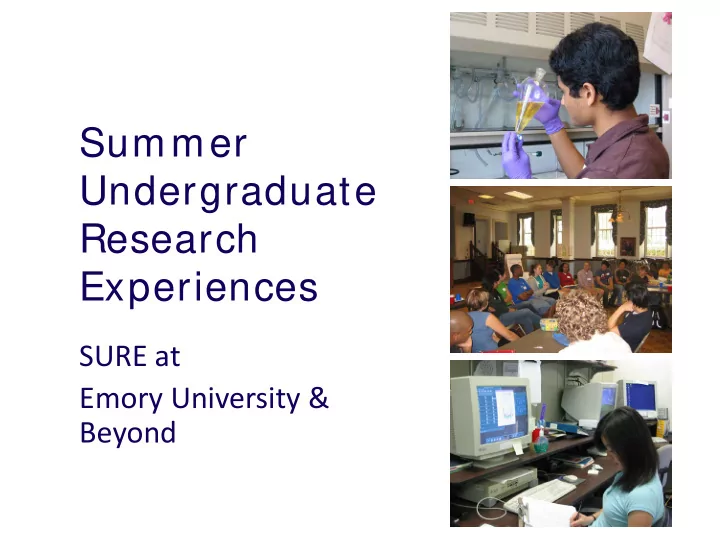
Summer Undergraduate Research Experiences SURE at Emory - - PowerPoint PPT Presentation
Summer Undergraduate Research Experiences SURE at Emory University & Beyond Questions to Ask Why do you want to do research? What are my objectives for getting involved in research? What type of training do I desire? What
SURE at Emory University & Beyond
research?
me?
do?
thic s e duc a tio n
grad students and program recruiters (separate sessions)
graduate school
talks and elevator talks
student- led discussions on:
– Authorship – Moral reasoning – Data ownership, secrecy in science, whistleblowing – Data choice, research integrity – Use of humans and animals in research – Mentorship; work environment; romance in the workplace
banquets
students
Vanderbilt.
urology diseases for undergraduate students.
participate in a 10 week didactic and laboratory or clinical research experience. Emory takes 8-10 students/summer.
Summer Student Research Symposium. The 2014 symposium was at Vanderbilt, 2015 at Emory, 2016 at Mayo, 2017 at NIH, and 2018 will be at Harvard.
SUPERR students are:
entire 10 week program
laboratories or clinical programs (minimum of 37 hours
research
professional development
(SURE Research Day and NIDDK R25 symposium)
Emory University Pediatric Engineering Research Summer Experience
bioengineering-summer-training-program
areas of research, provide clinical significance with clinician shadowing, educates students in current topics in pediatric engineering literature, and develops presentation skills needed for graduate research. In collaboration with the Emory SURE program, the students will take part in graduate school and career panels, have the opportunity to interface one-on-one with researchers from nearly every avenue, and receive critical ethics training in research with a special session devoted to pediatric medicine.
Chemistry Summer Undergraduate Research Program (CSURP)
Presented by Lloyd Munjanja, PhD CCHF Director of Education, Outreach and Diversity October 2nd, 2017
NSF Center for Selective C-H Functionalization (CCHF)
CSURP: Access and Mentorship
14
43 students over 4 years 80% from Historically Underrepresented Groups in STEM >90% of alumni are in (or plan to attend) PhD or MD programs 100% of alumni indicated that CSURP had direct impact on their future plans
“CSURP granted me a full summer of research experience at an esteemed R1 university. This experience greatly influenced my development as a scientist and influenced my decision to pursue a Ph.D. is chemistry.” Jessica Elinburg – Boston University
Online Application Due - February 9, 2018 CSURP Fellows will receive funding support to perform their summer research experience including: Travel awards to their host institution. A stipend of up to $5,000 for 10 weeks of participation. On campus housing, if required. Attending seminars, workshops, career planning sessions and other professional development opportunities Engaging in innovative, cutting edge research Interacting with prominent leaders in the field
2017 - Fellows
17
UNIVERISITY OF MICHIGAN-ANN ARBOR Natalia Harris (Sherman Lab) EMORY Whitley Ramirez (MacBeth Lab) UNIVERSITY OF WASHINGTON Nathan Turner (Luscombe Lab) GEORGIA TECH Lanae Davis (Jones Lab) Caria Evans (Marder Lab) MISSISSIPPI STATE UNIVERSITY Sam McKinnon (Scott Lab) UNIVERSITY OF WISCONSIN- MADISON Bria Garcia (Berry Lab)
This work was supported by NSF under the CCI Center for Selective C–H Functionalization, CHE-1205646. Any opinions, findings, and conclusions or recommendations expressed here are those of the authors and do not necessarily reflect the views of the National Science Foundation (NSF).
CCHF Director of Education, Outreach and Diversity lloyd.munjanja@emory.edu http: / / nsf-cchf.com/ CSURP/
might wish to go to graduate school!
research opportunities. If you just use Undergraduate Research you will get 200 million hits, so be more specific!!
are in February!
least two projects that sound interesting.
campus?
– For credit? – For pay?
Audience: students with long-term PhD* goals who are not well-suited for graduate study in the immediate future.
readiness: ability to thrive and excel in graduate school vs. just surviving [maturity, confidence, coping mechanisms, interpersonal and/or professional skills] competitiveness: likelihood of securing and successfully completing an interview at a quality graduate program of choice [GPA/research experience/meaningful recommendations/GRE scores/writing skills/interview skills]
The right postbacc research experience can address deficiencies, develop skills, and in general enhance the odds of successfully completing a PhD. Help your student to (1) identify/acknowledge strengths and weaknesses, (2) pursue experience(s) that address deficiencies, and (3) be prepared to discuss how said deficiencies have been or are being addressed in application statements and interviews.
– Positions posted online, word of mouth. “Work for hire” nature
communicate long-term goals with PI, be proactive in securing mentoring and pursuing developmental activities.
professional development, retention in the sciences, etc. as well as skill development
– NIH is the likeliest funding source, via
» R25 postbaccalaureate grants (to universities) » IRTA (intramural research training awards at NIH laboratories; one award type focuses on training future PhDs, the other focuses on training future research personnel)
– See https://www.training.nih.gov/
WebGuide to Undergraduate Research has program listings from all
http://www.webguru.neu.edu/ NSF REU sites https://www.nsf.gov/crssprgm/reu/ https://www.nsf.gov/crssprgm/reu/reu_search.jsp Association of American Medical Colleges https://students-residents.aamc.org/applying-medical- school/article/md-phd-summer-undergrad-research-programs/