Undergraduate Research Task Force Enhancing the undergraduate - - PowerPoint PPT Presentation

undergraduate research task force
SMART_READER_LITE
LIVE PREVIEW

Undergraduate Research Task Force Enhancing the undergraduate - - PowerPoint PPT Presentation

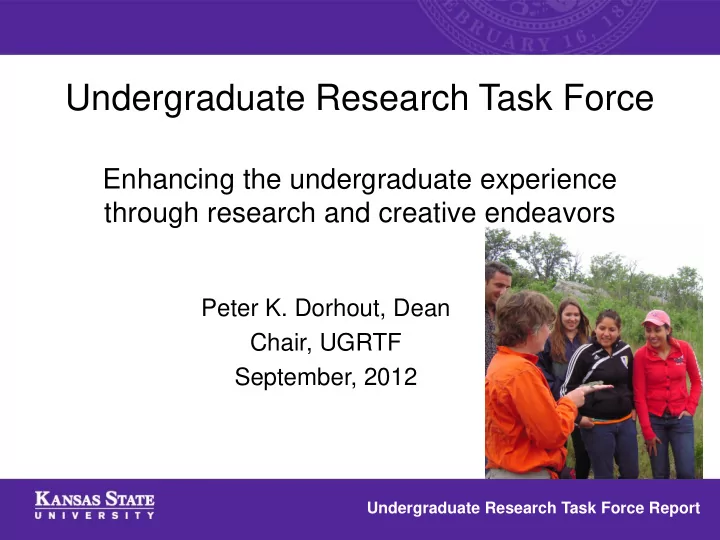
Undergraduate Research Task Force Enhancing the undergraduate experience through research and creative endeavors Peter K. Dorhout, Dean Chair, UGRTF September, 2012 Undergraduate Research Task Force Report Membership David Andrus,

slide-1
SLIDE 1

Undergraduate Research Task Force Report

Undergraduate Research Task Force

Enhancing the undergraduate experience through research and creative endeavors

Peter K. Dorhout, Dean Chair, UGRTF September, 2012

slide-2
SLIDE 2

Undergraduate Research Task Force Report

Membership

  • David Andrus, Professor, Marketing
  • Itzik Ben-Itzhak, Professor, Physics
  • Lora Boyer, Associate Director for McNair

Scholars Program, Student Life

  • Barry Bradford, Associate Professor, Animal

Sciences and Industry

  • Fred Burrack, Director/Associate Professor,

Music and Assessment Office

  • Stephen Chapes, Professor, Biology
  • Anita Cortez, Director of Developing Scholars
  • Greg Eiselein, Professor, English
  • Jane Garcia, Professor, Family Studies &

Human Services

  • Keith Hohn, Professor, Chemical Engineering
  • Vibhavari Jani, Associate Professor, Interior

Architecture and Product Design

  • Sara Kearns, Associate Professor/Department

Head, Libraries

  • Paul Lowe, Assistant Vice President for Research
  • Bonnie Lynn-Sherow, Associate Professor, History
  • Eric Maatta, Department Head/Professor,

Chemistry

  • Marian Mersmann, UG student Biology,

Psychology

  • Annelise Nguyen, Associate Professor, Diagnostic

Medicine & Pathobiology

  • Graciela Orozco, UG student, Biology/Animal

Science

  • Bob Peterman, Professor, Civil Engineering
  • Gail Shroyer, Professor/Department Chair,

Curriculum & Instruction

  • Alysia Starkey, Asst. Dean of Academics, K-State

Salina

  • Janice Taggart, Staff, Grain Science and Industry
  • Farrell Webb, Associate Professor, Family Studies

and Human Services

Photos – Bruce Snyder, REU director, and KSU Photo Services

slide-3
SLIDE 3

Undergraduate Research Task Force Report

Committee Charge

  • Provide a definition of undergraduate

research and creative endeavors (UGRCE)

  • Provide an environmental scan of

comparable institutions (benchmark peers, aspirational peers, others)

  • Propose mechanisms for assessment
  • Propose methods to promote and

celebrate UGRCE

  • Propose resources needed to

enhance UGRCE

slide-4
SLIDE 4

Undergraduate Research Task Force Report

Key Assumptions – Vision 2025

  • In order to become a top 50 public research university in today’s

world, Vision 2025 expects that there will be an increased participation by undergraduates in RSCAD through expanded

  • pportunities.
  • Under RSCAD in Vision 2025, we will be competitive among our

peers in the percentage of undergraduates involved in research.

  • Successful integration of undergraduate education and meaningful

research will be standard practice.

  • Participation in undergraduate research will be a factor in improving

retention and time to graduation.

  • Creation of scholarship by undergraduates will increase as the result
  • f their participation in research and creative endeavors at Kansas

State University

slide-5
SLIDE 5

Undergraduate Research Task Force Report

Process

  • Task Force meetings March 8 – May 3
  • Three subcommittees – Environmental Scan,

Assessment, Celebrate and Promote

  • Committee Chairs led the final report discussions,

written report (Garcia, Burrack, Hohn)

  • Final report shared back with Task Force
  • Report finalized in August – ready for campus

comment

slide-6
SLIDE 6

Undergraduate Research Task Force Report

Define UGRCE

  • An authentic research project
  • Setting the bar high – not just bean counting
  • r credit counting
  • Interpolating from the faculty, postdoc, PhD

student, Master’s student….undergraduate

  • Public dissemination
  • A project with evidence-based design
  • New knowledge creation - adding to the

body of knowledge

  • A mentored experience
  • Utilizing skills, not just learning skills
  • Leading to unique creative solutions or

discovery

  • A project that is Individual or collaborative
  • An activity that enhances professional self-

awareness

slide-7
SLIDE 7

Undergraduate Research Task Force Report

Defining Undergraduate Research and Creative Endeavors

Undergraduate research and creative endeavors are defined as scholarly, collaborative, authentic, original work

  • r an assessment from a new point of view conducted by a

student or group of students within a mentored environment for the purpose of publicly disseminating the information through a university seminar, poster/oral conference presentation, performance, exhibition, and/or

  • publication. The projects shall involve inquiry, design,

investigation, research, scholarship, discovery, application, writing and/or performance to a greater or lesser degree depending on the discipline.

slide-8
SLIDE 8

Undergraduate Research Task Force Report

Environmental Scans

Infrastructure of Programs:

  • 10 of 15 institutions have some sort of

“centralized” approach to undergraduate research (including 6 of 7 benchmark institutions). Coordination or organization of programs range from an administrator with a desk to both administrative and student work space to support activities.

  • Institutions convey a heavy reliance on grants

and endowments; institutional support for funded positions varies. Some programs also include graduate assistant positions to help manage central programs.

  • In a number of instances, offices for UG

research also oversee programs for national scholar development, which may represent a consolidation of resources for some.

slide-9
SLIDE 9

Undergraduate Research Task Force Report

Program Components:

  • Almost all offer a dedicated web site for

undergraduate research highlighting program components and providing links to department specific activities

  • Workshops and/or classes for UGs on topics

such as research ethics, presenting research, and writing proposals

  • Mentoring workshops
  • Summer research programs
  • Programs that target freshman
  • Support of research conducted at external

locations/private sector or through international/study abroad initiatives

  • Funding of undergraduate research projects
  • Travel awards for student presentations
  • Graduate students who serve as mentors
  • Online mechanism to connect students to

faculty in areas of interest or as a specific program

slide-10
SLIDE 10

Undergraduate Research Task Force Report

Promotion, Recognition & Dissemination:

  • Annual symposia of some type appear quite common
  • Use of “blogs” to promote communications between

current participants or web site to highlight student activity

  • Research or “Scholar” designation on transcript or

recognition at graduation

  • Presentation to State Legislature often in conjunction

with other state institutions

  • At least 9 of 15 have an Undergraduate Research

Journal (quite varied in purpose and function)

  • University awards for students and faculty mentors
  • Poster awardees at annual undergraduate exhibition

become part of libraries’ digital collections

slide-11
SLIDE 11

Undergraduate Research Task Force Report

  • Best practices in

UGRCE reported in 2012 by the Council

  • n Undergraduate

Research

http://www.cur.org/assets/1/23/COEUR_f inal.pdf

slide-12
SLIDE 12

Undergraduate Research Task Force Report

Assessment of UGRCE

  • Develop a comprehensive Assessment plan for KSU

Undergraduate Research.

– Tactic: Identify in relation to undergraduate research/creative endeavors, demographics of students and mentors

  • Create an online database and interface for students, faculty,

and staff.

– Tactic: Connect survey data (below), through which students will self-report additional information pertaining to their research/creative endeavor in the format

  • f a resumé.
  • Survey graduating seniors and recent alumni about their

experiences.

– Tactic: Include questions on the Senior Survey and 1st year, 4th year Alumni Surveys that identify student perception of the contribution of undergraduate research/creative experiences and possible ties to future achievement

  • Substantiate qualities of impact

RECOMMENDATIONS: http://www.k-state.edu/2025/

slide-13
SLIDE 13

Undergraduate Research Task Force Report

Promotion & Celebration

  • Create a Center for Undergraduate Research and Creative

Endeavors (UGRCE)

  • Recognize UGRCE on the transcript, at graduation, at different

levels, and through awards for students and faculty

  • Celebrate UGRCE at a university or college-wide convocation

for students at the start of each year.

  • Host a research and creativity symposium (campus wide, >1

days) in the spring that celebrates accomplishments with presentations, displays, shows, performances. (See NCUR example) Invite legislators to campus.

  • Create/host an online UGRCE journal
  • Coordinate with Communications and Marketing to generate

news stories and releases about UGRCE.

  • Hold a UGRCE display at the Capitol in Topeka with legislators.
  • K-State should be the destination school for UGRCE.

RECOMMENDATIONS RECOMMENDATIONS: http://www.k-state.edu/2025/

slide-14
SLIDE 14

Undergraduate Research Task Force Report

Impact on Students

  • Match students with mentors and projects using a

web database of opportunities and talents.

  • Web based e-portfolio/resumé linked with Career &

Employment Services for each student.

  • Provide financial support for students with

fellowships/scholarships.

  • Provide travel funds for students to attend

conferences to present their work.

  • Provide resources to support their research.
  • Provide training for students – ethical conduct of

research, how to generate problems, how to do research, effective/appropriate use of source material – Research Methodology.

  • Create a 0-N credit hour course option to track or

give credit for student research.

RECOMMENDATIONS: http://www.k-state.edu/2025/

slide-15
SLIDE 15

Undergraduate Research Task Force Report

Impact on Faculty

  • Recognize undergraduate research

mentoring as a key component to time-and-effort distribution and towards promotion & tenure.

  • Provide faculty with professional

development around undergraduate research (mentor-the-mentor) and how to incorporate research into teaching/classroom experiences.

  • Provide financial support to

facilitate projects with undergraduates

RECOMMENDATIONS RECOMMENDATIONS: http://www.k-state.edu/2025/

slide-16
SLIDE 16

Undergraduate Research Task Force Report

Resources Needed

  • Director – Center for UGRCE (1/2-

time)$50,000

  • Assistant to the Director, event

coordinator$20,000-40,000

  • Annual Celebration Activities $20,000
  • Financial Support for Students ($1500

scholarships x 3000) $4.5M

  • Financial Support for Faculty

(materials/supplies) $500,000

  • Travel support for students

(meetings/presentations) $50,000

  • Council on Undergraduate Research

Annual Membership $825

Photo - Katie Weilbacher

RECOMMENDATIONS RECOMMENDATIONS: http://www.k-state.edu/2025/