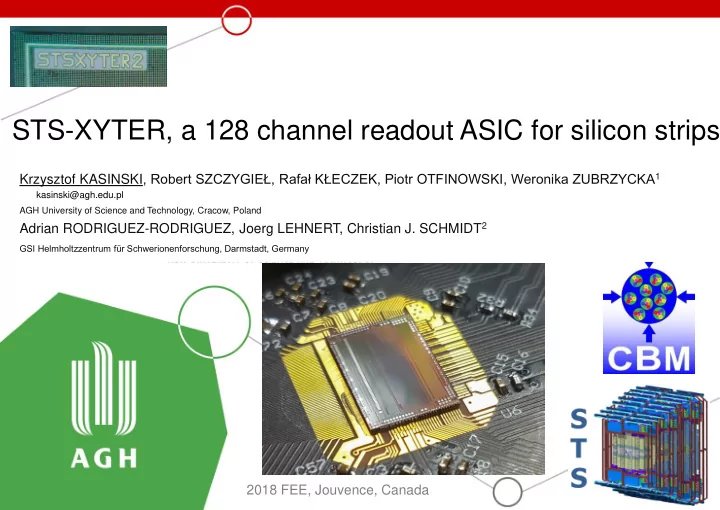
STS-XYTER, a 128 channel readout ASIC for silicon strips Krzysztof - - PowerPoint PPT Presentation

sts xyter a 128 channel readout asic for silicon strips
SMART_READER_LITE
LIVE PREVIEW

STS-XYTER, a 128 channel readout ASIC for silicon strips Krzysztof - - PowerPoint PPT Presentation

STS-XYTER, a 128 channel readout ASIC for silicon strips Krzysztof KASINSKI , Robert SZCZYGIE, Rafa KECZEK, Piotr OTFINOWSKI, Weronika ZUBRZYCKA 1 kasinski@agh.edu.pl AGH University of Science and Technology, Cracow, Poland Adrian


slide-1
SLIDE 1

STS-XYTER, a 128 channel readout ASIC for silicon strips

2018 FEE, Jouvence, Canada Krzysztof KASINSKI, Robert SZCZYGIEŁ, Rafał KŁECZEK, Piotr OTFINOWSKI, Weronika ZUBRZYCKA1

AGH University of Science and Technology, Cracow, Poland

Adrian RODRIGUEZ-RODRIGUEZ, Joerg LEHNERT, Christian J. SCHMIDT2

GSI Helmholtzzentrum für Schwerionenforschung, Darmstadt, Germany kasinski@agh.edu.pl

slide-2
SLIDE 2
  • CBM Experiment, STS & MUCH detectors
  • DAQ system
  • STS/MUCH-XYTER2 ASIC
  • Analog part
  • Digital read-out (Data flow, Protocol & Interface)
  • Measurement results
  • Lessons learned
  • Summary

2

Outline

C.J. Schmidt, GSI

slide-3
SLIDE 3

under construction in Darmstadt, Germany GSI Helmholtzzentrum Fuer Schwerionenforschung 3

slide-4
SLIDE 4

4

The Compressed Baryonic Matter experiment at GSI/FAIR

Aim: Creation of the highest baryon densities in nucleus- nucleus collisions, exploration of the properties of the super- dense nuclear matter. STS metrics: >1 790 000 channels >14 000 ASICs 1752 FEBs 600 ROBs 78 DPB s

Goal: exploration of the QCD phase diagram in the region of very high baryon densities

  • up to 10 MHz interactions
  • self-triggering front-end chip

STS: (Silicon Tracking System) Track reconstruction and momentum determination

  • f charged particles in 1T field,

8 detector stations (30cm – 100 cm from target)

slide-5
SLIDE 5

STS system - overview

DIPOLE MAGNET 8 STS DETECTOR STATIONS STS ISOLATION BOX CORNER OF THE SINGLE STATION

101.5mm 30.6mm 5.1 mm 1024 channels 7.6 mm Power connector ... LDO area ASIC

FRONT-END BOARD

... 10 mm x 6.7 mm micro-cables to detector SENSORS IN: 4, OUT: 80 Communication connector

CABLES FEB ROB (GBTx) POB (DC/DC) COOLING

SENSORS SENSORS SENSORS

COOLING STRUCTURE

mock-up demonstrator

  • J. Heuser, et al., GSI Report 2013-4 Technical Design Report for the CBM Silicon Tracking System (STS), GSI, Darmstadt, 2013.

5

double–sided, micro-strip, 1024 channels per side, 7.5◦stereo angle, 58 µm pitch, lengths 20 - 120 mm, 300 µm thickness, readout electronics located at the perimeter of the detector stations on FEB boards (8 chips/board). P=9-10W

slide-6
SLIDE 6

C.J. Schmidt (GSI, Darmstadt, Germany)

  • L. Mik (AGH University, Cracow, Poland)

FEB (Front-end Board): 8 ASICs read-out single side of 1024 strip sensor Rad-Hard LDOs (VECC India) AC-coupling of SLVS e-links

slide-7
SLIDE 7

STS Power & Readout

  • J. Lehnert ; W. F. J. Müller ; C. J. Schmidt;

The GBT-based readout concept for the silicon tracking system of the CBM experiment. Proc. SPIE 9662, 96622S.

7

STS metrics: >1 790 000 channels >14 000 ASICs 1752 FEBs 600 ROBs 78 DPB s

P=9-10W

ROB

slide-8
SLIDE 8

DAQ system

  • K. Kasinski, P. Koczon, S. Ayet, S. Loechner, C. J. Schmidt; System-level Considerations of the Front-End Readout ASIC in the

CBM Experiment from the Power Supply Perspective. JINST 2017.

  • J. Lehnert, A.P. Byszuk, D. Emschermann, K. Kasinski, W.F.J. Müller, C.J. Schmidt, R. Szczygiel, W.M. Zabolotny, GBT based readout in

the CBM experiment, JINST 12 (2017) C02061.

8

slide-9
SLIDE 9

9

Detector – readout ASICs assemby

demonstrator during assembly

Micro-cable tab-bonded to the ASIC

slide-10
SLIDE 10

STS & MUCH requirements

higher gain (x6) ESD not critical all channels (100% power) lower gain (x1) ESD critical every 2nd channel (50% power) STS: Noise ~ 1000 e- rms

Detector system STS MUCH Sensor type Silicon microstrip, double-sided, AC- coupled, stereo-angle 7°

  • n n-side, 280 - 320 µm

thickness Gas electron multiplier, 3-foil, trapezoidal GEM sensors Sensor lengths 2 cm, 4 cm, 6 cm, 12 cm Microcable lengths 15 cm - 47 cm Expected total capacitance 4-50 pF up to 50 pF Hit rate 250 kHz average up to 2 MHz (in central pads) Channel pitch 58 µm 116 µm Power consumption [mW/channel] < 10 Dynamic range 0-15 fC 4 fC typical 1-100 fC Time measurement accuracy < 10 ns Signal polarity positive, negative negative Operating temperature ~ -10 °C ~ 60 °C Irradiation expected up to 2 Mrad | 20 kGy

10

slide-11
SLIDE 11

STS/MUCH-XYTER2 - overview

  • 128 channels + 2 test channels
  • charge sensitive amplifier (continuous+pulsed reset, switchable gains (STS/MUCH) + trim)
  • 5-bit amplitude measurement (shaper slow + ADC)
  • 14-bit timestamp measurement (shaper fast + leading edge discriminator)

11

slide-12
SLIDE 12

12

Back-end:

  • control via synthesized reg & AFE DICE cells
  • 9.41 – 47 Mhit/s/ASIC data BW
  • dedicated protocol
  • throttling, diagnostic features
  • link loopback (multi-level)
  • 64-bit e-fuse for traceability

0-12 fC electrons & holes (STS) gain switching & trimming 250 khit/s rate (pulsed reset) 80-280 ns shaping time (slow path) time-walk corrected offline continuous-time ADC + peak det. P=8.5-10 mW/channel (incl. logic) 128 channels - time (3.125 ns) & amplitude digitization (5-bit)

slide-13
SLIDE 13

13

Back-end:

  • control via synthesized reg & AFE DICE cells
  • 9.41 – 47 Mhit/s/ASIC data BW
  • dedicated protocol
  • throttling, diagnostic features
  • link loopback (multi-level)
  • 64-bit e-fuse for traceability

0-12 fC electrons & holes (STS) gain switching & trimming 250 khit/s rate (pulsed reset) 80-280 ns shaping time (slow path) time-walk corrected offline continuous-time ADC + peak det. P=8.5-10 mW/channel (incl. logic) 128 channels - time (3.125 ns) & amplitude digitization (5-bit)

slide-14
SLIDE 14

14

slide-15
SLIDE 15

Sensor and cable models

Cross section and parasitic capacitances of ultra-light micro-cable assembly Cross section and parasitic capacitances of double-sided detector strip to strip strip to metal strip strip to bulk metal (Al) strip to same-layer neighbor to a neighbor

  • n adjacent layer

between top and bottom sides

  • array of strip-shaped, reverse-biased diodes on

a common bulk;

  • 1024 strips with 58 µm pitch;
  • 7.5º stereo angle on each side;
  • thickness - 300 µm;
  • lengths - 2, 4, 6 and 12 cm;
  • AC coupled (the coupling capacitor formed with

the metal strip deposited over a diffusion strip and an isolation layer);

  • multi-line micro-cables;
  • 128 thin aluminum trace lines;
  • 116 µm pitch, 15 µm thickness
  • signals’ transfer between the sensors and front-end (FE)

electronics and for the sensors biasing;

  • insulating meshed spacer made from polyimide foil

between the layers of cables in a bundle

  • shieliding of the stack with four micro-cable layers
slide-16
SLIDE 16

Sensor and cable models

Double-sided sensor Ultra-light micro-cable

Sensor parameter Value Cable parameter Value FAB1 FAB2 strip to strip Cp-p (p+) strip to strip Cp-p (n+) strip to metal strip Cp-m strip to bulk Cp-b metal (Al) strip Rsm strip Rsp (p+) strip Rsp (n+) Bias resistance Rbias (p-side) Bias resistance Rbias (n-side) Sensor thickness 0.36 pF/cm 0.37 pF/cm 10 pF/cm 0.18 pF/cm 10.5 Ω/cm 66 kΩ/cm 44 kΩ/cm 500 kΩ/strip 500 kΩ/strip 285 µm 0.43 pF/cm 0.57 pF/cm 18 pF/cm 0.21 pF/cm 10.5 Ω/cm 66 kΩ/cm 44 kΩ/cm 450 kΩ/strip 1700 kΩ/strip 320 µm trace material & dimensions capacitance to same-layer neighbor C2-2=C1-1= CS-S capacitance to a neighbor on adjacent layer C1-2 to ground plane C2-G to ground plane C1-G trace series resistance Rs (signal) trace series resistance Rs (bias) Al 35 µm × 14 µm 0.119 pF/cm 0.139 pF/cm 0.38 pF/cm 0.29 pF/cm 0.635 Ω/cm 0.618 Ω/cm Total strip capacitance p-side n-side 1.02 pF/cm 1.02 pF/cm 1.74 pF/cm 1.52 pF/cm Total cable capacitance 0.382 pF/cm

  • ptimized for

best R & C combination (incl. yield) lowest C (selection of dielectric) SENSOR CABLE

16

slide-17
SLIDE 17

Noise contributors

voltage noise current noise

aluminum readout strip

  • n detector

detector bias resistor ESD protection

17

slide-18
SLIDE 18

18

slide-19
SLIDE 19

19

MCAS

Vin_ref

MIN MICAS M1 Vdd Vdd Vbias CSA

Vto_cap

POL

Vbuf_ref

POL POL POL POL

Vout_e

Vdd Vddm

DIS DIS DIS

Vcas_ref Vout_fed

M3 M2 MIBUF M4 MIIN

M5 M6 TG1 TG2 TG3

Vdd

Vout_h

v_res

MF ID ICAS IBUF

CFB_MUCH = 500 fF CFB_TRIM1&2 = 20 fF CFB_STS

= 80 fF

G<2> G<1:0>

Vi_fed

RF_HL

Vdd Vddm Vdd Vddm Vbias CSA in-channel decoupling ESD protection MF range selection

M7 M8 M9 M10 M11

INPUT

CTES T

test t u(t)

Vout_e Vout_h RBIAS1 Cc1 RBIAS2 Cc2

Detector t i(t)

ho les electron s

Vdetb 1 Vdetb 2

OR

res resb pulsed reset circuit

RRES

MR1 MR2

RRES2 100k 200k

G<2> MR2

Input amplifier

  • NMOS input
  • typ. Id=2 mA
  • GBW=9.1GHz

Cfb=600fF Cfb=100fF

0.014 mm2

worst case ΔV=20mV gm=44.8 mA/V Cmin=3.92 pF 9.2 mV/fC 1.6 mV/fC

19

slide-20
SLIDE 20

20

slide-21
SLIDE 21

200 ns Hits leave channel out of order depending on their amplitude.

Hit digitization mechanism

21

slide-22
SLIDE 22

22

slide-23
SLIDE 23

Back-end

control path data path

Physical interface on FEB

  • DOWNLINK: shared, multi-drop, AC-coupled 160 Mbps clock & data lines, SLVS (e-links of GBTx)
  • UPLINK: individual, AC-coupled, 320 Mbps
  • Dedicated protocol: STS-HCTSP (shown later)

test path

to evaluate noise introduced by digital part secure configuration fast hit data streaming

  • ctr. requests ack.

No separate slow control interface.

9.41 – 47 Mhit/s/ASIC 2.6 Mframes/s

20 Mbps

slide-24
SLIDE 24

AFE > Channel FIFO > Sorter > 5 output serializers

Diagnostic / throttling features:

  • test hit generator (multi level, separate generator (rate & content control), channel triggering)
  • counting of: event missed, channel FIFO almost full
  • channel masking & data drop & FIFOs

Pre-sorting based on timestamp <13:6> Hit from any channel can leave via any link 320 Mbps/link 9.41 Mhit/s/link

24

slide-25
SLIDE 25

STS-HCTSP Protocol

25 25

downlink frames

  • K. Kasinski, R. Szczygiel, W. Zabolotny, J. Lehnert, C.J. Schmidt, W.F.J. Müller,

A protocol for hit and control synchronous transfer for the front-end electronics at the CBM experiment, NIM A 835 (2016) 66–73. uplink frames

  • fully synchronous
  • constant frame lenghts
  • 8b/10b encoding
  • huffman encoding
  • periodic sync frames (comma)
  • lossless compression
  • special synchronization

method

(setting up GBTx delays)

protocol adapted for other CBM-related ASICs 25

slide-26
SLIDE 26

26

Test setup

Python + LabVIEW

IPBus Omitting GBTx 26

slide-27
SLIDE 27

Inter-assembly testing with pogo-prober

  • C. Simons (GSI, Darmstadt, Germany)

additional set of pads 150x150, pitch 240 µm Aim: check connectivity of ASIC – CABLE – SENSOR prior to wire-bonding onto PCB Bring chip into operation and quickly evaluate noise growth. Tab-bonding can be reworked at this level. pads are wire-bondable afterwards (multi-tier bonding of VDD)

Winway Tech. GmbH

27

slide-28
SLIDE 28

28

Fast Shaper

(Time measurement at leading edge)

Slow Shaper

(Amplitude Measurement)

Switchable Shaping Time

Measured waveforms

linear range (STS) 0-10fC High gain (STS) Typical charge

73±8.6 mV/fC (STS) 14.3±0.36 mV/fC (MUCH) 35±5.5 mV/fC (STS) 6±0.18 mV/fC (MUCH)

slide-29
SLIDE 29

29

Time walk of comparator

Timestamp will be corrected based on 5-bit amplitude value.

2 V/µs up to 11 V/µs Voltage slope jitter <4 ns rms

slide-30
SLIDE 30

30

Measured effective fast discriminator offset spread (128 channels) Before trimming After trimming

s-curves

Offset spread after trimming 1.12 mV / 0.015fC / 93 e- Gain spread: 0.8% 30

slide-31
SLIDE 31

Slope spread: 0.8% after correction Single channel All channels

ADC response

31

slide-32
SLIDE 32

32

slide-33
SLIDE 33

Lessons learned

  • ESD protection structure leakage (vs. simulation).
  • Rad-Hard Memory Cells SEU immunity.
  • Input transistor current source reference decoupling.

33

slide-34
SLIDE 34

34 after compensation

CSA reset

Fmax~ 600 kHz

34

slide-35
SLIDE 35

Fast reset – ESD diode leakage

Simulated leakage: Ileak_total = 1.3nA , Ileak_to_amplifier=700pA, @ 430mV Vpad, 60 ºC.

Between 1 nA – 6 nA (and more) (approx. 8 times more than simulated) NMOS leaks 10* more than PMOS

Affects: Noise, Feedback Resistor (speed & noise), Fast reset (speed)

.... and Reality :

PMOS: 8*33u/280n (~0.328pF), NMOS: 8*27u/280n (~0.248pF)

leakage into the CSA amplifier depending on temperature

For STS: no protection For MUCH: external ESD protection chip Test structure 35

slide-36
SLIDE 36

AFE configuration memory

36

slide-37
SLIDE 37

DICE used for AFE configuration memory layout-related SEU immunity

7 6 1 5 2 4 3

Observation: Better performance for 4-7 bits

PMOS NMOS

ring bias contacts only on this side

DATA DATAB CK Q Q DATAB Q Q CK

37

slide-38
SLIDE 38

SEUs on DICEs

38

slide-39
SLIDE 39

Observation: Noise difference bewteen even/odd channels

~ 280 e-

unbonded channels even

  • dd

39

slide-40
SLIDE 40

External capacitors for noise reduction

  • dd

even

  • dd

input

even input external cap for even

DACs

128

Separate control of input transistor currents in even/odd channels is needed (STS: all channels / MUCH: even channels

  • nly).

external cap for odd

40 Input transistor current source reference noise is crucial for noise performance.

slide-41
SLIDE 41

6um 8um FRONT BACK

Noise at reference node with and without external 100 nF capacitor Vertical bias lines. Sum up to: 57 ohms and 75 ohms Solution: place external capacitor close to the DAC. OR Use in-channel R-C filtering. 41

The problem pops-up when DAC has low

  • utput resistance (comparable to series R

aggregated on the line)

slide-42
SLIDE 42

Summary

  • STS/MUCH-XYTER2 (or SMX2) ASIC

was developed, fabricated and tested

  • Long Si microstrip sensors & GEM read-out
  • Self-triggered read-out
  • Dedicated for STS/MUCH Detectors

in the CBM experiment

  • New version (SMX2.1)
  • Submission -> june 2018
  • High-volume production planned Q1 2018
  • Caveats were presented:
  • ESD leakage much different than simulation
  • Negative effect on pused reset circuits
  • Layout-related effects on DICE memory SEU immunity
  • Importance of DAC noise filter placement when small Rout.

42

Parameter Value Names STS/MUCH-XYTER2 / SMX2 Process 180 nm CMOS MM/RF Chip area 10.0 mm  6.75 mm Channel number 128 + 2 test ADC bits 5 Input charge frequency

  • max. 500 kHz

Power Consumption: Uninitialized Initialized 0.6 – 1.2 W/chip 1.023 W/chip @ Id=2 mA 8 mW/channel Offset spread

  • f fast channel

1.12 mV rms / 0.015 fC rms (after correction) Offset spread

  • f ADC [fC]

0.09 (before correction) [39] 0.02 (after correction) Gain Fast shaper (STS) Slow shaper (STS) 73 mV/fC 32.7 mV/fC Gain spread: Fast shaper Slow shaper 0.8 % 0.5 % (after calibration) ENC (Equivalent Noise Charge) Fast shaper Slow shaper 44 e-/pF + 583 e− rms 27 e-/pF + 538 e− rms Slow shaper peaking time [ns] 90 / 180 / 262 / 332 Yield >91% (146 ASICs tested on PCBs)

slide-43
SLIDE 43

Thank you for your attention

43 Microelectronics Team

Department of Measurement and Electronics, AGH University, Cracow, Poland

http://www.kmet.agh.edu.pl/katedra-metrologii/zespoly-badawcze/asics/?lang=en

Acknowledgements: Warsaw University of Technology, Poland : W. Zabołotny, A. Byszuk, A. Wojeński, M. Gumiński GSI, Darmstadt, Germany: M. Teklishyn, A. Lymanets, M. Dogan, A. Weiss, C. Simons, W. F. Müller

slide-44
SLIDE 44

44

  • [GSI-2013-05499] Technical Design Report for the CBM Silicon Tracking System (STS), GSI, Darmstadt, 2013. http://repository.gsi.de/record/54798.
  • [GSI-2015-02580] Technical Design Report for the CBM Muon Chambers, GSI, Darmstadt, (2015), http://repository.gsi.de/record/161297
  • CBM Progress Report 2015, Darmstadt (2016).
  • CBM Progress Report 2016, Darmstadt (2017).
  • CBM Progress Report 2017, Darmstadt (2018).
  • W. Zubrzycka, K. Kasinski, “Performance Evaluation of the Detector and Ultra-Light Micro-cable Assembly for Tracking Application in the CBM experiment”, Proc. SPIE, vol

10445 (2017).

  • K. Kasinski, R. Kleczek, C.J. Schmidt, Optimization of the microcable and detector parameters towards low noise in the STS readout system, in: Proc. SPIE - Int. Soc. Opt. Eng.,
  • 2015. doi:10.1117/12.2205699.
  • K. Kasinski, R. Szczygiel, W. Zabolotny, J. Lehnert, C.J. Schmidt, W.F.J. Müller, A protocol for hit and control synchronous transfer for the front-end electronics at the {CBM}

experiment, Nucl. Instruments Methods Phys. Res. Sect. A Accel. Spectrometers, Detect. Assoc. Equip. 835 (2016) 66–73. doi:http://dx.doi.org/10.1016/j.nima.2016.08.005.

  • J. Lehnert, A.P. Byszuk, D. Emschermann, K. Kasinski, W.F.J. Müller, C.J. Schmidt, R. Szczygiel, W.M. Zabolotny, GBT based readout in the CBM experiment, J. Instrum. 12

(2017) C02061. http://stacks.iop.org/1748-0221/12/i=02/a=C02061.

  • R. Kleczek, Analog front-end design of the STS/MUCH-XYTER2—full size prototype ASIC for the CBM experiment, J. Instrum. 12 (2017) C01053. http://stacks.iop.org/1748-

0221/12/i=01/a=C01053.

  • K. Kasinski, R. Szczygiel, W. Zabolotny, Back-end and interface implementation of the STS-XYTER2 prototype ASIC for the CBM experiment, J. Instrum. 11 (2016) C11018.

http://stacks.iop.org/1748-0221/11/i=11/a=C11018.

  • K. Kasinski, R. Kleczek, R. Szczygiel, Front-end readout electronics considerations for Silicon Tracking System and Muon Chamber, J. Instrum. 11 (2016). doi:10.1088/1748-

0221/11/02/C02024.

  • K. Kasinski, R. Kleczek, A flexible, low-noise charge-sensitive amplifier for particle tracking application, 2016 Mixdes - 23rd Int. Conf. Mix. Des. Integr. Circuits Syst., 2016: pp.

124–129. doi:10.1109/MIXDES.2016.7529715.

  • Zubrzycka, W., & Kasinski, K. (2018). Leakage current-induced effects in the silicon microstrip and gas electron multiplier readout chain and their compensation method. Journal
  • f Instrumentation, 13(4), T04003. Retrieved from http://stacks.iop.org/1748-0221/13/i=04/a=T04003
  • P. Otfinowski, P. Grybos, R. Szczygiel, K. Kasinski, Offset correction system for 128-channel self-triggering readout chip with in-channel 5-bit energy measurement functionality,
  • Nucl. Instruments Methods Phys. Res. Sect. A Accel. Spectrometers, Detect. Assoc. Equip. 780 (2015) 114–118. doi:http://dx.doi.org/10.1016/j.nima.2015.01.048.
  • K. Kasinski, W. Zubrzycka, Test systems of the STS-XYTER2 ASIC: from wafer-level to in-system verification, Proc. SPIE. 10031 (2016) 100313N–100313N–10.

doi:10.1117/12.2249137.

  • W.M. Zabołotny, A.P. Byszuk, D. Emschermann, M. Gumiński, B. Juszczyk, K. Kasiński, G. Kasprowicz, J. Lehnert, W.F.J. Müller, K. Poźniak, R. Romaniuk, R. Szczygieł, Design
  • f versatile ASIC and protocol tester for CBM readout system, J. Instrum. 12 (2017) C02060. http://stacks.iop.org/1748-0221/12/i=02/a=C02060.
  • K. Kasinski, P. Koczon, S. Ayet, S. Löchner, C.J. Schmidt, System-level considerations for the front-end readout ASIC in the CBM experiment from the power supply perspective,
  • J. Instrum. 12 (2017) C03023. http://stacks.iop.org/1748-0221/12/i=03/a=C03023.

List of STS/MUCH-XYTER related papers