Algebra II Exponential Growth and Decay 2015-11-19 www.njctl.org - - PDF document

algebra ii
SMART_READER_LITE
LIVE PREVIEW

Algebra II Exponential Growth and Decay 2015-11-19 www.njctl.org - - PDF document

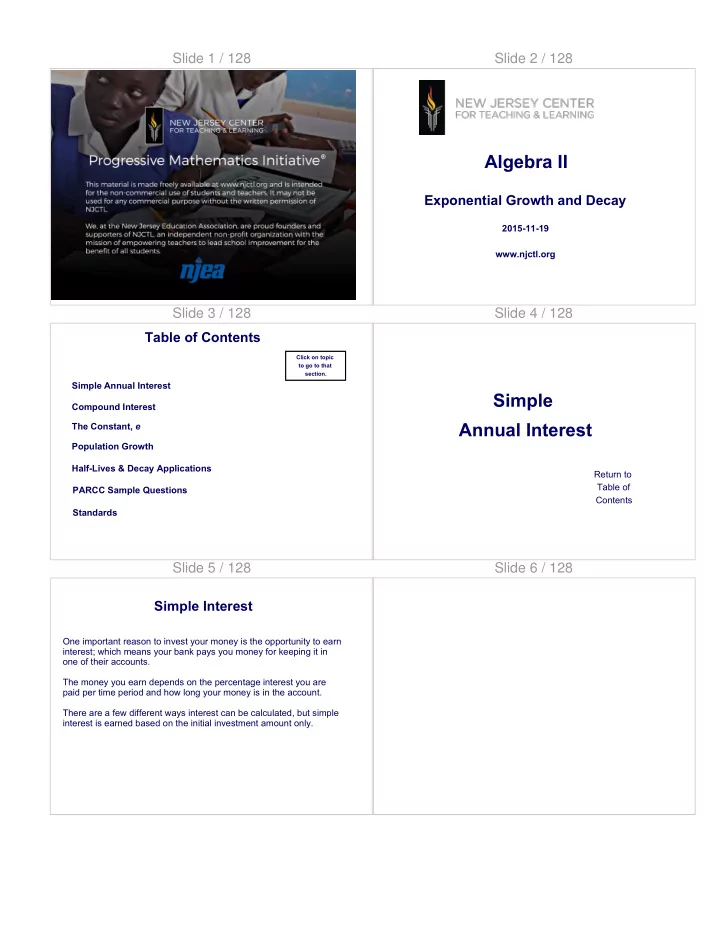
Slide 1 / 128 Slide 2 / 128 Algebra II Exponential Growth and Decay 2015-11-19 www.njctl.org Slide 3 / 128 Slide 4 / 128 Table of Contents Click on topic to go to that section. Simple Annual Interest Simple Compound Interest Annual


slide-1
SLIDE 1

Slide 1 / 128 Slide 2 / 128

Algebra II

Exponential Growth and Decay

2015-11-19 www.njctl.org

Slide 3 / 128 Table of Contents

Click on topic to go to that section.

Simple Annual Interest Compound Interest Half-Lives & Decay Applications Population Growth PARCC Sample Questions Standards The Constant, e

Slide 4 / 128

Simple Annual Interest

Return to Table of Contents

Slide 5 / 128

One important reason to invest your money is the opportunity to earn interest; which means your bank pays you money for keeping it in

  • ne of their accounts.

The money you earn depends on the percentage interest you are paid per time period and how long your money is in the account. There are a few different ways interest can be calculated, but simple interest is earned based on the initial investment amount only.

Simple Interest Slide 6 / 128

slide-2
SLIDE 2

Slide 7 / 128 Slide 8 / 128

In general, this becomes Where A is the accrued amount P is the principal (initial investment) r is the interest rate for that time period t is the time invested

Simple Interest Slide 9 / 128 Simple Interest

Continuing with our example... If you are paid 10% simple interest per year on your initial investment of $1000, what would be your account balance after 3 years?

Slide 9 (Answer) / 128 Simple Interest

Continuing with our example... If you are paid 10% simple interest per year on your initial investment of $1000, what would be your account balance after 3 years?

[This object is a pull tab]

Answer

Slide 10 / 128 Simple Interest

With simple interest, your interest is always calculated based on your initial investment, or starting principal. You can see that the $100 remains the same each year because the initial investment was $1000. Year Account Balance Interest $1000 1 $1100 $100 2 $1200 $100 3 $1300 $100 4 $1400 $100

Slide 11 / 128

1 Which equation describes your ending bank balance if $1000 earns 5% simple annual interest for 7 years? A B C D E None of these

slide-3
SLIDE 3

Slide 11 (Answer) / 128

1 Which equation describes your ending bank balance if $1000 earns 5% simple annual interest for 7 years? A B C D E None of these

Answer

[This object is a pull tab]

B Slide 12 / 128

2 Which equation describes your ending bank balance if $500 earns 6% simple annual interest for 3 years? A B C D E None of these

Slide 12 (Answer) / 128

2 Which equation describes your ending bank balance if $500 earns 6% simple annual interest for 3 years? A B C D E None of these

Answer

[This object is a pull tab]

A Slide 13 / 128

3 What will be your bank balance if you put $600 in your account and earn 5% simple annual interest for seven years?

Slide 13 (Answer) / 128

3 What will be your bank balance if you put $600 in your account and earn 5% simple annual interest for seven years?

Answer

[This object is a pull tab]

$810 Slide 14 / 128

4 What will be your bank balance if you put $1800 in your account and earn 4% simple annual interest for six years?

slide-4
SLIDE 4

Slide 14 (Answer) / 128

4 What will be your bank balance if you put $1800 in your account and earn 4% simple annual interest for six years?

Answer

[This object is a pull tab]

$2,232 Slide 15 / 128

5 What will be your bank balance if you put $3000 in your account and earn 2% simple annual interest for ten years?

Slide 15 (Answer) / 128

5 What will be your bank balance if you put $3000 in your account and earn 2% simple annual interest for ten years?

Answer

[This object is a pull tab]

$3,600 Slide 16 / 128

6 If you are earning 7% simple annual interest and your goal is to have $3000 in your account after six years, how much will you have to initially deposit?

Slide 16 (Answer) / 128

6 If you are earning 7% simple annual interest and your goal is to have $3000 in your account after six years, how much will you have to initially deposit?

Answer

[This object is a pull tab]

$2112.68 Slide 17 / 128

7 If you are earning 10% simple annual interest and your goal is to have $3000 in your account after six years, how much will you have to initially deposit?

slide-5
SLIDE 5

Slide 17 (Answer) / 128

7 If you are earning 10% simple annual interest and your goal is to have $3000 in your account after six years, how much will you have to initially deposit?

Answer

[This object is a pull tab]

$1,875 Slide 18 / 128

8 If you are earning 2% interest and your goal is to have $3000 in your account after six years, how much will you have to initially deposit?

Slide 18 (Answer) / 128

8 If you are earning 2% interest and your goal is to have $3000 in your account after six years, how much will you have to initially deposit?

Answer

[This object is a pull tab]

$2,678.57 Slide 19 / 128

Compound Interest

Return to Table of Contents

Slide 20 / 128 Compound Interest

Compound interest can be thought of as "making interest on interest." Every time the interest is calculated, the current account balance is used to calculate the new interest. This means you are earning slightly more each time period (assuming the other factors are constant) compared to simple interest.

Slide 21 / 128

Recalling our example from the first section, if you are paid 10% simple interest per year on your balance of $1000, you would be paid $100 at the end of one year so your balance at the end of one year is $1100. With compound interest, the following years you will earn interest not

  • nly on your original $1000, but also the interest you've earned in

prior years. This is called the compounding effect of interest. In the real world, it is better to be earning compounding interest than to be paying it...it grows very fast. That's why saving and investing early is so important. At the same time, this is why it can be hard to get out of debt, when you're on the wrong side of compounding interest.

Compound Interest

slide-6
SLIDE 6

Slide 22 / 128

Year Balance Interest $1000 $100 1 $1100 $110 2 $1210 $121 3 $1331 $133.1 4 $1464.1 $146.41 5 $1610.51

Compound Interest

Earning 10% compound interest, yield the table below. Notice, the interest is calculated based on the previous year's ending balance.

Slide 23 / 128

Why does the amount of interest earned increase each year? Instead of total interest of $500 (with simple interest), you earn $610.51. Why?

Compound Interest

Year Balance Interest $1000 $100 1 $1100 $110 2 $1210 $121 3 $1331 $133.1 4 $1464.1 $146.41 5 $1610.51

Math Practice

Slide 24 / 128

Algebraically, After two years, the amount you earn would be given by But we can rewrite this expression to yield: What do you think your account balance will be after three years?

Compound Interest Slide 24 (Answer) / 128

Algebraically, After two years, the amount you earn would be given by But we can rewrite this expression to yield: What do you think your account balance will be after three years?

Compound Interest

[This object is a pull tab]

Math Practice

The question on this slide addresses MP.8 Additional Question to address MPs: What generalization can you make? (MP.8)

Slide 25 / 128

Therefore, in general, your account balance with compound interest will be given by where A(t) is the amount of money after t time periods P is the principal, or initial investment t is the number of time periods (usually years) r is the interest rate per time period

Compound Interest Slide 26 / 128 Compound Interest

Practice: Calculate the total account balance after investing $750 at 5% interested compounded yearly for 8 years.

slide-7
SLIDE 7

Slide 26 (Answer) / 128 Compound Interest

Practice: Calculate the total account balance after investing $750 at 5% interested compounded yearly for 8 years.

[This object is a pull tab]

Answer

Slide 27 / 128

With annual interest, you receive your interest at the end of the time period, in this case the year. But, it's also possible for interest to compound within the year. For instance, your interest rate could be compounded quarterly. In this case, the interest is paid four time each year. The number of times per year that interest is compounded is called n. So, in this case, n = 4.

Compound Interest Slide 28 / 128

If n = 4, that means that we calculate and pay interest four times. It also means that only 1/4 of a year will have passed between each interest calculation. So, we have to divide the annual interest rate by 4 to get the interest rate for one calendar quarter: 10% divided by 4 = 2.5% Then we calculate the interest 4 times. The power of 4 reflects that the interest is calculated four times a year, each time at the annual rate divided by 4.

Quarterly Compounding Slide 29 / 128

So, even though the annual interest rate is the same: 10% In this case, you earn an extra $3.81 by quarterly compounding as compared to annual interest. You end with $1103.81 rather than $1100.00

Quarterly Compounding Slide 30 / 128

In general, the result of compounding more frequently is given by the formula: where A is the total account balance P is the principal, or starting balance r is the annual interest rate t is the number of years n is the number of times per year that the interest is compounded

Compounding Slide 31 / 128

What if we compounded weekly? What would the formula look like for that? Discuss and write a formula for that case. Then, determine your bank balance after one year, starting with $1000 and compounding weekly with 10% interest.

Weekly Compounding

slide-8
SLIDE 8

Slide 31 (Answer) / 128

What if we compounded weekly? What would the formula look like for that? Discuss and write a formula for that case. Then, determine your bank balance after one year, starting with $1000 and compounding weekly with 10% interest.

Weekly Compounding

[This object is a pull tab]

Math Practice & Answer The question on this slide addresses MP.2 Additional Questions to address MPs: How can you represent the problem with symbols & numbers? (MP.2) How would you describe the problem in your

  • wn words? (MP.2)

Slide 32 / 128

When we compounded 4 times, we gained $3.08 more than if we had used simple interest Compounding 52 times earns a bit more: $5.06 is $1.98 more than the $3.08 we earned by compounding 4 times. Let's see what happens if we keep increasing our compounding

Weekly Compounding Slide 33 / 128

Fill in this chart for compounding: Daily (365.25 times) Each second (31,557,600 times)

Compound Interest

Interest Balance Annual $100 $1100 Quarterly $103.81 $1103.81 Weekly $5.06 $1105.06 Daily Every second

Math Practice

Slide 34 / 128

Compounding Interest Balance Annually $100 $1100 Quarterly $103.81 $1103.81 Weekly $5.06 $1105.06 Daily Every second

Compound Interest

Answer

Slide 35 / 128

9 Which equation describes your bank balance if $5250 earns 4% annual interest, compounded annually for 9 years? A B C D E None of these

Slide 35 (Answer) / 128

9 Which equation describes your bank balance if $5250 earns 4% annual interest, compounded annually for 9 years? A B C D E None of these

Answer

[This object is a pull tab]

B

slide-9
SLIDE 9

Slide 36 / 128

10 Which equation describes your bank balance if $1000 earns 6% annual interest, compounded quarterly, for 7 years? A B C D E None of these

Slide 36 (Answer) / 128

10 Which equation describes your bank balance if $1000 earns 6% annual interest, compounded quarterly, for 7 years? A B C D E None of these

Answer

[This object is a pull tab]

E Slide 37 / 128

11 Which equation describes your ending bank balance if $500 earns 9% annual interest, compounded monthly, for 3 years? A B C D E None of these

Slide 37 (Answer) / 128

11 Which equation describes your ending bank balance if $500 earns 9% annual interest, compounded monthly, for 3 years? A B C D E None of these

Answer

[This object is a pull tab]

D Slide 38 / 128

12 What will your bank balance be if you put $600 in your account and earn 5% interest, compounded weekly, for seven years?

Slide 38 (Answer) / 128

12 What will your bank balance be if you put $600 in your account and earn 5% interest, compounded weekly, for seven years?

Answer

[This object is a pull tab]

$851.30

slide-10
SLIDE 10

Slide 39 / 128

13 What will be your bank balance if you put $1800 in your account and earn 4% interest, compounded daily, for six years?

Slide 39 (Answer) / 128

13 What will be your bank balance if you put $1800 in your account and earn 4% interest, compounded daily, for six years?

Answer

[This object is a pull tab]

$2,288.22 Slide 40 / 128

14 What will be your bank balance if you put $3000 in your account and earn 2% interest, compounded weekly, for ten years?

Slide 40 (Answer) / 128

14 What will be your bank balance if you put $3000 in your account and earn 2% interest, compounded weekly, for ten years?

Answer

[This object is a pull tab]

$3,664.06 Slide 41 / 128

15 If you are earning 7% interest, compounded daily, and your goal is to have $3000 in your account after six years, how much will you have to initially deposit?

Slide 41 (Answer) / 128

15 If you are earning 7% interest, compounded daily, and your goal is to have $3000 in your account after six years, how much will you have to initially deposit?

Answer

[This object is a pull tab]

$1,971.22

slide-11
SLIDE 11

Slide 42 / 128

16 If you are earning 10% interest, compounded weekly, and your goal is to have $3000 in your account after six years, how much will you have to initially deposit?

Slide 42 (Answer) / 128

16 If you are earning 10% interest, compounded weekly, and your goal is to have $3000 in your account after six years, how much will you have to initially deposit?

Answer

[This object is a pull tab]

$1,647.39 Slide 43 / 128

17 How much was originally invested if you have $63,710.56 in an account generating 4% interest (compounded monthly) over 15 years?

Slide 43 (Answer) / 128

17 How much was originally invested if you have $63,710.56 in an account generating 4% interest (compounded monthly) over 15 years?

Answer

[This object is a pull tab]

$35,000 Slide 44 / 128

18 What interest rate is needed to double your money if it's invested for 8 years compounded quarterly?

Slide 44 (Answer) / 128

18 What interest rate is needed to double your money if it's invested for 8 years compounded quarterly?

Answer

[This object is a pull tab]

slide-12
SLIDE 12

Slide 45 / 128

Let's look at this data from a slightly different perspective: Compounding Times Per Year Interest Extra Interest Earned 1 $100.00 4 $103.81 $3.81 52 $105.06 $1.25 365.25 $105.16 $0.10 31,557,600 $105.17 $0.01 What do you notice about the amount of interest gained as the amount of compounding increases?

Compound Interest Slide 46 / 128

The amount of interest earned is approaching $105.17 per year as the amount of compounding gets very large. Mathematicians wondered if there was a way to predict the limit as the amount of compounding approached infinity (if compounding was done continuously.) The next section will address this intriguing question! Compound Times Per Year Interest Extra Interest Earned 1 $100.00 4 $103.81 $3.81 52 $105.06 $1.25 365.25 $105.16 $0.10 31,557,600 $105.17 $0.01

Compound Interest Slide 47 / 128 Recap:

Discuss: What is the difference between simple and compound interest?

Slide 48 / 128

The Constant, e

Return to Table of Contents

Slide 49 / 128

Let's focus in on a portion of our formula Specifically looking at just one year, let t = 1 Now using the special case of r = 1 Does this approach a number as n gets very large?

The Constant, e Slide 49 (Answer) / 128

Let's focus in on a portion of our formula Specifically looking at just one year, let t = 1 Now using the special case of r = 1 Does this approach a number as n gets very large?

The Constant, e

[This object is a pull tab]

Math Practice

The slide and the next 3 slides address MP.2 & MP.8 Additional Questions to address MPs: What generalizations can you make? (MP.8) What do you think the answer/result will be? (MP.2)

slide-13
SLIDE 13

Slide 50 / 128

n 1 10 100 1000 10,000 100,000 Use your calculator to complete this table.

The Constant, e Slide 51 / 128

n 1 2 10 2.5937 100 2.7048 1000 2.7169 10,000 2.7181 100,000 2.7182 Infinity Mathematicians proved that as n approaches infinity, approaches the number they were to name e.

The Constant, e Slide 52 / 128

n 1 2 10 2.5937 100 2.7048 1000 2.7169 10,000 2.7181 100,000 2.7182 Infinity 2.7182... e is an irrational number: its decimals go on forever and never end, repeat or form a pattern. It's first few digits are 2.7182.

The Constant, e Slide 53 / 128

2.718281828459045235360287471352662497757247093699959574966967627 7240766303535475945713821785251664274274663919320030599218174135 9662904357290033429526059563073813232862794349076323382988075319 5251019011573834187930702154089149934884167509244761460668082264 8001684774118537423454424371075390777449920695517027618386062613 3138458300075204493382656029760673711320070932870912744374704723 0696977209310141692836819025515108657463772111252389784425056953 6967707854499699679468644549059879316368892300987931277361782154 2499922957635148220826989519366803318252886939849646510582093923 9829488793320362509443117301238197068416140397019837679320683282 3764648042953118023287825098194558153017567173613320698112509961 8188159304169035159888851934580727386673858942287922849989208680 5825749279610484198444363463244968487560233624827041978623209002 1609902353043699418491463140934317381436405462531520961836908887 0701676839642437814059271456354906130310720851038375051011574770 41718986106873969655212671546889570350354

Here are the first 1000 digits of e, but e has been calculated to millions of digits.

The Constant, e Slide 54 / 128

Your calculator actually has a key for e since it has many uses! e shows up in a wide range of math, science, business, economics, medicine, etc. It was first used, but not identified specifically, by John Napier in about 1618.It was derived by Jacob Bernouli and then used by Leibniz and Huygens in the late 1600s.The designation of the letter e for this number was made by Euler in the early 1700s. It was first computed from solving the problem we've been exploring...compound interest. Since then, it has been computed many different ways.

The Constant, e Slide 55 / 128

The letter e allows us to simplify the continuous compounding of interest (n going to infinity) by replacing this formula: with this formula where A is the amount after t time periods P is the principal, or starting amount r is the growth rate per time period t is the number of time periods

Continuous Compounding

slide-14
SLIDE 14

Slide 56 / 128

Let's check this by substituting into the formula for our example of $1000 earning 10% interest compounded continuously.

Continuous Compounding

The account balance after one year of being compounded continuously is $1,105.17.

Slide 57 / 128

We can now add a row for continuous compounding by using e in

  • ur calculators.

Compound Times Per Year Interest Extra Interest Earned 1 $100.00 4 $103.81 $3.81 52 $105.06 $1.25 365.25 $105.16 $0.10 31,557,600 $105.17 $0.01 Continuous $105.17 < $0.01

Continuous Compounding Slide 58 / 128

19 Which equation describes your bank balance if $1000 earns 6% annual interest, compounded continuously, for 7 years? A B C D E None of these

Slide 58 (Answer) / 128

19 Which equation describes your bank balance if $1000 earns 6% annual interest, compounded continuously, for 7 years? A B C D E None of these

Answer

[This object is a pull tab]

A Slide 59 / 128

20 Which equation describes your ending bank balance if $500 earns 9% annual interest, compounded continuously for 3 years? A B C D E None of these

Slide 59 (Answer) / 128

20 Which equation describes your ending bank balance if $500 earns 9% annual interest, compounded continuously for 3 years? A B C D E None of these

Answer

[This object is a pull tab]

B

slide-15
SLIDE 15

Slide 60 / 128

21 What will your bank balance be if you put $600 in your account and earn 5% annual interest, compounded continuously, for seven years?

Slide 60 (Answer) / 128

21 What will your bank balance be if you put $600 in your account and earn 5% annual interest, compounded continuously, for seven years?

Answer

[This object is a pull tab]

$851.44 Slide 61 / 128

22 What will be your bank balance if you put $1800 in your account and earn 4% annual interest, compounded continuously, for six years?

Slide 61 (Answer) / 128

22 What will be your bank balance if you put $1800 in your account and earn 4% annual interest, compounded continuously, for six years?

Answer

[This object is a pull tab]

$2,288.25 Slide 62 / 128

23 What will be your bank balance if you put $3000 in your account and earn 2% annual interest, compounded continuously, for ten years?

Slide 62 (Answer) / 128

23 What will be your bank balance if you put $3000 in your account and earn 2% annual interest, compounded continuously, for ten years?

Answer

[This object is a pull tab]

$3,664.21

slide-16
SLIDE 16

Slide 63 / 128

24 If you are earning 7% annual interest, compounded continuously, and your goal is to have $3000 in your account after six years, how much will you have to initially deposit?

Slide 63 (Answer) / 128

24 If you are earning 7% annual interest, compounded continuously, and your goal is to have $3000 in your account after six years, how much will you have to initially deposit?

Answer

[This object is a pull tab]

$1,971.14 Slide 64 / 128

25 If you are earning 10% annual interest, compounded continuously, and your goal is to have $3000 in your account after six years, how much will you have to initially deposit?

Slide 64 (Answer) / 128

25 If you are earning 10% annual interest, compounded continuously, and your goal is to have $3000 in your account after six years, how much will you have to initially deposit?

Answer

[This object is a pull tab]

$1,646.43 Slide 65 / 128

Population Growth

Return to Table of Contents

Slide 66 / 128 Population Growth

Sometimes, you will be asked questions that are related to the interest formulas, but presented slightly different. Here's an example: A town's population is growing at a rate of 3% per year. If its initial population is 1.2 million people, what will its population be in 5 years? Which formula would we use for this problem?

slide-17
SLIDE 17

Slide 66 (Answer) / 128 Population Growth

Sometimes, you will be asked questions that are related to the interest formulas, but presented slightly different. Here's an example: A town's population is growing at a rate of 3% per year. If its initial population is 1.2 million people, what will its population be in 5 years? Which formula would we use for this problem?

[This object is a pull tab]

Math Practice

The question on this slide addresses MP.2 Additional Questions to address MPs: How can you represent the problem with symbols & numbers? (MP.2) How would you describe the problem in your own words? (MP.2)

Slide 67 / 128 Population Growth

A town's population is growing at a rate of 3% per year. If its initial population is 1.2 million people, what will its population be in 5 years? The familiar formula we can use to answer this question is where A is the population at some time, t P is the initial population r is the growth rate (written as a decimal) t is the time in years after the initial population was measured

Slide 68 / 128 Population Growth

A town's population is growing at a rate of 3% per year. If its initial population is 1.2 million people, what will its population be in 5 years, in millions? Now, we can substitute our values into the equation and solve. The town's population will be 1.391 million people Populations often grow based on this exponential model.

Slide 69 / 128

26 A town's population is growing at a rate of 4.5% per

  • year. If its initial population is 2.3 million people, what

will be its population in 3 years?

Slide 69 (Answer) / 128

26 A town's population is growing at a rate of 4.5% per

  • year. If its initial population is 2.3 million people, what

will be its population in 3 years?

Answer

[This object is a pull tab]

2.625 million Slide 70 / 128

27 A town's population is growing at a rate of 5.3% per

  • year. If its initial population is 1.4 million people, what

will be its population in 7 years?

slide-18
SLIDE 18

Slide 70 (Answer) / 128

27 A town's population is growing at a rate of 5.3% per

  • year. If its initial population is 1.4 million people, what

will be its population in 7 years?

Answer

[This object is a pull tab]

2.010 million Slide 71 / 128

28 A town's population is growing at a rate of 6.25% per

  • year. If its initial population is 2.15 million people, what

will be its population in 11 years?

Slide 71 (Answer) / 128

28 A town's population is growing at a rate of 6.25% per

  • year. If its initial population is 2.15 million people, what

will be its population in 11 years?

Answer

[This object is a pull tab]

4.188 million Slide 72 / 128

29 A town's population is growing at a rate of 7.75% per

  • year. If its initial population is 2.8 million people, what

will be its population in 13 years?

Slide 72 (Answer) / 128

29 A town's population is growing at a rate of 7.75% per

  • year. If its initial population is 2.8 million people, what

will be its population in 13 years?

Answer

[This object is a pull tab]

7.389 million Slide 73 / 128

In other scenarios, you will be provided with an equation that contains some of the information already provided, such as where A(t) is the population at some time, t P is the initial population, t is the time in years after the initial population was measured 1.5 can be translated into (1 + 0.5), which means that the growth rate was 0.5, or 50%. Let's use this model for the next questions.

Population Models

slide-19
SLIDE 19

Slide 74 / 128

If the initial population is 4 million, what will the population be after

  • ne year?

Example Slide 74 (Answer) / 128

If the initial population is 4 million, what will the population be after

  • ne year?

Example

[This object is a pull tab]

Math Practice

The questions on this slide & the next slide address MP.1 & MP.2 Additional Questions to address MPs: What information are you given? (MP.1) What is this problem asking? (MP.1) How can you represent the problem with symbols & numbers? (MP.2) How would you describe the problem in your own words? (MP.2)

Slide 75 / 128

If the initial population is 4 million, what will the population be after six years?

Example Slide 76 / 128

If the initial population is 4 million, what will the population be after five months? You might think that you could just recall that after one year the population is 6 million and it started at 4 million, so after half a year it'd be 4 million + of 2 million = 5.83 million But, that would only be true for a linear model...and this is

  • exponential. So this is not correct.

Discuss possible solutions.

Example Slide 76 (Answer) / 128

If the initial population is 4 million, what will the population be after five months? You might think that you could just recall that after one year the population is 6 million and it started at 4 million, so after half a year it'd be 4 million + of 2 million = 5.83 million But, that would only be true for a linear model...and this is

  • exponential. So this is not correct.

Discuss possible solutions.

Example

[This object is a pull tab]

Math Practice

The questions on this slide & the next 4 slides address MP.1, MP.2, MP.3 & MP.6 Additional Questions to address MPs: What information are you given? (MP.1) What is this problem asking? (MP.1) How can you represent the problem with symbols & numbers? (MP.2) What math language will help you prove your answer? (MP.3) How do you know your answer is accurate? (MP.6) What decimal place should we use for rounding? (MP.6)

Slide 77 / 128

We convert the formula to provide monthly results by raising the rate to the power of 12t, rather than t, so that when we put in the number of years as t, it converts that to 12 t months. In order not to change the amount after one year, I have to take the 12th root of the rate, so that the equation is still true NOTE: The properties of exponents shows that Substitute t = , since we are looking for of a year

Example

slide-20
SLIDE 20

Slide 78 / 128

Substitute t = , since we are looking for of a year

Example Slide 79 / 128

where the value of t is measured in years. To convert and be able to substitute months, we must divide t by 12.

Example

Instead of changing our exponential base to solve the problem, we could also change the form of the exponent. In our original problem, our function was

Slide 80 / 128 Slide 81 / 128

If the initial population is 4 million, what will the population be after 15 months?

Example Slide 81 (Answer) / 128 Slide 82 / 128

30 Using the below model, calculate the population, in millions, after one year if the initial population is 5.8 million.

slide-21
SLIDE 21

Slide 82 (Answer) / 128

30 Using the below model, calculate the population, in millions, after one year if the initial population is 5.8 million.

Answer

[This object is a pull tab]

10.44 million Slide 83 / 128

31 Using the below model, calculate the population, in millions, after five years, if the initial population is 5.8 million.

Slide 83 (Answer) / 128

31 Using the below model, calculate the population, in millions, after five years, if the initial population is 5.8 million.

Answer

[This object is a pull tab]

109.59 million Slide 84 / 128

32 Which equation would describe the monthly population consistent with the given annual model. A B C D E None of the above

Slide 84 (Answer) / 128

32 Which equation would describe the monthly population consistent with the given annual model. A B C D E None of the above

Answer

[This object is a pull tab]

D Slide 85 / 128

33 Which equation would describe the quarterly population consistent with the given annual model. A B C D E None of the above

slide-22
SLIDE 22

Slide 85 (Answer) / 128

33 Which equation would describe the quarterly population consistent with the given annual model. A B C D E None of the above

Answer

[This object is a pull tab]

C Slide 86 / 128

34 Using this annual model for population growth, calculate the population, in millions, after three months.

Slide 86 (Answer) / 128

34 Using this annual model for population growth, calculate the population, in millions, after three months.

Answer

[This object is a pull tab]

6.72 million Slide 87 / 128

35 Using this annual model for population growth, calculate the population, in millions, after 16 months.

Slide 87 (Answer) / 128

35 Using this annual model for population growth, calculate the population, in millions, after 16 months.

Answer

[This object is a pull tab]

17.95 million Slide 88 / 128

36 Using this annual model for population growth, calculate the population, in millions, after 19 months.

slide-23
SLIDE 23

Slide 88 (Answer) / 128

36 Using this annual model for population growth, calculate the population, in millions, after 19 months.

Answer

[This object is a pull tab]

11.16 million Slide 89 / 128

Half-Lives and Decay Applications

Return to Table of Contents

Slide 90 / 128

There are nuclear reactions that occur which result in a nucleus having fewer protons or neutrons. If the number of protons changes, the result is a new element. If only the number of neutrons changes, the element stays the same but it becomes a new isotope of that element. Spontaneous transformation (those that occur without outside forces) result in a reduction in the number of protons and/or neutrons...so it's called "nuclear decay."

Nuclear Decay Slide 91 / 128

It is impossible to predict if an individual nucleus will decay. But, given a large number of nuclei, the percentage which will decay in a fixed amount of time is predictable. The time it takes for half of the nuclei in a sample to decay is called the half-life of that isotope. After each half-life, half of the nuclei have decayed.

Nuclear Decay Slide 92 / 128

Since this rate of decay is so predictable, it can be used to date how long a substance was created. This is done by measuring the ratio of the amount of the original nuclei to the decayed nuclei. From that, the number of half-lives which have occurred is calculated. Since half-lives are known and predictable, the age of the object can be determined.

Nuclear Decay Slide 93 / 128

When plants grow they take in Carbon from the atmosphere. That Carbon decays from Carbon-14 to Nitrogen-14 over many years. By looking at the ration of those elements, how old the living material is can be determined. The half-life of that reaction is 5,730 years.

Carbon Dating

slide-24
SLIDE 24

Slide 94 / 128

Each half life results in a loss of half the original substance.

Half Lives

https://en.wikipedia.org/wiki/Half-life

Slide 95 / 128

The amount of remaining substance over time is shown here.

Half Lives Slide 96 / 128 Slide 97 / 128

can be an amount of mass, m, or the number of nuclei, N

Half Life Formula Slide 98 / 128

From our previous formula, n was the number of half-lives which have elapsed. It can be calculated on its own using the formula where t is the time elapsed , tau, is the half-life of the material

Half Life Formula

Combining our formulas yields

Slide 98 (Answer) / 128

From our previous formula, n was the number of half-lives which have elapsed. It can be calculated on its own using the formula where t is the time elapsed , tau, is the half-life of the material

Half Life Formula

Combining our formulas yields

[This object is a pull tab]

Teacher Notes Using rather than for legibility. Make sure students note the difference between the variable, t, and the greek symbol, tau. They appear very similar when written.

slide-25
SLIDE 25

Slide 99 / 128

After 250 days, how many grams will remain of a 100 gram sample if the for that substance is 75 days?

Example Slide 100 / 128

Teachers: Use the questions located in the pull tab for the next 6 slides.

Slide 100 (Answer) / 128

Teachers: Use the questions located in the pull tab for the next 6 slides.

[This object is a pull tab]

Math Practice

The SMART Response Question on the next 6 slides address MP.4, MP.5 & MP.6 Additional Questions to address MPs: What connections do you see between the powers of 2, or 1/2, and the half- lives? (MP.4) Can you do this mentally? (MP.5) Will a calculator help? (MP.5) How do you know your answer is accurate? (MP.6) What decimal place should we use for rounding? (MP.6)

Slide 101 / 128

37 If 1/4 of the initial substance remains, how many half- lives have elapsed?

Slide 101 (Answer) / 128

37 If 1/4 of the initial substance remains, how many half- lives have elapsed?

Answer

[This object is a pull tab]

2 Slide 102 / 128

38 If the half-life of that substance is 22 days, and only 1/4

  • f it remains, how many days have elapsed?
slide-26
SLIDE 26

Slide 102 (Answer) / 128

38 If the half-life of that substance is 22 days, and only 1/4

  • f it remains, how many days have elapsed?

Answer

[This object is a pull tab]

44 days Slide 103 / 128

39 If 1/16 of an initial substance remains, how many half- lives have elapsed?

Slide 103 (Answer) / 128

39 If 1/16 of an initial substance remains, how many half- lives have elapsed?

Answer

[This object is a pull tab]

4 half-lives Slide 104 / 128

40 If the half-life of that substance is 80 days, and only 1/16

  • f it remains, how many days have elapsed?

Slide 104 (Answer) / 128

40 If the half-life of that substance is 80 days, and only 1/16

  • f it remains, how many days have elapsed?

Answer

[This object is a pull tab]

320 days Slide 105 / 128

41 If 12.5% of an initial amount of Carbon 14 remains, how many years ago did the plant die? ( , for Carbon-14 is 5730 years.)

slide-27
SLIDE 27

Slide 105 (Answer) / 128

41 If 12.5% of an initial amount of Carbon 14 remains, how many years ago did the plant die? ( , for Carbon-14 is 5730 years.)

Answer

[This object is a pull tab]

17,190 years Slide 106 / 128

42 A certain radioactive material has a half-life of 20 years. If 100g were present to start, how much will remain in 7 years?

Slide 106 (Answer) / 128

42 A certain radioactive material has a half-life of 20 years. If 100g were present to start, how much will remain in 7 years?

Answer

[This object is a pull tab]

78.46g Slide 107 / 128 Additional Applications

Sometimes, you will be asked questions that are related to the interest formulas, but are slightly different. Here's an example: A new car depreciates in value at a rate of 8% per year. If you purchase it for $31,000, how much is it worth after 10 years? Which formula would we use for this problem?

Slide 107 (Answer) / 128 Additional Applications

Sometimes, you will be asked questions that are related to the interest formulas, but are slightly different. Here's an example: A new car depreciates in value at a rate of 8% per year. If you purchase it for $31,000, how much is it worth after 10 years? Which formula would we use for this problem?

[This object is a pull tab]

Math Practice

The questions on this slide & the next 3 slides address MP.1 & MP.2 Additional Questions to address MPs: What information are you given? (MP.1) What is this problem asking? (MP.1) How can you represent the problem with symbols & numbers? (MP.2) How would you describe the problem in your own words? (MP.2)

Slide 108 / 128 Additional Applications

A new car depreciates in value at a rate of 8% per year. If you purchase it for $31,000, how much is it worth after 10 years? The formula that we can use to answer this question is How will we write the rate?

slide-28
SLIDE 28

Slide 109 / 128 Additional Applications

A new car depreciates in value at a rate of 8% per year. If you purchase it for $31,000, how much is it worth after 10 years? Since the car's value is falling at a rate is 8%, it is given a negative value, so our equation would become

  • r

Slide 110 / 128 Additional Applications

A new car depreciates in value at a rate of 8% per year. If you purchase it for $31,000, how much will it be worth after 10 years? Now, we can calculate our answer Therefore, the car will be worth $13,466.04 in 10 years.

Slide 111 / 128

43 A new truck depreciates in value at a rate of 9% per year. If you purchase one for $27,150, how much is it worth after 5 years?

Slide 111 (Answer) / 128

43 A new truck depreciates in value at a rate of 9% per year. If you purchase one for $27,150, how much is it worth after 5 years?

Answer

[This object is a pull tab]

$16,942.47 Slide 112 / 128

44 A new SUV depreciates in value at a rate of 9.5% per

  • year. If you purchase one for $33,725, how much will it

be worth after 7 years?

Slide 112 (Answer) / 128

44 A new SUV depreciates in value at a rate of 9.5% per

  • year. If you purchase one for $33,725, how much will it

be worth after 7 years?

Answer

[This object is a pull tab]

$16,768.41

slide-29
SLIDE 29

Slide 113 / 128

45 A new sofa depreciates in value at a rate of 22% per

  • year. If you purchase one for $1,300, how much will it be

worth after 4 years?

Slide 113 (Answer) / 128

45 A new sofa depreciates in value at a rate of 22% per

  • year. If you purchase one for $1,300, how much will it be

worth after 4 years?

Answer

[This object is a pull tab]

$481.20 Slide 114 / 128

46 A new car depreciates in value at a rate of 8% per year. If a 5 year old car is worth $20,000, how much was it

  • riginally worth?

Slide 114 (Answer) / 128

46 A new car depreciates in value at a rate of 8% per year. If a 5 year old car is worth $20,000, how much was it

  • riginally worth?

Answer

[This object is a pull tab]

The original value of the car was $30,345.26. .26

Slide 115 / 128

47 A new sofa depreciates in value at a rate of 22% per

  • year. If a 5 year old sofa is worth $500, how much was it
  • riginally worth?

Slide 115 (Answer) / 128

47 A new sofa depreciates in value at a rate of 22% per

  • year. If a 5 year old sofa is worth $500, how much was it
  • riginally worth?

Answer

[This object is a pull tab]

$1,731.80

slide-30
SLIDE 30

Slide 116 / 128

PARCC Sample Questions

The remaining slides in this presentation contain questions from the PARCC Sample Test. After finishing this unit, you should be able to answer these questions. Good Luck! Return to Table

  • f Contents

Slide 117 / 128

48 During a 1 year period, a population of tropical insects grew according to the model P = P0(1.46)t, where P is the population, P0 is the initial population, and t is time in

  • years. Which equation can be used to model the

approximate weekly growth rate? (Assume 52 weeks in a year.) A P = P0(1.0073)52t B P = P0(1.0088)52t C P = P0(1.0281)52t D P = P0(1.0371)52t

PARCC Released Question - PBA - Calculator Section

Question 2/13

Slide 117 (Answer) / 128

48 During a 1 year period, a population of tropical insects grew according to the model P = P0(1.46)t, where P is the population, P0 is the initial population, and t is time in

  • years. Which equation can be used to model the

approximate weekly growth rate? (Assume 52 weeks in a year.) A P = P0(1.0073)52t B P = P0(1.0088)52t C P = P0(1.0281)52t D P = P0(1.0371)52t

PARCC Released Question - PBA - Calculator Section

Question 2/13

Answer

[This object is a pull tab]

A Slide 118 / 128

49 A scientist places 7.35 grams of radioactive element in a dish. The half-life of the element is 2 days. After d days, the number of grams of the element remaining in the dish is given by the function Which statement is true about the equation when it is rewritten without a fractional exponent? Select all that apply. A An approximately equivalent equation is B An approximately equivalent equation is C The base of the exponent in this form of the equation can be interpreted to mean that the element decays by 0.250 grams per day. D The base of the exponent in this form of the equation can be interpreted to mean that the element decays by 0.707 grams per day. E The base of the exponent in this form of the equation can be interpreted to mean that about 25% of the element remains from one day to the next day. F The base of the exponent in this form of the equation can be interpreted to mean that about 70.7% of the element remains from one day to the next day. PARCC Released Question - EOY - Calculator Section

Question 13/26

Slide 118 (Answer) / 128

49 A scientist places 7.35 grams of radioactive element in a dish. The half-life of the element is 2 days. After d days, the number of grams of the element remaining in the dish is given by the function Which statement is true about the equation when it is rewritten without a fractional exponent? Select all that apply. A An approximately equivalent equation is B An approximately equivalent equation is C The base of the exponent in this form of the equation can be interpreted to mean that the element decays by 0.250 grams per day. D The base of the exponent in this form of the equation can be interpreted to mean that the element decays by 0.707 grams per day. E The base of the exponent in this form of the equation can be interpreted to mean that about 25% of the element remains from one day to the next day. F The base of the exponent in this form of the equation can be interpreted to mean that about 70.7% of the element remains from one day to the next day. PARCC Released Question - EOY - Calculator Section

Question 13/26

Answer

[This object is a pull tab]

B and F Slide 119 / 128

PARCC Released Question - EOY Calculator Section An investor deposits g dollars into an account at the beginning of each year for n years. The account earns an annual interest rate of r, expressed as a decimal. The amount of money S, in dollars, in the account can be determined by the formula Part A Suppose the investor deposits $500 for 10 years into an account that earns an annual interest rate of 5%. If no additional deposits or withdrawals are made, what will be the balance in the account at the end of 10 years?

  • A. $6,003.05
  • B. $6,015.06
  • C. $6,288.95
  • D. $6,301.52

Part B Suppose the investor wanted the balance in the account to be at least $12,000 at the end of 10 years. At an annual interest rate of 5%, the amount of the yearly deposit should be at least $_______. (answer to the nearest cent)

Question 19/26
slide-31
SLIDE 31

Slide 120 / 128

50 Part A - Suppose the investor deposits $500 a year for 10 years into an account that earns an annual interest rate

  • f 5%. If no additional deposits or withdrawals are made,

what will be the balance in the account at the end of 10 years? A $6,003.05 B $6,015.06 C $6,288.95 D $6,301.52

PARCC Released Question - EOY Calculator Section

Question 19/26

Slide 120 (Answer) / 128

50 Part A - Suppose the investor deposits $500 a year for 10 years into an account that earns an annual interest rate

  • f 5%. If no additional deposits or withdrawals are made,

what will be the balance in the account at the end of 10 years? A $6,003.05 B $6,015.06 C $6,288.95 D $6,301.52

PARCC Released Question - EOY Calculator Section

Question 19/26

Answer

[This object is a pull tab]

C

S = g/r [(1+r)n - 1] S = $500/(0.05) [(1+.05)10 - 1] S = $10,000 [(1.05)10 - 1] S = $10,000 [1.628895 - 1] S = $10,000 [0.628895] S = $6288.95

Slide 121 / 128

51 PART B - Suppose the investor wanted the balance in the account to be at least $12,000 at the end of 10

  • years. At an annual interest rate of 5%, the amount of

the yearly deposit should be at least $_______. (answer to the nearest cent)

PARCC Released Question - EOY Calculator Section

Question 19/26

Slide 121 (Answer) / 128

51 PART B - Suppose the investor wanted the balance in the account to be at least $12,000 at the end of 10

  • years. At an annual interest rate of 5%, the amount of

the yearly deposit should be at least $_______. (answer to the nearest cent)

PARCC Released Question - EOY Calculator Section

Question 19/26

Answer

[This object is a pull tab]

$954.05

12,000 = [(1+0.05)10 - 1] 600 = g[(1.05)10 - 1] 600 = 0.62889g g = 954.05 g 0.05

Slide 122 / 128

52 When approximating the age of an artifact that is less than 40,000 years old, the radioisotope carbon-14 can be used. Carbon-14 is an element with the property that every 5,730 years the mass of the element in a sample is reduced by half. The mass of the carbon-14 in an artifact can be modeled by an exponential function, m of its age, x. Part A Let A represent the original mass of carbon-14. Which function is an appropriate model?

A B C D

PARCC Released Question - EOY - Calculator Section

Question 26/26

Slide 122 (Answer) / 128

52 When approximating the age of an artifact that is less than 40,000 years old, the radioisotope carbon-14 can be used. Carbon-14 is an element with the property that every 5,730 years the mass of the element in a sample is reduced by half. The mass of the carbon-14 in an artifact can be modeled by an exponential function, m of its age, x. Part A Let A represent the original mass of carbon-14. Which function is an appropriate model?

A B C D

PARCC Released Question - EOY - Calculator Section

Question 26/26

Answer

[This object is a pull tab]

B

slide-32
SLIDE 32

Slide 123 / 128

53 When approximating the age of an artifact that is less than 40,000 years old, the radioisotope carbon-14 can be used. Carbon-14 is an element with the property that every 5,730 years the mass of the element in a sample is reduced by half. The mass of the carbon-14 in an artifact can be modeled by an exponential function, m of its age, x. Part B Based on the situation, which interval represents the domain of the function m? A B C 0 ≤ x ≤ 5,730 D 0 ≤ x ≤ 40,000 PARCC Released Question - EOY - Calculator Section

Question 26/26

Slide 123 (Answer) / 128

53 When approximating the age of an artifact that is less than 40,000 years old, the radioisotope carbon-14 can be used. Carbon-14 is an element with the property that every 5,730 years the mass of the element in a sample is reduced by half. The mass of the carbon-14 in an artifact can be modeled by an exponential function, m of its age, x. Part B Based on the situation, which interval represents the domain of the function m? A B C 0 ≤ x ≤ 5,730 D 0 ≤ x ≤ 40,000 PARCC Released Question - EOY - Calculator Section

Question 26/26

Answer

[This object is a pull tab]

D Slide 124 / 128

54 When approximating the age of an artifact that is less

than 40,000 years old, the radioisotope carbon-14 can be used. Carbon-14 is an element with the property that every 5,730 years the mass of the element in a sample is reduced by half. The mass of the carbon-14 in an artifact can be modeled by an exponential function, m of its age, x. Part C Which statements describe the graph of m in the coordinate plane? Select all that apply. A The function m is a linear function. B The function m is a nonlinear function. C The function m is an increasing function. D The function m is a decreasing function. E The function m is a periodic function.

PARCC Released Question - EOY - Calculator Section

Slide 124 (Answer) / 128

54 When approximating the age of an artifact that is less

than 40,000 years old, the radioisotope carbon-14 can be used. Carbon-14 is an element with the property that every 5,730 years the mass of the element in a sample is reduced by half. The mass of the carbon-14 in an artifact can be modeled by an exponential function, m of its age, x. Part C Which statements describe the graph of m in the coordinate plane? Select all that apply. A The function m is a linear function. B The function m is a nonlinear function. C The function m is an increasing function. D The function m is a decreasing function. E The function m is a periodic function.

PARCC Released Question - EOY - Calculator Section

Answer

[This object is a pull tab]

B and D Slide 125 / 128

55 When approximating the age of an artifact that is less

than 40,000 years old, the radioisotope carbon-14 can be used. Carbon-14 is an element with the property that every 5,730 years the mass of the element in a sample is reduced by half. The mass of the carbon-14 in an artifact can be modeled by an exponential function, m of its age, x. Part D At what age would the mass of carbon-14 in an artifact be one-fourth the original amount? A 1,432.5 years old B 2,865 years old C 11,460 years old D 22,920 years old

PARCC Released Question - EOY - Calculator Section

Slide 125 (Answer) / 128

55 When approximating the age of an artifact that is less

than 40,000 years old, the radioisotope carbon-14 can be used. Carbon-14 is an element with the property that every 5,730 years the mass of the element in a sample is reduced by half. The mass of the carbon-14 in an artifact can be modeled by an exponential function, m of its age, x. Part D At what age would the mass of carbon-14 in an artifact be one-fourth the original amount? A 1,432.5 years old B 2,865 years old C 11,460 years old D 22,920 years old

PARCC Released Question - EOY - Calculator Section

Answer

[This object is a pull tab]

C

slide-33
SLIDE 33

Slide 126 / 128

Standards

Return to Table

  • f Contents

Slide 127 / 128

Throughout this unit, the Standards for Mathematical Practice are used. MP1: Making sense of problems & persevere in solving them. MP2: Reason abstractly & quantitatively. MP3: Construct viable arguments and critique the reasoning of

  • thers.

MP4: Model with mathematics. MP5: Use appropriate tools strategically. MP6: Attend to precision. MP7: Look for & make use of structure. MP8: Look for & express regularity in repeated reasoning. Additional questions are included on the slides using the "Math Practice" Pull-tabs (e.g. a blank one is shown to the right on this slide) with a reference to the standards used. If questions already exist on a slide, then the specific MPs that the questions address are listed in the Pull-tab.

Slide 127 (Answer) / 128

Throughout this unit, the Standards for Mathematical Practice are used. MP1: Making sense of problems & persevere in solving them. MP2: Reason abstractly & quantitatively. MP3: Construct viable arguments and critique the reasoning of

  • thers.

MP4: Model with mathematics. MP5: Use appropriate tools strategically. MP6: Attend to precision. MP7: Look for & make use of structure. MP8: Look for & express regularity in repeated reasoning. Additional questions are included on the slides using the "Math Practice" Pull-tabs (e.g. a blank one is shown to the right on this slide) with a reference to the standards used. If questions already exist on a slide, then the specific MPs that the questions address are listed in the Pull-tab.

[This object is a pull tab]

Math Practice

Slide 128 / 128