SLIDE 1
. .
MA111: Contemporary mathematics
Jack Schmidt
University of Kentucky
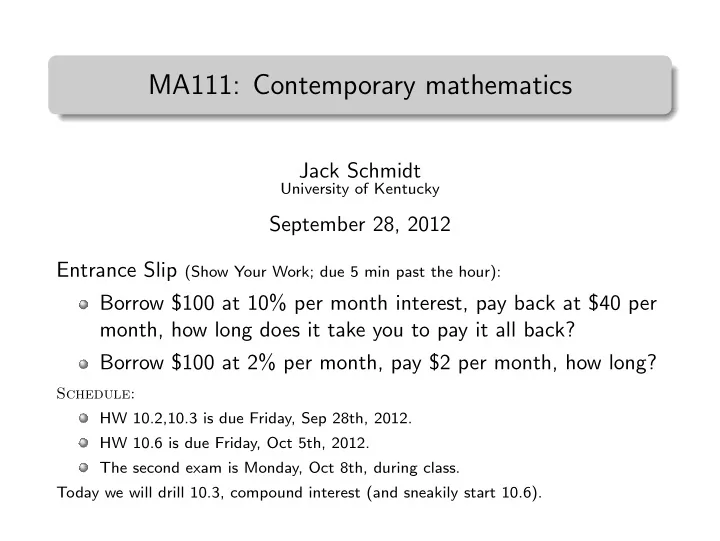
September 28, 2012 Entrance Slip (Show Your Work; due 5 min past the hour): Borrow $100 at 10% per month interest, pay back at $40 per month, how long does it take you to pay it all back? Borrow $100 at 2% per month, pay $2 per month, how long?
Schedule: HW 10.2,10.3 is due Friday, Sep 28th, 2012. HW 10.6 is due Friday, Oct 5th, 2012. The second exam is Monday, Oct 8th, during class. Today we will drill 10.3, compound interest (and sneakily start 10.6).
SLIDE 2 Context: Practice on some more exam like problems
“Which is the better deal?” problems are better done with your pencil and paper than with your time and money “How long does it take to pay back?” is also important to know before you borrow, not three years into the loan. $100 at 10% per month interest, pay back at $40 per month End of first month, owe ($100)(1.10) − $40 = $110 − $40 = $70 End of second month, owe ($70)(1.10) − $40 = $77 − $40 = $37 End of third month, owe ($37)(1.10) − $40 = $40.70 − $40 = $0.70
Probably should just send the extra $0.70 this month
We’ll start with a few review problems similar to the homework
SLIDE 3
10.3: Review of compound interest
$100 Savings Account earning 2.4% compound interest annually Value after 5 years?
SLIDE 4
10.3: Review of compound interest
$100 Savings Account earning 2.4% compound interest annually Value after 5 years? $112.59,
not $112.00 as in simple
P = $100 p = 0.024 per year T = 5 years F = P(1 + p)T = $100(1 + 0.024)5 = $112.5899907 = $112.59
SLIDE 5
10.3: Review of compound interest
$100 Savings Account earning 2.4% compound interest annually Value after 5 years? $112.59,
not $112.00 as in simple
P = $100 p = 0.024 per year T = 5 years F = P(1 + p)T = $100(1 + 0.024)5 = $112.5899907 = $112.59 $100 Savings Account earning 2.4% compound interest annually the first two years, then 2.1% compound interest annually the next three years, Value after 5 years?
SLIDE 6
10.3: Review of compound interest
$100 Savings Account earning 2.4% compound interest annually Value after 5 years? $112.59,
not $112.00 as in simple
P = $100 p = 0.024 per year T = 5 years F = P(1 + p)T = $100(1 + 0.024)5 = $112.5899907 = $112.59 $100 Savings Account earning 2.4% compound interest annually the first two years, then 2.1% compound interest annually the next three years, Value after 5 years? $111.60 F = $100(1.024)(1.024)(1.021)(1.021)(1.021) = $111.60
SLIDE 7 Activity: Moving money and compound interest
$100 Savings Account earning 2.4% compound interest annually the first two years, then you deposit another $100, then 2.4% compound interest annually the next three years, Value after 5 years? Use simple interest month-by-month to find the total amount Can you use compound interest to solve it? What if you had two banks,
- ne that you put in $100 at the beginning
- ne that you put in $100 after two years
How much do you have total from the two accounts?
SLIDE 8
Activity answers
$100 Savings Account earning 2.4% compound interest annually the first two years, then you deposit another $100, then 2.4% compound interest annually the next three years, Value after 5 years?
SLIDE 9
Activity answers
$100 Savings Account earning 2.4% compound interest annually the first two years, then you deposit another $100, then 2.4% compound interest annually the next three years, Value after 5 years? $219.97 T F formula =F number Now $100.00 = $100.00 1st year ($100.00)(1.024) = $102.40 2nd year ($102.40)(1.024) = $104.86 deposit $104.86 + 100 = $204.86 3rd year ($204.86)(1.024) = $209.78 4th year ($209.78)(1.024) = $214.81 5th year ($214.81)(1.024) = $219.97
SLIDE 10
Activity answers
$100 Savings Account earning 2.4% compound interest annually the first two years, then you deposit another $100, then 2.4% compound interest annually the next three years, Value after 5 years? $219.97 or $219.96 Faster is to think: $100 was compounded 5 years, plus $100 was compounded 3 years F = $100(1.024)5 + $100(1.024)3 = $219.9641731 = $219.96
SLIDE 11 Activity 2: Short installment loans
Similar to the entrance slip: Borrow $100 at 10% per month, and pay back $22.96 at the end
How much do you owe after each month? When are you done paying it off? How much total did you end up paying? Is it better to pay $100 now or the $137.76 over six months?
SLIDE 12
Fast: Applications of interest
Simple interest is used over the course of a single period Compound interest is just repeated simple interest For a changing interest rate, or just a few periods, use simple repeatedly Amortized loans, pay back a loan in equal payments For just a few payments, just use compound repeatedly Monday we’ll learn to use the fancy formulas for longer loans Wednesday we’ll go over consumer financial products Friday we’ll review for the exam
SLIDE 13 Assignment and exit slip
Book problems are decent: #1-4, 5-8, 9-10, 11-12, 13-18, 21-22, 23-24, 31-32, 33-36, 37-40, 41-42, 43-44, 45-46, 47-48, 49-50 Ok, so #1-4, #21, #37, #41, #43, #45, #47, #49, #19 but use a current news article
(one of the presidential candidates released his taxes recently; do his figures add up?)
Exit slip: Which is cheaper:
A loan at 2% per month, compounded monthly, 60 months A loan at 25% per year, compounded yearly, 5 years A loan at 0.4% per week, compounded weekly, 260 weeks
Do you need to take them out to five years or is one year enough?