SLIDE 1
. .
MA111: Contemporary mathematics
Jack Schmidt
University of Kentucky
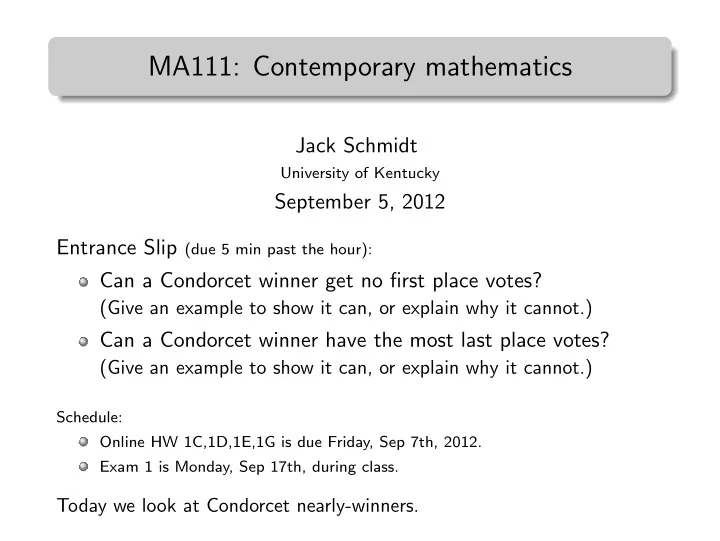
September 5, 2012 Entrance Slip (due 5 min past the hour): Can a Condorcet winner get no first place votes?
(Give an example to show it can, or explain why it cannot.)
Can a Condorcet winner have the most last place votes?
(Give an example to show it can, or explain why it cannot.)
Schedule: Online HW 1C,1D,1E,1G is due Friday, Sep 7th, 2012. Exam 1 is Monday, Sep 17th, during class.
Today we look at Condorcet nearly-winners.
SLIDE 2
Review of the vote counting methods
We have discusssed 3 major (and 2 more minor) vote counting methods:
(1.2) Plurality: most first place votes wins (1.3) Borda count: highest average ranking wins
2nd place is half credit: like plurality, but 2nd place counts as half a 1st place
(1.4) Plurality with elimination: eliminate the candidate with the least first place votes
Survivor: eliminate the candidate with the most last place votes
Each method had good features and bad features. To be precise, we defined “fairness criteria” a vote counting method either satisfied them or not
SLIDE 3
Review of the fairness criteria
We have discussed 3 major (and 2 more minor) fairness criterion:
Majority (winner) fairness criterion: If a candidate has more than 50% of the first place votes, he should win.
Majority loser fairness criterion: If a candidate has more than 50% of the last place votes, he should lose.
Condorcet (winner) fairness criterion: If a candidate can beat every other candidate head-to-head, he should win.
Condorcet loser fairness criterion: If a candidate is beaten by every other candidate head-to-head, he should lose.
Monotonicity: If a candidate wins one election, then he should also win an election where the only difference is a voter ranked the winner higher. (“more first place votes should help”)
SLIDE 4 Review: How do they do?
Here is a table describing how well our vote counting methods do: MW
ML
CW
CL
Mo IIA Pl Y N N N Y N BC N Y N Y Y N
2 = 1
2
N N N N Y N PE Y * N * N N
Su
N Y N * N N PC Y Y Y Y Y N Today we will cover the gray row and column
The * means mathematically no, but practically yes
SLIDE 5 Activity: Finding Condorcet winners
Examine the preference schedule: 7 7 3 3
1st
E B B E
2nd
B C G B
3rd
G G E D
4th
C D F G
5th
F A C C
6th
A E D A
7th
D F A F In your group, split up the work to check all the head-to-head matchups Who is closest to being a Condorcet winner? How can you organize the winners to find the best one?
SLIDE 6 Fast: Pairwise comparison mechanics
Look at every head-to-head competition Winners of head-to-heads get 1 point, ties get 1/2 point Most points wins One head-to-head: A vs B: 6+3+1 vs 5+3+2, tie! A vs C: 6+3+1 vs 5+3+2, tie! B vs C? Do they tie too? 6 5 3 3 2 1
1st
A B B C C A
2nd
B C A A B C
3rd
C A C B A B
SLIDE 7 Fast: Pairwise comparison mechanics
Look at every head-to-head competition Winners of head-to-heads get 1 point, ties get 1/2 point Most points wins One head-to-head: A vs B: 6+3+1 vs 5+3+2, tie! A vs C: 6+3+1 vs 5+3+2, tie! B vs C: 6+5+3 vs 3+2+1, B wins 6 5 3 3 2 1
1st
A B B C C A
2nd
B C A A B C
3rd
C A C B A B Total scores: A B C Wins 1 Ties 2 1 Total 1 1.5 So B is the Pairwise Comparison winner
SLIDE 8
Fast: Pairwise comparison is very fair
Pairwise comparison satisfies all of our old criteria: .
Theorem
. . Pairwise comparison satisfies: the majority (winner) fairness criterion, the majority loser fairness criterion, the Condorcet (winner) fairness criterion, the Condorcet loser fairness criterion, the monotonicity criterion However, it has two main problems: ties and disqualification
SLIDE 9
Fast: Interlude and a silly story
Waitress: Will you have the Apple or the Blueberry pie Sidney:
The Apple please.
Waitress: Oh, we also have Cherry pie. Sidney:
In that case, I’ll have the Blueberry. We know pie is irrational, but is Sidney?
SLIDE 10 Fast: Independence of Irrelevant Alternatives
Sidney ranks pie (Apple, Blueberry, Cherry) using 7 criteria:
Texture Aroma Gooeyness Nutrition Crumbliness Flavor Beauty 1st
A A C C B B B
2nd
C C A A A A A
3rd
B B B B C C C The best flavor is the one highest ranked (amongst those available) in the most categories Apple versus Blueberry: Apple wins on the first four categories! Apple versus Blueberry versus Cherry: B wins on the last three! Rational, but weird.
SLIDE 11
Fast: Independence of Irrelevant Alternatives
We prefer our voting methods to be less weird: .
Definition
. . A vote counting method is said to satisfy the independence of irrelevant alternatives criterion if a winner remains a winner even if a losing candidate is disqualified. .
Theorem
. . Plurality does not satisfy the IIA criterion. In fact, none of our methods satisfy the IIA.
SLIDE 12 Fast: IIA nearly always fails
In a 3-candidate race where not everyone wins, IIA means we can eliminate a loser to get a 2-candidate race In a 2-candidate race, there is only one sane way to decide! But consider Condorcet’s Paradox: 40% 35% 25%
1st
A B C
2nd
B C A
3rd
C A B If A is not a winner, then IIA+majority says B wins (75%) If B is not a winner, then IIA+majority says C wins (60%) If C is not a winner, then IIA+majority says A wins (65%) Problem: If B wins, then both A and C are not winners, so C wins, but wait. . . Solution: Everyone wins! YAY!
SLIDE 13
Assignment
Reread and understand pages 2-20 Read pages 27-28 Good book homeworks #1, 3, 17, 23, 33, 59, 60, 61, 62, 68, 72, 73, 74, 75, 79 Exit slip: Give a single example where each of the following statements is the view of a (sizable) majority:
A is better than B B is better than C C is better than D D is better than E E is better than A
Which candidate is best?