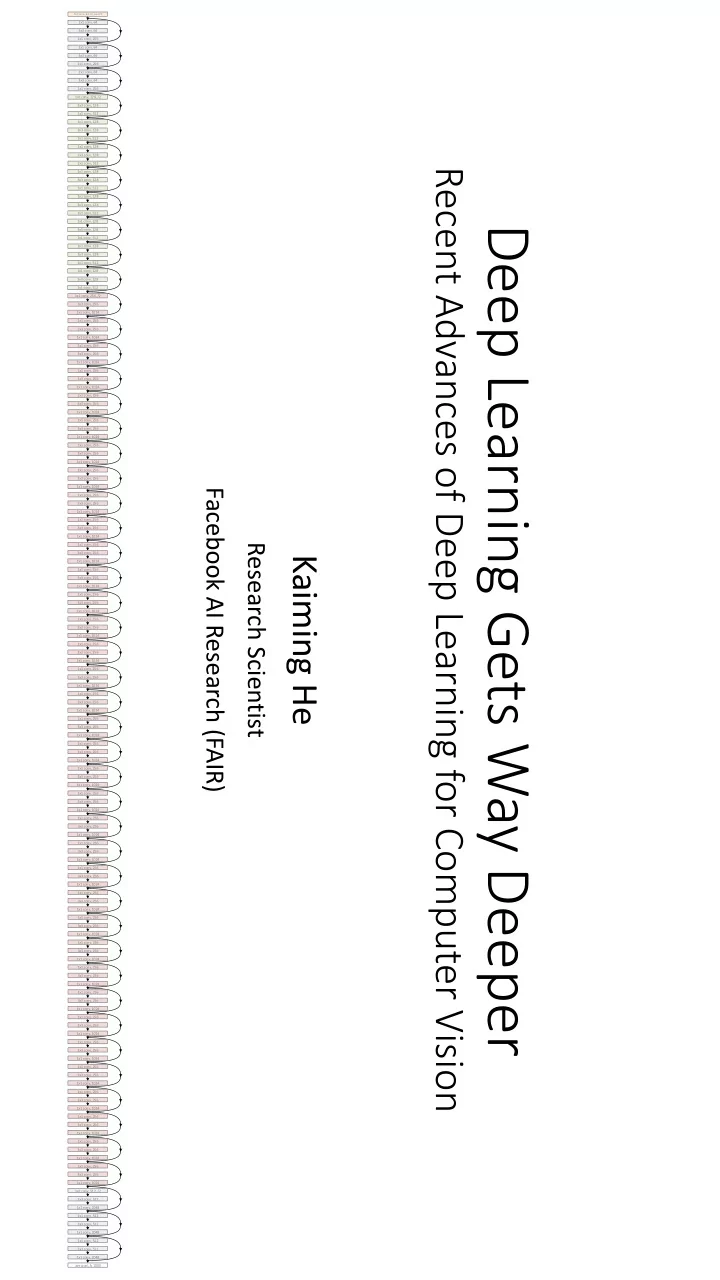
Deep Learning Gets Way Deeper 3x3 conv, 128 1x1 conv, 512 1x1 - - PDF document

deep learning gets way deeper
SMART_READER_LITE
LIVE PREVIEW

Deep Learning Gets Way Deeper 3x3 conv, 128 1x1 conv, 512 1x1 - - PDF document

7x7 conv, 64, /2, pool/2 1x1 conv, 64 3x3 conv, 64 1x1 conv, 256 1x1 conv, 64 3x3 conv, 64 1x1 conv, 256 1x1 conv, 64 3x3 conv, 64 1x1 conv, 256 1x1 conv, 128, /2 3x3 conv, 128 1x1 conv, 512 1x1 conv, 128 3x3 conv, 128 1x1 conv, 512


slide-1
SLIDE 1

Deep Learning Gets Way Deeper

Recent Advances of Deep Learning for Computer Vision

Kaiming He

Research Scientist Facebook AI Research (FAIR)

1x1 conv, 64 3x3 conv, 64 1x1 conv, 256 1x1 conv, 64 3x3 conv, 64 1x1 conv, 256 1x1 conv, 64 3x3 conv, 64 1x1 conv, 256 1x1 conv, 128, /2 3x3 conv, 128 1x1 conv, 512 1x1 conv, 128 3x3 conv, 128 1x1 conv, 512 1x1 conv, 128 3x3 conv, 128 1x1 conv, 512 1x1 conv, 128 3x3 conv, 128 1x1 conv, 512 1x1 conv, 128 3x3 conv, 128 1x1 conv, 512 1x1 conv, 128 3x3 conv, 128 1x1 conv, 512 1x1 conv, 128 3x3 conv, 128 1x1 conv, 512 1x1 conv, 128 3x3 conv, 128 1x1 conv, 512 1x1 conv, 256, /2 3x3 conv, 256 1x1 conv, 1024 1x1 conv, 256 3x3 conv, 256 1x1 conv, 1024 1x1 conv, 256 3x3 conv, 256 1x1 conv, 1024 1x1 conv, 256 3x3 conv, 256 1x1 conv, 1024 1x1 conv, 256 3x3 conv, 256 1x1 conv, 1024 1x1 conv, 256 3x3 conv, 256 1x1 conv, 1024 1x1 conv, 256 3x3 conv, 256 1x1 conv, 1024 1x1 conv, 256 3x3 conv, 256 1x1 conv, 1024 1x1 conv, 256 3x3 conv, 256 1x1 conv, 1024 1x1 conv, 256 3x3 conv, 256 1x1 conv, 1024 1x1 conv, 256 3x3 conv, 256 1x1 conv, 1024 1x1 conv, 256 3x3 conv, 256 1x1 conv, 1024 1x1 conv, 256 3x3 conv, 256 1x1 conv, 1024 1x1 conv, 256 3x3 conv, 256 1x1 conv, 1024 1x1 conv, 256 3x3 conv, 256 1x1 conv, 1024 1x1 conv, 256 3x3 conv, 256 1x1 conv, 1024 1x1 conv, 256 3x3 conv, 256 1x1 conv, 1024 1x1 conv, 256 3x3 conv, 256 1x1 conv, 1024 1x1 conv, 256 3x3 conv, 256 1x1 conv, 1024 1x1 conv, 256 3x3 conv, 256 1x1 conv, 1024 1x1 conv, 256 3x3 conv, 256 1x1 conv, 1024 1x1 conv, 256 3x3 conv, 256 1x1 conv, 1024 1x1 conv, 256 3x3 conv, 256 1x1 conv, 1024 1x1 conv, 256 3x3 conv, 256 1x1 conv, 1024 1x1 conv, 256 3x3 conv, 256 1x1 conv, 1024 1x1 conv, 256 3x3 conv, 256 1x1 conv, 1024 1x1 conv, 256 3x3 conv, 256 1x1 conv, 1024 1x1 conv, 256 3x3 conv, 256 1x1 conv, 1024 1x1 conv, 256 3x3 conv, 256 1x1 conv, 1024 1x1 conv, 256 3x3 conv, 256 1x1 conv, 1024 1x1 conv, 256 3x3 conv, 256 1x1 conv, 1024 1x1 conv, 256 3x3 conv, 256 1x1 conv, 1024 1x1 conv, 256 3x3 conv, 256 1x1 conv, 1024 1x1 conv, 256 3x3 conv, 256 1x1 conv, 1024 1x1 conv, 256 3x3 conv, 256 1x1 conv, 1024 1x1 conv, 256 3x3 conv, 256 1x1 conv, 1024 1x1 conv, 512, /2 3x3 conv, 512 1x1 conv, 2048 1x1 conv, 512 3x3 conv, 512 1x1 conv, 2048 1x1 conv, 512 3x3 conv, 512 1x1 conv, 2048 ave pool, fc 1000 7x7 conv, 64, /2, pool/2
slide-2
SLIDE 2

Overview

  • Introduction
  • Look at some recent progress of deep learning for computer vision
  • From Shallow Models to 100+ Layers
  • Advances and challenges of getting way deeper
  • From Classification to Detection
  • Deep learning for complex recognition applications
slide-3
SLIDE 3

Introduction

slide-4
SLIDE 4

Revolution of Depth

3.57 6.7 7.3 11.7 16.4 25.8 28.2 ILSVRC'15 ResNet ILSVRC'14 GoogleNet ILSVRC'14 VGG ILSVRC'13 ILSVRC'12 AlexNet ILSVRC'11 ILSVRC'10

ImageNet Classification top-5 error (%)

shallow 8 layers 19 layers 22 layers

152 layers

8 layers

Kaiming He, Xiangyu Zhang, Shaoqing Ren, & Jian Sun. “Deep Residual Learning for Image Recognition”. CVPR 2016.

slide-5
SLIDE 5

Revolution of Depth

11x11 conv, 96, /4, pool/2

5x5 conv, 256, pool/2 3x3 conv, 384 3x3 conv, 384 3x3 conv, 256, pool/2 fc, 4096 fc, 4096 fc, 1000 AlexNet, 8 layers (ILSVRC 2012)

Kaiming He, Xiangyu Zhang, Shaoqing Ren, & Jian Sun. “Deep Residual Learning for Image Recognition”. CVPR 2016.

  • ReLU
  • End-to-end (no pre-training)
  • Data augmentation
slide-6
SLIDE 6

Revolution of Depth

11x11 conv, 96, /4, pool/2

5x5 conv, 256, pool/2 3x3 conv, 384 3x3 conv, 384 3x3 conv, 256, pool/2 fc, 4096 fc, 4096 fc, 1000

AlexNet, 8 layers (ILSVRC 2012)

3x3 conv, 64 3x3 conv, 64, pool/2 3x3 conv, 128 3x3 conv, 128, pool/2 3x3 conv, 256 3x3 conv, 256 3x3 conv, 256 3x3 conv, 256, pool/2 3x3 conv, 512 3x3 conv, 512 3x3 conv, 512 3x3 conv, 512, pool/2 3x3 conv, 512 3x3 conv, 512 3x3 conv, 512 3x3 conv, 512, pool/2 fc, 4096 fc, 4096 fc, 1000

VGG, 19 layers (ILSVRC 2014)

input Conv 7x7+ 2(S) MaxPool 3x3+ 2(S) LocalRespNorm Conv 1x1+ 1(V) Conv 3x3+ 1(S) LocalRespNorm MaxPool 3x3+ 2(S) Conv Conv Conv Conv 1x1+ 1(S) 3x3+ 1(S) 5x5+ 1(S) 1x1+ 1(S) Conv Conv MaxPool 1x1+ 1(S) 1x1+ 1(S) 3x3+ 1(S) Dept hConcat Conv Conv Conv Conv 1x1+ 1(S) 3x3+ 1(S) 5x5+ 1(S) 1x1+ 1(S) Conv Conv MaxPool 1x1+ 1(S) 1x1+ 1(S) 3x3+ 1(S) Dept hConcat MaxPool 3x3+ 2(S) Conv Conv Conv Conv 1x1+ 1(S) 3x3+ 1(S) 5x5+ 1(S) 1x1+ 1(S) Conv Conv MaxPool 1x1+ 1(S) 1x1+ 1(S) 3x3+ 1(S) Dept hConcat Conv Conv Conv Conv 1x1+ 1(S) 3x3+ 1(S) 5x5+ 1(S) 1x1+ 1(S) Conv Conv MaxPool 1x1+ 1(S) 1x1+ 1(S) 3x3+ 1(S) AveragePool 5x5+ 3(V) Dept hConcat Conv Conv Conv Conv 1x1+ 1(S) 3x3+ 1(S) 5x5+ 1(S) 1x1+ 1(S) Conv Conv MaxPool 1x1+ 1(S) 1x1+ 1(S) 3x3+ 1(S) Dept hConcat Conv Conv Conv Conv 1x1+ 1(S) 3x3+ 1(S) 5x5+ 1(S) 1x1+ 1(S) Conv Conv MaxPool 1x1+ 1(S) 1x1+ 1(S) 3x3+ 1(S) Dept hConcat Conv Conv Conv Conv 1x1+ 1(S) 3x3+ 1(S) 5x5+ 1(S) 1x1+ 1(S) Conv Conv MaxPool 1x1+ 1(S) 1x1+ 1(S) 3x3+ 1(S) AveragePool 5x5+ 3(V) Dept hConcat MaxPool 3x3+ 2(S) Conv Conv Conv Conv 1x1+ 1(S) 3x3+ 1(S) 5x5+ 1(S) 1x1+ 1(S) Conv Conv MaxPool 1x1+ 1(S) 1x1+ 1(S) 3x3+ 1(S) Dept hConcat Conv Conv Conv Conv 1x1+ 1(S) 3x3+ 1(S) 5x5+ 1(S) 1x1+ 1(S) Conv Conv MaxPool 1x1+ 1(S) 1x1+ 1(S) 3x3+ 1(S) Dept hConcat AveragePool 7x7+ 1(V) FC Conv 1x1+ 1(S) FC FC Soft maxAct ivat ion soft max0 Conv 1x1+ 1(S) FC FC Soft maxAct ivation soft max1 Soft maxAct ivat ion soft max2

GoogleNet, 22 layers (ILSVRC 2014)

Kaiming He, Xiangyu Zhang, Shaoqing Ren, & Jian Sun. “Deep Residual Learning for Image Recognition”. CVPR 2016.

  • Very deep
  • Simply deep
  • Branching
  • Bottleneck
  • Skip connection
slide-7
SLIDE 7 1x1 conv, 64 3x3 conv, 64 1x1 conv, 256 1x1 conv, 64 3x3 conv, 64 1x1 conv, 256 1x1 conv, 64 3x3 conv, 64 1x1 conv, 256 1x1 conv, 128, /2 3x3 conv, 128 1x1 conv, 512 1x1 conv, 128 3x3 conv, 128 1x1 conv, 512 1x1 conv, 128 3x3 conv, 128 1x1 conv, 512 1x1 conv, 128 3x3 conv, 128 1x1 conv, 512 1x1 conv, 128 3x3 conv, 128 1x1 conv, 512 1x1 conv, 128 3x3 conv, 128 1x1 conv, 512 1x1 conv, 128 3x3 conv, 128 1x1 conv, 512 1x1 conv, 128 3x3 conv, 128 1x1 conv, 512 1x1 conv, 256, /2 3x3 conv, 256 1x1 conv, 1024 1x1 conv, 256 3x3 conv, 256 1x1 conv, 1024 1x1 conv, 256 3x3 conv, 256 1x1 conv, 1024 1x1 conv, 256 3x3 conv, 256 1x1 conv, 1024 1x1 conv, 256 3x3 conv, 256 1x1 conv, 1024 1x1 conv, 256 3x3 conv, 256 1x1 conv, 1024 1x1 conv, 256 3x3 conv, 256 1x1 conv, 1024 1x1 conv, 256 3x3 conv, 256 1x1 conv, 1024 1x1 conv, 256 3x3 conv, 256 1x1 conv, 1024 1x1 conv, 256 3x3 conv, 256 1x1 conv, 1024 1x1 conv, 256 3x3 conv, 256 1x1 conv, 1024 1x1 conv, 256 3x3 conv, 256 1x1 conv, 1024 1x1 conv, 256 3x3 conv, 256 1x1 conv, 1024 1x1 conv, 256 3x3 conv, 256 1x1 conv, 1024 1x1 conv, 256 3x3 conv, 256 1x1 conv, 1024 1x1 conv, 256 3x3 conv, 256 1x1 conv, 1024 1x1 conv, 256 3x3 conv, 256 1x1 conv, 1024 1x1 conv, 256 3x3 conv, 256 1x1 conv, 1024 1x1 conv, 256 3x3 conv, 256 1x1 conv, 1024 1x1 conv, 256 3x3 conv, 256 1x1 conv, 1024 1x1 conv, 256 3x3 conv, 256 1x1 conv, 1024 1x1 conv, 256 3x3 conv, 256 1x1 conv, 1024 1x1 conv, 256 3x3 conv, 256 1x1 conv, 1024 1x1 conv, 256 3x3 conv, 256 1x1 conv, 1024 1x1 conv, 256 3x3 conv, 256 1x1 conv, 1024 1x1 conv, 256 3x3 conv, 256 1x1 conv, 1024 1x1 conv, 256 3x3 conv, 256 1x1 conv, 1024 1x1 conv, 256 3x3 conv, 256 1x1 conv, 1024 1x1 conv, 256 3x3 conv, 256 1x1 conv, 1024 1x1 conv, 256 3x3 conv, 256 1x1 conv, 1024 1x1 conv, 256 3x3 conv, 256 1x1 conv, 1024 1x1 conv, 256 3x3 conv, 256 1x1 conv, 1024 1x1 conv, 256 3x3 conv, 256 1x1 conv, 1024 1x1 conv, 256 3x3 conv, 256 1x1 conv, 1024 1x1 conv, 256 3x3 conv, 256 1x1 conv, 1024 1x1 conv, 256 3x3 conv, 256 1x1 conv, 1024 1x1 conv, 512, /2 3x3 conv, 512 1x1 conv, 2048 1x1 conv, 512 3x3 conv, 512 1x1 conv, 2048 1x1 conv, 512 3x3 conv, 512 1x1 conv, 2048 ave pool, fc 1000 7x7 conv, 64, /2, pool/2

AlexNet, 8 layers (ILSVRC 2012)

Revolution of Depth

ResNet, 152 layers (ILSVRC 2015)

3x3 conv, 64 3x3 conv, 64, pool/2 3x3 conv, 128 3x3 conv, 128, pool/2 3x3 conv, 256 3x3 conv, 256 3x3 conv, 256 3x3 conv, 256, pool/2 3x3 conv, 512 3x3 conv, 512 3x3 conv, 512 3x3 conv, 512, pool/2 3x3 conv, 512 3x3 conv, 512 3x3 conv, 512 3x3 conv, 512, pool/2 fc, 4096 fc, 4096 fc, 1000 11x11 conv, 96, /4, pool/2 5x5 conv, 256, pool/2 3x3 conv, 384 3x3 conv, 384 3x3 conv, 256, pool/2 fc, 4096 fc, 4096 fc, 1000

VGG, 19 layers (ILSVRC 2014)

Kaiming He, Xiangyu Zhang, Shaoqing Ren, & Jian Sun. “Deep Residual Learning for Image Recognition”. CVPR 2016.

slide-8
SLIDE 8

Revolution of Depth

ResNet, 152 layers

1x1 conv, 64 3x3 conv, 64 1x1 conv, 256 1x1 conv, 64 3x3 conv, 64 1x1 conv, 256 1x1 conv, 64 3x3 conv, 64 1x1 conv, 256 1x2 conv, 128, /2 3x3 conv, 128 1x1 conv, 512 1x1 conv, 128 3x3 conv, 128 1x1 conv, 512 1x1 conv, 128 3x3 conv, 128 1x1 conv, 512 1x1 conv, 128 3x3 conv, 128 1x1 conv, 512 1x1 conv, 128 3x3 conv, 128 1x1 conv, 512 1x1 conv, 128 3x3 conv, 128 1x1 conv, 512 1x1 conv, 128

7x7 conv, 64, /2, pool/2

Kaiming He, Xiangyu Zhang, Shaoqing Ren, & Jian Sun. “Deep Residual Learning for Image Recognition”. CVPR 2016.

slide-9
SLIDE 9

Revolution of Depth

34 58 66 86 HOG, DPM AlexNet (RCNN) VGG (RCNN) ResNet (Faster RCNN)*

PASCAL VOC 2007 Object Detection mAP (%)

shallow 8 layers 16 layers

101 layers

*w/ other improvements & more data

Kaiming He, Xiangyu Zhang, Shaoqing Ren, & Jian Sun. “Deep Residual Learning for Image Recognition”. CVPR 2016.

Engines of visual recognition

slide-10
SLIDE 10

ResNets @ ILSVRC & COCO 2015 Competitions

  • 1st places in all five main tracks
  • ImageNet Classification: “Ultra-deep” 152-layer nets
  • ImageNet Detection: 16% better than 2nd
  • ImageNet Localization: 27% better than 2nd
  • COCO Detection: 11% better than 2nd
  • COCO Segmentation: 12% better than 2nd

Kaiming He, Xiangyu Zhang, Shaoqing Ren, & Jian Sun. “Deep Residual Learning for Image Recognition”. CVPR 2016.

*improvements are relative numbers

slide-11
SLIDE 11

ResNet’s object detection result on COCO

*the original image is from the COCO dataset

Kaiming He, Xiangyu Zhang, Shaoqing Ren, & Jian Sun. “Deep Residual Learning for Image Recognition”. CVPR 2016.

slide-12
SLIDE 12

Background

From shallow to deep

slide-13
SLIDE 13

Traditional recognition

edges classifier “bus”? pixels classifier “bus”?

histogram

classifier “bus”? edges SIFT/HOG

histogram

classifier “bus”? edges

K-means/ sparse code

shallower deeper

But what’s next?

slide-14
SLIDE 14

Deep Learning

histogram

classifier “bus”? edges

K-means/ sparse code

Specialized components

“bus”?

Generic components (“layers”)

“bus”?

Repeat elementary layers => Going deeper

  • End-to-end learning
  • Richer solution space
  • Minimal domain knowledge
slide-15
SLIDE 15

Deep Learning is “Easy”

  • Minimal domain knowledge
  • Data driven
  • Features are generalizable

Deep Learning is “Hard”

  • Black boxes?
  • Unstable (vanishing/exploding)?
  • Hard to tune hyper-parameters?
slide-16
SLIDE 16

Cheat Sheet of Going Deeper

shallower deeper

>5 layers: use ReLU (instead of tanh) >10 layers: initialization, Batch Normalization >30 layers: skip connections >100 layers: identity skip connections >1000 layers: ?

slide-17
SLIDE 17

Initialization

LeCun et al 1998 “Efficient Backprop” Glorot & Bengio 2010 “Understanding the difficulty of training deep feedforward neural networks”

input 𝑌

  • utput

𝑍 = 𝑋𝑌 weight 𝑋

1-layer: 𝑊𝑏𝑠 𝑧 = (𝑜+,𝑊𝑏𝑠 𝑥 )𝑊𝑏𝑠[𝑦] Multi-layer: 𝑊𝑏𝑠 𝑧 = (2 𝑜3

+,𝑊𝑏𝑠 𝑥3

  • 3

)𝑊𝑏𝑠[𝑦]

If:

  • Linear activation
  • 𝑦, 𝑧, 𝑥: independent

Then:

𝑜+, 𝑜678

slide-18
SLIDE 18

Initialization

LeCun et al 1998 “Efficient Backprop” Glorot & Bengio 2010 “Understanding the difficulty of training deep feedforward neural networks”

1 3 5 7 9 11 13 15

depth exploding vanishing ideal

Forward: 𝑊𝑏𝑠 𝑧 = (2 𝑜3

+,𝑊𝑏𝑠 𝑥3

  • 3

)𝑊𝑏𝑠[𝑦] Backward: 𝑊𝑏𝑠 𝜖 𝜖𝑦 = (2 𝑜3

678𝑊𝑏𝑠 𝑥3

  • 3

)𝑊𝑏𝑠[ 𝜖 𝜖𝑧]

Both forward (response) and backward (gradient) signal can vanish/explode

slide-19
SLIDE 19

Initialization

  • Initialization under linear assumption

LeCun et al 1998 “Efficient Backprop” Glorot & Bengio 2010 “Understanding the difficulty of training deep feedforward neural networks”

∏ 𝑜3

+,𝑊𝑏𝑠 𝑥3

  • 3

= 𝑑𝑝𝑜𝑡𝑢?@ (healthy forward) and ∏ 𝑜3

678𝑊𝑏𝑠 𝑥3

  • 3

= 𝑑𝑝𝑜𝑡𝑢A@(healthy backward) 𝑜3

+,𝑊𝑏𝑠 𝑥3 = 1

  • r*

𝑜3

678𝑊𝑏𝑠 𝑥3 = 1

*: 𝑜3

678 = 𝑜3CD +, , so E6,F8GH E6,F8IH = ,JKLM

NOP

,IQRLM

ST

< ∞. It is sufficient to use either form.

“Xavier” init in Caffe

slide-20
SLIDE 20

Initialization

  • Initialization under ReLU

D W 𝑜3 +,𝑊𝑏𝑠 𝑥3

  • 3

= 𝑑𝑝𝑜𝑡𝑢?@ (healthy forward) and ∏

D W 𝑜3 678𝑊𝑏𝑠 𝑥3

  • 3

= 𝑑𝑝𝑜𝑡𝑢A@(healthy backward) 1 2 𝑜3

+,𝑊𝑏𝑠 𝑥3 = 1

  • r

1 2 𝑜3

678𝑊𝑏𝑠 𝑥3 = 1

Kaiming He, Xiangyu Zhang, Shaoqing Ren, & Jian Sun. “Delving Deep into Rectifiers: Surpassing Human-Level Performance on ImageNet Classification”. ICCV 2015.

With 𝐸 layers, a factor of 2 per layer has exponential impact of 2Z

“MSRA” init in Caffe

slide-21
SLIDE 21

Initialization

Kaiming He, Xiangyu Zhang, Shaoqing Ren, & Jian Sun. “Delving Deep into Rectifiers: Surpassing Human-Level Performance on ImageNet Classification”. ICCV 2015.

  • urs

Xavier

22-layer ReLU net: good init converges faster

𝑜𝑊𝑏𝑠 𝑥 = 1

  • urs

Xavier

30-layer ReLU net: good init is able to converge

1 2 𝑜𝑊𝑏𝑠 𝑥 = 1

1 2 𝑜𝑊𝑏𝑠 𝑥 = 1 𝑜𝑊𝑏𝑠 𝑥 = 1

*Figures show the beginning of training

slide-22
SLIDE 22

Batch Normalization (BN)

  • Normalizing input (LeCun et al 1998 “Efficient Backprop”)
  • BN: normalizing each layer, for each mini-batch
  • Greatly accelerate training
  • Less sensitive to initialization
  • Improve regularization
  • S. Ioffe & C. Szegedy. Batch normalization: Accelerating deep network training by reducing internal covariate shift. ICML 2015
slide-23
SLIDE 23

Batch Normalization (BN)

  • S. Ioffe & C. Szegedy. Batch normalization: Accelerating deep network training by reducing internal covariate shift. ICML 2015

layer

𝑦 𝑦 [ = 𝑦 − 𝜈 𝜏 𝑧 = 𝛿𝑦 [ + 𝛾

  • 𝜈: mean of 𝑦 in mini-batch
  • 𝜏: std of 𝑦 in mini-batch
  • 𝛿: scale
  • 𝛾: shift
  • 𝜈, 𝜏: functions of 𝑦,

analogous to responses

  • 𝛿, 𝛾: parameters to be learned,

analogous to weights

slide-24
SLIDE 24

Batch Normalization (BN)

  • S. Ioffe & C. Szegedy. Batch normalization: Accelerating deep network training by reducing internal covariate shift. ICML 2015

layer

𝑦 𝑦 [ = 𝑦 − 𝜈 𝜏 𝑧 = 𝛿𝑦 [ + 𝛾

2 modes of BN:

  • Train mode:
  • 𝜈, 𝜏 are functions of 𝑦; backprop gradients
  • Test mode:
  • 𝜈, 𝜏 are pre-computed* on training set

*: by running average, or post-processing after training

Caution: make sure your BN usage is correct

slide-25
SLIDE 25

Batch Normalization (BN)

  • S. Ioffe & C. Szegedy. Batch normalization: Accelerating deep network training by reducing internal covariate shift. ICML 2015

Figure taken from [S. Ioffe & C. Szegedy]

w/o BN best of w/o BN accuracy iter.

slide-26
SLIDE 26

Deep Residual Networks

From 10 layers to 100+ layers

slide-27
SLIDE 27

Simply stacking layers?

1 2 3 4 5 6 10 20

  • iter. (1e4)

train error (%)

1 2 3 4 5 6 10 20

  • iter. (1e4)

test error (%)

CIFAR-10

56-layer 20-layer 56-layer 20-layer

  • Plain nets: stacking 3x3 conv layers…
  • 56-layer net has higher training error and test error than 20-layer net

Kaiming He, Xiangyu Zhang, Shaoqing Ren, & Jian Sun. “Deep Residual Learning for Image Recognition”. CVPR 2016.

slide-28
SLIDE 28

Simply stacking layers?

1 2 3 4 5 6 5 10 20

  • iter. (1e4)

error (%)

plain-20 plain-32 plain-44 plain-56

CIFAR-10 20-layer 32-layer 44-layer 56-layer

10 20 30 40 50 20 30 40 50 60

  • iter. (1e4)

error (%)

plain-18 plain-34

ImageNet-1000 34-layer 18-layer

  • “Overly deep” plain nets have higher training error
  • A general phenomenon, observed in many datasets

solid: test/val dashed: train

Kaiming He, Xiangyu Zhang, Shaoqing Ren, & Jian Sun. “Deep Residual Learning for Image Recognition”. CVPR 2016.

slide-29
SLIDE 29 7x7 conv, 64, /2 3x3 conv, 64 3x3 conv, 64 3x3 conv, 64 3x3 conv, 64 3x3 conv, 128, /2 3x3 conv, 128 3x3 conv, 128 3x3 conv, 128 3x3 conv, 256, /2 3x3 conv, 256 3x3 conv, 256 3x3 conv, 256 3x3 conv, 512, /2 3x3 conv, 512 3x3 conv, 512 3x3 conv, 512 fc 1000

a shallower model (18 layers) a deeper counterpart (34 layers)

7x7 conv, 64, /2 3x3 conv, 64 3x3 conv, 64 3x3 conv, 64 3x3 conv, 64 3x3 conv, 64 3x3 conv, 64 3x3 conv, 128, /2 3x3 conv, 128 3x3 conv, 128 3x3 conv, 128 3x3 conv, 128 3x3 conv, 128 3x3 conv, 128 3x3 conv, 128 3x3 conv, 256, /2 3x3 conv, 256 3x3 conv, 256 3x3 conv, 256 3x3 conv, 256 3x3 conv, 256 3x3 conv, 256 3x3 conv, 256 3x3 conv, 256 3x3 conv, 256 3x3 conv, 256 3x3 conv, 256 3x3 conv, 512, /2 3x3 conv, 512 3x3 conv, 512 3x3 conv, 512 3x3 conv, 512 3x3 conv, 512 fc 1000

“extra” layers

  • Richer solution space
  • A deeper model should not have higher

training error

  • A solution by construction:
  • original layers: copied from a

learned shallower model

  • extra layers: set as identity
  • at least the same training error
  • Optimization difficulties: solvers cannot

find the solution when going deeper…

Kaiming He, Xiangyu Zhang, Shaoqing Ren, & Jian Sun. “Deep Residual Learning for Image Recognition”. CVPR 2016.

slide-30
SLIDE 30

Deep Residual Learning

  • Plaint net

Kaiming He, Xiangyu Zhang, Shaoqing Ren, & Jian Sun. “Deep Residual Learning for Image Recognition”. CVPR 2016.

any two stacked layers

𝑦 𝐼(𝑦)

weight layer weight layer

relu relu

𝐼 𝑦 is any desired mapping, hope the 2 weight layers fit 𝐼(𝑦)

slide-31
SLIDE 31

Deep Residual Learning

  • Residual net

Kaiming He, Xiangyu Zhang, Shaoqing Ren, & Jian Sun. “Deep Residual Learning for Image Recognition”. CVPR 2016.

𝐼 𝑦 is any desired mapping, hope the 2 weight layers fit 𝐼(𝑦) hope the 2 weight layers fit 𝐺(𝑦) let 𝐼 𝑦 = 𝐺 𝑦 + 𝑦

weight layer weight layer

relu relu

𝑦 𝐼 𝑦 = 𝐺 𝑦 + 𝑦

identity

𝑦 𝐺(𝑦)

slide-32
SLIDE 32

Deep Residual Learning

  • 𝐺 𝑦 is a residual mapping w.r.t. identity

Kaiming He, Xiangyu Zhang, Shaoqing Ren, & Jian Sun. “Deep Residual Learning for Image Recognition”. CVPR 2016.

  • If identity were optimal,

easy to set weights as 0

  • If optimal mapping is closer to identity,

easier to find small fluctuations weight layer weight layer

relu relu

𝑦 𝐼 𝑦 = 𝐺 𝑦 + 𝑦

identity

𝑦 𝐺(𝑦)

slide-33
SLIDE 33

Related Works – Residual Representations

  • VLAD & Fisher Vector [Jegou et al 2010], [Perronnin et al 2007]
  • Encoding residual vectors; powerful shallower representations.
  • Product Quantization (IVF-ADC) [Jegou et al 2011]
  • Quantizing residual vectors; efficient nearest-neighbor search.
  • MultiGrid & Hierarchical Precondition [Briggs, et al 2000], [Szeliski 1990, 2006]
  • Solving residual sub-problems; efficient PDE solvers.

Kaiming He, Xiangyu Zhang, Shaoqing Ren, & Jian Sun. “Deep Residual Learning for Image Recognition”. CVPR 2016.

slide-34
SLIDE 34 7x7 conv, 64, /2 pool, /2 3x3 conv, 64 3x3 conv, 64 3x3 conv, 64 3x3 conv, 64 3x3 conv, 64 3x3 conv, 64 3x3 conv, 128, /2 3x3 conv, 128 3x3 conv, 128 3x3 conv, 128 3x3 conv, 128 3x3 conv, 128 3x3 conv, 128 3x3 conv, 128 3x3 conv, 256, /2 3x3 conv, 256 3x3 conv, 256 3x3 conv, 256 3x3 conv, 256 3x3 conv, 256 3x3 conv, 256 3x3 conv, 256 3x3 conv, 256 3x3 conv, 256 3x3 conv, 256 3x3 conv, 256 3x3 conv, 512, /2 3x3 conv, 512 3x3 conv, 512 3x3 conv, 512 3x3 conv, 512 3x3 conv, 512 avg pool fc 1000 7x7 conv, 64, /2 pool, /2 3x3 conv, 64 3x3 conv, 64 3x3 conv, 64 3x3 conv, 64 3x3 conv, 64 3x3 conv, 64 3x3 conv, 128, /2 3x3 conv, 128 3x3 conv, 128 3x3 conv, 128 3x3 conv, 128 3x3 conv, 128 3x3 conv, 128 3x3 conv, 128 3x3 conv, 256, /2 3x3 conv, 256 3x3 conv, 256 3x3 conv, 256 3x3 conv, 256 3x3 conv, 256 3x3 conv, 256 3x3 conv, 256 3x3 conv, 256 3x3 conv, 256 3x3 conv, 256 3x3 conv, 256 3x3 conv, 512, /2 3x3 conv, 512 3x3 conv, 512 3x3 conv, 512 3x3 conv, 512 3x3 conv, 512 avg pool fc 1000

Network “Design”

  • Keep it simple
  • Our basic design (VGG-style)
  • all 3x3 conv (almost)
  • spatial size /2 => # filters x2 (~same complexity per layer)
  • Simple design; just deep!
  • Other remarks:
  • no hidden fc
  • no dropout

Kaiming He, Xiangyu Zhang, Shaoqing Ren, & Jian Sun. “Deep Residual Learning for Image Recognition”. CVPR 2016.

plain net ResNet

slide-35
SLIDE 35

Training

  • All plain/residual nets are trained from scratch
  • All plain/residual nets use Batch Normalization
  • Standard hyper-parameters & augmentation

Kaiming He, Xiangyu Zhang, Shaoqing Ren, & Jian Sun. “Deep Residual Learning for Image Recognition”. CVPR 2016.

slide-36
SLIDE 36

CIFAR-10 experiments

1 2 3 4 5 6 5 10 20

  • iter. (1e4)

error (%)

plain-20 plain-32 plain-44 plain-56

20-layer 32-layer 44-layer 56-layer CIFAR-10 plain nets

1 2 3 4 5 6 5 10 20

  • iter. (1e4)

error (%)

ResNet-20 ResNet-32 ResNet-44 ResNet-56 ResNet-110

CIFAR-10 ResNets 56-layer 44-layer 32-layer 20-layer 110-layer

  • Deep ResNets can be trained without difficulties
  • Deeper ResNets have lower training error, and also lower test error

solid: test dashed: train

Kaiming He, Xiangyu Zhang, Shaoqing Ren, & Jian Sun. “Deep Residual Learning for Image Recognition”. CVPR 2016.

slide-37
SLIDE 37

ImageNet experiments

10 20 30 40 50 20 30 40 50 60

  • iter. (1e4)

error (%)

ResNet-18 ResNet-34

10 20 30 40 50 20 30 40 50 60

  • iter. (1e4)

error (%)

plain-18 plain-34

ImageNet plain nets ImageNet ResNets

solid: test dashed: train

34-layer 18-layer 18-layer 34-layer

  • Deep ResNets can be trained without difficulties
  • Deeper ResNets have lower training error, and also lower test error

Kaiming He, Xiangyu Zhang, Shaoqing Ren, & Jian Sun. “Deep Residual Learning for Image Recognition”. CVPR 2016.

slide-38
SLIDE 38

ImageNet experiments

  • A practical design of going deeper

3x3, 64 3x3, 64

relu relu 64-d

3x3, 64 1x1, 64

relu

1x1, 256

relu relu 256-d

all-3x3

Kaiming He, Xiangyu Zhang, Shaoqing Ren, & Jian Sun. “Deep Residual Learning for Image Recognition”. CVPR 2016.

bottleneck

(for ResNet-50/101/152)

similar complexity

slide-39
SLIDE 39

ImageNet experiments

7.4 6.7 6.1 5.7

4 5 6 7 8

ResNet-34 ResNet-50 ResNet-101 ResNet-152

10-crop testing, top-5 val error (%)

this model has lower time complexity than VGG-16/19

  • Deeper ResNets have lower error

Kaiming He, Xiangyu Zhang, Shaoqing Ren, & Jian Sun. “Deep Residual Learning for Image Recognition”. CVPR 2016.

slide-40
SLIDE 40

ImageNet experiments

3.57 6.7 7.3 11.7 16.4 25.8 28.2 ILSVRC'15 ResNet ILSVRC'14 GoogleNet ILSVRC'14 VGG ILSVRC'13 ILSVRC'12 AlexNet ILSVRC'11 ILSVRC'10

ImageNet Classification top-5 error (%)

shallow 8 layers 19 layers 22 layers

152 layers

Kaiming He, Xiangyu Zhang, Shaoqing Ren, & Jian Sun. “Deep Residual Learning for Image Recognition”. CVPR 2016.

8 layers

slide-41
SLIDE 41

On the Importance of Identity Mapping

A Deeper Look at ResNets

slide-42
SLIDE 42

On identity mappings for op

  • ptimization
  • n

Kaiming He, Xiangyu Zhang, Shaoqing Ren, & Jian Sun. “Identity Mappings in Deep Residual Networks”. ECCV 2016.

𝑦dCD = 𝑔(ℎ 𝑦d + 𝐺 𝑦d ) 𝑦𝑚 ℎ(𝑦d) 𝐺(𝑦𝑚)

layer layer

  • shortcut mapping: ℎ = identity
  • after-add mapping: 𝑔 = ReLU
slide-43
SLIDE 43

On identity mappings for op

  • ptimization
  • n

Kaiming He, Xiangyu Zhang, Shaoqing Ren, & Jian Sun. “Identity Mappings in Deep Residual Networks”. ECCV 2016.

𝑦dCD = 𝑔(ℎ 𝑦d + 𝐺 𝑦d ) 𝑦𝑚 ℎ(𝑦d) 𝐺(𝑦𝑚)

layer layer

  • shortcut mapping: ℎ = identity
  • after-add mapping: 𝑔 = ReLU
  • What if 𝑔 = identity?
slide-44
SLIDE 44

On identity mappings for op

  • ptimization
  • n

Kaiming He, Xiangyu Zhang, Shaoqing Ren, & Jian Sun. “Identity Mappings in Deep Residual Networks”. ECCV 2016.

𝑦dCD = 𝑔(ℎ 𝑦d + 𝐺 𝑦d ) 𝑦𝑚 ℎ(𝑦d) 𝐺(𝑦𝑚)

layer layer

  • shortcut mapping: ℎ = identity
  • after-add mapping: 𝑔 = ReLU
  • What if 𝑔 = identity?
slide-45
SLIDE 45

Very smooth forward propagation

Kaiming He, Xiangyu Zhang, Shaoqing Ren, & Jian Sun. “Identity Mappings in Deep Residual Networks”. ECCV 2016.

𝑦dCD = 𝑦d + 𝐺 𝑦d 𝑦dCW = 𝑦dCD + 𝐺 𝑦dCD

slide-46
SLIDE 46

Very smooth forward propagation

Kaiming He, Xiangyu Zhang, Shaoqing Ren, & Jian Sun. “Identity Mappings in Deep Residual Networks”. ECCV 2016.

𝑦dCD = 𝑦d + 𝐺 𝑦d 𝑦dCW = 𝑦d + 𝐺 𝑦d + 𝐺 𝑦dCD 𝑦dCW = 𝑦dCD + 𝐺 𝑦dCD

slide-47
SLIDE 47

Very smooth forward propagation

Kaiming He, Xiangyu Zhang, Shaoqing Ren, & Jian Sun. “Identity Mappings in Deep Residual Networks”. ECCV 2016.

𝑦dCD = 𝑦d + 𝐺 𝑦d 𝑦dCW = 𝑦d + 𝐺 𝑦d + 𝐺 𝑦dCD 𝑦dCW = 𝑦dCD + 𝐺 𝑦dCD 𝑦h = 𝑦d + i 𝐺 𝑦+

hjD +kd

slide-48
SLIDE 48

Very smooth forward propagation

Kaiming He, Xiangyu Zhang, Shaoqing Ren, & Jian Sun. “Identity Mappings in Deep Residual Networks”. ECCV 2016.

𝑦h = 𝑦d + i 𝐺 𝑦+

hjD +kd

7x7 conv, 64, /2 pool, /2 3x3 conv, 64 3x3 conv, 64 3x3 conv, 64 3x3 conv, 64 3x3 conv, 64 3x3 conv, 64 3x3 conv, 128, /2 3x3 conv, 128 3x3 conv, 128 3x3 conv, 128 3x3 conv, 128 3x3 conv, 128 3x3 conv, 128 3x3 conv, 128 3x3 conv, 256, /2 3x3 conv, 256 3x3 conv, 256 3x3 conv, 256 3x3 conv, 256 3x3 conv, 256 3x3 conv, 256 3x3 conv, 256 3x3 conv, 256 3x3 conv, 256 3x3 conv, 256 3x3 conv, 256 3x3 conv, 512, /2 3x3 conv, 512 3x3 conv, 512 3x3 conv, 512 3x3 conv, 512 3x3 conv, 512 avg pool fc 1000

𝑦h 𝑦d

  • Any 𝑦d is directly forward-prop to any 𝑦h,

plus residual.

  • Any 𝑦h is an additive outcome.
  • in contrast to multiplicative: 𝑦h = ∏

𝑋

+𝑦d hjD +kd

slide-49
SLIDE 49

Very smooth backward propagation

Kaiming He, Xiangyu Zhang, Shaoqing Ren, & Jian Sun. “Identity Mappings in Deep Residual Networks”. ECCV 2016.

𝑦h = 𝑦d + i 𝐺 𝑦+

hjD +kd

7x7 conv, 64, /2 pool, /2 3x3 conv, 64 3x3 conv, 64 3x3 conv, 64 3x3 conv, 64 3x3 conv, 64 3x3 conv, 64 3x3 conv, 128, /2 3x3 conv, 128 3x3 conv, 128 3x3 conv, 128 3x3 conv, 128 3x3 conv, 128 3x3 conv, 128 3x3 conv, 128 3x3 conv, 256, /2 3x3 conv, 256 3x3 conv, 256 3x3 conv, 256 3x3 conv, 256 3x3 conv, 256 3x3 conv, 256 3x3 conv, 256 3x3 conv, 256 3x3 conv, 256 3x3 conv, 256 3x3 conv, 256 3x3 conv, 512, /2 3x3 conv, 512 3x3 conv, 512 3x3 conv, 512 3x3 conv, 512 3x3 conv, 512 avg pool fc 1000

𝜖𝐹 𝜖𝑦h 𝜖𝐹 𝜖𝑦d

𝜖𝐹 𝜖𝑦d = 𝜖𝐹 𝜖𝑦h 𝜖𝑦h 𝜖𝑦d = 𝜖𝐹 𝜖𝑦h (1 + 𝜖 𝜖𝑦d i 𝐺 𝑦+

hjD +kD

)

slide-50
SLIDE 50

Very smooth backward propagation

Kaiming He, Xiangyu Zhang, Shaoqing Ren, & Jian Sun. “Identity Mappings in Deep Residual Networks”. ECCV 2016.

7x7 conv, 64, /2 pool, /2 3x3 conv, 64 3x3 conv, 64 3x3 conv, 64 3x3 conv, 64 3x3 conv, 64 3x3 conv, 64 3x3 conv, 128, /2 3x3 conv, 128 3x3 conv, 128 3x3 conv, 128 3x3 conv, 128 3x3 conv, 128 3x3 conv, 128 3x3 conv, 128 3x3 conv, 256, /2 3x3 conv, 256 3x3 conv, 256 3x3 conv, 256 3x3 conv, 256 3x3 conv, 256 3x3 conv, 256 3x3 conv, 256 3x3 conv, 256 3x3 conv, 256 3x3 conv, 256 3x3 conv, 256 3x3 conv, 512, /2 3x3 conv, 512 3x3 conv, 512 3x3 conv, 512 3x3 conv, 512 3x3 conv, 512 avg pool fc 1000

𝜖𝐹 𝜖𝑦h 𝜖𝐹 𝜖𝑦d

𝜖𝐹 𝜖𝑦d = 𝜖𝐹 𝜖𝑦h (1 + 𝜖 𝜖𝑦d i 𝐺 𝑦+

hjD +kD

)

  • Any

mn mop is directly back-prop to any mn moq,

plus residual.

  • Any

mn moq is additive; unlikely to vanish

  • in contrast to multiplicative: mn

moq = ∏

𝑋

+

mn mop

hjD +kd

slide-51
SLIDE 51

Residual for every layer

𝑦h = 𝑦d + i 𝐺 𝑦+

hjD +kd

forward:

𝜖𝐹 𝜖𝑦d = 𝜖𝐹 𝜖𝑦h (1 + 𝜖 𝜖𝑦d i 𝐺 𝑦+

hjD +kD

)

backward: Enabled by:

  • shortcut mapping: ℎ = identity
  • after-add mapping: 𝑔 = identity

Kaiming He, Xiangyu Zhang, Shaoqing Ren, & Jian Sun. “Identity Mappings in Deep Residual Networks”. ECCV 2016.

slide-52
SLIDE 52

BN ReLU weight BN weight addition ReLU

xl xl+1

  • riginal ResNet

ReLU weight BN ReLU weight BN addition

xl xl+1

pre-activation ResNet

Kaiming He, Xiangyu Zhang, Shaoqing Ren, & Jian Sun. “Identity Mappings in Deep Residual Networks”. ECCV 2016.

slide-53
SLIDE 53

BN ReLU weight BN weight addition ReLU

xl xl+1

𝑔 = ReLU 𝑔 = identity

ReLU weight BN ReLU weight BN addition

xl xl+1

1001-layer ResNets on CIFAR-10

𝑔 = ReLU 𝑔 = identity

  • ReLU could also block prop when

there are 1000 layers

  • pre-activation design eases
  • ptimization (and improves generalization; see paper)

Kaiming He, Xiangyu Zhang, Shaoqing Ren, & Jian Sun. “Identity Mappings in Deep Residual Networks”. ECCV 2016.

solid: test dashed: train

slide-54
SLIDE 54

method error (%) NIN 8.81 DSN 8.22 FitNet 8.39 Highway 7.72 ResNet-110 (1.7M) 6.61 ResNet-1202 (19.4M) 7.93 ResNet-164, pre-activation (1.7M) 5.46 ResNet-1001, pre-activation (10.2M) 4.92 (4.89±0.14) method error (%) NIN 35.68 DSN 34.57 FitNet 35.04 Highway 32.39 ResNet-164 (1.7M) 25.16 ResNet-1001 (10.2M) 27.82 ResNet-164, pre-activation (1.7M) 24.33 ResNet-1001, pre-activation (10.2M) 22.71 (22.68±0.22)

Comparisons on CIFAR-10/100

CIFAR-10 CIFAR-100

*all based on moderate augmentation

Kaiming He, Xiangyu Zhang, Shaoqing Ren, & Jian Sun. “Identity Mappings in Deep Residual Networks”. ECCV 2016.

slide-55
SLIDE 55

ImageNet Experiments

method data augmentation top-1 error (%) top-5 error (%) ResNet-152, original scale 21.3 5.5 ResNet-152, pre-activation scale 21.1 5.5 ResNet-200, original scale 21.8 6.0 ResNet-200, pre-activation scale 20.7 5.3 ResNet-200, pre-activation scale + aspect ratio 20.1* 4.8*

*https://github.com/facebook/fb.resnet.torch/tree/master/pretrained#notes

training code and models available. ImageNet single-crop (320x320) val error

Kaiming He, Xiangyu Zhang, Shaoqing Ren, & Jian Sun. “Identity Mappings in Deep Residual Networks”. ECCV 2016.

slide-56
SLIDE 56

From Classification to Detection

“Features matter”

slide-57
SLIDE 57

“Features matter.” (quote [Girshick et al. 2014], the R-CNN paper)

Kaiming He, Xiangyu Zhang, Shaoqing Ren, & Jian Sun. “Deep Residual Learning for Image Recognition”. CVPR 2016.

task

2nd-place winner

ResNets

margin

(relative)

ImageNet Localization (top-5 error)

12.0 9.0

27% ImageNet Detection (mAP@.5)

53.6 62.1

16% COCO Detection (mAP@.5:.95)

33.5 37.3

11% COCO Segmentation (mAP@.5:.95)

25.1 28.2

12%

  • Our results are all based on ResNet-101
  • Deeper features are well transferrable

absolute 8.5% better!

slide-58
SLIDE 58

Revolution of Depth

34 58 66 86 HOG, DPM AlexNet (RCNN) VGG (RCNN) ResNet (Faster RCNN)*

PASCAL VOC 2007 Object Detection mAP (%)

shallow 8 layers 16 layers

101 layers

*w/ other improvements & more data

Kaiming He, Xiangyu Zhang, Shaoqing Ren, & Jian Sun. “Deep Residual Learning for Image Recognition”. CVPR 2016.

Engines of visual recognition

slide-59
SLIDE 59

Deep Learning for Computer Vision

backbone structure ImageNet data classification network pre-train features detection network (e.g. R-CNN) segmentation network (e.g. FCN) …... human pose estimation network depth estimation network target data fine-tune

slide-60
SLIDE 60

Example: Object Detection

ü boat ü person Image Classification (what?) Object Detection (what + where?)

slide-61
SLIDE 61

Object Detection: R-CNN

region proposals ~2,000 1 CNN for each region

Region-based CNN pipeline

figure credit: R. Girshick et al.

aeroplane? no.

. .

person? yes. tvmonitor? no.

warped region

. .

CNN

input image classify regions

Girshick, Donahue, Darrell, Malik. Rich Feature Hierarchies for Accurate Object Detection and Semantic Segmentation. CVPR 2014

slide-62
SLIDE 62

Object Detection: R-CNN

  • R-CNN

Girshick, Donahue, Darrell, Malik. Rich Feature Hierarchies for Accurate Object Detection and Semantic Segmentation. CVPR 2014

CNN feature image CNN feature CNN feature CNN feature

pre-computed Regions-of-Interest (RoIs) End-to-End training

slide-63
SLIDE 63

pre-computed Regions-of-Interest (RoIs)

image CNN feature feature feature

Object Detection: Fast R-CNN

  • Fast R-CNN
  • Girshick. Fast R-CNN. ICCV 2015

End-to-End training shared conv layers

RoI pooling

slide-64
SLIDE 64

Object Detection: Faster R-CNN

  • Faster R-CNN
  • Solely based on CNN
  • No external modules
  • Each step is end-to-end

End-to-End training

image

CNN feature map Region Proposal Net proposals features RoI pooling

Shaoqing Ren, Kaiming He, Ross Girshick, & Jian Sun. “Faster R-CNN: Towards Real-Time Object Detection with Region Proposal Networks”. NIPS 2015.

slide-65
SLIDE 65

Object Detection

backbone structure ImageNet data classification network pre-train features detection network detection data fine-tune

  • AlexNet
  • VGG-16
  • GoogleNet
  • ResNet-101
  • R-CNN
  • Fast R-CNN
  • Faster R-CNN
  • MultiBox
  • SSD

“plug-in” features detectors

independently developed

slide-66
SLIDE 66

Object Detection

  • Simply “Faster R-CNN + ResNet”

Kaiming He, Xiangyu Zhang, Shaoqing Ren, & Jian Sun. “Deep Residual Learning for Image Recognition”. CVPR 2016. Shaoqing Ren, Kaiming He, Ross Girshick, & Jian Sun. “Faster R-CNN: Towards Real-Time Object Detection with Region Proposal Networks”. NIPS 2015. image

CNN feature map Region Proposal Net proposals classifier RoI pooling

Faster R-CNN baseline mAP@.5 mAP@.5:.95

VGG-16 41.5 21.5 ResNet-101 48.4 27.2

COCO detection results

ResNet-101 has 28% relative gain vs VGG-16

slide-67
SLIDE 67

Object Detection

  • RPN learns proposals by extremely deep nets
  • We use only 300 proposals (no hand-designed proposals)
  • Add components:
  • Iterative localization
  • Context modeling
  • Multi-scale testing
  • All components are based on CNN features; all steps are end-to-end
  • All benefit more from deeper features – cumulative gains!

Kaiming He, Xiangyu Zhang, Shaoqing Ren, & Jian Sun. “Deep Residual Learning for Image Recognition”. CVPR 2016. Shaoqing Ren, Kaiming He, Ross Girshick, & Jian Sun. “Faster R-CNN: Towards Real-Time Object Detection with Region Proposal Networks”. NIPS 2015.

slide-68
SLIDE 68

ResNet’s object detection result on COCO

*the original image is from the COCO dataset

Kaiming He, Xiangyu Zhang, Shaoqing Ren, & Jian Sun. “Deep Residual Learning for Image Recognition”. arXiv 2015. Shaoqing Ren, Kaiming He, Ross Girshick, & Jian Sun. “Faster R-CNN: Towards Real-Time Object Detection with Region Proposal Networks”. NIPS 2015.

slide-69
SLIDE 69

Kaiming He, Xiangyu Zhang, Shaoqing Ren, & Jian Sun. “Deep Residual Learning for Image Recognition”. arXiv 2015. Shaoqing Ren, Kaiming He, Ross Girshick, & Jian Sun. “Faster R-CNN: Towards Real-Time Object Detection with Region Proposal Networks”. NIPS 2015.

*the original image is from the COCO dataset

slide-70
SLIDE 70

Kaiming He, Xiangyu Zhang, Shaoqing Ren, & Jian Sun. “Deep Residual Learning for Image Recognition”. arXiv 2015. Shaoqing Ren, Kaiming He, Ross Girshick, & Jian Sun. “Faster R-CNN: Towards Real-Time Object Detection with Region Proposal Networks”. NIPS 2015.

*the original image is from the COCO dataset

slide-71
SLIDE 71

Results on real video. Models trained on MS COCO (80 categories). (frame-by-frame; no temporal processing)

Kaiming He, Xiangyu Zhang, Shaoqing Ren, & Jian Sun. “Deep Residual Learning for Image Recognition”. arXiv 2015. Shaoqing Ren, Kaiming He, Ross Girshick, & Jian Sun. “Faster R-CNN: Towards Real-Time Object Detection with Region Proposal Networks”. NIPS 2015.

slide-72
SLIDE 72

More Visual Recognition Tasks

ResNet-based methods lead on these benchmarks (incomplete list):

  • ImageNet classification, detection, localization
  • MS COCO detection, segmentation
  • PASCAL VOC detection, segmentation
  • Visual Question Answering Challenge 2016
  • Human pose estimation [Newell et al 2016]
  • Depth estimation [Laina et al 2016]
  • Segment proposal [Pinheiro et al 2016]

PASCAL detection leaderboard PASCAL segmentation leaderboard

ResNet-101 ResNet-101

slide-73
SLIDE 73

More Applications

ResNets have shown outstanding or promising results on:

Visual Recognition Image Generation (Pixel RNN, Neural Art, etc.) Natural Language Processing (Very deep CNN) Speech Recognition Advertising, user prediction

slide-74
SLIDE 74

Resources

  • Models and Code
  • https://github.com/KaimingHe/deep-residual-networks
  • Many available implementations

(see https://github.com/KaimingHe/deep-residual-networks)

  • Facebook AI Research’s Torch ResNet:

https://github.com/facebook/fb.resnet.torch

  • Torch, CIFAR-10, with ResNet-20 to ResNet-110, training code, and curves: code
  • Lasagne, CIFAR-10, with ResNet-32 and ResNet-56 and training code: code
  • Neon, CIFAR-10, with pre-trained ResNet-32 to ResNet-110 models, training code, and curves: code
  • Torch, MNIST, 100 layers: blog, code
  • A winning entry in Kaggle's right whale recognition challenge: blog, code
  • Neon, Place2 (mini), 40 layers: blog, code
  • …....

Kaiming He, Xiangyu Zhang, Shaoqing Ren, & Jian Sun. “Deep Residual Learning for Image Recognition”. CVPR 2016. Kaiming He, Xiangyu Zhang, Shaoqing Ren, & Jian Sun. “Identity Mappings in Deep Residual Networks”. ECCV 2016.

slide-75
SLIDE 75

References

Classification

  • “ImageNet Classification with Deep Convolutional Neural Networks”, Krizhevsky et al. NIPS 2012
  • “Visualizing and Understanding Convolutional Networks”, Zeiler & Fergus. ECCV 2014
  • “Very Deep Convolutional Networks for Large-Scale Image Recognition”, Simonyan & Zisserman. ICLR 2015
  • “Going deeper with convolutions”, Szegedy et al. CVPR 2015
  • “Batch Normalization: Accelerating Deep Network Training by Reducing Internal Covariate Shift”, Szegedy et al. ICML 2015
  • “Deep Residual Learning for Image Recognition”, He et al. CVPR 2016

Detection

  • “Rich feature hierarchies for accurate object detection and semantic segmentation”, Girshick et al. CVPR 2014
  • “Spatial Pyramid Pooling in Deep Convolutional Networks for Visual Recognition”, He et al. ECCV 2014
  • “Fast R-CNN”, Girshick. ICCV 2015
  • “Faster R-CNN: Towards Real-Time Object Detection with Region Proposal Networks”, Ren et al. NIPS 2015

Segmentation

  • “Fully Convolutional Networks for Semantic Segmentation”, Long et al. CVPR 2015
  • “Learning to Segment Object Candidates”, Pinhero et al. NIPS 2015

Language

  • “Long-term Recurrent Convolutional Networks for Visual Recognition and Description”, Donahue et al. CVPR 2015
  • “Deep visual-semantic alignments for generating image descriptions”, Karpathy & Fei-Fei. CVPR 2015

Super-Resolution

  • “Learning a Deep Convolutional Network for Image Super-Resolution”, Dong et al. ECCV 2014

Neural Art

  • “A Neural Algorithm of Artistic Style”, Gatys et al. CVPR 2016

Generative models

  • “Generative Adversarial Nets”, Goodfellow et al. NIPS 2015