NOW Handout Page 1 SPARC (and RISC I) had register Can we have fast - - PDF document

now handout page 1
SMART_READER_LITE
LIVE PREVIEW

NOW Handout Page 1 SPARC (and RISC I) had register Can we have fast - - PDF document

Exception Unprogrammed change of control flow EECS 252 Graduate Computer Architecture Lec 9 Precise Exceptions David Culler Electrical Engineering and Computer Sciences University of California, Berkeley


slide-1
SLIDE 1

NOW Handout Page 1

EECS 252 Graduate Computer Architecture Lec 9 – Precise Exceptions

David Culler

Electrical Engineering and Computer Sciences University of California, Berkeley http://www.eecs.berkeley.edu/~culler http://www-inst.eecs.berkeley.edu/~cs252

2/15/2005 CS252S05 L9 Execptions 2

Exception

  • Unprogrammed change of control flow

2/15/2005 CS252S05 L9 Execptions 3

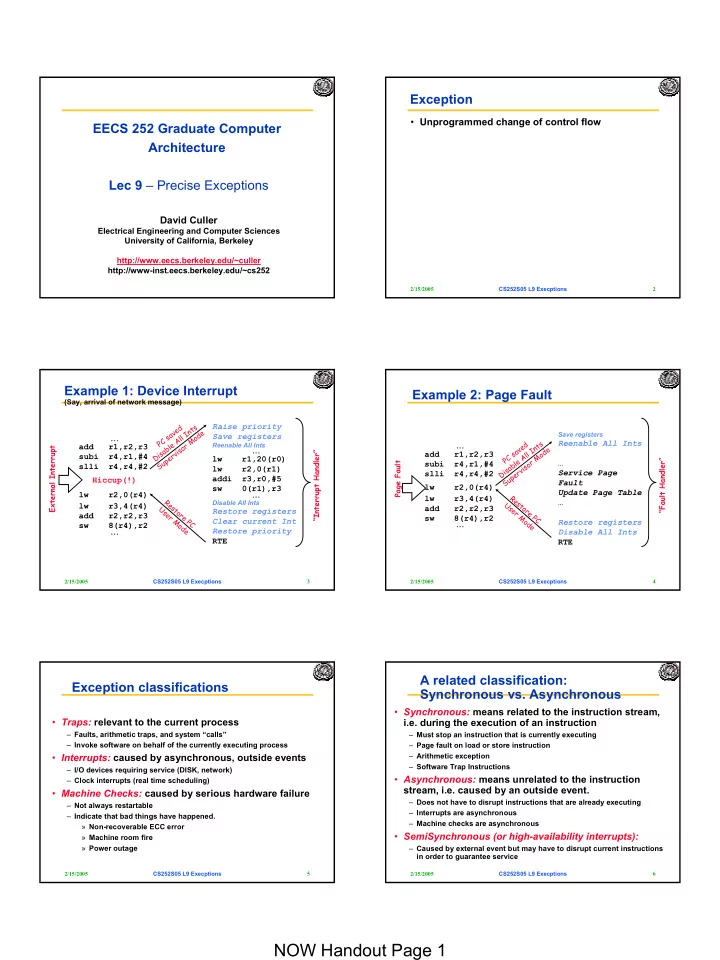
Example 1: Device Interrupt

(Say, arrival of network message)

… add r1,r2,r3 subi r4,r1,#4 slli r4,r4,#2 Hiccup(!) lw r2,0(r4) lw r3,4(r4) add r2,r2,r3 sw 8(r4),r2 … Raise priority Save registers

Reenable All Ints

… lw r1,20(r0) lw r2,0(r1) addi r3,r0,#5 sw 0(r1),r3 …

Disable All Ints

Restore registers Clear current Int Restore priority RTE

External Interrupt PC saved Disable All Ints Supervisor Mode Restore PC User Mode “Interrupt Handler”

2/15/2005 CS252S05 L9 Execptions 4

Example 2: Page Fault

… add r1,r2,r3 subi r4,r1,#4 slli r4,r4,#2 lw r2,0(r4) lw r3,4(r4) add r2,r2,r3 sw 8(r4),r2 …

Save registers

Reenable All Ints … Service Page Fault Update Page Table … Restore registers Disable All Ints RTE

Page Fault PC saved Disable All Ints Supervisor Mode Restore PC User Mode “Fault Handler”

2/15/2005 CS252S05 L9 Execptions 5

Exception classifications

  • Traps: relevant to the current process

– Faults, arithmetic traps, and system “calls” – Invoke software on behalf of the currently executing process

  • Interrupts: caused by asynchronous, outside events

– I/O devices requiring service (DISK, network) – Clock interrupts (real time scheduling)

  • Machine Checks: caused by serious hardware failure

– Not always restartable – Indicate that bad things have happened. » Non-recoverable ECC error » Machine room fire » Power outage

2/15/2005 CS252S05 L9 Execptions 6

A related classification: Synchronous vs. Asynchronous

  • Synchronous: means related to the instruction stream,

i.e. during the execution of an instruction

– Must stop an instruction that is currently executing – Page fault on load or store instruction – Arithmetic exception – Software Trap Instructions

  • Asynchronous: means unrelated to the instruction

stream, i.e. caused by an outside event.

– Does not have to disrupt instructions that are already executing – Interrupts are asynchronous – Machine checks are asynchronous

  • SemiSynchronous (or high-availability interrupts):

– Caused by external event but may have to disrupt current instructions in order to guarantee service

slide-2
SLIDE 2

NOW Handout Page 2

2/15/2005 CS252S05 L9 Execptions 7

Can we have fast interrupts?

  • Pipeline Drain: Can be very Expensive
  • Priority Manipulations
  • Register Save/Restore

– 128 registers + cache misses + etc.

… add r1,r2,r3 subi r4,r1,#4 slli r4,r4,#2 Hiccup(!) lw r2,0(r4) lw r3,4(r4) add r2,r2,r3 sw 8(r4),r2 … Raise priority Reenable All Ints Save registers … lw r1,20(r0) lw r2,0(r1) addi r3,r0,#5 sw 0(r1),r3 … Restore registers Clear current Int Disable All Ints Restore priority RTE

Fine Grain Interrupt PC saved Disable All Ints Supervisor Mode Restore PC User Mode Could be interrupted by disk

2/15/2005 CS252S05 L9 Execptions 8

SPARC (and RISC I) had register windows

  • On interrupt or procedure call, simply switch to a

different set of registers

  • Really saves on interrupt overhead

– Interrupts can happen at any point in the execution, so compiler cannot help with knowledge of live registers. – Conservative handlers must save all registers – Short handlers might be able to save only a few, but this analysis is compilcated

  • Not as big a deal with procedure calls

– Original statement by Patterson was that Berkeley didn’t have a compiler team, so they used a hardware solution – Good compilers can allocate registers across procedure boundaries – Good compilers know what registers are live at any one time

  • However, register windows have returned!

– IA64 has them – Many other processors have shadow registers for interrupts

2/15/2005 CS252S05 L9 Execptions 9

Supervisor State

  • Typically, processors have some amount of state that

user programs are not allowed to touch.

– Page mapping hardware/TLB » TLB prevents one user from accessing memory of another » TLB protection prevents user from modifying mappings – Interrupt controllers -- User code prevented from crashing machine by disabling interrupts. Ignoring device interrupts, etc. – Real-time clock interrupts ensure that users cannot lockup/crash machine even if they run code that goes into a loop: » “Preemptive Multitasking” vs “non-preemptive multitasking”

  • Access to hardware devices restricted

– Prevents malicious user from stealing network packets – Prevents user from writing over disk blocks

  • Distinction made with at least two-levels:

USER/SYSTEM (one hardware mode-bit)

– x86 architectures actually provide 4 different levels, only two usually used by OS (or only 1 in older Microsoft OSs)

2/15/2005 CS252S05 L9 Execptions 10

Entry into Supervisor Mode

  • Entry into supervisor mode typically happens on

interrupts, exceptions, and special trap instructions.

  • Entry goes through kernel instructions:

– interrupts, exceptions, and trap instructions change to supervisor mode, then jump (indirectly) through table of instructions in kernel intvec: j handle_int0 j handle_int1 … j handle_fp_except0 … j handle_trap0 j handle_trap1 – OS “System Calls” are just trap instructions: read(fd,buffer,count) => st 20(r0),r1 st 24(r0),r2 st 28(r0),r3 trap $READ

  • OS overhead can be serious concern for achieving fast

interrupt behavior.

2/15/2005 CS252S05 L9 Execptions 11

Precise Interrupts/Exceptions

  • An interrupt or exception is considered precise if there

is a single instruction (or interrupt point) for which:

– All instructions before that have committed their state – No following instructions (including the interrupting instruction) have modified any state.

  • This means, that you can restart execution at the

interrupt point and “get the right answer”

– Implicit in our previous example of a device interrupt: » Interrupt point is at first lw instruction

… add r1,r2,r3 subi r4,r1,#4 slli r4,r4,#2 lw r2,0(r4) lw r3,4(r4) add r2,r2,r3 sw 8(r4),r2 …

External Interrupt PC saved Disable All Ints

Supervisor Mode

R e s t

  • r

e P C U s e r M

  • d

e

Int handler

2/15/2005 CS252S05 L9 Execptions 12

Precise interrupt point may require multiple PCs

  • On SPARC, interrupt hardware produces “pc” and

“npc” (next pc)

  • On MIPS, only “pc” – must fix point in software

addi r4,r3,#4 sub r1,r2,r3 bne r1,there and r2,r3,r5 <other insts>

PC: PC+4: Interrupt point described as <PC,PC+4>

addi r4,r3,#4 sub r1,r2,r3 bne r1,there and r2,r3,r5 <other insts>

Interrupt point described as: <PC+4,there> (branch was taken)

  • r

<PC+4,PC+8> (branch was not taken) PC: PC+4:

slide-3
SLIDE 3

NOW Handout Page 3

2/15/2005 CS252S05 L9 Execptions 13

Why are precise interrupts desirable?

  • Restartability doesn’t require preciseness. However,

preciseness makes it a lot easier to restart.

  • Simplify the task of the operating system a lot

– Less state needs to be saved away if unloading process. – Quick to restart (making for fast interrupts)

  • Many types of interrupts/exceptions need to be
  • restartable. Easier to figure out what actually

happened:

– I.e. TLB faults. Need to fix translation, then restart load/store – IEEE gradual underflow, illegal operation, etc: e.g. Suppose you are computing: Then, for , Want to take exception, replace NaN with 1, then restart.

→ x

  • peration

illegal NaN f _ ) ( + ⇒ =

x x x f ) sin( ) ( =

2/15/2005 CS252S05 L9 Execptions 14

Approximations to precise interrupts

  • Hardware has imprecise state at time of interrupt
  • Exception handler must figure out how to find a precise PC

at which to restart program.

– Emulate instructions that may remain in pipeline – Example: SPARC allows limited parallelism between FP and integer core:

» possible that integer instructions #1 - #4 have already executed at time that the first floating instruction gets a recoverable exception » Interrupt handler code must fixup <float 1>, then emulate both <float 1> and <float 2> » At that point, precise interrupt point is integer instruction #5.

<float 1> <int 1> <int 2> <int 3> <float 2> <int 4> <int 5>

  • Vax had string move instructions that could be in

middle at time that page-fault occurred.

  • Could be arbitrary processor state that needs to be

restored to restart execution.

2/15/2005 CS252S05 L9 Execptions 15

Precise Exceptions in simple 5-stage pipeline:

  • Exceptions may occur at different stages in pipeline

(I.e. out of order):

– Arithmetic exceptions occur in execution stage – TLB faults can occur in instruction fetch or memory stage

  • What about interrupts? The doctor’s mandate of “do

no harm” applies here: try to interrupt the pipeline as little as possible

  • All of this solved by tagging instructions in pipeline as

“cause exception or not” and wait until end of memory stage to flag exception

– Interrupts become marked NOPs (like bubbles) that are placed into pipeline instead of an instruction. – Assume that interrupt condition persists in case NOP flushed – Clever instruction fetch might start fetching instructions from interrupt vector, but this is complicated by need for supervisor mode switch, saving of one or more PCs, etc

2/15/2005 CS252S05 L9 Execptions 16

Another look at the exception problem

  • Use pipeline to sort this out!

– Pass exception status along with instruction. – Keep track of PCs for every instruction in pipeline. – Don’t act on exception until it reache WB stage

  • Handle interrupts through “faulting noop” in IF stage
  • When instruction reaches WB stage:

– Save PC ⇒ EPC, Interrupt vector addr ⇒ PC – Turn all instructions in earlier stages into noops! Program Flow Time IFetch Dcd Exec Mem WB IFetch Dcd Exec Mem WB IFetch Dcd Exec Mem WB IFetch Dcd Exec Mem WB Data TLB Bad Inst Inst TLB fault Overflow

2/15/2005 CS252S05 L9 Execptions 17

How to achieve precise interrupts when instructions executing in arbitrary

  • rder?
  • Jim Smith’s classic paper discusses several methods

for getting precise interrupts:

– In-order instruction completion – Reorder buffer – History buffer – Future buffer

2/15/2005 CS252S05 L9 Execptions 18

Problem: “Fetch” unit

Instruction Fetch with Branch Prediction

Out-Of-Order Execution Unit Correctness Feedback On Branch Results Stream of Instructions To Execute

  • Instruction fetch decoupled from execution
  • Often issue logic (+ rename) included with Fetch
slide-4
SLIDE 4

NOW Handout Page 4

2/15/2005 CS252S05 L9 Execptions 19

Branches must be resolved quickly for loop overlap!

  • In our loop-unrolling example, we relied on the fact that branches

were under control of “fast” integer unit in order to get overlap! Loop: LD F0 R1 MULTD F4 F0 F2 SD F4 R1 SUBI R1 R1 #8 BNEZ R1 Loop

  • What happens if branch depends on result of multd??

– We completely lose all of our advantages! – Need to be able to “predict” branch outcome. – If we were to predict that branch was taken, this would be right most of the time.

  • Problem much worse for superscalar machines!

2/15/2005 CS252S05 L9 Execptions 20

  • Prediction has become essential to getting good

performance from scalar instruction streams.

  • We will discuss predicting branches. However,

architects are now predicting everything: data dependencies, actual data, and results of groups

  • f instructions:

– At what point does computation become a probabilistic operation + verification? – We are pretty close with control hazards already…

  • Why does prediction work?

– Underlying algorithm has regularities. – Data that is being operated on has regularities. – Instruction sequence has redundancies that are artifacts of way that humans/compilers think about problems.

  • Prediction ⇒ Compressible information streams?

Prediction: Branches, Dependencies, Data

2/15/2005 CS252S05 L9 Execptions 21

What about Precise Exceptions/Interrupts?

  • Both Scoreboard and Tomasulo have:

– In-order issue, out-of-order execution, out-of-order completion

  • Recall: An interrupt or exception is precise if there is

a single instruction for which:

– All instructions before that have committed their state – No following instructions (including the interrupting instruction) have modified any state.

  • Need way to resynchronize execution with instruction

stream (I.e. with issue-order)

– Easiest way is with in-order completion (i.e. reorder buffer) – Other Techniques (Smith paper): Future File, History Buffer

2/15/2005 CS252S05 L9 Execptions 22

Reorder Buffer

  • Idea:

– record instruction issue

  • rder

– Allow them to execute out of

  • rder

– Reorder them so that they commit in-order

  • On issue:

– Reserve slot at tail of ROB – Record dest reg, PC – Tag u-op with ROB slot

  • Done execute

– Deposit result in ROB slot – Mark exception state

  • WB head of ROB

– Check exception, handle – Write register value, or – Commit the store IFetch Opfetch/Dcd Write Back RF

2/15/2005 CS252S05 L9 Execptions 23

Reorder Buffer + Forwarding

  • Idea:

– Forward uncommitted results to later uncommitted operations

  • Trap

– Discard remainder of ROB

  • Opfetch / Exec

– Match source reg against all dest regs in ROB – Forward last (once available)

IFetch Opfetch/Dcd Write Back Reg

2/15/2005 CS252S05 L9 Execptions 24

Reorder Buffer + Forwarding + Speculation

  • Idea:

– Issue branch into ROB – Mark with prediction – Fetch and issue predicted instructions speculatively – Branch must resolve before leaving ROB – Resolve correct » Commit following instr – Resolve incorrect » Mark following instr in ROB as invalid » Let them clear

IFetch Opfetch/Dcd Write Back Reg

slide-5
SLIDE 5

NOW Handout Page 5

2/15/2005 CS252S05 L9 Execptions 25

History File

  • Maintain issue order, like

ROB

  • Each entry records dest reg

and old value of dest. Register

– What if old value not available when instruction issues?

  • FUs write results into

register file

– Forward into correct entry in history file

  • When exception reaches

head

– Restore architected registers from tail to head

IFetch Opfetch/Dcd Write Back Reg

2/15/2005 CS252S05 L9 Execptions 26

Future file

  • Idea

– Arch registers reflect state at commit point – Future register reflect whatever instructions have completed – On WB update future – On commit update arch – On exception » Discard future » Replace with arch

  • Dest w/I ROB

IFetch Opfetch/Dcd Write Back Future Reg

2/15/2005 CS252S05 L9 Execptions 27

HW support for precise interrupts

  • Concept of Reorder Buffer (ROB):

– Holds instructions in FIFO order, exactly as they were issued » Each ROB entry contains PC, dest reg, result, exception status – When instructions complete, results placed into ROB » Supplies operands to other instruction between execution complete & commit ⇒ more registers like RS » Tag results with ROB buffer number instead of reservation station – Instructions commit ⇒values at head of ROB placed in registers – As a result, easy to undo speculated instructions

  • n mispredicted branches
  • r on exceptions

Reorder Buffer FP Op Queue FP Adder FP Adder Res Stations Res Stations FP Regs Commit path

2/15/2005 CS252S05 L9 Execptions 28

Recall: Four Steps of Speculative Tomasulo Algorithm

  • 1. Issue—get instruction from FP Op Queue

If reservation station and reorder buffer slot free, issue instr & send

  • perands & reorder buffer no. for destination (this stage sometimes

called “dispatch”)

  • 2. Execution—operate on operands (EX)

When both operands ready then execute; if not ready, watch CDB for result; when both in reservation station, execute; checks RAW (sometimes called “issue”)

  • 3. Write result—finish execution (WB)

Write on Common Data Bus to all awaiting FUs & reorder buffer; mark reservation station available.

  • 4. Commit—update register with reorder result

When instr. at head of reorder buffer & result present, update register with result (or store to memory) and remove instr from reorder buffer. Mispredicted branch flushes reorder buffer (sometimes called “graduation”)

2/15/2005 CS252S05 L9 Execptions 29

What are the hardware complexities with reorder buffer (ROB)?

Reorder Buffer FP Op Queue FP Adder FP Adder Res Stations Res Stations FP Regs Compar network

  • How do you find the latest version of a register?

– As specified by Smith paper, need associative comparison network – Could use future file or just use the register result status buffer to track which specific reorder buffer has received the value

  • Need as many ports on ROB as register file

Reorder Table

Dest Reg Result Exceptions? Valid Program Counter

2/15/2005 CS252S05 L9 Execptions 30

Tomasulo With Reorder buffer:

To Memory FP adders FP adders FP multipliers FP multipliers Reservation Stations FP Op Queue

ROB7 ROB6 ROB5 ROB4 ROB3 ROB2 ROB1

F0 F0 LD F0,10(R2) LD F0,10(R2) N N Done? Dest Dest Oldest Newest from Memory 1 10+R2 1 10+R2 Dest

Reorder Buffer Registers

slide-6
SLIDE 6

NOW Handout Page 6

2/15/2005 CS252S05 L9 Execptions 31

2 ADDD R(F4),ROB1 2 ADDD R(F4),ROB1

Tomasulo With Reorder buffer:

To Memory FP adders FP adders FP multipliers FP multipliers Reservation Stations FP Op Queue

ROB7 ROB6 ROB5 ROB4 ROB3 ROB2 ROB1

F10 F10 F0 F0 ADDD F10,F4,F0 ADDD F10,F4,F0 LD F0,10(R2) LD F0,10(R2) N N N N Done? Dest Dest Oldest Newest from Memory 1 10+R2 1 10+R2 Dest

Reorder Buffer Registers

2/15/2005 CS252S05 L9 Execptions 32

3 DIVD ROB2,R(F6) 3 DIVD ROB2,R(F6) 2 ADDD R(F4),ROB1 2 ADDD R(F4),ROB1

Tomasulo With Reorder buffer:

To Memory FP adders FP adders FP multipliers FP multipliers Reservation Stations FP Op Queue

ROB7 ROB6 ROB5 ROB4 ROB3 ROB2 ROB1

F2 F2 F10 F10 F0 F0 DIVD F2,F10,F6 DIVD F2,F10,F6 ADDD F10,F4,F0 ADDD F10,F4,F0 LD F0,10(R2) LD F0,10(R2) N N N N N N Done? Dest Dest Oldest Newest from Memory 1 10+R2 1 10+R2 Dest

Reorder Buffer Registers

2/15/2005 CS252S05 L9 Execptions 33

3 DIVD ROB2,R(F6) 3 DIVD ROB2,R(F6) 2 ADDD R(F4),ROB1 2 ADDD R(F4),ROB1 6 ADDD ROB5, R(F6) 6 ADDD ROB5, R(F6)

Tomasulo With Reorder buffer:

To Memory FP adders FP adders FP multipliers FP multipliers Reservation Stations FP Op Queue

ROB7 ROB6 ROB5 ROB4 ROB3 ROB2 ROB1

F0 F0 ADDD F0,F4,F6 ADDD F0,F4,F6 N N F4 F4 LD F4,0(R3) LD F4,0(R3) N N

  • BNE F2,<…>

BNE F2,<…> N N F2 F2 F10 F10 F0 F0 DIVD F2,F10,F6 DIVD F2,F10,F6 ADDD F10,F4,F0 ADDD F10,F4,F0 LD F0,10(R2) LD F0,10(R2) N N N N N N Done? Dest Dest Oldest Newest from Memory 1 10+R2 1 10+R2 Dest

Reorder Buffer Registers

5 0+R3 5 0+R3

2/15/2005 CS252S05 L9 Execptions 34

3 DIVD ROB2,R(F6) 3 DIVD ROB2,R(F6) 2 ADDD R(F4),ROB1 2 ADDD R(F4),ROB1 6 ADDD ROB5, R(F6) 6 ADDD ROB5, R(F6)

Tomasulo With Reorder buffer:

To Memory FP adders FP adders FP multipliers FP multipliers Reservation Stations FP Op Queue

ROB7 ROB6 ROB5 ROB4 ROB3 ROB2 ROB1

  • F0

F0 ROB5 ROB5 ST 0(R3),F4 ST 0(R3),F4 ADDD F0,F4,F6 ADDD F0,F4,F6 N N N N F4 F4 LD F4,0(R3) LD F4,0(R3) N N

  • BNE F2,<…>

BNE F2,<…> N N F2 F2 F10 F10 F0 F0 DIVD F2,F10,F6 DIVD F2,F10,F6 ADDD F10,F4,F0 ADDD F10,F4,F0 LD F0,10(R2) LD F0,10(R2) N N N N N N Done? Dest Dest Oldest Newest from Memory Dest

Reorder Buffer Registers

1 10+R2 1 10+R2 5 0+R3 5 0+R3

2/15/2005 CS252S05 L9 Execptions 35

3 DIVD ROB2,R(F6) 3 DIVD ROB2,R(F6)

Tomasulo With Reorder buffer:

To Memory FP adders FP adders FP multipliers FP multipliers Reservation Stations FP Op Queue

ROB7 ROB6 ROB5 ROB4 ROB3 ROB2 ROB1

  • F0

F0 M[10] M[10] ST 0(R3),F4 ST 0(R3),F4 ADDD F0,F4,F6 ADDD F0,F4,F6 Y Y N N F4 F4 M[10] M[10] LD F4,0(R3) LD F4,0(R3) Y Y

  • BNE F2,<…>

BNE F2,<…> N N F2 F2 F10 F10 F0 F0 DIVD F2,F10,F6 DIVD F2,F10,F6 ADDD F10,F4,F0 ADDD F10,F4,F0 LD F0,10(R2) LD F0,10(R2) N N N N N N Done? Dest Dest Oldest Newest from Memory 1 10+R2 1 10+R2 Dest

Reorder Buffer Registers

2 ADDD R(F4),ROB1 2 ADDD R(F4),ROB1 6 ADDD M[10],R(F6) 6 ADDD M[10],R(F6)

2/15/2005 CS252S05 L9 Execptions 36

3 DIVD ROB2,R(F6) 3 DIVD ROB2,R(F6) 2 ADDD R(F4),ROB1 2 ADDD R(F4),ROB1

Tomasulo With Reorder buffer:

To Memory FP adders FP adders FP multipliers FP multipliers Reservation Stations FP Op Queue

ROB7 ROB6 ROB5 ROB4 ROB3 ROB2 ROB1

  • F0

F0 M[10] M[10] <val2> <val2> ST 0(R3),F4 ST 0(R3),F4 ADDD F0,F4,F6 ADDD F0,F4,F6 Y Y Ex Ex F4 F4 M[10] M[10] LD F4,0(R3) LD F4,0(R3) Y Y

  • BNE F2,<…>

BNE F2,<…> N N F2 F2 F10 F10 F0 F0 DIVD F2,F10,F6 DIVD F2,F10,F6 ADDD F10,F4,F0 ADDD F10,F4,F0 LD F0,10(R2) LD F0,10(R2) N N N N N N Done? Dest Dest Oldest Newest from Memory 1 10+R2 1 10+R2 Dest

Reorder Buffer Registers

slide-7
SLIDE 7

NOW Handout Page 7

2/15/2005 CS252S05 L9 Execptions 37

  • F0

F0 M[10] M[10] <val2> <val2> ST 0(R3),F4 ST 0(R3),F4 ADDD F0,F4,F6 ADDD F0,F4,F6 Y Y Ex Ex F4 F4 M[10] M[10] LD F4,0(R3) LD F4,0(R3) Y Y

  • BNE F2,<…>

BNE F2,<…> N N 3 DIVD ROB2,R(F6) 3 DIVD ROB2,R(F6) 2 ADDD R(F4),ROB1 2 ADDD R(F4),ROB1

Tomasulo With Reorder buffer:

To Memory FP adders FP adders FP multipliers FP multipliers Reservation Stations FP Op Queue

ROB7 ROB6 ROB5 ROB4 ROB3 ROB2 ROB1

F2 F2 F10 F10 F0 F0 DIVD F2,F10,F6 DIVD F2,F10,F6 ADDD F10,F4,F0 ADDD F10,F4,F0 LD F0,10(R2) LD F0,10(R2) N N N N N N Done? Dest Dest Oldest Newest from Memory 1 10+R2 1 10+R2 Dest

Reorder Buffer Registers

What about memory hazards???

2/15/2005 CS252S05 L9 Execptions 38

Memory Disambiguation: Sorting out RAW Hazards in memory

  • Question: Given a load that follows a store in program
  • rder, are the two related?

– (Alternatively: is there a RAW hazard between the store and the load)? Eg: st 0(R2),R5 ld R6,0(R3)

  • Can we go ahead and start the load early?

– Store address could be delayed for a long time by some calculation that leads to R2 (divide?). – We might want to issue/begin execution of both operations in same cycle. – Today: Answer is that we are not allowed to start load until we know that address 0(R2) ≠ 0(R3) – Later: We might guess at whether or not they are dependent (called “dependence speculation”) and use reorder buffer to fixup if we are wrong.

2/15/2005 CS252S05 L9 Execptions 39

Hardware Support for Memory Disambiguation

  • Need buffer to keep track of all outstanding stores to

memory, in program order.

– Keep track of address (when becomes available) and value (when becomes available) – FIFO ordering: will retire stores from this buffer in program order

  • When issuing a load, record current head of store queue

(know which stores are ahead of you).

  • When have address for load, check store queue:

– If any store prior to load is waiting for its address, stall load. – If load address matches earlier store address (associative lookup), then we have a memory-induced RAW hazard: » store value available ⇒ return value » store value not available ⇒ return ROB number of source – Otherwise, send out request to memory

  • Actual stores commit in order, so no worry about

WAR/WAW hazards through memory.

2/15/2005 CS252S05 L9 Execptions 40

  • LD F4, 10(R3)

LD F4, 10(R3) N N

Memory Disambiguation:

To Memory FP adders FP adders FP multipliers FP multipliers Reservation Stations FP Op Queue

ROB7 ROB6 ROB5 ROB4 ROB3 ROB2 ROB1

F2 F2 F0 F0

  • R[F5]

R[F5] <val 1> <val 1> ST 10(R3), F5 ST 10(R3), F5 LD F0,32(R2) LD F0,32(R2) ST 0(R3), F4 ST 0(R3), F4 N N N N Y Y Done? Dest Dest Oldest Newest from Memory 2 32+R2 2 32+R2 4 ROB3 4 ROB3 Dest

Reorder Buffer Registers

2/15/2005 CS252S05 L9 Execptions 41

Relationship between precise interrupts and speculation:

  • Speculation is a form of guessing

– Branch prediction, data prediction – If we speculate and are wrong, need to back up and restart execution to point at which we predicted incorrectly – This is exactly same as precise exceptions!

  • Branch prediction is a very important!

– Need to “take our best shot” at predicting branch direction. – If we issue multiple instructions per cycle, lose lots of potential instructions otherwise: » Consider 4 instructions per cycle » If take single cycle to decide on branch, waste from 4 - 7 instruction slots!

  • Technique for both precise interrupts/exceptions and

speculation: in-order completion or commit

– This is why reorder buffers in all new processors

2/15/2005 CS252S05 L9 Execptions 42

Explicit register renaming:

R10000 Freelist Management

F10 F10 F0 F0 P10 P10 P0 P0 ADDD P34,P4,P32 ADDD P34,P4,P32 LD P32,10(R2) LD P32,10(R2) N N N N Done? Oldest Newest P32 P32 P2 P2 P4 P4 F6 F6 F8 F8 P34 P34 P12 P12 P14 P14 P16 P16 P18 P18 P20 P20 P22 P22 P24 P24 p26 p26 P28 P28 P30 P30 P36 P36 P38 P38 P40 P40 P42 P42 … P60 P60 P62 P62 Current Map Table Freelist

slide-8
SLIDE 8

NOW Handout Page 8

2/15/2005 CS252S05 L9 Execptions 43

Explicit register renaming:

R10000 Freelist Management

  • F2

F2 F10 F10 F0 F0 P2 P2 P10 P10 P0 P0 BNE P36,<…> BNE P36,<…> N N DIVD P36,P34,P6 DIVD P36,P34,P6 ADDD P34,P4,P32 ADDD P34,P4,P32 LD P32,10(R2) LD P32,10(R2) N N N N N N Done? Oldest Newest P32 P32 P36 P36 P4 P4 F6 F6 F8 F8 P34 P34 P12 P12 P14 P14 P16 P16 P18 P18 P20 P20 P22 P22 P24 P24 p26 p26 P28 P28 P30 P30 P38 P38 P40 P40 P44 P44 P48 P48 … P60 P60 P62 P62 Current Map Table Freelist P32 P32 P36 P36 P4 P4 F6 F6 F8 F8 P34 P34 P12 P12 P14 P14 P16 P16 P18 P18 P20 P20 P22 P22 P24 P24 p26 p26 P28 P28 P30 P30 P38 P38 P40 P40 P44 P44 P48 P48 … P60 P60 P62 P62

Checkpoint at BNE instruction

2/15/2005 CS252S05 L9 Execptions 44

Explicit register renaming:

R10000 Freelist Management

  • F0

F0 F4 F4

  • F2

F2 F10 F10 F0 F0 P32 P32 P4 P4 P2 P2 P10 P10 P0 P0 ST 0(R3),P40 ST 0(R3),P40 ADDD P40,P38,P6 ADDD P40,P38,P6 Y Y Y Y LD P38,0(R3) LD P38,0(R3) Y Y BNE P36,<…> BNE P36,<…> N N DIVD P36,P34,P6 DIVD P36,P34,P6 ADDD P34,P4,P32 ADDD P34,P4,P32 LD P32,10(R2) LD P32,10(R2) N N y y y y Done? Oldest Newest P40 P40 P36 P36 P38 P38 F6 F6 F8 F8 P34 P34 P12 P12 P14 P14 P16 P16 P18 P18 P20 P20 P22 P22 P24 P24 p26 p26 P28 P28 P30 P30 P42 P42 P44 P44 P48 P48 P50 P50 … P0 P0 P10 P10 Current Map Table Freelist P32 P32 P36 P36 P4 P4 F6 F6 F8 F8 P34 P34 P12 P12 P14 P14 P16 P16 P18 P18 P20 P20 P22 P22 P24 P24 p26 p26 P28 P28 P30 P30 P38 P38 P40 P40 P44 P44 P48 P48 … P60 P60 P62 P62

Checkpoint at BNE instruction

2/15/2005 CS252S05 L9 Execptions 45

Explicit register renaming:

R10000 Freelist Management

F2 F2 F10 F10 F0 F0 P2 P2 P10 P10 P0 P0 DIVD P36,P34,P6 DIVD P36,P34,P6 ADDD P34,P4,P32 ADDD P34,P4,P32 LD P32,10(R2) LD P32,10(R2) N N y y y y Done? Oldest Newest Current Map Table Freelist P32 P32 P36 P36 P4 P4 F6 F6 F8 F8 P34 P34 P12 P12 P14 P14 P16 P16 P18 P18 P20 P20 P22 P22 P24 P24 p26 p26 P28 P28 P30 P30 P38 P38 P40 P40 P44 P44 P48 P48 … P60 P60 P62 P62

Checkpoint at BNE instruction

P32 P32 P36 P36 P4 P4 F6 F6 F8 F8 P34 P34 P12 P12 P14 P14 P16 P16 P18 P18 P20 P20 P22 P22 P24 P24 p26 p26 P28 P28 P30 P30 P38 P38 P40 P40 P44 P44 P48 P48 … P60 P60 P62 P62

Speculation error fixed by restoring map table and freelist

2/15/2005 CS252S05 L9 Execptions 46

Summary

  • Control flow causes lots of trouble with pipelining

– Other hazards can be “fixed” with more transistors or forwarding – We will spend a lot of time on branch prediction techniques

  • Some pre-decode techniques can transform dynamic

decisions into static ones (VLIW-like)

– Beginnings of dynamic compilation techniques

  • Interrupts and Exceptions either interrupt the current

instruction or happen between instructions

– Possibly large quantities of state must be saved before interrupting

  • Machines with precise exceptions provide one single

point in the program to restart execution

– All instructions before that point have completed – No instructions after or including that point have completed

  • Hardware techniques exist for precise exceptions even

in the face of out-of-order execution!

– Important enabling factor for out-of-order execution

2/15/2005 CS252S05 L9 Execptions 47

Disable Network Intr … subi r4,r1,#4 slli r4,r4,#2 lw r2,0(r4) lw r3,4(r4) add r2,r2,r3 sw 8(r4),r2 lw r1,12(r0) beq r1,no_mess lw r1,20(r0) lw r2,0(r1) addi r3,r0,#5 sw 0(r1),r3 Clear Network Intr …

Alternative: Polling

(again, for arrival of network message)

External Interrupt “Handler”

no_mess:

Polling Point (check device register)

2/15/2005 CS252S05 L9 Execptions 48

Interrupt Priorities Must be Handled

… add r1,r2,r3 subi r4,r1,#4 slli r4,r4,#2 Hiccup(!) lw r2,0(r4) lw r3,4(r4) add r2,r2,r3 sw 8(r4),r2 … Raise priority Reenable All Ints Save registers … lw r1,20(r0) lw r2,0(r1) addi r3,r0,#5 sw 0(r1),r3 … Restore registers Clear current Int Disable All Ints Restore priority RTE

Network Interrupt PC saved Disable All Ints Supervisor Mode Restore PC User Mode Could be interrupted by disk Note that priority must be raised to avoid recursive interrupts!

slide-9
SLIDE 9

NOW Handout Page 9

2/15/2005 CS252S05 L9 Execptions 49

Interrupt controller hardware and mask levels

  • Operating system constructs a hierarchy of masks

that reflects some form of interrupt priority.

  • For instance:

– This reflects the an order of urgency to interrupts – For instance, this ordering says that disk events can interrupt the interrupt handlers for network interrupts.

Priority Examples Software interrupts 2 Network Interrupts 4 Sound card 5 Disk Interrupt 6 Real Time clock

  • Non-Maskable Ints (power)

2/15/2005 CS252S05 L9 Execptions 50

Polling is faster/slower than Interrupts.

  • Polling is faster than interrupts because

– Compiler knows which registers in use at polling point. Hence, do not need to save and restore registers (or not as many). – Other interrupt overhead avoided (pipeline flush, trap priorities, etc).

  • Polling is slower than interrupts because

– Overhead of polling instructions is incurred regardless of whether or not handler is run. This could add to inner-loop delay. – Device may have to wait for service for a long time.

  • When to use one or the other?

– Multi-axis tradeoff » Frequent/regular events good for polling, as long as device can be controlled at user level. » Interrupts good for infrequent/irregular events » Interrupts good for ensuring regular/predictable service of events.