stretched with 360 turn on rings in artistic gymnastics Author: - - PowerPoint PPT Presentation

stretched with 360 turn on rings in artistic gymnastics
SMART_READER_LITE
LIVE PREVIEW

stretched with 360 turn on rings in artistic gymnastics Author: - - PowerPoint PPT Presentation

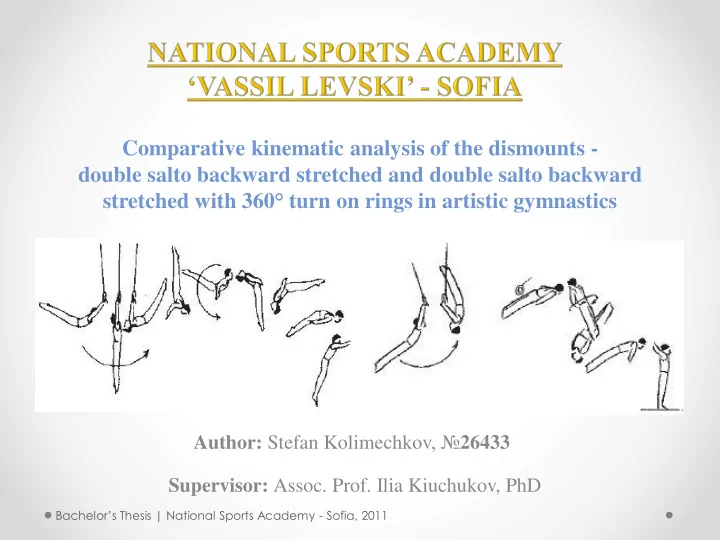
Comparative kinematic analysis of the dismounts - double salto backward stretched and double salto backward stretched with 360 turn on rings in artistic gymnastics Author: Stefan Kolimechkov , 26433 Supervisor: Assoc. Prof. Ilia Kiuchukov,


slide-1
SLIDE 1

Comparative kinematic analysis of the dismounts - double salto backward stretched and double salto backward stretched with 360° turn on rings in artistic gymnastics

Author: Stefan Kolimechkov, №26433 Supervisor: Assoc. Prof. Ilia Kiuchukov, PhD

Bachelor’s Thesis | National Sports Academy - Sofia, 2011

slide-2
SLIDE 2

RINGS

ARTISTIC GYMNASTICS

National Sports Academy - Sofia, 2011

slide-3
SLIDE 3

Rings dismounts which were performed by the medallists of the last three Olympic games

45% 33% 11% 11%

Double salto backward stretched Double salto backward stretched with 720° turn Double salto backward stretched with 360° turn Other dismounts

National Sports Academy - Sofia, 2011

slide-4
SLIDE 4

Rings dismounts which were performed by the World championship medallists of the last ten years

40% 56% 4%

Double salto backward stretched Double salto backward stretched with 360° turn Other dismounts

National Sports Academy - Sofia, 2011

slide-5
SLIDE 5

Purpose of the study

The purpose of this study was to conduct a comparative kinematic analysis of the dismounts - double salto backward stretched and double salto backward stretched with a 360° turn on rings, in addition to giving a summary of methodological recommendations for their training.

National Sports Academy - Sofia, 2011

slide-6
SLIDE 6

Objectives and tasks

  • Calculating and comparing kinematic variables
  • f the main joints (shoulder, hip and ankle);
  • Describing and analysing the technique of the

exercises;

  • Offering a progressive methodology for

achieving an adequate technique for the exercises.

National Sports Academy - Sofia, 2011

slide-7
SLIDE 7

National Sports Academy - Sofia, 2011

slide-8
SLIDE 8

National Sports Academy - Sofia, 2011

slide-9
SLIDE 9

Results

1 2 5 4 3 6 7 8 9 10 11 12

National Sports Academy - Sofia, 2011

slide-10
SLIDE 10

2 4 6 8 10 12 0.2 0.4 0.6 0.8 1 1.2 1.4 1.6 1.8 2 2.2 2.4

Speed [m/s] of the ankle joints Time /sec./

–– Gymnast 1 –– Gymnast 2

National Sports Academy - Sofia, 2011

slide-11
SLIDE 11

1 2 3 4 5 6 7 0.2 0.4 0.6 0.8 1 1.2 1.4 1.6 1.8 2 2.2 2.4

Speed [m/s] of the hip joints Time /sec./

–– Gymnast 1 –– Gymnast 2

National Sports Academy - Sofia, 2011

slide-12
SLIDE 12

1 2 3 4 5 6 0.2 0.4 0.6 0.8 1 1.2 1.4 1.6 1.8 2 2.2 2.4

Speed [m/s] of the shoulder joints Time /sec./

–– Gymnast 1 –– Gymnast 2

National Sports Academy - Sofia, 2011

slide-13
SLIDE 13

13 12 8 8 12 11 11 10 9 9 10 6 6 1 1 2 2 5 5 4 4 3 3 7 7

Phase I Phase II Phase III

National Sports Academy - Sofia, 2011

slide-14
SLIDE 14

1 2 5 4 3

  • I. Preparatory phase

National Sports Academy - Sofia, 2011

slide-15
SLIDE 15

Gymnast 1 Gymnast 2

National Sports Academy - Sofia, 2011

slide-16
SLIDE 16
  • II. Execution phase

Gymnast 1 Gymnast 2 11.11 11.29

National Sports Academy - Sofia, 2011

slide-17
SLIDE 17
  • III. Landing phase

9 11.3

National Sports Academy - Sofia, 2011

slide-18
SLIDE 18

Methodology of training

  • Performing a dismount – double salto backward

pucked (open tucked) on rings from handstand;

National Sports Academy - Sofia, 2011

slide-19
SLIDE 19
  • Performing a dismount – one and a half salto

backward stretched to flat back on soft mats;

National Sports Academy - Sofia, 2011

slide-20
SLIDE 20
  • On a trampoline – performing double salto

backward stretched with a spotting rig;

  • Performing the skill from a trampoline into a

gymnastics pit or onto soft mats;

National Sports Academy - Sofia, 2011

slide-21
SLIDE 21
  • Performing double salto backward stretched on

a trampoline;

National Sports Academy - Sofia, 2011

slide-22
SLIDE 22
  • Performing double salto backward stretched on

rings above into a gymnastics pit;

  • Performing the skill from a handstand or a

backward giant swing, landing on soft mats;

National Sports Academy - Sofia, 2011

slide-23
SLIDE 23
  • Performing double salto backward stretched on

rings requiring the gymnast’s body to remain absolutely straight;

  • Performing double salto backward stretched

with a 360° turn from a trampoline into a gymnastics pit;

  • Performing the skill from handstand on rings

into a gymnastics pit;

National Sports Academy - Sofia, 2011

slide-24
SLIDE 24
  • Performing double salto backward stretched

with 360° turn from a handstand or a backward giant swing, landing on soft mats;

  • Performing the skill in real conditions.

National Sports Academy - Sofia, 2011

slide-25
SLIDE 25

Possible mistakes:

  • Not enough swing, therefore the rotation of the skill

cannot be finished;

  • During the leg kick stage, the hang position is not

sufficient and the gymnast’s head is out, therefore, the rotation cannot be completed;

  • Bending arms just before the take off (at the

beginning of the execution phase);

  • When the first part of the salto is lower than normal,

which means that the hip joints are lower than the level of the rings, the exercise cannot be successfully completed.

  • If the extension from the hip joints is performed at

too late stage, the head and chest will enjoy no advantage in the subsequent backward movement.

National Sports Academy - Sofia, 2011

slide-26
SLIDE 26

Conclusions and recommendations

  • The gymnast should possess a technique which

is adequate for the performance of basic gymnastics skills, in order then to learn and execute these additional and more demanding exercises successfully;

  • The critical issue regarding the analysed

exercises is the amplitude of swing combined with the strength of the leg kick;

National Sports Academy - Sofia, 2011

slide-27
SLIDE 27

Conclusions and recommendations

  • The analysed elements require an adequate

technique, which will allow for progression to more difficult skills.

  • We recommend that our methodology for

learning the analysed exercises should be taught in the same progressive order.

National Sports Academy - Sofia, 2011

slide-28
SLIDE 28

Conclusions and recommendations

  • We recommend that the move of the gymnast

concerning twisting should start at the very end of the leg kick (the moment of releasing the rings) when performing the dismount with a 360° turn.

  • We recommend that any technical mistakes

during the training process should be eliminated as soon as possible.

National Sports Academy - Sofia, 2011

slide-29
SLIDE 29

Thank You!

Bachelor’s Thesis | National Sports Academy - Sofia, 2011

Downloaded from https://www.stk-sport.co.uk