Nutrition assessment of pre-school and primary school children - - PowerPoint PPT Presentation

nutrition assessment
SMART_READER_LITE
LIVE PREVIEW

Nutrition assessment of pre-school and primary school children - - PowerPoint PPT Presentation

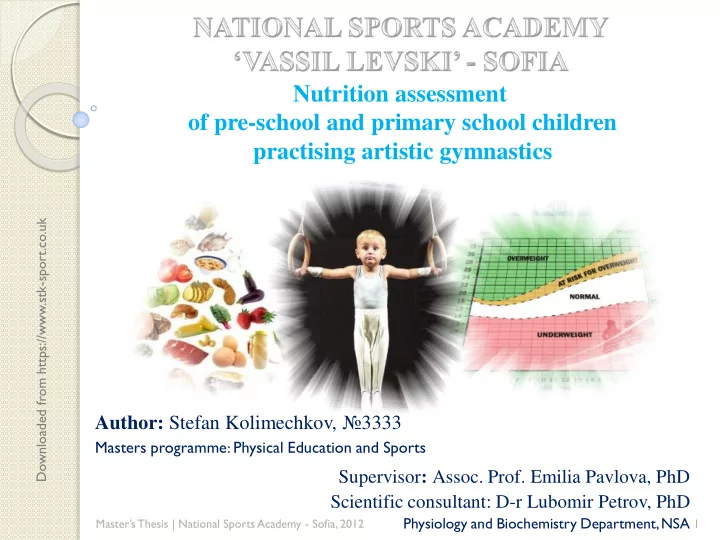
Nutrition assessment of pre-school and primary school children practising artistic gymnastics Downloaded from https://www.stk-sport.co.uk Author: Stefan Kolimechkov, 3333 Masters programme : Physical Education and Sports Supervisor : Assoc.


slide-1
SLIDE 1

Nutrition assessment

  • f pre-school and primary school children

practising artistic gymnastics

Supervisor: Assoc. Prof. Emilia Pavlova, PhD Scientific consultant: D-r Lubomir Petrov, PhD

Physiology and Biochemistry Department, NSA

Author: Stefan Kolimechkov, №3333

Masters programme: Physical Education and Sports

1 Master’s Thesis | National Sports Academy - Sofia, 2012

Downloaded from https://www.stk-sport.co.uk

slide-2
SLIDE 2

Purpose

The aim of this study was to assess, using accessible methods for wide application in practice, the diet of pre-school and primary school children practising artistic gymnastics.

2 National Sports Academy - Sofia, 2012

slide-3
SLIDE 3

Objectives and tasks

3

 Approbation and adaptation of an appropriate food

questionnaire in order to assess diet and nutrition of children;

 Nutritional assessment of pre-school and primary

school children practising artistic gymnastics;

 Approbation of appropriate methods in order to

assess physical development in young children;

 Assessment of the physical development of pre-

school and primary school children practising gymnastics;

 Assessment of nutrition and physical development

based on the children's training process.

National Sports Academy - Sofia, 2012

slide-4
SLIDE 4

Methods

 The study included 40 children, 22 boys and

18 girls, from 4 to 12 years of age, practising artistic gymnastics in ‘Sports Centre Levski’ in Sofia (Bulgaria).

 Groups:

  • Pre-school (3-6 years old)
  • Primary school (7-11 years old)

4 National Sports Academy - Sofia, 2012

slide-5
SLIDE 5

Anthropometry

Height (cm), percentile and Z-score Weight (kg), percentile and Z-score Upper arm circumference (cm) Skinfolds: triceps, subscapular (mm) Dynamometry (kg, N) BMI (kg/m2), percentile and Z-score % Body Fat Upper arm muscle area (сm2)

5 National Sports Academy - Sofia, 2012

slide-6
SLIDE 6

Skinfold & Dynamometer Tests

6 National Sports Academy - Sofia, 2012

slide-7
SLIDE 7

Height, weight and BMI assessment

We used specialised software prepared by the World Health Organization (WHO) – ‘WHO Anthro’ (for children under six years of age) and ‘WHO Anthro Plus’ (for children over six years of age), to assess height, weight and BMI in children (WHO 2007). For each variable we calculated the Z-score and percentile score for the relevant age. To distinguish the BMI scores, we used references provided by the WHO for children from 5 to 19 years

  • f age:

(overweight > +1 SD,

  • bese

> +2 SD, underweight < -2 SD, mortality <-3 SD)

7 National Sports Academy - Sofia, 2012

slide-8
SLIDE 8

Nutrition assessment

The nutrition questionnaire which had been used for adult athletes (Zaikova 2010, 2011, 2012) was adapted for our purposes in order to assess the nutrient intake in children. The Food Frequency Questionnaire (FFQ) was completed by the children’s parents. It included 24 questions relating to the weekly consumption of basic foodstuffs and questions about the physical activity, height and weight of children. Based on the results, the daily intake of proteins, carbohydrates and fats, protein/kg body weight, in addition to the total daily energy intake (kcal/24h) was calculated . The data concerning height and weight between our measurements and those obtained from the parents were compared.

8 National Sports Academy - Sofia, 2012

slide-9
SLIDE 9

Results

Anthropometric data of the children from our study

9

Males 3-6 years Females 3-6 years Males 7-11 years Females 7-11 years Age (y)

5.00 ± 0.58 5.6 ± 0.89 7.55 ± 0.52 8.7 ± 2.11

Sport experience (m)

7.43 ± 5.35 24.6 ± 12.28 26.82 ± 15.30 14.8 ± 13.97

Height (сm)

112.17 ± 6.25 116.66 ± 5.91 126.27 ± 3.87 131.82 ± 12.09

Height Z-score

  • 0.28 ± 0.65

0.10 ± 0.87

  • 0.28 ± 0.61
  • 0.27 ± 1.12

Weight (kg)

18.83 ± 2.83 21.6 ± 3.11 25.54 ± 2.79 30.87 ± 10.19

Weight Z-score

  • 0.39 ± 0.77

0.25 ± 0.66

  • 0.10 ± 0.80
  • 0.02 ± 1.09

BMI (kg/cm2)

14.91 ± 1.30 15.79 ± 1.06 16.01 ± 1.59 17.30 ± 2.82

BMI Z-score

  • 0.37 ± 1.03

0.24 ± 0.67 0.04 ± 1.03 0.304 ± 0.86

Body fat (%)

12.07 ± 2.21 14.66 ± 2.74 12.53 ± 2.80 17.36 ± 5.64

National Sports Academy - Sofia, 2012

slide-10
SLIDE 10

Anthropometric and dynamometric data

10

Males 3-6 years Females 3-6 years Males 7-11 years Females 7-11 years Skinfold subscapular (mm)

4.50 ± 0.58 5.72 ± 0.93 5.14 ± 0.81 7.99 ± 4.88

Skinfold triceps (mm)

7.93 ± 1.67 9.52 ± 2.29 7.77 ± 2.16 11.25 ± 4.19

Upper arm muscle area (сm2)

16.35 ± 2.11 20.19 ± 3.84 21.80 ± 2.75 25.57 ± 7.23

Grip force Left hand (N)

69.37 ± 12.48 79.26 ± 18.27 103.36 ± 28.46 93.29 ± 16.50

Grip force Right hand (N)

83.39 ± 39.65 84.37 ± 17.48 111.92 ± 28.33 100.45 ± 26.2

National Sports Academy - Sofia, 2012

slide-11
SLIDE 11

BMI Z-scores for the children under study

11

2 4 6 8 10 12 Number of children

BMI Z-scores < -2

  • 2 to -1
  • 1 to 0

0 to 1 1 to 2 > 2

National Sports Academy - Sofia, 2012

slide-12
SLIDE 12

3-6 years of age, urban population, Bulgaria 1997 3-6 years of age, children under study 6-10 years of age, urban population, Bulgaria 1997 6-10 years of age, children under study Expected energy expenditure (kcal/24 h)

1423 ± 243 1558 ± 135.9

Energy intake (kcal/24 h)

1740 ± 479 1503 ± 330 2069 ± 518 1831 ± 432.2

Protein (Е%)

10.5 16.0 ± 1.7 10.7 16.1 ± 2.4

Fat (E%)

37.3 33.3 ± 3.9 40.2 34.4 ± 4.5

Carbohydrates (E %)

52.2 48.4 ± 4.7 49.1 47.3 ± 5.6

Protein (g/kg body weight)

3.2 ± 0.9 2.9 ± 0.9

Protein (g/day)

46.2 ± 12.3 60.4 ± 14.7 55.6 ± 14.7 73.9 ± 19.1

Fat (g)

72.6 ± 21.6 55.6 ± 12.9 92.4 ± 29.5 70.0 ± 18.0

Carbohydrates (g)

228 ± 70 182 ± 45.6 254 ± 72 217.1 ± 59.3

Food intake data of the children from our study and children of the same age group from the Nutritional Survey of the population of Bulgaria 1997

12 National Sports Academy - Sofia, 2012

slide-13
SLIDE 13

Boys (6-10 years old), < 2 years sport experience Competitors (6-10 years old), > 2 years sport experience Expected energy expenditure (kcal/24 h)

1458 ± 84.5 1557 ± 149.5

Energy intake (kcal/24 h)

1733 ± 482.9 1868 ± 464.0

Protein (Е%)

18.0 ± 3.0 15.3 ± 1.7

Fat (E%)

34.5 ± 4.0 34.4 ± 5.3

Carbohydrates (E%)

45.2 ± 6.4 48.4 ± 5.7

Protein (g/kg body weight)

3.1 ± 0.90 2.7 ± 0.7

Protein (g/day)

76.9 ± 19.5 71.3 ± 18.3

Carbohydrates (g)

196.8 ± 68.0 226.0 ± 61.2

Fat (g)

66.6 ± 20.1 71.6 ± 21.4 Food intake data of boys with less than 2 years sport experience in gymnastics, and boys who are competitors with sport experience greater than 2 years

13 National Sports Academy - Sofia, 2012

slide-14
SLIDE 14

14

8.0 25.2 15.7 20.5 10.5 12.4 7.6 27.1 16.3 23.7 12.4 12.9 5 10 15 20 25 30 под 2 г. спортен стаж над 2 г. спортен стаж

*

Age Weight BMI UAMA Grip force (kg) Grip force (kg) (kg) (kg/cm2) (cm2) Left hand Right hand

< 2 years sport experience > 2 years sport experience

Anthropometric and dynamometric data of primary school boys with less than 2 years sport experience in gymnastics (n=13), and boys who are competitors with sport experience greater than 2 years (n=6). (* p < 0.05)

National Sports Academy - Sofia, 2012

slide-15
SLIDE 15

15 National Sports Academy - Sofia, 2012

slide-16
SLIDE 16

Group Competitors Overweight children Average ± SD n Average ± SD n t-test Energy expenditure (kcal/kg/24h)

70.16± 8.82 13.00 48.73±8.98 6.00 p<0.001

Energy intake (kcal/kg/24h)

72.32± 21.19 13 63.65±15.28 6 p>0.05

Protein (g/kg)

2.87± 0.86 13 2.57±0.80 6 p>0.05

Fat (g/kg)

2.65± 0.88 13 2.30±0.50 6 p>0.05

Carbohydrates (g/kg)

8.86± 2.62 13 7.86±2.02 6 p>0.05

Energy expenditure and energy intake; protein, fat and carbohydrate / kg body weight (Average ± SD) in the overweight children (n=6) and children who are competitors (n=13)

16 National Sports Academy - Sofia, 2012

slide-17
SLIDE 17

BMI Z-score and ratio (energy intake)/(energy expenditure) in the overweight children (n=6) and the children who are competitors (boys and girls, n=13) * p < 0.05; *** p < 0.001

17 0.00 0.20 0.40 0.60 0.80 1.00 1.20 1.40

BMI Z-score Energy (intake / calculated expenditure)

0.13 1.03 1.29 1.27 Athletes (n=13) Overweight (n=6)

National Sports Academy - Sofia, 2012

slide-18
SLIDE 18

Average age, sports experience (months) and energy proportion of the essential nutrients in overweight children (n=6) and young athletes (boys and girls, n=13)

18

5 10 15 20 25 30 35 40 45 50 Age (y) Sports experience Protein % Fat % Carbohydrates % 7.0 29.5 15.9 32.9 49.2 8.5 8.3 16.0 32.7 49.4

Athletes Overweight

National Sports Academy - Sofia, 2012

slide-19
SLIDE 19

Conclusions and recommendations

19

 We recommend that weight and height in children

should be measured by a coach or a health professional;

 The BMI does not assess weight adequately in

some child athletes with greater muscle mass;

 The amount of aerobic exercise in training sessions

should be increased for overweight children;

 The correct assessment of energy expenditure

needs more accurate calculation including any extra physical activity;

National Sports Academy - Sofia, 2012

slide-20
SLIDE 20

20

 The food questionnaire keeps parents interested

in adopting a healthy diet and adequate levels

  • f physical activity for their children;

 The nutrition questionnaire which was used

gives a good indication of the average intake of the main food groups, nutrients and energy;

 We recommend that coaches should use their

authority to encourage children to adopt a healthier diet;

 We recommend that more attention should be

given to children's dental health including brushing teeth and chewing food.

National Sports Academy - Sofia, 2012

slide-21
SLIDE 21

You are what you eat! Be active, do sports, feel great. Repeat!

Thank You

21 Master’s Thesis | National Sports Academy - Sofia, 2012

Downloaded from https://www.stk-sport.co.uk