Physics 460 F 2006 Lect 7 1
Stress and Strain in Crystals Kittel Ch 3 Elasticity Elastic - - PDF document
1 Physics 460 F 2006 Lect 7 Stress and Strain in Crystals Kittel Ch 3 Elasticity Elastic Behavior is the fundamental distinction between solids and liquids Similartity: both are condensed matter A solid or liquid in
Physics 460 F 2006 Lect 7 2
Elastic Behavior is the fundamental distinction between solids and liquids
- Similartity: both are “condensed matter”
- A solid or liquid in equilibrium has a definite density
(mass per unit volume measured at a given temperature)
- The energy increases if the density (volume) is changed from the
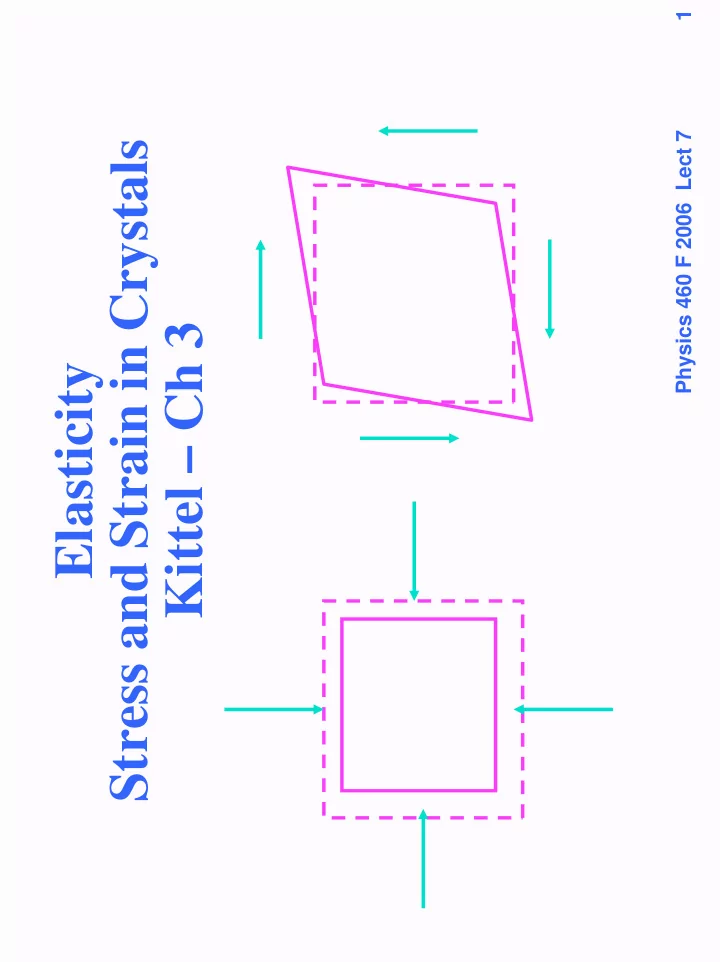
equilibrium value - e.g. by applying pressure Pressure applied to all sides Change of volume
Physics 460 F 2006 Lect 7 3
Elastic Behavior is the fundamental distinction between solids and liquids
- Difference:
- A solid maintains its shape
- The energy increases if the shape is changed – “shear”
- A liquid has no preferred shape
- It has no resistance to forces that do not change the volume
Two types of shear
Physics 460 F 2006 Lect 7 4
Strain and Stress
Strain is a change of relative positions of the parts of the material Stress is a force /area applied to the material to cause the strain
Two types of shear Volume dilation
Physics 460 F 2006 Lect 7 5
Pressure and Bulk Modulus
- Consider first changes in the volume – applies to
liquids and any crystal
- General approach:
E(V) where V is volume
Can use ether Ecrystal(Vcrystal) or Ecell(Vcell) since Ecrystal= N Ecell and Vcrystal = N Vcell
- Pressure = P = - dE/dV (units of Force/Area)
- Bulk modulus B = - V dP/dV = V d2E/dV2 (same
units as pressure )
- Compressibility K = 1/B
Physics 460 F 2006 Lect 7 6
Total Energy of Crystal
Volume
The general shape applies for any type of binding P = -dE/dV = 0 at the minimum B = - V dP/dV = V d2E/dV2 proportional to curvature at the minimum
Energies of Crystal
Physics 460 F 2006 Lect 7 7
Elasticity
- Up to now in the course we considered only
perfect crystals with no external forces
- Elasticity describes:
- Change in the volume and shape of the crystal when
external stresses (force / area) are applied
- Sound waves
- Some aspects of the elastic properties are
determined by the symmetry of the crystal
- Quantitative values are determined by strength
and type of binding of the crystal?
Physics 460 F 2006 Lect 7 8
Elastic Equations
- The elastic equations describe the relation of
stress and strain
- Linear relations for small stress/strain
Stress = (elastic constants) x Strain
- Large elastic constants fi the material is stiff -
a given strain requires a large applied stress
- We will give the general relations - but we will
consider only cubic crystals
- The same relations apply for isotropic materials like a glass
- More discussion of general case in Kittel
Physics 460 F 2006 Lect 7 9
Elastic relations in general crystals
- Strain and stress are tensors
- Stress eij is force per unit area on a surface
- Force is a vector Fx, Fy, Fz
- A surface is defined by the
normal vector nx, ny, nz
- 3 x 3 = 9 quantities
Normal n Force F
- Strain σij is displacement per unit distance in a
particular direction
- Displacement is a vector ux, uy, uz
- A position is a vector Rx, Ry, Rz
- 3 x 3 = 9 quantities
Position R Displacement u
Physics 460 F 2006 Lect 7 10
Elastic Properties of Crystals
- Definition of strain
Six independent variables: e1 ≡ exx , e2 ≡ eyy , e3 ≡ ezz , e4 ≡ eyz , e5 ≡ exz , e6 ≡ exy
- Stress
σ1 ≡ σxx = Xx , σ2 ≡ Yy , σ3 ≡ Zz σ4 ≡ Yz , σ5 ≡ Xz , σ6 ≡ Xy
- Linear relation of stress and strain
Elastic Constants Cij σi = Σj Cij ej , (i,j = 1,6) ( Also compliances Sij = (C-1) ij)
Using the relation exy = eyx etc. Here Xy denotes force in x direction applied to surface normal to y.
σxy = σyx etc.
Physics 460 F 2006 Lect 7 11
Strain energy
- For linear elastic behavior, the energy is quadratic
in the strain (or stress) Like Hooke’s law for a spring
- Therefore, the energy is given by:
E = (1/2) Σi ei σi = (1/2) Σij ei Cij ej , (i,j = 1,6)
- Valid for all crystals
- Note 21 independent values in general
(since Cij = Cji )
Physics 460 F 2006 Lect 7 12
Symmetry Requirements Cubic Crystals
- Simplification in cubic crystals due to symmetry
since x, y, and z are equivalent in cubic crystals
- For cubic crystals all the possible linear elastic
information is in 3 quantities: C11 = C11 = C22 = C33 C12 = C13 = C23 C44 = C55 = C66
- Note that by symmetry
C14 = 0, etc
- Why is this true for cubic crystals?
Physics 460 F 2006 Lect 7 13
Elasticity in Cubic Crystals
- Elastic Constants Cij are completely specified by
3 values C11 , C12 , C44 σ1 = C11 e1 + C12 (e2 + e3) , etc. σ4 = C44 e4 , etc. Pure change in volume – compress equally in x, y, z
- For pure dilation δ = ∆V / V
e1 = e2 = e3 = δ / 3
- Define ∆E / V = 1/2 B δ2
- Bulk modulus B = (1/3) (C11 + 2 C12 )
Physics 460 F 2006 Lect 7 14
Elasticity in Cubic Crystals
- Elastic Constants Cij are completely specified by
3 values C11 , C12 , C44 σ1 = C11 e1 + C12 (e2 + e3) , etc. σ4 = C44 e4 , etc. Two types of shear – no change in volume C44
C11 - C12 No change in volume if e2 = e3 = -½ e1
Physics 460 F 2006 Lect 7 15
Elasticity in Cubic Crystals
- Pure uniaxial stress and strain
- σ1 = C11 e1 with e2 = e3 = 0
- ∆E = (1/2) C11 (δx/x)2
- Occurs for waves where there is
no motion in the y or z directions Also for a crystal under σ1 ≡ Xx stress if there are also stresses σ2 ≡ Yy , σ3 ≡ Zz of just the right magnitude so that e2 = e3 = 0
Physics 460 F 2006 Lect 7 16
Elastic Waves
- The general form of a displacement pattern is
∆r (r ) = u(r ) x + v(r ) y + w(r ) z
- A traveling wave is described by
∆r (r ,t) = ∆r exp(ik . r -iωt)
- For simplicity consider waves along the x direction in a
cubic crystal Longitudinal waves (motion in x direction) are given by u(x) = u exp(ikx -iωt) Transverse waves (motion in y direction) are given by v(x) = v exp(ikx -iωt)
Physics 460 F 2006 Lect 7 17
Waves in Cubic Crystals
- Propagation follows from Newton’s Eq. on each
volume element
- Longitudinal waves:
ρ ∆V d2 u / dt2 = ∆x dXx/ dx = ∆x C11 d2 u / dx2 (note that strain is e1 = d u / dx)
- Since ∆V / ∆x = area and ρ area = mass/length = ρL,
this leads to ρL u / dt2 = C11 du/ dx
- r
ω2 = (C11 / ρL ) k2
- Transverse waves (motion in the y direction) are given
by ω2 = (C44 / ρL ) k2
Physics 460 F 2006 Lect 7 18
Elastic Waves
- Variations in x direction
- Newton’s Eq: ma = F
- Longitudinal: displacement u along x,
ρ ∆V d2 u / dt2 = ∆x dXx/ dx = ∆x C11 d2 u / dx2
- Transverse: displacement v along y,
ρ ∆V d2 v / dt2 = ∆x dYx/ dx = ∆x C44 d2 v / dx2
z x y
∆x ∆y ∆z ∆V= ∆x ∆y ∆z
Net force in x direction Net force in y direction
Physics 460 F 2006 Lect 7 19
Sound velocities
- The relations before give (valid for any elastic wave):
ω2 = (C / ρL ) k2
- r ω = s k
- where s = sound velocity
- Different for longitudinal and transverse waves
- Longitudinal sound waves can happen in a liquid, gas,
- r solid
- Transverse sound waves exist only in solids
- More in next chapter on waves
Physics 460 F 2006 Lect 7 20
Young’s Modulus & Poisson Ratio
- Consider crystal under tension (or compression) in x
direction
- If there are no stresses σ2 ≡ Yy , σ3 ≡ Zz then the
crystal will also strain in the y and z directions
- Poisson ratio defined by (dy/y) / (dx/x)
- Young’s modulus defined by
Y = tension/ (dx/x) Homework problem to work this out for a cubic crystal
y x
Physics 460 F 2006 Lect 7 21
When does a crystal break?
- Consider crystal under tension (or compression) in x
direction
- For large strains, when does it break?
- Crystal planes break apart – or slip relative to one
another
- Governed by “dislocations”
- See Kittel – Chapter 20
Physics 460 F 2006 Lect 7 22
Next Time
- Vibrations of atoms in crystals
- Normal modes of harmonic crystal
- Role of Brillouin Zone
- Quantization and Phonons
- Read Kittel Ch 4