Physics 460 F 2006 Lect 2a 1
Solid State Physics 460- Lecture 2a Structure of Crystals (Kittel - - PowerPoint PPT Presentation
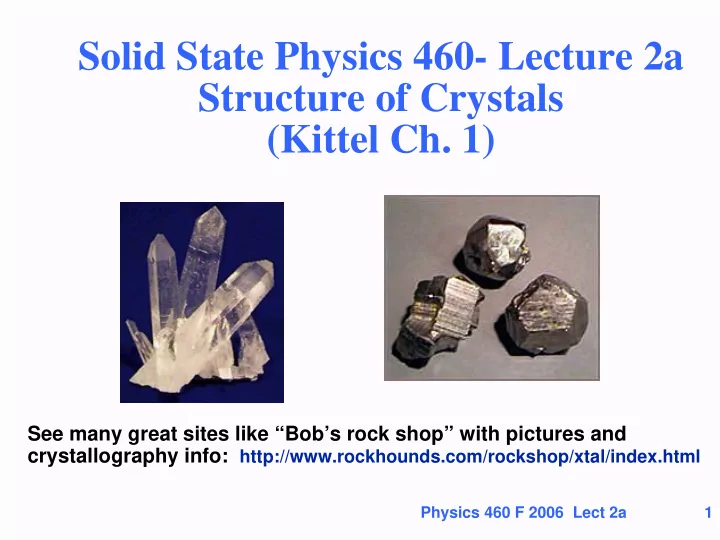
Solid State Physics 460- Lecture 2a Structure of Crystals (Kittel Ch. 1) See many great sites like Bobs rock shop with pictures and crystallography info: http://www.rockhounds.com/rockshop/xtal/index.html Physics 460 F 2006 Lect 2a 1
Physics 460 F 2006 Lect 2a 2
Crystals
From Last Time
- A crystal is a repeated array of atoms
- Crystal
¤ Lattice + Basis Crystal Lattice of points (Bravais Lattice) Basis of atoms
- Crystals can be classified into a small number of
types – See text for more details
Physics 460 F 2006 Lect 2a 3
Two Dimensional Crystals
From Last Time
a1 a2
φ
Basis Lattice
- Infinite number of possible lattices and crystals
- Finite number of possible lattice types and crystal
types
Physics 460 F 2006 Lect 2a 4
Possible Two Dimensional Lattices
From Last Time
a1 a2
φ General oblique
a1 a2
Hexagonal Φ = 60, a1 = a2 6-fold rotation , reflections
a1 a2
Square 4-fold rot., reflect.
a1 a2
Rectangular 2-fold rot., reflect. Centered Rectangular 2-fold rot., reflect.
a1 a2
- These are the only possible special crystal
types in two dimensions
Physics 460 F 2006 Lect 2a 5
Three Dimensional Lattices
- Every point on the Bravais lattice is a multiple of
3 primitive lattice vectors T(n1,n2,n3) = n1 a1 + n2 a2 + n3 a3 where the n’s are integers
a1 a2 a3
X y z
Physics 460 F 2006 Lect 2a 6
Three Dimensional Lattices Simplest examples
- Orthorhombic: angles 90 degrees, 3 lengths different
Tetragonal: 2 lengths same Cubic: 3 lengths same
- Hexagonal: a3 different from a1, a2 by symmetry
Simple Orthorhombic Bravais Lattice
a1 a2 a3
Hexagonal Bravais Lattice
a1 a2 a3
Physics 460 F 2006 Lect 2a 7
Cubic Lattices
Length of each side - a a3 a2 a1 a a a
Simple Cubic Body Centered Cubic (BCC)
Primitive lattice vectors a1 = (1,0,0) a a2 = (0,1,0) a a3 = (0,0,1) a One atom per cell at position (0,0,0)
Conventional Cell with 2 atoms at positions (000), (1/2,1/2,1/2) a
Physics 460 F 2006 Lect 2a 8
Cubic Lattices
Length of each side - a a3 a2 a1 a3 a2 a1
Face Centered Cubic (FCC) Simple Cubic
Primitive lattice vectors a1 = (1,0,0) a a2 = (0,1,0) a a3 = (0,0,1) a One atom per cell at position (0,0,0)
Conventional Cell with 4 atoms at positions (000 ), (0,1/2,1/2), (1/2,0,1/2), (1/2,1/2,0)a
Physics 460 F 2006 Lect 2a 9
Face Centered Cubic Two views - Conventional Cubic Cell
X y z X
Conventional Cell of Face Centered Cubic Lattice 4 times the volume of a primitive cell
y z
Physics 460 F 2006 Lect 2a 10
Face Centered Cubic (fcc) Also called cubic closed packed (ccp)
X y z X
Each atom has 12 equal neighbors We will see later that this is a “close packed” lattice
y z
Physics 460 F 2006 Lect 2a 11
Face Centered Cubic
X y z
a1 a3 a2
Wigner-Seitz Cell One Primitive Cell
Primitive lattice vectors a1 = (1/2,1/2,0) a a2 = (1/2,0,1/2) a a3 = (0,1/2,1/2) a One atom per cell at position (0,0,0)
Physics 460 F 2006 Lect 2a 12
Body Centered Cubic
X y z
a3 a1 a2
Wigner-Seitz Cell One Primitive Cell
Primitive lattice vectors a1 = (1/2,1/2,-1/2) a a2 = (1/2, -1/2,1/2) a a3 = (-1/2,1/2,1/2) a One atom per cell at position (0,0,0)
Physics 460 F 2006 Lect 2a 13
Lattice Planes - Index System
s1 a1 Plane through the points s1 a1 , s2 a2, s3a3 Each s can be an integer or a rational fractions s2 a2 s3 a3
- Define the plane by the reciprocals 1/s1, 1/s2, 1/s3
- Reduce to three integers with same ratio h,k,l
- Plane is defined by (h,k,l)
Physics 460 F 2006 Lect 2a 14
Schematic illustrations of lattice planes Lines in 2d crystals
Lattice
- Infinite number of possible planes
- Can be through lattice points or between
lattice points
a1 a2
φ
Basis
(22) (11) (01) (14) (02)
Physics 460 F 2006 Lect 2a 15
Schematic illustrations of lattice planes Lines in 2d crystals
Lattice
(01)
a1 a2
φ (14)
- Equivalent parallel planes
- Low index planes: more dense, more widely
spaced
- High index planes: less dense, more closely
spaced Basis
(02)
Physics 460 F 2006 Lect 2a 16
Schematic illustrations of lattice planes Lines in 2d crystals
a1 a2
(01) (02) (14)
- Planes “slice through” the basis of physical
atoms
Physics 460 F 2006 Lect 2a 17
Lattice planes in cubic crystals
X y z X z y
(100) and (110) planes in a cubic lattice (illustrated for the fcc lattice)
Physics 460 F 2006 Lect 2a 18
(111) lattice planes in cubic crystals
X y z
Face Centered Cubic Lattice Lattice planes perpendicular to [111] direction Each plane is hexagonal close packed array of points
Physics 460 F 2006 Lect 2a 19
Stacking hexagonal 2d layers to make close packed 3-d crystal
- Each sphere has 12 equal neighbors
- 6 in plane, 3 above, 3 below
- Close packing for spheres
- Can stack each layer in one of two ways, B
- r C above A
- Also see figure in Kittel
A B C
Physics 460 F 2006 Lect 2a 20
Stacking hexagonal 2d layers to make hexagonal close packed (hcp) 3-d crystal
- Each sphere has 12 equal neighbors
- Close packing for spheres
- See figure in Kittel for stacking sequence
- HCP is ABABAB….. Stacking
- Basis of 2 atoms
Physics 460 F 2006 Lect 2a 21
Hexagonal close packed
a1 a2 a3
A B A Hexagonal Bravais Lattice Two atoms per cell
Physics 460 F 2006 Lect 2a 22
Stacking hexagonal 2d layers to make cubic close packed (ccp) 3-d crystal
Cube ABC stacking
- Each sphere has 12 equal neighbors
- Close packing for spheres
- See figure in Kittel for stacking sequence
- CCP is ABCABCABC….. Stacking
- Basis of 1 atom
Physics 460 F 2006 Lect 2a 23
Stacking hexagonal 2d layers to make cubic close packed (ccp) 3-d crystal
Cube [111] direction in cube
Physics 460 F 2006 Lect 2a 24
Face Centered Cubic (fcc) Also called cubic closed packed (ccp)
X y z
Recall from before [111] direction in cube Each atom has 12 equal neighbors The figure at the right shows the face centered character
Physics 460 F 2006 Lect 2a 25
(111) planes in an fcc crystal
X y z
C B A C B A ABCABC... stacking of hexagonal planes fi fcc crystal fcc is a close packed crtsal – cubic close packed - ccp [111] direction in cube [111] direction in cube
Physics 460 F 2006 Lect 2a 26
More on stacking hexagonal 2d layers
A B C B A B A B A C A C B B B A A A CCP Other polytype HCP
- Infinite number of ways to stack planes
- Polytypes occur in some metals, some
compounds like silicon carbide (SiC)
Physics 460 F 2006 Lect 2a 27
Cubic crystals with a basis
NaCl Structure with Face Centered Cubic Bravais Lattice
X y z
ZnS Structure with Face Centered Cubic Bravais Lattice C, Si, Ge form diamond structure with
- nly one type of atom
Physics 460 F 2006 Lect 2a 28
NaCl Structure with Face Centered Cubic Bravais Lattice
X y
NaCl Structure
z
Physics 460 F 2006 Lect 2a 29
CsCl Structure
CsCl Structure Simple Cubic Bravais Lattice
X y z
a3 a2 a1
From http://www.ilpi.com/inorganic/structures/cscl/index.html
Physics 460 F 2006 Lect 2a 30
Atomic planes in NaCl and ZnS crystals
(110) planes in NaCl crystal rows of the Na and Cl atoms
X y z
(110) plane in ZnS crystal zig-zag Zn-S chains of atoms
Physics 460 F 2006 Lect 2a 31
(110) plane in diamond structure crystal
(100) plane in ZnS crystal zig-zag Zn-S chains of atoms (diamond if the two atoms are the same)
X y z
Calculated valence electron density in a (110) plane in a Si crystal (Cover of Physics Today, 1970)
Physics 460 F 2006 Lect 2a 32
(111) planes in ZnS crystals
X y z
(111) planes in cubic ZnS crystal C B A C B A CCP
Note: ABAB... stacking gives hexagonal ZnS
Zn S [111] direction in cube Zn S Zn S Zn S Zn Zn S S
Physics 460 F 2006 Lect 2a 33
A
Simple Cubic Bravais Lattice
B B B B B B B B O
Perovskite Structure ABO3
A atoms have 12 O neighbors B atoms have 6 closer O neighbors Many compounds form the perovskite structure, SrTiO3, BaTiO3, LaMnO3, . . .
Physics 460 F 2006 Lect 2a 34
Symmetries of crystals in 3 dimensions
- All Crystals can be classified by:
- 7 Crystal systems (triclinic, monoclinic,
- rthorhombic, tetragonal, cubic, hexagonal,
trigonal)
- 14 Bravais Lattices (primitive, face-centered or
body-centered for each system – 14 of the 7x3 possibilities describe all Bravais lattices )
- 32 Points groups (rotations, inversion, reflection)
- See references in Kittel Ch 1, G. Burns, “Solid
State Physics”
Physics 460 F 2006 Lect 2a 35
Is a crystal really different from a liquid?
Crystal Liquid
Yes – the crystal has “order” – different directions are different Other crucial differences? Yes – dislocations
Crystal with a “dislocation”
Example of a dislocation
- a crystal with an extra plane
- f atoms on the left
- The dislocation can move but
it cannot disappear! Important for deformations, … See Kittel Ch. 20
Physics 460 F 2006 Lect 2a 36
Next Time
- Diffraction from crystals
- Reciprocal lattice
- Read Kittel Ch 2