SLIDE 1 Elasticity of Pu and ZrW2O8-a window into fundamental understanding
Albert Migliori NHMFL/LANL
A.Migliori, H. Ledbetter, J.B.Betts, D. Doolley, D.Miller C. Pantea, I. Mihut,, M.Ramos, F. Drymiotis, F.Freibert, R. Ronquillo, J.P.Baiardo J.C.Lashley, F. Drymiotis, S. El-Khatib, A.C. Lawson, F. Balakirev, B.Martinez, R. McQueeney, J.M.Wills, M.Graf, S. Rudin, J. Singleton, C.
- M. Varma, G. Kotliar, E. Abrahams…..
1)Intro and review 2)ZrW2O8 3)Pu
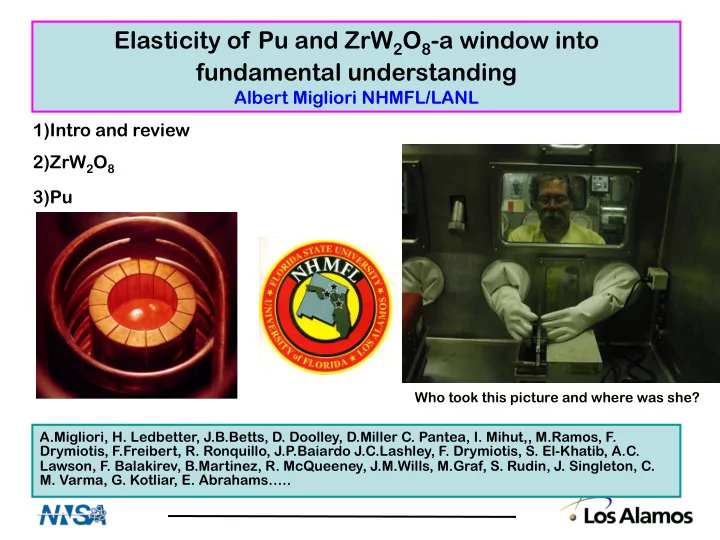
Who took this picture and where was she?
SLIDE 2
Elasticity—we like it!
This is the elastic energy. We measure adiabatic elastic moduli-they really connect to physics! For band structure guys, adiabatic means leave electron occupation numbers fixed and deform—the very easiest thing to do! Mass and spring Solid and Temperature moduli Symmetrized strains
SLIDE 3
Elasticity and entropy
The sound speeds (the dispersion curves) determine characteristic vibrational temperature-and most of the entropy at high T. If phases with lots of entropy are accessible, they tend to become the stable high-T phase. Entropy goes up with: Electronic instabilities Structural instabilities Soft structures …… Not the Debye Temperature
SLIDE 4
Anharmonicity and Elasticity
SLIDE 5 Perfectly linear models and this talk
- The volume V is independent of
temperature T.
- The elastic moduli cij—should be
independent of T and V and not differ between adiabatic and isothermal conditions
Pretty much rubbish
SLIDE 6
All materials are anharmonic. This is why solids undergo structural phase transitions and eventually come apart
As system energy (temperature) rises, anharmonicity can induce new behavior not easily predicted! Example: classic soft-mode transition where phonon frequencies decrease to zero with decreasing temperature. The “stopped” vibration is a static distortion or new phase!—here it is cubic to tetragonal. Migliori’s theorem: (unproven-a not unusual situation)
no solid can be harmonic-furthermore, anharmonicity is an intrinsic fundamental property!
SLIDE 7 Ordinary thermal expansion and specific heat
Zwikker, 1953, Physical Properties of Solids
- In 1912, Grüneisen defined
- and then found such things as
- In the subsequent 90+ years, this concept has remained
astonishingly useful.
- E. Grüneisen, Ann. Phys. 39, 257 (1912)
β= thermal expansion, Cp=specific heat per unit mass at constant pressure, B= bulk modulus, ρ =1/V= density, ω=mode frequency
SLIDE 8
Pair potentials do not easily explain thermal expansion
It is really, really hard to compute thermal expansion from pair potentials-all k vectors are needed! The single-atom potential for any crystal has the crystal symmetry. It therefore never has odd terms (like cubic). The primary source for thermal expansion in solids is the increase of entropy with volume--not a cubic term in the potential. (D.C. Wallace)
SLIDE 9
Elasticity and the not-intuitive: Constant volume and constant pressure
B almost always decreases with T at constant pressure but: B almost always increases with T at constant volume if not, something new is happening! Difference between constant volume and constant pressure is a very big deal. We almost always measure at constant pressure
SLIDE 10
Why they pay me to look at ZrW2O8 Pu Complexity in the phase diagram, doping-induced heterogeneity, martensite? ZrW2O8 complex, heterogeneous in important ways at the unit cell level, but homogeneous macroscopically. Can we use volume and elasticity of easy-to-study negative expansion systems to understand Pu?
SLIDE 11
RUS uses normal modes that look like this
SLIDE 12
RUS systems at LANL
290mK-350K 0-15T Note that the sample is mounted flat on the transducers Approximate cubes are the best shape
SLIDE 13
Aging is different in α and δ PU
300K On short time scales, we observe very rapid changes.
SLIDE 14
ZrW2O8
SLIDE 15 ZrW2O8-Structure and Thermal Expansion
- A. P Ramirez and G. R. Kowach, Phys. Rev. Letters, 80, 22 (1998)
SLIDE 16 ZrW2O8 thermal expansion
- T. A. Mary, J. S. O. Evans, T. Vogt, and A. W. Sleight, Science 272, 90, 1996
Looks like temperature and volume are the interesting variables—perfect subject for ultrasound which gets the second derivatives of the volume wrt strains.
SLIDE 17 Ultrasound and ZrW2O8
The contracting solid gets softer,
- pposite what most materials
do, and the change is an order of magnitude too large.
Shear modulus change is normal= 7%
It’s negative
- F. Drymiotis, H. Ledbetter, J. Betts, T, Kimura, J. Lashley, A. Migliori, A. Ramirez,
- G. Kowach, and J. Van Duijn, Phys. Rev. Lett. 93, 025502(2004).
SLIDE 18
ZAP cell for pulse-echo ultrasound under hydrostatic pressure
SLIDE 19 Why monocrystals are important ZrW2O8
Pressure induced phase transition at 5.8kbar Neutron scattering studies of powder samples published in Science got this wrong—the stress risers in grains of powder produce signatures of the phase transition well below the actual transition—the transition was reported at 2kbar. Pulse-echo on monocrystals gets it right! For this material, maybe the incipient phase transition with pressure is the source
SLIDE 20
The other moduli
A cubic solid should exhibit only small changes in the shear elastic constants as it changes volume because bond angles hardly change
SLIDE 21
Confirmation via Raman spectroscopy
SLIDE 22
Plutonium polycrystal measurements
SLIDE 23
This? Or this?
UNCLASSIFIE (Required viewgraph for any Pu talk)
Only Pu exhibits so many phases in such a small (< a factor of 2) temperature range.
Is Pu the second most interesting element?
SLIDE 24
All the science comes from electronic structure-but…
SLIDE 25
Phase diagram-with Ga
SLIDE 26
Stability-Atomic number
SLIDE 27
Phase diagram with pressure
Pu also has pressure-induced phases. Do these contribute to the strong temperature dependences at zero pressure?
SLIDE 28
Elastic moduli: the usual temperature dependence
Varshni figured this out We can get γ from either thermal expansion or elastic moduli
SLIDE 29
Cu: 3.5% decrease from 10K to 300K
SLIDE 30
α-Pu: 34% decrease from 10K to 350K
Bulk and shear moduli have same temperature dependence—and it is much bigger than Cu
SLIDE 31
δ-Pu: 31% decrease from 10K to 350K
Mechanically-induced hysterisis. Cannot recover original state on heating to 500K.
SLIDE 32 Poisson ratio independent of temperature from 10
Poisson’s ratio determines how much a material bulges when stressed uniaxially. It is typically strongly associated with bond strengths V=0.183 @ 300K In Pu, moduli change an order of magnitude more than in a typical metal, but not Poisson’s ratio. This suggests a single new physics driver is responsible
SLIDE 33 From Poisson ratio
In alpha Pu, strong temperature variation of moduli and same temperature dependence of B and G suggest one physical driver
- verwhelms ordinary temperature dependence.
SLIDE 34 Pu single crystal measurements (Ledbetter and Moment, 1975)
- c11 =36.3 GPa controls longitudinal sound speed
- c44 =33.6 GPa controls one shear speed
- c*
=4.8 GPa controls the other shear speed Biggest shear anisotropy of an fcc metal
SLIDE 35
Hidden phases like ZrW2O8?
Invar fit
Different sign for elasticity and thermal expansion.
Grüneisen bites the dust.
SLIDE 36 Invar-a gradual change yields negative thermal expansion
Fe0.65Ni0.35 invar
Volume fixed, stiffness increases –OK????
SLIDE 37 The framework solid model: Pu and ZrW2O8
M.E. Simon and C. M. Varma, Phys. Rev.
Rigid squares, floppy bonds-remember this for Pu! Cold—the square has the biggest area. Hot—the average area is reduced! This is a “thermodynamic” model-it has enough degrees of freedom.
SLIDE 38
Pressure and constrained lattices
SLIDE 39 Bain’s path, framework solids etc.
The bcc volume is less than the fcc volume.
fcc(stiff) bcc(soft) d-Pu is very soft (softer than Pb) and has an especially soft shear mode. Poisson’s ratio is about 0.43 along the soft direction, making Pu nearly like a liquid when squeezed in this direction. Pu does not care what its volume is!!!!!!!!!!!!!!!!!! Does this make the framework solid model applicable?
SLIDE 40
Poisson ratio for fcc Pu
SLIDE 41 Today’s key question
- Pu and ZrW2O8, soften as volume
- decreases. Why? What microscopic
models can make this happen
SLIDE 42 We have not succeeded in answering all of our questions. Indeed, we sometimes feel that we have not completely answered any of them. The answers we have found only served to raise a whole new set of questions. In some ways we feel that we are as confused as ever, but we think we are now confused on a higher level, and about more important things.
Beware of the muddle puddles. -Benjamin Migliori, age 3, April 1986 I was trying to paint a jungle scene but it came out looking like a clown suit
- Robert Migliori, age 10, Mar
2000