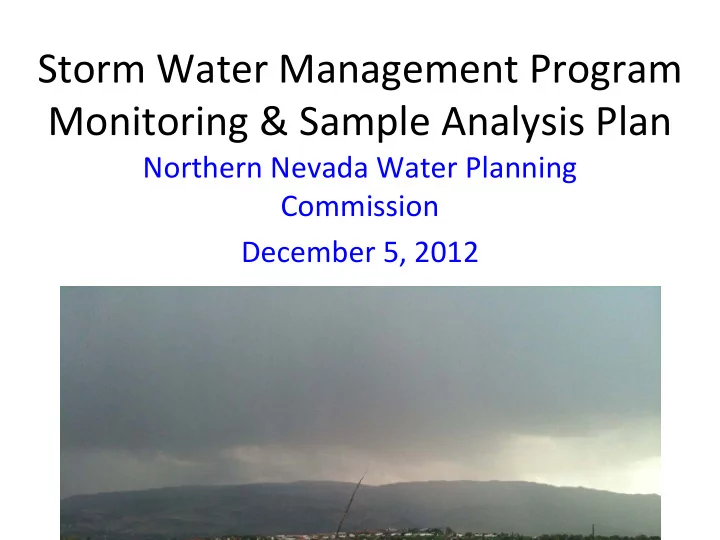
Storm Water Management Program Monitoring & Sample Analysis Plan - - PowerPoint PPT Presentation

storm water management program monitoring sample analysis
SMART_READER_LITE
LIVE PREVIEW

Storm Water Management Program Monitoring & Sample Analysis Plan - - PowerPoint PPT Presentation

Storm Water Management Program Monitoring & Sample Analysis Plan Northern Nevada Water Planning Commission December 5, 2012 Truckee River Watershed Coordinated Monitoring Program Began: Evolved: Memorandum of Desert Research Institute


slide-1
SLIDE 1

Storm Water Management Program Monitoring & Sample Analysis Plan

Northern Nevada Water Planning Commission December 5, 2012

slide-2
SLIDE 2

Truckee River Watershed Coordinated Monitoring Program

Began: Memorandum of Understanding (13 groups); 18 month process of sharing programmatic information; Product: Compendium of Truckee River Watershed Monitoring programs; Evolved: Desert Research Institute Funding by Truckee River Fund Surface water monitoring Benefits: TMWRF, SWPCC, NDEP, PLPT, Flood Project/restoration.

slide-3
SLIDE 3

Truckee River Info Gateway

  • Identified by NV as the clearinghouse tool for sharing

program information on coordinated efforts;

  • TRIG: www.truckeeriverinfo.org

– going to the next level…

  • Data housed/linked:

SWPCC, NDEP, TMWA, TMWRF, WC DWR creek data, TRWC, PLPT, USGS, T-TSA, DRI/TMWRF/DEP Coordinated program efforts…

slide-4
SLIDE 4

Sample Analysis Plan: a public process

  • Stantec

was selected to assist in the development of the 2012 plan, based on 2010 permit requirements;

  • Public meetings and Workshop

– Attended by committee members, citizens, PLPT representatives and staff;

  • A Consensus Model was used to develop the

approach and priorities for the Plan;

  • Accepted by Nevada Division of Environmental

Protection in November 2012,

  • Implementation to begin in January 2013.
slide-5
SLIDE 5

Storm Water Monitoring Goals

  • Continuing:

Characterize both background WQ & rain event WQ in the major tributaries to the Truckee.

  • New: Collect the data

necessary to improve

  • ur understanding of

SW effects on 303(d) & TMDL listings on the Truckee and its tribs.

  • Moving ahead:

Measure the background & rain event WQ in selected

  • utfalls, catchments &

land use types.

  • Conduct special studies

& investigations as the needs arise & funding is available.

slide-6
SLIDE 6

Tributary Monitoring continue at existing locations

  • Semi‐annual sample collection (scheduled),
  • Rain event grab samples (wet weather),
  • Typically sample site selections are upstream

and downstream of urbanized areas on 6 tributaries.

slide-7
SLIDE 7

12 Tributary Monitoring Locations

  • Steamboat Ck @
  • Rhodes Rd,
  • The Narrows,
  • Clean Water Way.
  • Whites Creek @
  • Timberline Road,
  • Old Virginia Hwy.
  • Chalk Ck @
  • Chalk Bluff
  • North Truckee Drain @
  • Orr Ditch,
  • Kleppe

Ln.

  • Thomas Creek @
  • Timberline Road,
  • S. Meadows Pkwy.
  • Alum Creek @
  • Above Steamboat Ditch,
  • The Truckee River.
slide-8
SLIDE 8

Outfall Monitoring (10 sites)

  • Alum at Chrissie

Caughlin Park;

  • Oxbow Nature Park;
  • Dickerson Rd.,
  • Wingfield

at Arlington (north side),

  • Wingfield

/ Island at Arlington (South side), Fisherman’s Park II,

  • Paradise Park / Galletti

Way,

  • Mary Wahl Ditch,
  • Cottonwood Park

(west),

  • Greg Street (East)
  • GOAL:

Understanding runoff from various land uses: Industrial, Commercial, Residential, Agricultural, Urban.

slide-9
SLIDE 9

Considerations / Challenges

  • Traffic Control;
  • Environmental and human safety;
  • Seasonal challenge: frozen or dry?
  • QA/QC Plan includes protocols to be used, holding

times, chains of custody, sample labeling and handling,

  • Storm discharge forecasting to capture entire

hydrograph in specific tributaries

slide-10
SLIDE 10
slide-11
SLIDE 11

Special Studies

  • Boynton Slough Watershed Characterization
  • Alum Creek Watershed Characterization
  • Sparks Marina Inflow Study
slide-12
SLIDE 12

Tech memo/evaluation of data

  • First task: Comprehensive

Literature review, evaluating NV

303 (d) listed streams/pollutants;

  • Next: Propose to exclude

constituents that are found not a

result of storm water influence;

  • Monitoring program developed

to address the constituents remaining which MAY be from storm water;

  • SAP has been approved by the

State.

  • Implementation begins in 2013
slide-13
SLIDE 13

Watershed Management

  • 2012 Tributary Assessment

an annual watershed tool (since 2005);

  • Available on TRIG

at Truckeeriverinfo.org;

  • Stems from Watershed Management Plan of 2003;
  • Fire restoration sites included to provide lessons

learned and illustrate success stories;

– Caughlin Fire, Washoe Fire

  • Benefits:

– Useful for Community Development processes, – Useful in drainageways evaluations and projects, – Assist in identifying/prioritizing special studies, – Helpful identifying locations of noxious weed infestations, – Help in understanding of hydromodification

  • f streams.
slide-14
SLIDE 14

Any Questions?

Thank you.

Lynell Garfield‐Qualls, M.S., CPESC

City of Reno Hydrologist

Terri Svetich, P.E.

SWPCC Coordinator City of Reno Engineering Manager