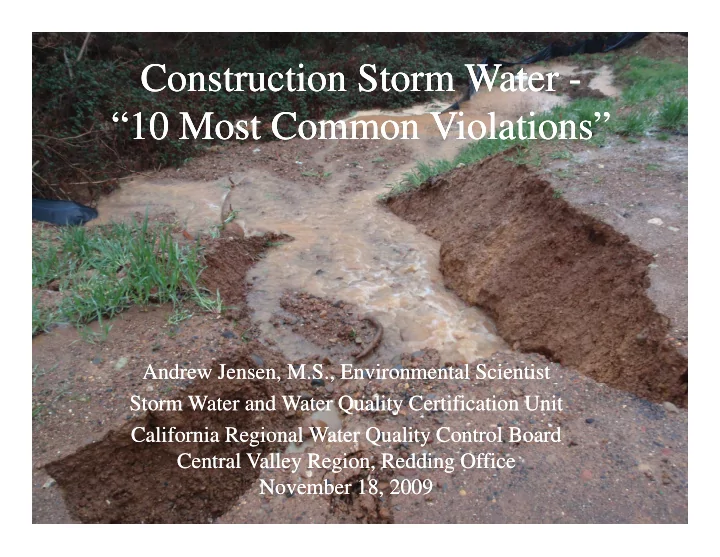
Construction Storm Water Construction Storm Water Construction - - PowerPoint PPT Presentation

construction storm water construction storm water
SMART_READER_LITE
LIVE PREVIEW

Construction Storm Water Construction Storm Water Construction - - PowerPoint PPT Presentation

Construction Storm Water Construction Storm Water Construction Storm Water - - 10 Most Common Violations 10 Most Common Violations 10 Most Common Violations Andrew Jensen, M.S., Environmental Scientist Andrew Jensen, M.S.,


slide-1
SLIDE 1

Construction Storm Water Construction Storm Water Construction Storm Water -

  • “10 Most Common Violations”

“10 Most Common Violations” “10 Most Common Violations”

Andrew Jensen, M.S., Environmental Scientist Andrew Jensen, M.S., Environmental Scientist Storm Water and Water Quality Certification Unit Storm Water and Water Quality Certification Unit California Regional Water Quality Control Board California Regional Water Quality Control Board C l ll i ddi Offi C l ll i ddi Offi Central Valley Region, Redding Office Central Valley Region, Redding Office November 18, 2009 November 18, 2009

slide-2
SLIDE 2

Central Valley Regional Central Valley Regional Water Quality Control Board Water Quality Control Board

S T A T E O F C A L I F O R N I A ★ ★ ★ ★

Water Quality Control Board Water Quality Control Board

R E G I O N A L W A T E R Q U A L I T Y C O N T R O L B O A R D CENTRAL CENTRAL VALLEY ALLEY REGION REGION E R Q U A L I T Y C O

Our mission is to preserve, enhance Our mission is to preserve, enhance and restore the quality of California’s and restore the quality of California’s water resources and ensure their water resources and ensure their water resources, and ensure their water resources, and ensure their proper allocation and efficient use for proper allocation and efficient use for the benefit of present and future the benefit of present and future generations. generations.

slide-3
SLIDE 3

Brief Biography

  • Grew up enjoying the outdoors,

wildlife, camping and fishing in Sonoma County along the Russian River River,

  • Bachelor of Science – Freshwater

Fisheries (1996) from HSU

  • In 1997 decided to go back to school
  • In 1997 decided to go back to school

for Master’s Degree in Wastewater- Water Quality Program,

  • Realized that fish/critters/humans
  • Realized that fish/critters/humans

need clean water to live = Water is Gold of the Future

  • In 2000 took a position with Regional
  • In 2000, took a position with Regional

Water Quality Control Board in Santa Rosa, transferred to Redding in 2006

  • Master of Science – Water Quality
  • Master of Science – Water Quality

(2003)

  • Work in the SW and 401 Programs
slide-4
SLIDE 4

Presentation Overview Presentation Overview Presentation Overview Presentation Overview

  • RWQCB Overview
  • Construction Storm

Water Permit Overview

  • Current General Permit

O i /R i t Overview/Requirements

  • “10 Most Common SW

Issues Leading to Issues Leading to Violations”

  • Enforcement
  • Staying in Compliance
slide-5
SLIDE 5

Central Valley Central Valley Region

3 R i l Offi –3 Regional Offices:

  • Redding
  • Sacramento
  • Fresno
  • Fresno
slide-6
SLIDE 6

Basin Plan and Beneficial Uses Basin Plan and Beneficial Uses

  • The Water Quality Control Plan for the Central Valley

Q y y Region (“Basin Plan”) is comprehensive in scope, and describes its water quality and quantity problems, as well as present and potential beneficial uses as present and potential beneficial uses.

  • “Beneficial uses” of waters of the state that may be

e e c a uses o wate s o t e state t at ay be protected against water quality degradation include, but are not limited to: ti d h t f fi h ildlif d – preservation and enhancement of fish, wildlife, and

  • ther aquatic resources; recreation; domestic,

municipal; agricultural; navigation; industrial; p g g aesthetic enjoyment; ect.

slide-7
SLIDE 7

State General Construction Permit Regulations

  • The EPA delegated storm water enforcement authority to the State
  • The EPA delegated storm water enforcement authority to the State

Water Resource Control Board ,

  • The State Water Resources Control Board issues coverage under the

The State Water Resources Control Board issues coverage under the General Construction Storm Water Permit (Order 99-08-DWQ) for construction projects disturbing 1 or more acres,

  • September 2, 2009 – State Water Resources Control Board adopted a

new construction general permit (CGP) to replace Order 99-08-DWQ

  • SWRCB Order No. 99-08-DWQ remains in effect until July 1, 2010
slide-8
SLIDE 8

Current Requirements

  • f the General

Construction Storm Water Permit

slide-9
SLIDE 9

Submit a Notice of Intent (NOI) to Comply with the Terms of the General Permit General Permit

  • Submit NOI, Site Map, and filing fee to the State

Water Resources Control Board Copies to Local Water Resources Control Board – Copies to Local RWQCB

  • Filing fees have changed: $317 for 1 acre up to
  • Filing fees have changed: $317 for 1 acre, up to

$3,192 for 100+ acres

  • Forms and permit documentation are available

Forms and permit documentation are available from the State Board Web Site at:

http://www.waterboards.ca.gov/water_issues/programs/stormwater/

F l il bl t l l RWQCB ffi

  • Forms are also available at local RWQCB office -

415 Knollcrest Drive, Redding

slide-10
SLIDE 10

Notice of Intent (NOI)

Required as first step in obtaining coverage under the State’s General Required as first step in obtaining coverage under the State s General Permit, and must be filed prior to beginning construction activities.

slide-11
SLIDE 11

Eliminate / Minimize Discharges from Construction Sites to Storm Drains Construction Sites to Storm Drains and Waters of the State

  • Storm water discharges

resulting from rain events (i e sediment) events (i.e. sediment)

  • Non-storm water

discharges: discharges:

– improper dumping l ki t d – leaking storage and maintenance areas – spillage of chemicals and spillage of chemicals and waste materials

slide-12
SLIDE 12

Additional Permit Requirements Additional Permit Requirements

  • Provide Training to Staff
  • Provide Training to Staff
  • Certify Site Annually
  • Notify the Permitting Agency of

Non-Compliance Issues and ALL p Discharges

  • Submit a Notice of Termination when

Submit a Notice of Termination when complete

slide-13
SLIDE 13

“10 Most Common Storm Water Issues L di t Vi l ti ” Leading to Violations”

1. Starting to Late in the g Season to Implement BMPs:

  • Getting BMPs in early
  • Getting BMPs in early =

better stabilization

  • Provides protection against

early storm events early storm events

  • Ideally prior to Oct 15 -

“Magic Number”?? Pl h d d h

  • Plan ahead - do not have an

unprotected site = Enforcement

slide-14
SLIDE 14

2 I l ti BMP th t d 2. Implementing BMPs that do not fit the site:

  • One size does not fit all
  • Each site is different – present

unique challenges

  • Design SWPPP/BMPs to fit the

site

  • Ensure effective combination =

adequate protection

  • Token BMPs do not prevent

storm water pollution and can result in enforcement esu e

  • ce e
slide-15
SLIDE 15

3 F il t I l t

  • 3. Failure to Implement

SWPPP and Have On-site at All Times:

  • BMP implementation does

not reflect the SWPPP SWPPP d d i h

  • SWPPP not updated with

changes made on-site SWPPP t dil il bl

  • SWPPP not readily available
  • n-site
  • Workers not familiar with
  • Workers not familiar with

SWPPP

slide-16
SLIDE 16

4. Lack of Adequate Tracking Controls:

  • Results in sediment on

roadways = potential discharges discharges

  • Simple and effective BMP

to install/maintain to install/maintain

  • Forgotten during the

summer months = tracking and discharges

slide-17
SLIDE 17

5 I d t E i C t l 5. Inadequate Erosion Control BMPs:

  • Keep soil in its place – “soil

stabilization”

  • First Line of Defense
  • Limit disturbance
  • Stabilize / vegetate disturbed

areas ASAP after grading

  • Failure to stabilize =

Discharges and Enforcement

slide-18
SLIDE 18

6. Lack of Adequate Sediment Control BMPs:

  • Second Line of Defense
  • Filter sediment out of runoff

prior to discharging off-site

  • Failure to implement & maintain

SC BMPs = Discharges to surface waters =NOV/ACLs surface waters =NOV/ACLs

slide-19
SLIDE 19
  • 7. Ineffective Concrete

Waste Containment:

  • Lack of containment =

di h discharges

  • Fines for $10k + issued

last year for failure to last year for failure to contain waste Haul Away Bins Haul Away Bins Haul Away Bins Haul Away Bins Haul Away Bins Haul Away Bins

slide-20
SLIDE 20

8. Improperly Installed BMPs:

  • Silt fence trenched in and

Silt fence trenched in and staked,

  • Wattles trenched and

Watt es t e c ed a d staked,

  • Straw mulch with tacifier,

, ect., ect.

  • Improper installation =

waste of money & possible violations

slide-21
SLIDE 21

9 Failure to Inspect & 9. Failure to Inspect & Maintain BMPs:

  • Inspect regularly, and

before/during/after storms M k i i

  • Make corrective actions
  • Perform maintenance
  • Document all inspections
  • Monitoring reports will be

requested when problems are

  • bserved – failure to provide =

violations and potential fines violations and potential fines

slide-22
SLIDE 22

10 No BMPs Implemented:

  • 10. No BMPs Implemented:
  • Complete lack of BMPs =

lik l f t d fi likely enforcement and fines

  • Even in active construction

areas implement appropriate areas, implement appropriate BMPs

  • Especially important during
  • Especially important during

wet season

  • Must have an Effective

Must have an Effective Combination of Erosion & Sediment Control BMPs

slide-23
SLIDE 23

Utilize an Effective Combination Utilize an Effective Combination

  • f Sediment and Erosion Controls

**At a minimum – discharger must implement effective combination of erosion and sediment control on all disturbed areas during the rainy season.

slide-24
SLIDE 24

Enforcement –

How the Regional Board Responds How the Regional Board Responds to Storm Water Violations

Informal Enforcement Verbal Warning Staff Enforcement Letter Notice of Violation – compels action compels action within a timeframe

slide-25
SLIDE 25

Formal Enforcement

Notice to Comply

p y

Notice of Noncompliance Cleanup and Abatement

Order

Cease and Desist Order

Ad i i t ti Ci il

Administrative Civil

Liabilities (ACL = Fines)

Attorney General/District

y Attorney Referral

slide-26
SLIDE 26

Administrative Civil Liability

Mi i A Minimum Amounts

  • Failure to Submit a Notice of Intent for coverage under the

NPDES storm water permit. Minimum $5,000 plus recovery of staff costs

  • Failure to submit an annual report of construction

tifi ti h i d b th R i l B d certification when required by the Regional Board. Minimum $1,000 plus recovery of staff costs

  • Violation of Permit Terms or Basin Plan Prohibitions

Minimum amount is the economic savings of the violation

slide-27
SLIDE 27

Administrative Civil Liability

Fines - Maximum Amounts

State – Maximum Amounts are $10,000 per day, plus

$10/gallon of sediment-laden or polluted water discharged for each violation

Federal – Amounts of up to $27,500 per day, can be

imposed for UNINTENTIONAL violation, up to $55 000 d f k i i l ti i dditi t $55,000 per day for knowing violation, in addition to criminal liability and responsibility for cleanup costs

slide-28
SLIDE 28

Good Housekeeping – The Key to Compliance

slide-29
SLIDE 29

Inspect and Maintain all BMPs Inspect and Maintain all BMPs

  • Inspections by
  • Inspections by

qualified personnel need to be performed: p

– Prior to anticipated storm events, – During extended storms, and after actual storm – and after actual storm events

slide-30
SLIDE 30

Monitoring Reports g p

  • Inspection reports should be prepared weekly!!

Inspection reports should be prepared weekly!!

  • Conduct inspections before and after every rain event,

and every 24 hours during extended storms!! R h ld i l d d fi i i i i

  • Report should include deficiencies, repairs, maintenance,

monitoring activities

  • Keep reports with SWPPP and hold onto them for

3-years after the site work is completed y p

slide-31
SLIDE 31

Avoid Enforcement – Stay in Avoid Enforcement Stay in compliance with the GP

slide-32
SLIDE 32

Maintenance is Key to Compliance y p

slide-33
SLIDE 33

Compliance is the Goal! Compliance is the Goal! Compliance is the Goal! Compliance is the Goal!

  • Keep your site clean

Keep your site clean

  • Monitor regularly

Monitor regularly

  • Monitor regularly

Monitor regularly

  • Make corrective actions

Make corrective actions

  • Report discharges

Report discharges

slide-34
SLIDE 34

Contact Information Contact Information Contact Information Contact Information

Andrew J. Jensen, M.S. Andrew J. Jensen, M.S. Central Valley Regional Water Quality Central Valley Regional Water Quality Central Valley Regional Water Quality Central Valley Regional Water Quality Control Board Control Board 415 Knollcrest Drive Suite 100 415 Knollcrest Drive Suite 100 415 Knollcrest Drive, Suite 100 415 Knollcrest Drive, Suite 100 Redding, CA 96002 Redding, CA 96002 #(530) 224 #(530) 224-

  • 4783

4783 Ajensen@waterboards.ca.gov Ajensen@waterboards.ca.gov j @ g j @ g

slide-35
SLIDE 35

Questions /Answers