Step 1: Define Aggregation Level Step 1: Define Aggregation Level - - PDF document

step 1 define aggregation level step 1 define aggregation
SMART_READER_LITE
LIVE PREVIEW

Step 1: Define Aggregation Level Step 1: Define Aggregation Level - - PDF document

Case Study for Replacement of Inefficient Boilers: Case Study for Replacement of Inefficient Boilers: HOB Standardized Baseline in Mongolia HOB Standardized Baseline in Mongolia 6 September 2011 Yuriko KOYANAGI Yuriko KOYANAGI Market


slide-1
SLIDE 1

Case Study for Replacement of Inefficient Boilers: Case Study for Replacement of Inefficient Boilers: HOB Standardized Baseline in Mongolia HOB Standardized Baseline in Mongolia

6 September 2011

Yuriko KOYANAGI Yuriko KOYANAGI Market Mechanism Group Institute for Global Environmental Strategies

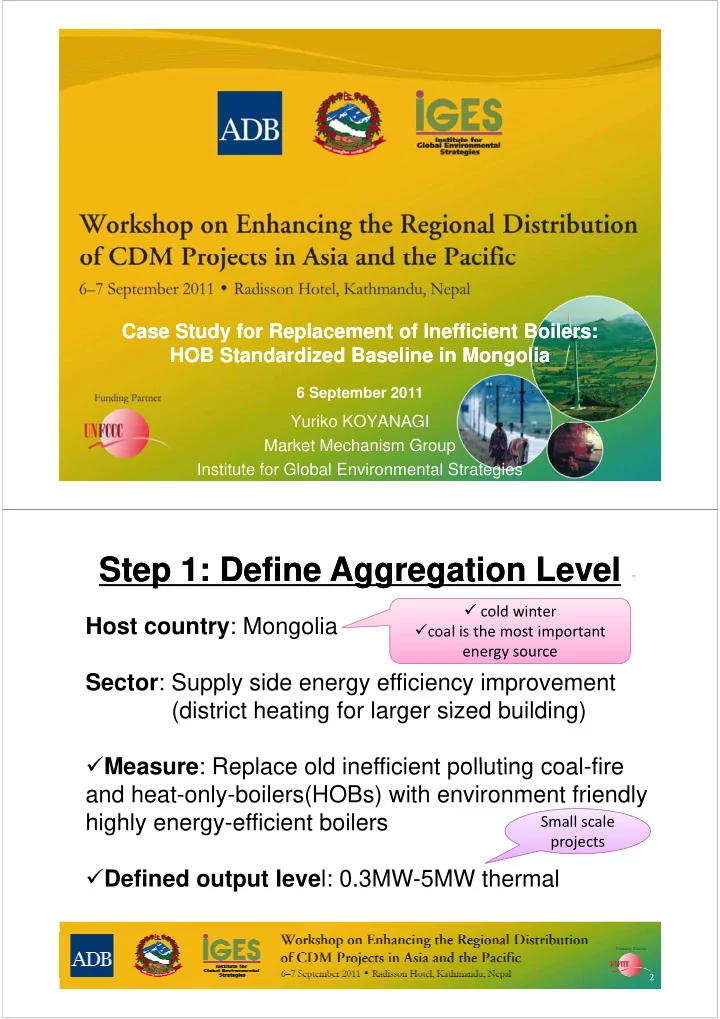
Step 1: Define Aggregation Level Step 1: Define Aggregation Level

Host country: Mongolia

 cold winter coal is the most important energy source

Sector: Supply side energy efficiency improvement (district heating for larger sized building)

energy source

(district heating for larger sized building) Measure: Replace old inefficient polluting coal fire Measure: Replace old inefficient polluting coal-fire and heat-only-boilers(HOBs) with environment friendly highly energy efficient boilers

Small scale Small scale

highly energy-efficient boilers Defined output level: 0 3MW 5MW thermal

Small scale projects

Defined output level: 0.3MW-5MW thermal

2

slide-2
SLIDE 2

Step 2: Define Additionality Criteria Step 2: Define Additionality Criteria

E ti f d t ti dditi lit Exemption from demonstrating additionality:  The remaining lifetime* of boilers is over 10 years 10 years

Refer to “Tool to determine the remaining lifetime of equipment (ver 1)” [EB50 Anx15] Refer to Tool to determine the remaining lifetime of equipment (ver. 1) [EB50, Anx15]

 The thermal efficiency of the boilers to be replaced is e t e a e c e cy o t e bo e s to be ep aced s lower than 55% lower than 55%

% f b il th l 55% 70% 80% % of boiler thermal efficiency rate Baseline Baseline

National Standard (MNS 5043:2001)

Current efficiency of most boilers in Ulaanbaatar (UB) city is 50…60% Additional Level

(according to the research under the World Bank projects in cooperation with Ministry of Nature Environment and Tourism, Mongolia (MNET)

Benchmark

Source: “Market Study of heat-only Boilers and Coal-fired Water Heaters” 2009, p.43 3

Step 2: Define Step 2: Define Additionality Additionality Criteria (cont.) Criteria (cont.)

How to define the benchmark of additional level?

  • The average efficiency of boilers manufactured
  • The average efficiency of boilers manufactured

and supplied in Mongolian market is 75% 75%.

Efficient rate X<65% 75%≦Y Total # (2008) 28 boilers 81 boilers

Estimation by IGES (raw data from “Market Study of heat-only Boilers and Coal-fired Water Heaters” 2009 p 35)

  • The current most efficient boiler supplied in

M li i 80% 80% ffi i

Estimation by IGES (raw data from Market Study of heat-only Boilers and Coal-fired Water Heaters 2009, p. 35)

Mongolia is 80% 80% efficiency. Thus, 80% 80% efficiency seems to be the most possible project scenario.

4

slide-3
SLIDE 3

Step 3: Identify Baseline Scenario Step 3: Identify Baseline Scenario

Baseline scenario: Continuation of heat supply by the current HOBs Continuation of heat supply by the current HOBs The energy baseline The energy baseline The monitored performance of the existing generating unit generating unit  Threshold Threshold Due to the highly share of coal as fuel (almost 100%), the threshold is defined as (almost 100%), the threshold is defined as energy efficient rate, not energy rate.

5

Step 3: Identify Baseline Scenario (cont.) Step 3: Identify Baseline Scenario (cont.)

The types and share of HOBs in UB city(2008‐2009)

Issue to be developed How to calculate the average efficiency?

W≦55% 55%<X<70% 70%≦Y≦75% 75%<Z

average efficiency?  average or median?

24% 16% 23%

 average or median?  Boiler efficiency test?  Boiler registration

37%

 Boiler registration system?

66 boilers might be the 66 boilers might be the target of CDM (PoA)

Estimation by IGES (raw data from “Market Study of heat-

  • nly Boilers and Coal-fired Water Heaters” 2009, pp. 6-7)

6

slide-4
SLIDE 4

Step 4: Baseline Emission Factor Step 4: Baseline Emission Factor

BE = E BE = EBL.

BL.

x x CO CO2-EF EF

Baseline Baseline emissions emissions Primary Primary Energy Energy consumed consumed in the in the baseline baseline Emission factor of the coal Emission factor of the coal = = NCV NCV coal (lignite) by the IPCC coal (lignite) by the IPCC default default value 0.101t value 0.101t-CO CO2/GJ /GJ baseline baseline default default value 0.101t value 0.101t CO CO2/GJ /GJ EBL = Eou / □BL = 14.40TJ / 0.55 =26.19TJ In case of 1MW boiler replacement

th li bl ti l

BL.

  • u

BL

Eou: useful energy output in year = capacity x operation hours/year = 1MW x 4 000hours

the reliable national data instead of IPCC default values might be

?

BE 28 8TJ 101 CO /TJ

1MW x 4,000hours = 4,000MWh = 4,000MWh x 3.6 = 14.40TJ □ ff f

default values might be examined…

∴BE = 28.8TJ x 101t-CO2/TJ = 2,645t-CO2

□BL: measured efficiency of the baseline boilers 55%

7

Summary Summary

 Positive list for boiler replacement CDM:

 Mongolia (and other regions characterized by cold winter and importance of coal as fuel)  the remaining lifetime of replaced boiler is over 10 yrs  the benchmark of additional level is 80% efficiency  the benchmark of additional level is 80% efficiency

 More possibility as PoA than normal CDM  More possibility as PoA than normal CDM Setting the baseline scenario how to define the Setting the baseline scenario, how to define the average efficient rate? 55% efficiency or…?  As for baseline CO2-EF, IPCC default value

8