SLIDE 3 Hawaii Health Care Innovation Models Project Steering Committee Meeting June 2, 2015 Health Care Innovation Office | 2 access, and addressing population health. The slides were sent out to Steering Committee members on June 2. Giesting noted that consultants Goldberg and Edlund will be facilitating additional, in-depth discussion
- n vision, roles, and structure later in June; accordingly, the presentation was an opportunity for
committee members to share some ideas. She said that our framing of the discussion includes options for the immediate term when the federal grant ends (February – June 2016), short to mid-term, and long term. Giesting reported that, for the immediate term, there are some general funds for health care innovation, but not sufficient to meet current program needs. Options for the short to mid-term include being incorporated into an existing State agency such as DHS/MedQUEST, DOH, State Health Planning & Development Agency (SHPDA), and the Hawai’i Health Authority (HHA). Giesting added the importance
- f also reuniting the health care innovation program with the APCD, which is currently at the Office for
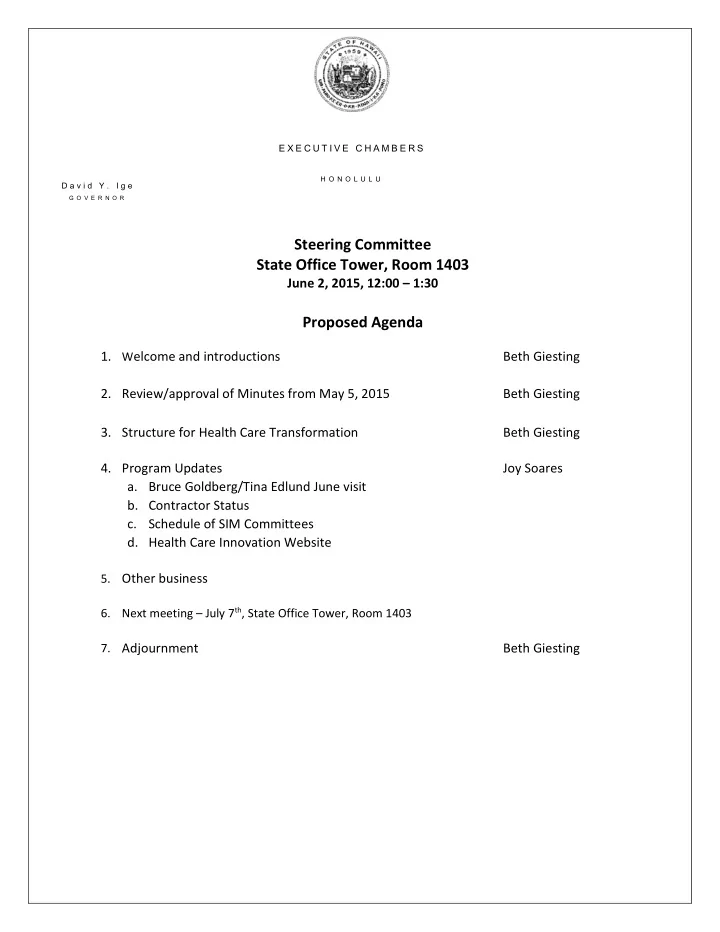
Information Management & Technology. In the long term, she emphasized, it is essential that there are durable relationships with any department that is involved with health care to ensure a common vision and collaborative investment and responsibility. State Examples of Health Care Transformation: Giesting shared examples of how five states - Connecticut, Maine, Minnesota, Oregon, and Washington - are structuring their health transformation programs. (See slides 6-10) Key Considerations for Health Care Innovation Giesting identified a short list of items to consider as we think about the future of Health Care Innovation:
- Legislation and legislative relationships
- Funding
- General funds
- Private funds, fees
- Federal grants
- CMS/Medicaid Match
- Exempt vs. civil service positions
- Agency buy-in
Q & A/Discussion: The following items were raised by Steering Committee members:
- Has health care innovation thought about becoming attached to RCUH?
- There are advantages and disadvantages to becoming a part of a department agency versus
continuing to represent the state as a whole in its current structure in the Governor’s Office.
- Health care innovation must identify priorities post-SIM to shape thinking about which agency
structure would be most appropriate. Taking a step back, it is important to confirm that there’s agreement that health care innovation is a continuing need.
- Is there a possibility to get into public health research?
- Businesses have been innovative while government has not changed much. How can this group
have the oversight and accountability to become a change agent while also being adaptive over time?
- DHS supports the work of health care innovation and would be willing to help fund some of the
- work. Medicaid must take the lead as a driving force for change.