Population Health Committee State Office Tower, Room 1403 June 22, - - PDF document

population health committee state office tower room 1403
SMART_READER_LITE
LIVE PREVIEW

Population Health Committee State Office Tower, Room 1403 June 22, - - PDF document

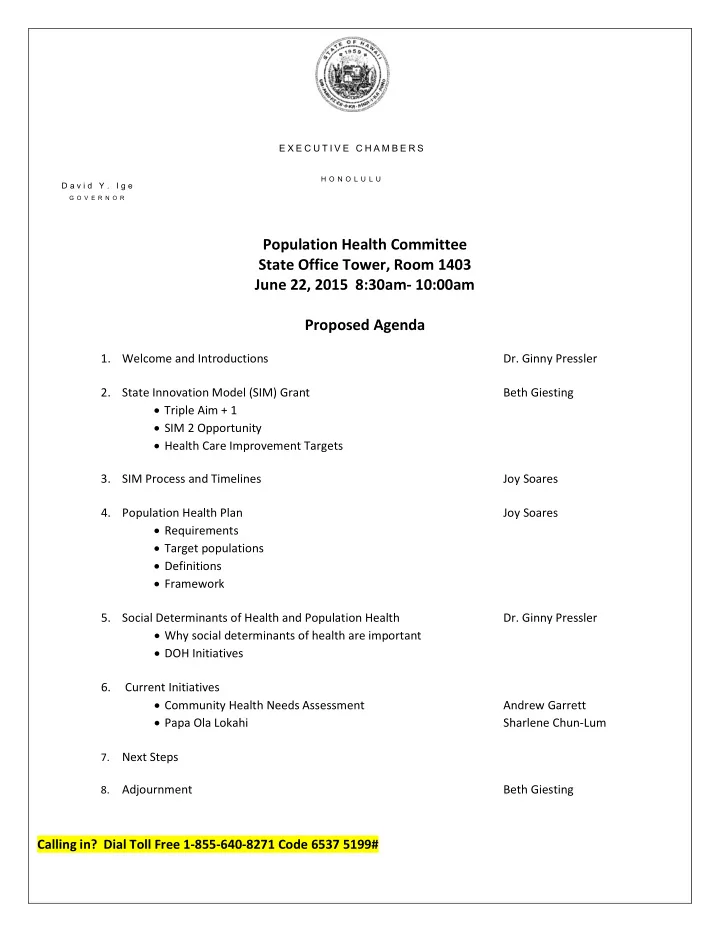
E X E C U T I V E C H A M B E R S H O N O L U L U D a v i d Y . I g e G O V E R N O R Population Health Committee State Office Tower, Room 1403 June 22, 2015 8:30am- 10:00am Proposed Agenda 1. Welcome and Introductions Dr. Ginny Pressler


slide-1
SLIDE 1 D a v i d Y . I g e G O V E R N O R

E X E C U T I V E C H A M B E R S

H O N O L U L U

Population Health Committee State Office Tower, Room 1403 June 22, 2015 8:30am- 10:00am Proposed Agenda

  • 1. Welcome and Introductions
  • Dr. Ginny Pressler
  • 2. State Innovation Model (SIM) Grant

Beth Giesting

  • Triple Aim + 1
  • SIM 2 Opportunity
  • Health Care Improvement Targets
  • 3. SIM Process and Timelines

Joy Soares

  • 4. Population Health Plan

Joy Soares

  • Requirements
  • Target populations
  • Definitions
  • Framework
  • 5. Social Determinants of Health and Population Health
  • Dr. Ginny Pressler
  • Why social determinants of health are important
  • DOH Initiatives
  • 6. Current Initiatives
  • Community Health Needs Assessment

Andrew Garrett

  • Papa Ola Lokahi

Sharlene Chun-Lum

  • 7. Next Steps
  • 8. Adjournment

Beth Giesting

Calling in? Dial Toll Free 1-855-640-8271 Code 6537 5199#

slide-2
SLIDE 2

State of Hawai‘i, Health Care Innovation Office | Page 1 of 8

EXECUTIVE CHAMBERS HONOLULU DAVID Y. IGE

GOVERNOR

Hawai’i Health Care Innovation Models Project Population Health Committee Meeting June 22, 2015 Committee Members Present: Beth Giesting, Co-Chair Ginny Pressler, Co-Chair Katy Akimoto Jamie Boyd Sharlene Chun-Lum Andrew Garrett Paige Heckathorn Brigitte McKale Tom Matsuda Andrew Nichols Linda Rosen Vija Sehgal Debbie Shimizu Kelly Stern Kerrie Urosevich Jessica Yamauchi Staff Present: Joy Soares Trish La Chica Abby Smith Nora Wiseman Guests: Mark Eshima (attending on behalf of Kealoha Fox) Committee Members Excused: Kealoha Fox Robert Hirokawa Ryan Okahara Tony Pfaltzgraff State Innovation Model (SIM) Grant: Co-Chair Beth Giesting gave an overview of SIM process: (please see attached slides for more details).  Health care innovation/transformation started with a stakeholder convening in 2012  SIM round 1 was carried out in 2013 with more stakeholder engagement  First plan was broad and high level  SIM round 2 provides the opportunity to create a more finely tuned implementation plan, more narrowly focused  All Payer Claims Database (APCD) and No Wrong Door (through Executive Office on Aging) are also working in parallel to SIM

slide-3
SLIDE 3

Hawai’i Health Care Innovation Models Project Population Health Committee Meeting June 22, 2015 State of Hawai‘i, Health Care Innovation Office | Page 2 of 8  SIM 2 continues to focus on the Triple Aim +1 Goal: Better Health, Better Care, Cost- effective Care, and the +1 for Hawai’i, which is to reduce health disparities  SIM 2 Targets: Behavioral health integration with primary care and oral improvement via increased access

  • Note – focus on Medicaid – we have a very supportive and engaged
  • leadership. Judy Mohr-Peterson will be the new Medicaid Administrator

 Rationale for Target Populations:

  • Based from feedback from first round of SIM, we felt that BH integration was

the most important to focus on and make great impact. Currently, BH conditions are disproportionately affecting the most vulnerable populations and that BH has been left out of innovations. It is worth noting that total healthcare costs for those with Behavioral Health cost three times more than those without BH conditions  SIM 2 grant ends January 31, 2016 (Innovation Plan due) SIM 2: Developing a Plan of Action (Please see slides for more detail) SIM Director Soares gave an overview of the current SIM Process:  A total of six (6) committees provide guidance to SIM: Steering, Delivery & Payment, Health IT, Work Force, Population Health, and Oral Health  The Operational plan being developed is for a 5 year period  At each committee meeting, members will be informed about what other committees are working

  • n. There is an opportunity to provide feedback and suggestions

SIM 2 Stakeholder Engagement:  Focus Groups:

  • Nine focus groups will be led by Dr. Withy with behavioral health and primary care providers

in July on all islands  Community conversations:

  • Community meetings will be on all islands in August or September to provide preliminary

thoughts on the way forward and receive feedback  Website is now active through the Governor’s webpage

  • This is also an opportunity to provide feedback on draft plan through the website
  • http://governor.hawaii.gov/healthcareinnovation/
  • SIM 2 Decision-making workflow (see chart below)

 Committees and SC work together to guide the work  Questions will be Decisions are made via consensus  Co-Chair Pressler noted that DOH and SHPDA will also be working on a State Health Improvement Plan (SHIP) that was last updated in 1989. This is separate and not to be confused from the SIM Health System Innovation Plan. The DOH/SHPDA SHIP will be aligned with SIM

  • For any questions on outline and membership, email Soares at

joy.soares@hawaii.gov

slide-4
SLIDE 4

Hawai’i Health Care Innovation Models Project Population Health Committee Meeting June 22, 2015 State of Hawai‘i, Health Care Innovation Office | Page 3 of 8 SIM 2 Decision-Making Workflow Population Health Plan Requirements:  Director Soares shared the SIM requirements for Population Health:  Improve the health and wellbeing of the state’s population  Identify measurable goals, objectives and interventions that will enable the state to improve the health of the entire state population  Focus on the general population, high risk groups, and/or groups experiencing disparities  Address social determinants of health  At a minimum address tobacco, obesity, and diabetes  Be evidence-based  Include a population health needs assessment  Have a strong prevention focus  Be sustainable Soares identified the CDC Framework for developing a plan for PH: 

  • Ms. Edwards’ story: low-income, barriers to eating healthy and exercising, under

stress, housing is sub-par where she lives  The CDC Framework consists of using three (3) buckets:

  • Bucket 1: Traditional Clinical Approaches – Focused on Preventive Care
  • Example: Million Hearts Campaign, looking at the ABCs of Aspirin,

Blood Pressure, Cholesterol, and Smoking

  • Bucket 2: Innovative Patient-Centered Care
  • Example: The value of working with Community Health Workers

(CHWs), who are from the community and can serve as community

slide-5
SLIDE 5

Hawai’i Health Care Innovation Models Project Population Health Committee Meeting June 22, 2015 State of Hawai‘i, Health Care Innovation Office | Page 4 of 8 health educators, patient navigators, and link health systems to communities

  • Bucket 3: Community-Wide Health
  • Example: Hawai‘i’s current Tobacco Purchase restriction Policy as a

community-wide policy

  • Policies on the built environment are also included as community-

wide components

  • Patient with Asthma (all 3 buckets applied see slide below)

Social Determinants of Health (SDOH) and Population Health  Chair Pressler shared that there are different definitions for population health. For example, they can be a panel of patients that physicians care for. But care does not remain in the hospital anymore, it extends to the community. Hospitals are now accountable for population health  Wai‘anae Coast Comprehensive Health Center Initiative on SDOH

  • CHCs in Hawai’i experience SIM’s target population everyday – those with co-

morbidities, are stressed, poor, and have limited access to fruits/vegetables and exercise

  • Environment – underlying cause that affects health
  • We are also looking at policy: to objectively define using data what the impact
  • f SDOH is in affecting payment reform
  • Predictive modeling program: computing risk scores for SDOH

 Targeting patients that cost more

slide-6
SLIDE 6

Hawai’i Health Care Innovation Models Project Population Health Committee Meeting June 22, 2015 State of Hawai‘i, Health Care Innovation Office | Page 5 of 8  Those patients who are at risk for becoming high-cost

  • Working with 4 CHC groups on a Federal initiative:

 Working with EHR vendors to collect data  Developing tools to implement data analysis  In response to Wai‘anae’ s initiative on adding value to payment reform, Dr. Pressler mentioned that SIM, Medicaid/DHS, and DOH are exploring a kind of Medicaid waiver called DSRIP – Delivery System Reform Incentive Payment - as a means to look at alternative methods of payment and ultimately, drive change Current Initiatives:

  • Dr. Pressler invited different committee members to share their current initiatives on

addressing social determinants of health as well as population health: Pali Momi:  Pali Momi chose to impact exercise nutrition and weight as well as heart disease and stroke in response to the HAH Community Health Needs Assessment  A 12 week program was aimed at healthy eating, exercise and weight loss. Pali Momi partnered with a local gym and provided community members an opportunity to learn about healthy nutrition, exercise and did a weekly weigh in  Pali Momi also worked with Pearl Ridge Mall and created a walking path in the mall so people could exercise safely indoors. Services were offered twice a month to check people’s blood pressure and blood sugar. Free education was also provided and there was a kiosk at the mall where people could find information about health  To affect heart disease and stroke Pali Momi chose to work with Aiea high school. They trained the junior class in CPR as well as providing for them an AED. They also went to a health career day to engage them in health careers and behavior. Windward Community College:  [View this short 10-minute video to learn about the Pathway Out of Poverty Program at WCC: http://nursingpathway.windward.hawaii.edu/]  The program supports health/education/employment promotion through culturally sound education and training in health career paths  Students enroll at entry-level health care worker training that is an 8-week Certified Nurse Aide (CNA) course that leads to one of the most stable jobs in Hawai`i  Students who choose to advance to higher education and training beyond CNA can earn stipends and tuition assistance by participating in all of the activities below:

  • Community service
  • 2-hrs per week in aloha `aina Food as Medicine garden program on campus at

WCC

  • Leadership in Pathway governance
  • Teachers in Training program that pairs advanced students with new students

as mentors Department of Education – School-Based Behavioral Health:

slide-7
SLIDE 7

Hawai’i Health Care Innovation Models Project Population Health Committee Meeting June 22, 2015 State of Hawai‘i, Health Care Innovation Office | Page 6 of 8  Project AWARE (Advancing Wellness and Resilience in Education) and School Climate Transformation grants will help increase awareness of mental health issues, enhance early intervention systems, and connect children and families with services.  Current campaign is on defining mental health and behavioral health. The ongoing dialogue is now framed more positively. The initiative is to dispel myths and stigma. DOE is currently using the WHO definition, in addition to emerging definitions.  Efforts include early identification and referrals by the lay people. SBBH trains a lot of lay people  SBBH and CAMD

  • DOE focuses on behavior among kids – where layers of understanding must

take place, specifically emerging behavior

  • SAMHSA – every caring adult promotes an environment on well-being. Focus
  • n those in the environment such as teachers, then moving to multi-level

approaches among providers University Health Services Mānoa  Mental Health

  • An anecdotal observation that improvements in mental health therapeutics
  • ver the past few decades have led to higher levels of functionality among

those with mental health conditions and a consequent higher prevalence of mental health disease among college students

  • The prevalence of attention-deficit disorder diagnosis among college-aged

persons has also increased substantially over this same period

  • These factors, as well as a perhaps reduced stigma in seeking mental health

care, has led to an increased utilization of mental health services by college students at the University of Hawai‘i at Mānoa

  • University Health Services Mānoa (UHSM) and the Counseling and Student

Development Center (CSDC) collaborate closely to meet the clinical medical and mental health needs of UH Mānoa students as well as students from various other University of Hawai‘i System campuses

  • UH Mānoa psychiatrists offer clinical services at both the CSDC and UHSM

facilities  Health Promotion

  • Services and activities of the UHSM Health Promotion section include peer

education outreach, substance abuse counseling, smoking cessation, nutrition, and health insurance consultation

  • The Mānoa campus will become smoke/electronic cigarette-free, effective Fall

Semester 2015

  • The Warrior Recreation Center was completed in 2014. This centrally located,

state of the art facility promotes healthy living and provides an outstanding

  • pportunity for UH Mānoa students, faculty, and staff to become more

physically active

  • An “Exercise is Medicine” campaign is in development for the UH Mānoa
  • campus. Regular physical activity has been shown to have numerous health

benefits on such conditions as cardiovascular disease, diabetes mellitus,

  • besity, mental health, and substance abuse.
slide-8
SLIDE 8

Hawai’i Health Care Innovation Models Project Population Health Committee Meeting June 22, 2015 State of Hawai‘i, Health Care Innovation Office | Page 7 of 8 Questions and Discussion:  What is the timeline for SIM SHIP?

  • Plan is due January 31st. SIM will be sharing work from the other committees

to keep everyone informed and have the opportunity to provide feedback.

  • Plan is to look at what we want to do for 5 years

 We don’t want to duplicate efforts and instead want to leverage efforts on what everyone is doing  HAH priorities does it include BH for children? This is a priority of the Executive Office

  • n Early Learning

 SIM is a great opportunity to engage with everyone  Legislature passed a bill to create a group that address SDOH: needs to be resurrected because the committee did not progress apart from meeting twice  Sustainability is important and proving the value for why SDOH is driving down costs and improving health  Why is there no BH representation in this committee? Is there a clinician we can include?

  • DOH can identify someone.

 HAH is looking at chronic conditions – specifically diabetes data  Childhood diabetes is a growing issue  What MH definition are we using?  In the University of South Carolina, therapists walk with kids around campus. The approach is more mentorship and friendship. Kids are losing weight and MH is improving.  One of the SIM identified approaches is on trauma-informed care. Community Health Needs Assessment (CHNA) Andrew Garrett, from the Healthcare Association of Hawai‘i (HAH) provided an update on their Community Health Needs Assessment:  The ACA, via the IRS, now requires hospitals to submit CHNAs to keep their non-profit status.  Initially embarked on this in 2013, HAH and DOH partnership.  2016 initiative: working with Healthy Communities Institute, who came last month to Honolulu to share initial findings:

  • Primary data: based on 75 key informant interviews
  • Secondary data: Hawai‘i Health Matters website key metrics
  • Top issues:
  • Access to healthcare services
  • Lack of accessible BH services

 Not just a lack of specialists, but lack of addressing MH issues in the PC setting

  • Coverage for COFA migrants who are no longer covered by Medicaid
  • Next steps:
  • Finalizing state-wide report, will be reviewed by different

stakeholders

  • Will share final results with the committee this summer
slide-9
SLIDE 9

Hawai’i Health Care Innovation Models Project Population Health Committee Meeting June 22, 2015 State of Hawai‘i, Health Care Innovation Office | Page 8 of 8

  • Hospital members will meet privately to identify 1-2 health priorities

by September  Want to move away from siloed approach because they cannot address PH issues by themselves  Integrate with SIM priorities Papa Ola Lokahi Sharlene Chun-Lum shared information on POL’s Native Hawaiian Master Plan:  Papa is working with different committees: Education and Training, Systems Integration, Communication and Community Engagement, Research and Data  Target population is Native Hawaiian – affected by disparities the most  Must engage with everybody because health affects everybody  HI #2 in health in the nation but not true for Native Hawaiians  It is not just Papa’s responsibility but the responsibility for the state  Pressler: unless we address SDOH, we haven’t really addressed population health  Alaska – tribal focus and BH are aligned  NH population – 75% are either 17 and under, college age is about half

  • On behavioral health, Papa is trying to promote positive approaches, like how

education can become a more natural thing – such as what the community does to become healthy  Currently, there is a lack of access:

  • On Hawaii Island the Native Hawaiian Healthcare System serves everyone but

has no clinic of its own

  • In Maui, they rely on CHCs and other providers

 Rethinking Native Hawaiian Healthcare System – from “systems to system” such that Native Hawaiians will always have access if they go from island to island  Native Hawaiian Healthcare Improvement Act (Federal): one of the issues is that they are being forced to apply more Western clinical measures; work must be done to educate HHS that such approaches will not necessarily apply to Native Hawaiians  Region 9 HHS meeting – last year, looked at how to implement SDOH approach but there is currently no funding for implementation Next Steps  The Health Care Innovation team will share the current draft of the SIM Population Health Assessment to the committee  The Health Care Innovation team will work with Dr. Pressler to identify additional committee members representing behavioral health and Medicaid.  Next meeting will focus on DOH activities that can be included in the SIM SHIP  PHP monthly meetings: not everyone is available on the dates we’ve set. A Doodle Poll will be sent out to committee members to determine the next meeting dates.  The venue for future meetings will probably be at DOH  Parking will be at state lots, and parking passes can be provided. Contact Trish La Chica, trish.lachica@hawaii.gov or 808-445-4855 to request for passes ahead of time.

slide-10
SLIDE 10

State Innovation Model Design 2

POP OPULA LATIO ION H HEALTH C H COM OMMITTEE JUNE 22, 22, 201 2015

slide-11
SLIDE 11

Welcome and Introductions

  • 1. Beth Giesting, Office of the Governor, Co-Chair
  • 2. Ginny Pressler, Dept of Health, Co-chair
  • 3. Katy Akimoto, HMSA
  • 4. Jamie Boyd, Windward Community College
  • 5. Sharlene Chun-Lum, Papa Ola Lokahi
  • 6. Kealoha Fox, OHA
  • 7. Andrew Garrett, HAH
  • 8. Paige Heckathorn, Queen’s Medical Center
  • 9. Robert Hirokawa, Hawaii Primary Care Association

10.Brigitte McKale, Pali Momi, HPH SIM Staff: Joy Soares Trish LaChica Abby Smith Nora Wiseman

  • 11. Tom Matsuda, Hawaii Community Foundation
  • 12. Andrew Nichols, University Health Services
  • 13. Ryan Okahara, HUD
  • 14. Tony Pfaltzgraff, Kalihi YMCA/Community Rep.
  • 15. Linda Rosen, HHSC
  • 16. Vija Sehgal, Waianae Coast Comprehensive Health Ctr
  • 17. Debbie Shimizu, No Wrong Door Grant
  • 18. Kelly Stern, DOE
  • 19. Kerrie Urosevich, Executive Office on Early Learning
  • 20. Jessica Yamauchi, Hawaii Public Health Institute
slide-12
SLIDE 12

Review: 2012 - 2014

  • Hawaii

Healthcare Project

  • Learning

Sessions

2012

  • SIM 1
  • Stakeholder

Consultation

  • Health

Summit

2013

  • SIM 2

Priorities

  • ACA, NWD,

APCD

  • Transition

2014

  • Getting started
  • PCMH, ACO, Care

Coord.

  • Expanded

discussions

  • High level plan
  • 6 Catalysts
  • SIM 2 Proposal
  • Associated projects
  • New Governor
slide-13
SLIDE 13

SIM Goals

Triple Aim + 1

  • Better health
  • Reliably good quality care
  • Cost-effective care
  • + Reducing disparities in health status and access to care
slide-14
SLIDE 14

SIM Initiative

SIM is based on the premise that state-led innovation, supported by broad stakeholder input and engagement, will accelerate health care delivery system transformation to provide better health and better care at a lower cost. SIM encourages public and private sector collaboration to design and test multi-payer models to transform the health care systems in the state.

slide-15
SLIDE 15

SIM2 Targets

Behavioral health integration with primary care – effective awareness, diagnosis and treatment

Adults with behavioral health needs Adults with chronic conditions in combination with behavioral health conditions

Oral health improvement via increased access to timely and preventive services

Access for children and increase dental sealants and fluoride varnishes Strategies to increase coverage for low-income adults

FOCUS IS ON MEDICAID

slide-16
SLIDE 16

Rationale for Target Populations

 Feedback from stakeholders, providers, community.  BH conditions disproportionately affect the most vulnerable populations.  While transformation in Hawaii is progressing, BH has largely been left out of innovations.  CHNA identified mental illness as number one preventable cause of hospitalization in 2012.  SIM Round 1 actuarial analysis showed the average total cost for individuals with a BH diagnosis was three times the average total cost for individuals without a BH diagnosis.

slide-17
SLIDE 17

Rationale for Target Populations

 Mental illness is a co-existing condition for 34% of potentially preventable hospitalizations and almost 10% of hospital readmissions (SIM HHIC analysis)  Total annual costs associated with potentially avoidable stays/visits (SIM HHIC analysis):

  • ER: $93 million (charges)
  • Preventable hospitalizations: $159 million (estimated cost)
  • Readmissions: $103 million (estimated cost)
slide-18
SLIDE 18

SIM 2: Developing a Plan of Action

Committees

 Steering  Delivery & Payment  Health IT  Work Force  Population Health  Oral Health

slide-19
SLIDE 19

Committee Schedule

Steering Committee – 1st Tuesday of the month Oral Health Committee – 2nd Fridays Delivery and Payment – 3rd Tuesdays Population Health Committee – 3rd Monday but may change Workforce – 4th Thursday HIT – committee membership and meeting times will be determined soon

slide-20
SLIDE 20

SIM 2: Stakeholder Engagement

Provider focus groups – facilitated by Dr. Kelley Withy

Focus groups on all islands Final report submitted by September 30th

Community conversations

Meetings on all islands Report completed by October 31st

slide-21
SLIDE 21

HCI Website

  • The Hawaii Health Care Project (hawaiihealthcareproject.org) is no longer

being updated

  • Governor’s Office to host HCI content (http://governor.hawaii.gov/)
  • Program updates
  • Agendas, minutes, meeting materials
  • Opportunity to provide feedback
  • Resources and reports
slide-22
SLIDE 22

Steering Committee

Delivery & Payment Committee HIT Committee Workforce Committee Oral Health Committee

State Innovation Plan

Population Health Committee Innovation Director Finalizes, Submits

Support by Health Innovation Program Staff, Governor’s Office

SIM 2 Decision-Making Workflow

slide-23
SLIDE 23

SIM 2: Developing a Plan of Action

All-Committee Meetings

 SIM Kick-Off with Bruce Goldberg - May  Initial SHIP Draft and Committee Check-In - September  Structure & Sustainability Plans - November  Final SHIP Celebration and Next Steps - January

slide-24
SLIDE 24

PHP PLAN REQUIREMENTS:

Improve the health and wellbeing of the state’s population. Identify measurable goals, objectives and interventions that will enable the state to improve the health of the entire state population. Focus on the general population, high risk groups, and/or groups experiencing disparities. Address social determinants of health. At a minimum address tobacco, obesity, and diabetes. Be evidence-based. Include a population health needs assessment. Have a strong prevention focus. Be sustainable.

slide-25
SLIDE 25

FRAMEWORK FOR PHP - CDC

slide-26
SLIDE 26
slide-27
SLIDE 27
slide-28
SLIDE 28
slide-29
SLIDE 29
slide-30
SLIDE 30
slide-31
SLIDE 31
slide-32
SLIDE 32
slide-33
SLIDE 33
slide-34
SLIDE 34
slide-35
SLIDE 35
slide-36
SLIDE 36
slide-37
SLIDE 37
slide-38
SLIDE 38

Another Way to Describe PH & SDOH…

slide-39
SLIDE 39

TARGET POPULATION

Medicaid adults with behavioral health conditions Adults who are obese Adults who use tobacco Adults who are diabetic

slide-40
SLIDE 40

Next Meeting

Decide on date and time