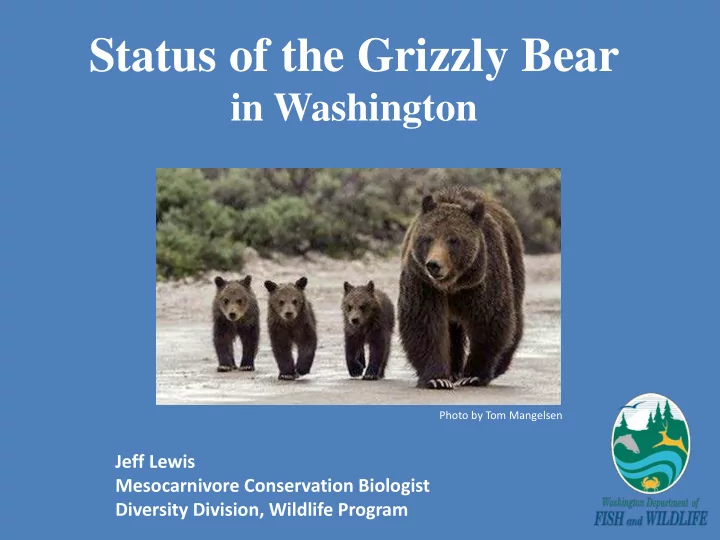
Status of the Grizzly Bear in Washington Photo by Tom Mangelsen - - PowerPoint PPT Presentation

status of the grizzly bear
SMART_READER_LITE
LIVE PREVIEW

Status of the Grizzly Bear in Washington Photo by Tom Mangelsen - - PowerPoint PPT Presentation

Status of the Grizzly Bear in Washington Photo by Tom Mangelsen Jeff Lewis Mesocarnivore Conservation Biologist Diversity Division, Wildlife Program Natural History of the Grizzly Bear in NA Native to western North America Largest


slide-1
SLIDE 1

Status of the Grizzly Bear

in Washington

Jeff Lewis Mesocarnivore Conservation Biologist Diversity Division, Wildlife Program

Photo by Tom Mangelsen
slide-2
SLIDE 2

Natural History of the Grizzly Bear in NA

  • Native to western North

America

  • Largest terrestrial

carnivore; omnivorous; habitat generalist; uses very large areas

  • Females can give birth

to 1-3 cubs every three years

  • Life spans up to 30

years.

Males 137-185 kg (301-407 lbs.) Females 90-118 kg (198-260 lbs.)

from Servheen et al. 1999

slide-3
SLIDE 3

Human-caused mortality (i.e., direct killing by shooting, poisoning, trapping) associated with westward exploration/expansion.

Historical Range Contraction

Servheen et al. 1999 David Mattson (2016)

slide-4
SLIDE 4

Legal Status, Distribution, Recovery Zones

  • ESA

Threatened (1975)

  • Endangered

in WA (1980)

slide-5
SLIDE 5

The Selkirk Mountain Recovery Zone in Washington:

Monitoring, Surveys, and Detections

  • Recent survey

detections

  • Females with cubs
  • bserved since

2014; male radio- collared 2016

  • Population may be

slowly growing (1- 2% per year)

  • Detections outside

the zone

slide-6
SLIDE 6

The North Cascades Recovery Zone:

Monitoring, Surveys and Detections

  • Extensive survey

effort throughout the NCRZ over last 20 years to detect grizzly bears; none detected

  • Five detections in

BC portion of the NCRZ in last ten years.

slide-7
SLIDE 7

BC WA

Factors Affecting Grizzly Bears

  • Historical

extirpation

  • Isolation
  • Human caused

mortality

  • High road-

densities

slide-8
SLIDE 8
  • Surveys and monitoring
  • Reducing road densities and motorized

vehicle access plans on Federal lands

  • Minimize human food and refuse

available to bears

  • “Living with bears” outreach
  • Federal proposal for NCRZ reintroduction
  • Interagency Grizzly Bear Committee

Conservation Actions

slide-9
SLIDE 9

Recommendation

The Grizzly Bear should remain classified as Endangered in Washington

slide-10
SLIDE 10

Public Comments

  • WDFW received 21 individual

comments

  • Eight indicated support for

maintaining endangered status

  • Seven indicated opposition
  • Eight comments indicated
  • pposition to the Federal

proposed reintroduction of grizzly bears in the NCRZ

slide-11
SLIDE 11

Questions?