Draft recommendations for reducing bear- human conflicts and A - - PDF document

draft recommendations for reducing bear human conflicts
SMART_READER_LITE
LIVE PREVIEW

Draft recommendations for reducing bear- human conflicts and A - - PDF document

11/1/2019 Draft recommendations for reducing bear- human conflicts and A draft report to the Yellowstone Ecosystem Subcommittee grizzly bear mortalities October 30, 2019 in the Yellowstone Ecosystem Andrew Pils, Shoshone National


slide-1
SLIDE 1

11/1/2019 1

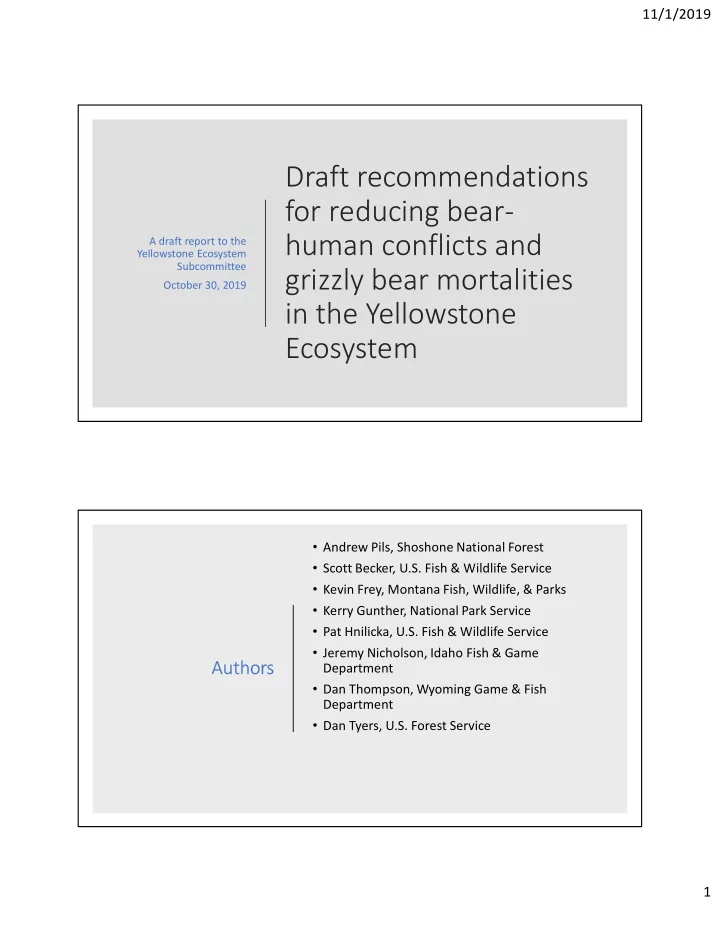
Draft recommendations for reducing bear- human conflicts and grizzly bear mortalities in the Yellowstone Ecosystem

A draft report to the Yellowstone Ecosystem Subcommittee October 30, 2019

Authors

  • Andrew Pils, Shoshone National Forest
  • Scott Becker, U.S. Fish & Wildlife Service
  • Kevin Frey, Montana Fish, Wildlife, & Parks
  • Kerry Gunther, National Park Service
  • Pat Hnilicka, U.S. Fish & Wildlife Service
  • Jeremy Nicholson, Idaho Fish & Game

Department

  • Dan Thompson, Wyoming Game & Fish

Department

  • Dan Tyers, U.S. Forest Service
slide-2
SLIDE 2

11/1/2019 2

Key Points to Remember

  • Mortalities are on average below thresholds
  • As bear numbers increase & range expansion

continues, conflicts & mortalities are expected to increase (especially outside DMA)

  • Goal of this effort is to continue managing

mortality within established thresholds inside the DMA & continue efforts to minimize conflicts throughout the GYE

  • Report includes recommendations for reducing

human-bear conflicts to address concerns other than just grizzly bear mortality

Topic 1: Backcountry & Hunting Related Conflicts

  • J. Hicks
slide-3
SLIDE 3

11/1/2019 3

Current efforts

  • B. Houck

Montana Bear Education Working Group Montana Fish, Wildlife, & Parks Montana Fish, Wildlife, & Parks

  • A. Pils

Recommendation 1: Continue training to outfitters and guides operating in grizzly bear country.

  • A. Pils
slide-4
SLIDE 4

11/1/2019 4

Recommendation 2: Agencies should continue to sponsor workshops to provide information on best practices for minimizing human-bear conflicts for different backcountry user groups.

Montana Fish, Wildlife, & Parks

Recommendation 3: Recognizing that backcountry use patterns in the GYE are changing, adapt messaging to different user groups on best practices for minimizing human-bear conflicts.

slide-5
SLIDE 5

11/1/2019 5

Recommendation 4: Continue to improve food & game carcass storage infrastructure in backcountry campsites.

  • L. Livingston

Recommendation 5: Seek additional funding to continue or expand outreach programs such as bear spray giveaways.

Wyoming Game & Fish

slide-6
SLIDE 6

11/1/2019 6

Recommendation 6: Re-evaluate YNP’s Bear Management Areas, and evaluate the potential for implementing BMA’s in GTNP & JODR.

Topic 2: Front Country Conflicts and Community Planning

  • D. Probasco
slide-7
SLIDE 7

11/1/2019 7

Current Efforts

Wyoming Game & Fish

  • A. Pils

Dusty Lasseter Wyoming Game & Fish

  • A. Pils

Recommendation 1: Continue to improve garbage storage infrastructure on private and public lands within the DMA.

  • D. Probasco
slide-8
SLIDE 8

11/1/2019 8

Recommendation 2: Purchase & install bear boxes at campsites in YNP & GTNP.

  • A. Pils

Recommendation 3: Improve consistency & messaging of human-bear conflict signing on National Forest & Park lands.

slide-9
SLIDE 9

11/1/2019 9

Recommendation 4: Work with local communities to ensure enforcement of existing sanitation

  • rdinances/regulations, or to enact new ones.

Montana Bear Education Working Group

Recommendation 5: Continue education and electric fencing efforts to reduce orchard/small livestock conflicts on private lands.

Wyoming Game & Fish

slide-10
SLIDE 10

11/1/2019 10

Recommendation 6: Identify strategies and additional resources needed among state and federal agencies for collaboratively managing roadside bears outside National Parks.

Recommendation 7: Work with interested NGOs to increase funding.

Agency funds and capacity for conflict work are becoming strained More resources are needed to implement of these preliminary recommendations

slide-11
SLIDE 11

11/1/2019 11

Topic 3: Efficacy of Information & Education Efforts

  • L. Dickerson

Past Efforts

  • Absaroka-Beartooth Wilderness User Surveys

(1990’s-2000’s)

  • GTNP: evaluation of signing & bear safety

products (2011)

  • YNP: public surveys to evaluate bear safety

practices (reported since 2015)

  • WGFD: public surveys at bear spray giveaway

events

slide-12
SLIDE 12

11/1/2019 12

Recommendation 1: Work with agency or university social science experts to evaluate the most effective methods of outreaching to people who live, work, and recreate in grizzly bear country.

  • L. Dickerson

Topic 4: Livestock conflicts and livestock producer outreach

Wyoming Game & Fish

slide-13
SLIDE 13

11/1/2019 13

Current Efforts

Montana Fish, Wildlife, & Parks

  • A. Pils

Wyoming Game & Fish

Recommendation 1: Engage with livestock producers that are new to managing livestock in areas occupied by grizzly bears.

  • D. Lasseter

Wyoming Game & Fish

slide-14
SLIDE 14

11/1/2019 14

Recommendation 2: Continue to work with livestock producers to evaluate depredation risk relative to various livestock management practices.

Montana Fish, Wildlife, & Parks

Recommendation 3: Continue to distribute information to livestock producers on effective management strategies for minimizing livestock conflicts.

slide-15
SLIDE 15

11/1/2019 15

Topic 5: Targeted community outreach in grizzly bear range expansion areas

  • D. Lasseter

Current Efforts

slide-16
SLIDE 16

11/1/2019 16

Recommendation 1: Improve signing related to bear-human conflict reduction practices on public lands in grizzly bear range expansion areas. Recommendation 2: Work with permittees on National Forest lands in areas where grizzly bear

  • ccupancy is new or anticipated to increase

awareness & incorporate bear-human conflict prevention measures into permits or operations.

  • J. Flower
slide-17
SLIDE 17

11/1/2019 17

Questions?