Status of project components Country: South Africa Grant Executed - - PowerPoint PPT Presentation

status of project components
SMART_READER_LITE
LIVE PREVIEW

Status of project components Country: South Africa Grant Executed - - PowerPoint PPT Presentation

Status of project components Country: South Africa Grant Executed By: National Treasury, Ministry of Finance USD 5, 000, 000 Grant Amount (USD): Project Status Est. date of Component completion May 2020 Component 1: Review of Emissions


slide-1
SLIDE 1

Status of project components

Project Component Status

  • Est. date of

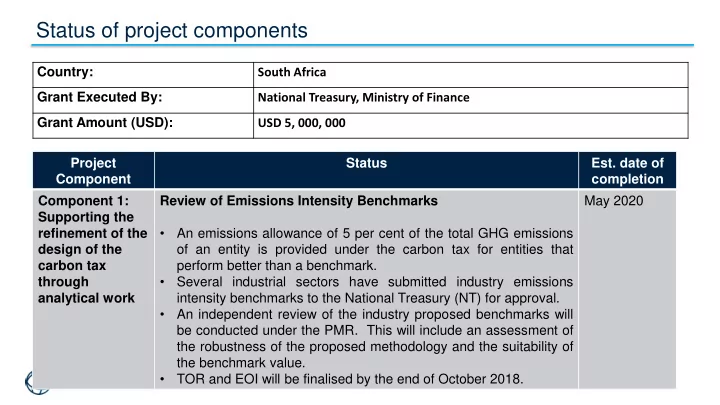
completion Component 1: Supporting the refinement of the design of the carbon tax through analytical work Review of Emissions Intensity Benchmarks

  • An emissions allowance of 5 per cent of the total GHG emissions
  • f an entity is provided under the carbon tax for entities that

perform better than a benchmark.

  • Several industrial sectors have submitted industry emissions

intensity benchmarks to the National Treasury (NT) for approval.

  • An independent review of the industry proposed benchmarks will

be conducted under the PMR. This will include an assessment of the robustness of the proposed methodology and the suitability of the benchmark value.

  • TOR and EOI will be finalised by the end of October 2018.

May 2020 Country: South Africa Grant Executed By: National Treasury, Ministry of Finance Grant Amount (USD): USD 5, 000, 000

slide-2
SLIDE 2

Status of project components continued

2

Project Component Status

  • Est. date
  • f

completion Component 2: Strengthening the capacity of government to enhance the data management and reporting (GHGs) and measurement / monitoring, reporting and verification (MRV) system 2.1 NAEIS Modification

  • A full technical and financial proposal was submitted by the service provider in

July 2018, evaluated by the National Treasury (NT) and Department of Environmental Affairs (DEA) in September and approved by the Bank in October 2018.

  • The NT legal team is currently drafting the contract for the appointment of the

service provider. This activity is expected to commence in early November.

  • The Vessels Under Pressure Registry activity will no longer be conducted by the
  • DEA. The funds amounting to US$ 400 000 has been reallocated to the NAEIS

modification activity. 2.2 Strengthening the DoE Central Energy Database (CED)

  • This activity will enhance the design capabilities of the existing Central Energy

Database managed by the Department of Energy (DOE), and facilitate testing and implementation of a web-based energy efficiency monitoring system.

  • The TOR was submitted to NT by the DOE on 27 September

and will be finalised by the end of October. May 2020

slide-3
SLIDE 3

Status of project components continued

3

Project Component Status

  • Est. date of

completion Component 2: Continued 2.3 NAEIS-CED institutional set-up and business case

  • A workshop was held in September 2018 between NT, DEA, DOE

and the South African Revenue Services (SARS) to discuss the key design features of the carbon tax administration system, linkages between respective systems and to finalise the TOR.

  • The updated TOR including infrastructure and human resource

requirements for emissions verification at the DEA and the SARS was completed and has been submitted for Bank approval. 2.4 Capacity building on Carbon Tax MRV

  • A draft TOR for the hiring of 2 MRV specialists and a Tax Admin

expert has been developed by the DEA and SARS.

  • The TOR will be submitted for Bank consideration and approval by

the end of October. June 2020

slide-4
SLIDE 4

Status of project components continued

4

Project Component Status

  • Est. date of

completion Component 3: Supporting the design of the carbon offset scheme 3.1 Review and technical assessment of the Carbon Offset Administration System (COAS) and Offsets Registry

  • Companies are allowed to use carbon offsets to reduce their carbon

tax liability - capped at 10 per cent of the total greenhouse gas emissions of a firm.

  • The Designated National Authority (DNA) within the Department of

Energy (DoE) will be the implementing agency of the carbon offset

  • allowance. The DoE has developed a Carbon Offset Administration

System (COAS).

  • This activity involves a review and technical assessment of the COAS,

and the options for hosting the offsets registry.

  • TOR, EOI and RFP have been approved by the Bank. The EOI was

published 6 July, proposals received on 10 August and evaluated on 17 August.

  • The RFP was submitted for bank approval on 27 September and

issued to shortlisted companies on 10 October. May 2020

slide-5
SLIDE 5

Status of project components continued

5

Project Component Status

  • Est. date of

completion Component 3: Continued 3.2 Framework for local standard and manual for offset scheme

  • This activity will develop a technical guideline which will serve as a

guide to all role players including project developers on how the offset program will be implemented and operated.

  • The ToR for the technical guidelines was revised to include the

development of a framework and pilot testing of a local standard.

  • The TOR and EOI will be submitted for Bank approval in October.

3.3 Capacity building of the Offsets Programme

  • A TOR and EOI for this activity has been completed.
  • The procurement process for the offsets experts will commence in

January 2019. May 2020

slide-6
SLIDE 6

Status of project components continued

6

Project Component Status

  • Est. date of

completion Component 4: Communication, stakeholder engagement and project administration support 4.1 Design and implementation of a communication, media & stakeholder engagement plan (CMSEP)

  • A CMSEP is required to support the finalization of the carbon

tax policy.

  • The

process

  • f

hiring an Individual Consultant (communication specialist) has commenced with interviews to be scheduled for end October. 4.2 Project Administration

  • The

procurement process for a dedicated programme coordinator was finalised in September 2018.

  • The Coordinator will drive the procurement process, support

project & financial management as well as administration. June 2020

slide-7
SLIDE 7

Key achievements since last ISR

Key Achievements

  • Terms of References (ToRs) have been completed for almost all activities, and the procurement processes for the

priority activities have commenced.

  • An updated implementation plan has been developed to expedite the procurement process to ensure that all major

activities can be completed by 30 June 2020 to align with the ending of the PMR program.

  • A Programme Coordinator joined the NT in September 2018 on a full time basis and will help to drive the

procurement process, support project and financial management as well as administration.

  • The first withdrawal application was processed and an initial disbursement of US$ 98 643 or R1.35m was made by

the Bank.

  • Policy developments:
  • The revised Carbon Offset Regulations taking into account stakeholder comments have been completed and

will be published for further consultation by early Nov 2018.

  • The revised Draft Carbon Tax Bill was published for public comment in December 2017, and presented to the

Joint Parliamentary Standing Committee on Finance and Portfolio Committee on Environmental Affairs in

  • February. Public Hearings on the bill were held by the Joint Committee in March, and the NT and DEA

presented a response to the comments in June 2018. The Bill is expected to be tabled later this year.

slide-8
SLIDE 8

Key Challenges Going Forward

Key Challenges

  • Due to delays in the legislative process, the proposed date of implementation
  • f the carbon tax scheduled for 1 January 2019 may be slightly delayed.
  • To complete the procurement for all major activities by January 2019 to

ensure activities can be finalized by the end of 2020.

  • The hiring of the program coordinator has helped to improve and

strengthen the capacity of the NT supply chain management team and address bottlenecks in the system.

slide-9
SLIDE 9

Key Lessons Learned

Key Lessons Learned

  • Having a dedicated programme coordinator and focal point at the World Bank together

with a clearly defined implementation plan is critical for the effective implementation of activities.

  • For recipient executed grants, regular meetings of the oversight body that is, the

Project Steering Committee comprising representatives of key project partners is critical to support and expedite implementation of activities.

  • Appropriate training interventions in STEP and Client Connection in-country are

essential for the smooth implementation of project activities.