Statement of Problem 2 More than 100 varieties of commercial - - PDF document

statement of problem
SMART_READER_LITE
LIVE PREVIEW

Statement of Problem 2 More than 100 varieties of commercial - - PDF document

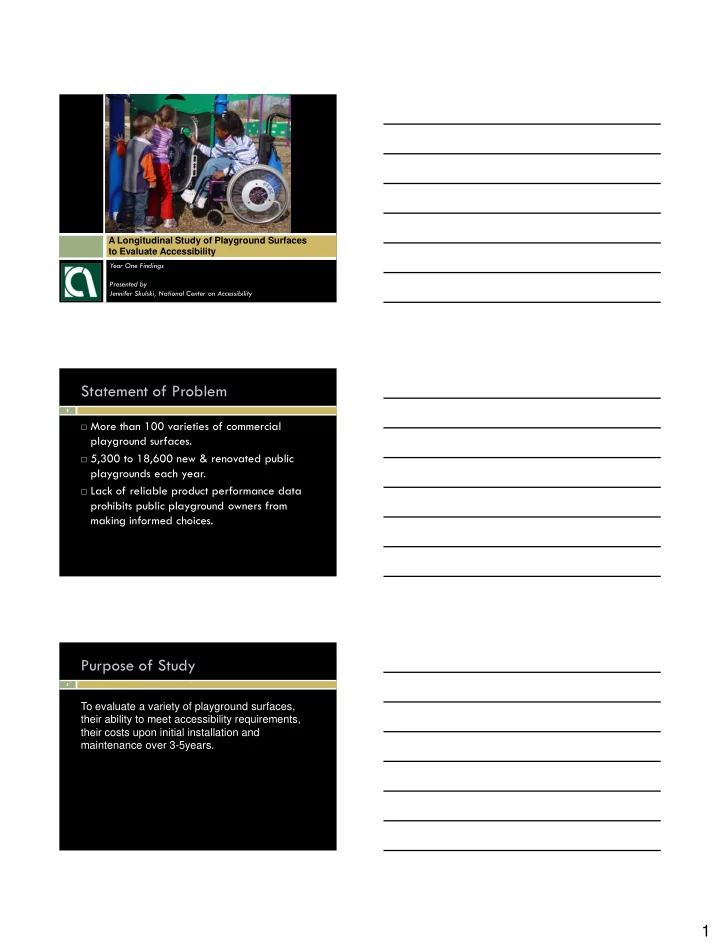
A Longitudinal Study of Playground Surfaces to Evaluate Accessibility Year One Findings Presented by Jennifer Skulski, National Center on Accessibility Statement of Problem 2 More than 100 varieties of commercial playground surfaces.


slide-1
SLIDE 1

1

Year One Findings Presented by Jennifer Skulski, National Center on Accessibility

A Longitudinal Study of Playground Surfaces to Evaluate Accessibility

Statement of Problem

 More than 100 varieties of commercial

playground surfaces.

 5,300 to 18,600 new & renovated public

playgrounds each year.

 Lack of reliable product performance data

prohibits public playground owners from making informed choices.

2

Purpose of Study

3

To evaluate a variety of playground surfaces, their ability to meet accessibility requirements, their costs upon initial installation and maintenance over 3-5years.

slide-2
SLIDE 2

2

Research Questions

Installation

1.

How well do various playground surfaces meet the accessibility requirements upon installation?

2.

What are the costs for the various playground surfaces and are the costs related to performance?

3.

What accessibility issues arise out of initial installation?

4

Research Design

 Within 12 months of installation  NCA longitudinal study  Advisory committee  RPTS faculty  NCA staff  U.S. Access Board staff  National Playground Safety Institute  Beneficial Designs  Members of the Access Board Reg Neg Committee or

ASTM F08.63 Playground Subcommittee

5

Playground Selection

 Municipal park settings  Limited within driving distances of IU-Bloomington;  Accessibility to children with and without disabilities;  Surface materials consistent with study;  Geographic location;  Seasonal weather conditions; and  Willingness of owner/operator to participate.

6

slide-3
SLIDE 3

3

Limitations

 Sample size, recruiting technique and ability to

generalize findings to general population;

 Visitor use and impact on surface conditions;  Weather;  Risks of liability affecting playground owner’s

willingness to participate in the study.

7

5 Categories of Surfaces

1.

Engineered wood fiber product;

2.

Shredded rubber / crumb rubber;

3.

Unitary rubber mat / tile surfaces;

4.

Unitary rubber “poured in place” surfaces;

5.

Combination or hybrid surface systems under development.

8

Initial Surface Requirements

1.

ADA-ABA 1008.2 Accessible Routes;

2.

ADA-ABA 1008.2.6 Ground Surfaces;

3.

ASTM F1292-99 Standard Specification for Impact Attenuation of Surface Systems Under and Around Playground Equipment as determined by the surface manufacturer in laboratory testing;

4.

ASTM F1951-99 Standard Specification for Determination of Accessibility

  • f Surface Systems Under and Around Playground Equipment as

determined by the surface manufacturer in laboratory testing; and

5.

ASTM F2075 Standard Specification for Engineered Wood Fiber for Use as a Playground Safety Surface Under and Around Playground Equipment.

9

slide-4
SLIDE 4

4

Instrumentation

1.

Installation form

2.

On-site visual inspection

3.

Rotational Penetrometer measurements for firmness & stability

4.

TRIAX 2000 measurements for impact attenuation (optional)

10

On-site inspection

9 Critical Areas

1.

Entry to playground where playground surface starts

2.

Accessible route connecting accessible play elements

3.

Egress point of slide(s)

4.

Swings

5.

Entry point(s) to composite structure(s)/transfer stations

6.

Climber(s)

7.

Ground level play element(s) such as spring rockers, play tables, interactive panels, etc

8.

Sliding poles

9.

Other areas (i.e. water play elements, etc)

11

Accessible Routes & Walking Surfaces

Slope

403.3 The running slope of walking surfaces shall not be steeper than 1:20. The cross slope of walking surfaces shall not be steeper than 1:48.

Floor and ground surface (403.2 refers to 302)

302.1 Floor and ground surfaces shall be stable, firm, and slip resistant.

Openings

302.3 Openings in floor or ground surfaces shall not allow passage of a sphere more than 1/2 inch (13 mm) diameter.

Changes in level (403.4 refers to 303)

303.2 Changes in level of 1/4 inch (6.4 mm) high maximum shall be permitted to be vertical.

303.3 Changes in level between 1/4 inch (6.4 mm) high minimum and 1/2 inch (13 mm) high maximum shall be beveled with a slope not steeper than 1:2.

ASTM F1951-99. Ground surfaces shall be inspected and maintained regularly and frequently to ensure continued compliance with ASTM F 1951.

ASTM F 1292

12

slide-5
SLIDE 5

5

1st On-site Measure

Surface Deficiency Score (SDS)

 Slope exceeds 1:16 (6.25%)  Cross slope exceeds 1:48 (2.08%)  Change in level greater than ½ inch  Opening greater than ½ diameter

13

ASTM F1951-99

 A lab test in a controlled environment  Wheelchair work method  7% ramp used as baseline  Measures work per sq ft for straight propulsion and

turning

 Manual rehabilitation wheelchair with rider 165 +

11 lbs

 Records data applied to pushrim over 6 ½ ft

distance

14

ASTM F1951-99

 The surface “passes in the lab” if the work to propel

across the surface and to turn is less than the work required to propel across a 7% ramp.

PASS = WORK on surface sample < WORK on 7% ramp

15

slide-6
SLIDE 6

6

2nd On-Site Measure

Firmness & Stability

 Rotational Penetrometer  Developed by Beneficial

Designs as a portable field test to replace ASTM 1951.

 Wheelchair caster set in

spring loaded caliper.

 Measures the vertical

displacement of the penetrator.

16

Sample Values for Various Surface Types*

17

Surface Type Firmness Stability

Concrete .15 - .17 .17 - .19 Turfgrass .55 - .65 .69 - .79 Carpet

( ½ inch cut pile w/ ½ inch pad)

.32 - .43 .41 - .55 Sand 1.13 < 1.13

*The values are from sample surfaces that are not part of a playground installation.

3rd On-Site Measure

Impact Attenuation (Optional)

18

slide-7
SLIDE 7

7

19

Data Report

20

TRIAX Report – ASTM F1292

Findings

slide-8
SLIDE 8

8

Playground Sites

Surface Area Cost / sq ft Total PIP 2,400 to 6,600 sq ft $6.59 to $19.80 $30,019 to $136,065 Tile 1,100 to 2,571 $8.96 to $15.29 $15,950 to $27,971 EWF 4,000 to 12,510 $1.08 to $2.50 $4,200 to $12,500 Hybrid 6,031 to 8,500 $7.50 to $12.65 $74,000 to $111,626

22

N = 25 sites

23 PIP $6.59 -19.80 SDS Mean = .00 Mode = 0 Firmness .36308 Stability .40876 Sum .77184 Failure for impact attenuation 24 Tiles $8.96-15.29 SDS Mean = .36 Mode = 0 Firmness .27805 Stability .31687 Sum .59492 Changes in level Separation at seams Punctures

slide-9
SLIDE 9

9

25 EWF $1.08 – 2.50 SDS Mean = 2.16 Mode = 3 Firmness .34206 Stability .78200 Sum 1.12406 Undulating running & cross slope Displacement Installation instructions 26 HYB $7.50 – 12.65 SDS Mean = .04 Mode = 0 Firmness .43969 Stability .49385 Sum .93354 Minimal accessibility deficiencies 27

Table 4 Surface Deficiency Score (SDS) within One Year of Installation Surface by Type N Mean Mode PIP 50 .00 TIL 39 .36 EWF 70 2.16 3 HYB 26 .04

slide-10
SLIDE 10

10

Surface Deficiency Score (SDS)

 ANOVA, Post hoc test: multiple comparisons of SDS

 Significant difference in the number of

identified deficiencies between EWF and the other three surfaces.

28

Firmness & Stability

29

Table 2 Firmness and Stability by Surface Type N Mean Std. Deviation Std. Error Min. Max. Firmness PIP 50 .36308 .060747 .008591 .228 .480 Tiles 39 .27805 .028579 .004576 .216 .342 EWF 70 .34206 .051741 .006184 .258 .568 HYB 26 .43969 .060899 .011943 .336 .566 Stability PIP 50 .40876 .069118 .009775 .264 .598 Tiles 39 .31687 .056598 .009063 .246 .596 EWF 70 .78200 .130442 .015591 .518 1.162 HYB 26 .49385 .069247 .013580 .372 .606

Firmness & Stability

 ANOVA, Post hoc test: multiple comparisons of means

for firmness & stability

 Firmness: NO statistical difference between PIP &

EWF

 All other comparisons by surface type show a

statistical difference in mean values for firmness and stability.

30

slide-11
SLIDE 11

11

Firmness & Stability

 ANOVA, Post hoc test: multiple comparisons of

standard deviation for firmness & stability

 Only statistical difference is between EWF and the

  • ther three surface types in the sample.

 Future questions:  Is there a statistical difference between unitary and loose fill surface

materials when SD is compared?

 Do surfaces with greater variability require more maintenance over

time?

31

Sum of Firmness & Stability

32

Table 3 Sum of Firmness and Stability by Surface Type N Mean

  • Std. Deviation Std. Error Minimum Maximum

PIP 50 .77184 .128745 .018207 .492 1.078 Tiles 39 .59492 .079460 .012724 .462 .908 EWF 70 1.12406 .168176 .020101 .782 1.730 HYB 26 .93354 .127251 .024956 .708 1.168 Total 185 .89054 .248761 .018289 .462 1.730

Sum of Firmness & Stability

 ANOVA, Post hoc test: multiple comparisons of the

sum of firmness & stability

 There is a statistical difference between all surface

types when firmness & stability are added together.

33
slide-12
SLIDE 12

12

SDS Compared to Firmness & Stability

 Pearson Correlation, bivariate correlations between

the sum of firmness and stability with the surface deficiency score (SDS)

 There is a bivariate correlation between all of the

surfaces EXCEPT the hybrid surface systems.

 This does NOT suggest that the SDS or Firmness &

Stability have an effect on one another.

34

SDS Compared to Stability

 Pearson Correlation, bivariate correlations

between the stability with the surface deficiency score (SDS)

 There is a correlation between the stability

measurement and the SDS with all of the surfaces in the sample.

Future question: Could this suggest/predict that surfaces measured with greater stability will have fewer number of accessibility deficiencies while surfaces with lesser stability will have more identifiable accessibility deficiencies?

35

Key Finding(s)

There is NO perfect surface.

36

slide-13
SLIDE 13

13

Key Findings

1.

Loose fill EWF had greatest number of deficiencies affecting accessible route.

2.

Loose fill EWF had highest values for firmness and stability.

3.

PIP , TIL and EWF have correlations between number of deficiencies and sum value for firmness and stability.

37

Key Findings

4.

Occurrences were identified where the installation did not parallel the manufacturer’s installation instructions or procedures for the laboratory test sample for ASTM F1951.

5.

A surface with fewer accessibility deficiencies and lower measurement for firmness and stability does not necessarily meet the safety standards for impact attenuation.

6.

The relationship between surface cost and performance in this sample was inconclusive.

38

Where do we go from here?

 Longitudinal Study –

data collection continues in May

 Recruiting additional sites  Access Board commitment to funding through

Sept 2012

 Maintenance Data  What was done?  How much material added?  Size of surface area repaired?  Cost?

39

slide-14
SLIDE 14

14

National Center on Accessibility

 First Year Findings – Playground Surface Study

www.ncaonline.org

 Contact:

Jennifer Skulski National Center on Accessibility jskulski@indiana.edu

40