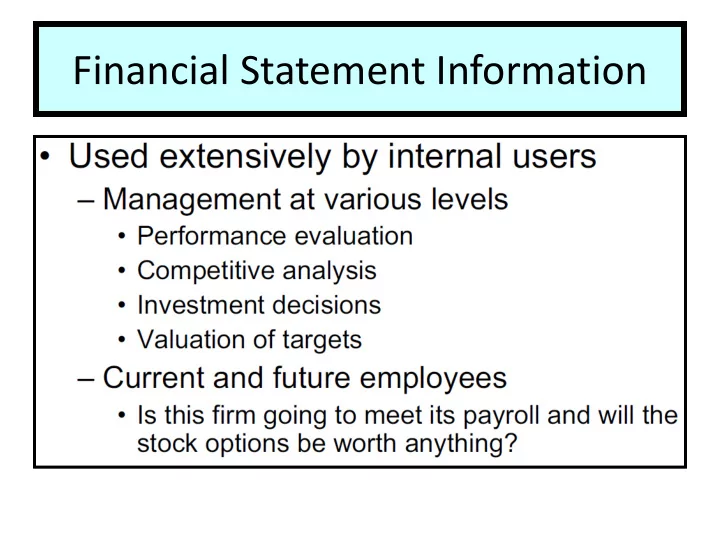
SLIDE 1
Financial Statement Information
SLIDE 2
Financial Statement Information
SLIDE 3
Financial Statement Information
SLIDE 4
Financial Statement Information
SLIDE 5
Market Efficiency and the Role of Financial Statement Analysis
SLIDE 6
Market Efficiency and the Role of Financial Statement Analysis
SLIDE 7 Financial Statement Information
- Business strategy – A leadership plan to
achieve a specific set of goals or objectives such as
– Developing new products or services – Entering new markets – Increasing customer loyalty – Attracting new customers – Increasing sales
SLIDE 8 Identifying Competitive Advantages
- Competitive advantage – A product or service
that an organization’s customers place a greater value on than similar offerings from a competitor
- First-mover advantage – Occurs when an
- rganization can significantly impact its
market share by being first to market with a competitive advantage
SLIDE 9 Identifying Competitive Advantages
- Competitive Intelligence –The process of
gathering information about the competitive environment to improve the company’s ability to succeed
- Competitive Intelligence analysis tools
– Porter’s Five Forces Model – Porter’s Three Generic Strategies – Porter’s Value Chain
SLIDE 10
Porter’s Five-Forces Model
SLIDE 11
Financial Statement Information
SLIDE 12
Competitive Advantage Analysis
– Best-made product – Superior customer service – Lower costs – Superior manufacturing technology – Shorter lead times – Well-known brand name – High value per cost
SLIDE 13 “CEO Speak” for Competitive Advantages
- Intensification: improving processes to serve current customers
better: reengineer current processes, eliminate ineffective ops.
- Extension: using efficient existing processes to enter new markets
to gain competitive advantage.
- Augmentation: expanding processes to provide additional services
to current customers.
- Conversion: taking a process that the company performs well and
performing it as a service to other companies.
- Innovation: applying existing processes that one performs well to
create and deliver different goods or services.
- Diversification: creating new processes to deliver new goods or
services
SLIDE 14
Competitive Advantage Strategies
SLIDE 15
PORTER’S THREE GENERIC STRATEGIES : Choosing A Business Focus
SLIDE 16 Financial Statement Information
Information is available from
– Published annual reports
Financial statements
Notes to financial statements
Letters to stockholders
Auditor’s report (Independent accountants)
Management’s discussion and analysis
– Reports filed with the government
- e.g., Form 10-K, Form 10-Q and Form 8-K
SLIDE 17 Financial Statement Information
Information is available from
– Other sources
Newspapers (e.g., Wall Street Journal )
Periodicals (e.g. Forbes, Fortune)
Financial information organizations such as: Moody’s, Standard & Poor’s, Dun & Bradstreet, Inc., and Robert Morris Associates
Other business publications
SLIDE 18 Financial Statement Information
- Project 1 is peforming a Five Forces and
Competitive Advantage Analysis of Your Chosen company and Industry
– First: Apply 5 Forces Analysis to INDUSTRY – Second: Classify the Industry (how value is created). – Third: Determine the “Key Success Factors” (Value Drivers) for the Industry – Fourth: Assess the extent to which your firm is managing/achieving these Value Drivers
SLIDE 19 Strategic Implications of Porter’s Five Forces Model
- Industry industry is attractive when:
–Rivalry is moderate or low –Entry barriers are high –Good substitutes do not exist –Suppliers and buyers are in a weak bargaining position
SLIDE 20 How Firms Should Cope with the Five Competitive Forces
- Craft a strategy that will:
–Insulate firm from competitive forces –Influence competitive pressures in ways that will favor company –Build sustainable competitive advantage
SLIDE 21 Drivers of Change in an Industry
- Industries change because forces are driving industry
participants to alter their actions
- What are driving forces ?
– Key underlying causes of changing industry & conditions
– Identify forces likely to exert greatest influence over next 1-3 years – usually not more than 3-4 factors – Assess their impact – difference they make – Environmental scanning a pre-requisite
- Discussion: Importance and Applicability for:
– Equity Analysts – Bankers – Management of the Firm
SLIDE 22 Common Types of Driving Forces
- Changes in long-term industry growth rate
- Changes in buyers of the product & how they use it
- Product innovation
- Technological change/process innovation
- Marketing innovation
- Entry or exit of major firms
- Diffusion of technical knowledge
- Changes in costs and efficiency
SLIDE 23 Common Types of Driving Forces
- Increasing globalization of industry
- Market shift from standardized to differentiated
products
- New regulatory policies and/or government legislation
- Changing societal concerns, attitudes, and risk lifestyles
- Changes in the degree of uncertainty and business risk
SLIDE 24 Key Success Factors (KSFs) in an Industry
– The competitive elements that every industry member must be competent at doing or concentrate on achieving in order to be competitive and financially successful in the marketplace
- Specific strategy elements
- Product attributes
- Resources,Competencies & Competitive capabilities
SLIDE 25 Identifying Industry KSFs
- KSF’s in an industry spell difference between
– Profits and loss – Competitive success or failure
- Answers to three questions pinpoint KSF’s
(1) On what basis do customers choose between competing brands or sellers? (2) What must a seller do to be competitively successful – what resources and competitive capabilities does it need? (3) What does it take for sellers to achieve a sustainable competitive advantage? – KSFs consist of 3-5 major determinants of financial & competitive success in an industry
SLIDE 26 Common Types of KSFs (6)
– Scientific research expertise; product innovation capability; expertise in a given technology; etc.
– Low-cost production efficiency; low cost plant location; Quality of manufacture, low-cost product design & engineering, etc
– Strong network of wholesaler distributors/dealers; ability to gain ample space on retail shelves; accurate filling of customer orders; short delivery times, etc.
SLIDE 27 Common Types of KSFs (6)
– Customer service; merchandising skills; clever advertising; attractive styling or packaging, Guarantees & warrantees
– Superior workforce talent; quality control know-how; design expertise; technological expertise, etc.
- Organizational capability
– Superior information systems; ability to employ internet to conduct business; managerial expertise
SLIDE 28 Consistency between KSFs and Industry Classification
- Previous KSFs are Generic in Nature
– Industries have developed their own specific language to describe these generic terms. You need to learn them. – Financial Institutions have developed a strategy of “relationship banking”.
- Cross-Sell product and services across functional lines in order to
generate more fee or service income.
- Do you see any similarities in the current airline industry?
SLIDE 29
Recapping the Match between KSFs and Industry Classification from 5-Fs