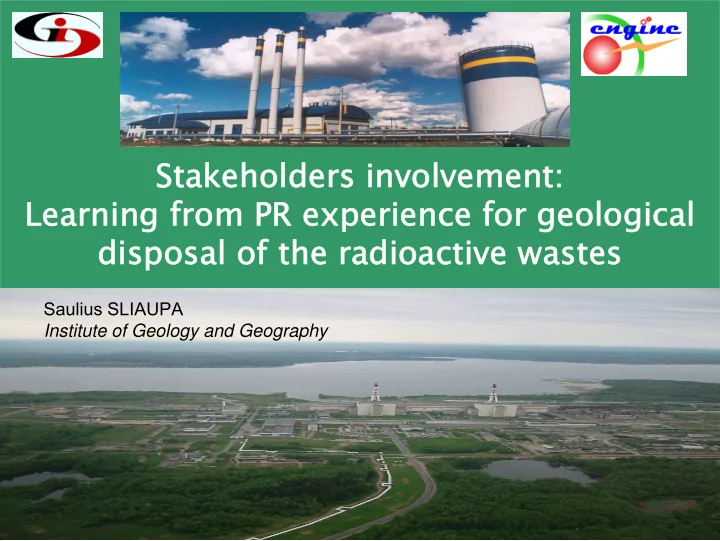
SLIDE 1 Stakeholders involvement: Stakeholders involvement: Learning from PR experience for geological Learning from PR experience for geological disposal of the radioactive wastes disposal of the radioactive wastes
Saulius SLIAUPA Institute of Geology and Geography
SLIDE 2 “ Engaging in Stakeholder Dialogue for the first time feels like making a proposal
marriage. One knows it is absolutely the right thing to do but always those lingering doubts
betrothal, the desire for Stakeholder Dialogue rarely flows from a deep affection for the stakeholders. Often it is precisely the
Rupert Wilcox-Baker, BNFL, August 2002
SLIDE 3
Geological disposal is now the accepted solution for RW in every country that has a final management solution. In Europe, at the end of its recent five-year programme the EC declared (EC, 2004) that: “Disposal in deep (>300 metre) geological repositories, the favoured strategy in Europe for long-lived high-level radioactive waste, is now possible”.
STATUS
SLIDE 4 Geological disposal was first formally advanced as an appropriate, safe solution to radioactive management almost fifty years ago, in the United States (NAS, 1957).
SLIDE 5
SLIDE 6 The delays have been in part due to the complexity of some of the technical tasks. More often, however, delays have resulted from a failure to integrate the technical and the societal issues associated with repository development.
SLIDE 7
SLIDE 8
Examples of possible stakeholders
the general public; demographic groups (like young people); residents, representatives or elected officials of local communities; national/regional government ministries/departments; regulators; trade unions; the media; the scientific research community; implementing organisations; the nuclear industry; international organisations.
SLIDE 9 The opposition can have various reasons:
can be part of the widespread genuine anxiety about
nuclear matters; it can be a deliberate tactic to hinder the development of nuclear power; it may reflect public scepticism towards any new, major technological development; it may result from the failure of the nuclear industry to accept the importance of interacting with the concerned public.
SLIDE 10 After 2nd world war, shortages and cold war gave experts the legitimacy to decide: expert = decision maker Later difficulties and recognition that alternatives are possible led to distinguish the roles. expert ≠ decision maker Later crises in health and environment caused a number of independent actors to ask for “public policies” defined and implemented through “decision making processes”, with stakeholders participation. Complexity of issues, complexity of the social system have led to : An interplay among three types of actors: public, experts, decision makers
It takes three to tango It takes three to tango … …but it took time to realize it but it took time to realize it
SLIDE 11 On stakeholder involvement On stakeholder involvement
Stakeholder involvement is a key concept in modern approaches to
recognising its relevance will, most likely, lead one to failure. NWD countries are moving away from a traditional “decide, announce and defend” model, for which the focus was almost exclusively on technical content, to one of “engage, interact and co-operate”, for which both technical content and quality of process are of comparable import to a constructive outcome. Organisational ability to learn, to communicate and to adapt now moves into the foreground.
SLIDE 12 The requirements over and above straightforward technical feasibility can be grouped under the following headings:
- Safety:....
- Security: .....
- Environmental acceptability: ....
- Economic
viability:.....
- Ethics: Can geological repositories be implemented without being
“unfair” to any of the present day stakeholders or to future generations, who should also not be subjected to unnecessary burdens?
- Public acceptability: What are the public views on waste repositories?
How can the public best be included in the decision making processes? Can a sufficient degree of societal consensus be achieved?
Requirements on geological disposal programmes Requirements on geological disposal programmes
As a committee of the US National Research Council recently pointed out, “the main challenges are societal rather than technical” (NRC, 2001).
SLIDE 13
INFORMIN INFORMING G THE PUBLIC THE PUBLIC
Social and ethical issues are at least as important as technical issues. Public involvement, at the earliest possible stage, is perhaps the most vital requirement, although it will not necessarily be enough. The public deserves and should have our respect. We cannot expect their trust if we do not trust them. Without them we are lost.
SLIDE 14
LEGAL BASIS FOR INVOLVEMENT OF THE STAKEHODLERS
SLIDE 15 Calls and Legal Bases for Stakeholder Involvement Calls and Legal Bases for Stakeholder Involvement
Member countries in the European Union are bound by the terms
- f Directives on Environmental Impact Assessment (EIA) (85/337/EEC as
amended by 97/11/EC) and Strategic Environmental Assessment (SEA) (2001/42/EC). Crucially, they make specific provision for informing the public and neighbouring EU Member States. In France, the Radioactive Waste Act of 1991 introduced a compulsory consultation with the local authorities and the population before surface investigations for an underground laboratory for research in waste disposal could start. Canadian Environmental Assessment Act increases the opportunities for participation in industrial project planning by affected stakeholders, including the public. In the United States there are statutory requirements on stakeholder involvement connected to the issuance of an Environmental Impact Statement.
SLIDE 16
STAGED APPROACH
SLIDE 17 FRANCE – first URL, than Parliament is to designate a site for the disposal facility SWEDEN
a repository in two
first step involves the full licensing
a small repository (containing about 10% of the waste). After an
period, the experience will be evaluated and a decision will be made whether to go ahead and dispose
the remainder
the waste
to retrieve it UK
research, dialogue, consultation, and choice regarding both waste management
and sites for waste management facilities (Nirex, 2000) US
licensing regulations for a proposed repository at Yucca Mountain, Nevada, provide for stepwise review and decision making with respect to construction, authorisation, initial receipt
waste, and repository closure.
STAGED APPROACH examples
SLIDE 18 The most comprehensive discussion is contained in “One step at a time” (NRC, 2003).
- The stages are deliberately planned with the objective of gaining
further knowledge or experience that might lead to amendments of a subsequent stage.
- At the decision points between stages (and at any other major decisions
that might arise) a broad and open participation in the decision process is designed into the overall staging.
- To the maximum extent possible, the steps are designed to be reversible,
in case subsequent experience reveals that the chosen direction does not help progress towards the chosen goals.
BASICS OF STAGED APPROACH
SLIDE 19
INCENTIVES
SLIDE 20 COMPENSATIONS
USA (2 types) Financial assistance during characterisation of the repository / construction of centralised storage Agreement on benefits to state after selection is made Korea Applicable to municipalities within 5 km of nuclear power plant Financial resources for specific projects during construction and operation
programmes: public works, education, public information
programmes: deductions in electricity prices, improve life quality, support to industrial activities France Only regulated compensations for underground laboratories Sponsorships of activities in hosting municipalities by ANDRA Switzerland Nuclear power plants negotiate contracts with the hosting municipalities Sweden According to the Law, the expenses of information campaigns and Local Committees
- f Information can be reimbursed in the locations where SKB is undertaking feasibility
studies.
SLIDE 21 Definition in dictionary: To compensate: to make amends for, or to recompense: to counterbalance” Compensation: act
compensating: amends for loss sustained Legal contexts: counterbalance the expected risks
projects
local communities for benefits Economic theories: risk-benefit trade-off Politics: Combine the interests
the potential hosting communities with general interests
CONCEPTS OF COMPENSATIONS
SLIDE 22
International stakeholder networking and programs
SLIDE 23 IAEA Technical Cooperation Network Training courses on stakeholder involvement (Tengelic, 2005)
SLIDE 24 (1) To establish a European networking platform between universities, implementers, stakeholders and civil society in general, (2) To develop a model of a European Observatory for long-term governance, (3) To test the efficiency of a pilot training package as a mechanism for the transfer and dissemination
local and regional stakeholders, (4) To make recommendations on how the model of the Observatory could be implemented.
OBRA
SLIDE 26 OBRA meeting (…continue discussions)
SLIDE 27 COWAM (2001) Collective reflection
the way to improve NWM Decision Making Processes (DMP) at local and regional levels in Europe Create the conditions for local actors to participate actively, bring their views and concerns, network at European level Facilitate a fair, equitable dialogue
local actors with implementers, public authorities and experts Issue recommendations for improving the quality
decision making in NWM, notably at local level in Europe Aim To agree
a participatory methodology for decision-making processes regarding the siting
a facility (how rather than where) Objectives To learn from COWAM I and similar experiences To understand the values, expectations and concerns
the different stakeholders To suggest guidelines to build public awareness in the management, governance and responsibility
conflictive projects To design a decision-making process
SLIDE 28
Structure of COWAM
SLIDE 29 The Forum
Stakeholder Confidence (FSC) was created under a mandate from the RWM Committee
the Nuclear Energy Agency (NEA) to facilitate the sharing
international experience in addressing the societal dimension
RWM (August 2000).
FSC
The new dynamic
dialogue and decision-making process has been characterised by the FSC as a shift from the traditional “decide, announce and defend” model, focussed exclusively
technical content, to one
“engage, interact and co-operate”
SLIDE 30
OVERVIEW OF NATIONAL PROGRAMS
SLIDE 31 SWEDEN
In October 1992 SKB sent a letter to all 286 municipalities in Sweden. In this letter the work of managing and disposing of nuclear waste was presented. A municipality agreed to let SKB conduct a feasibility study (thus it declared an interest in hosting a final repository for spent nuclear fuel). Therefore, both SKB and the municipalities had reasons for participating in a feasibility study, and could be said to be strategic actors. This kind of siting strategy provided a way beyond a narrow technocratic siting strategy:
- ffering local politicians and concerned citizens a say in the siting process with some
room to negotiate where to store spent nuclear fuel. In 1993 Storuman and Malå municipalities decided to allow SKB to carry out feasibility studies. However, local residences voted against later
failure
committees were elite organizations for important negotiations, with no invovment
general public. 1995 – general assessment
the geological suitability
the five “nuclear”
that there was the request for letting performing feasibility studies. Got yes from some. Main new principles - The stakeholder involvement! Staged veto right (before feasibility study and construction). Financial support from the Nuclear Waste Fund (2 mln Kr, 1995). Municipalities did go as far as to establish three different local groups.
SLIDE 32 UK
Absence
any dialog BNFL’s vision was “to become the leading global nuclear company”. Adverse media coverage, consequent political concern made BNFL a contentious business. Accused of not providing any or enough information, or of favouring certain stakeholders over others. “Attack and defence” typified relationships with stakeholders. 1998 1998 Entering into dialog Recognition that Dialogue offered unique opportunity to explore overtly antagonistic positions with a view to revealing underlying common ground. Broke away from “Decide, Announce, Defend” without removing the ultimate responsibility of management to decide and then act. Allowed existing ideas to be examined from new perspectives.
SLIDE 33 Range of Working Groups
UK
Working Groups made up of volunteers from the Main Group
interest groups. Increasingly controversial topics covered in the six years of the BNFL Dialogue: Waste Discharges Spent Fuel Management Options Plutonium Business Futures Security Lessons learned The BNFL Dialogue over 8 years has demonstrated an approach to tackling one
- f the most contentious and complex areas of UK policy
As well as the products of the Dialogue, significant process learning and capacity building has been achieved This process learning is both useable within the nuclear sector but also easily transferable to other challenging policy areas
SLIDE 34 What did BNFL gain from engagement? Extensive range of BNFL’s stakeholders now possess far greater understanding
- f Company’s operations, constraints and opportunities
Informed evolving Company structure as it adapts to a new UK focus on clean- up and decommissioning of nuclear sites Recommendations from the Dialogue provided context for research and development programmes. Commitment from the Board downwards for continuing engagement with stakeholders. Change in BNFL culture about accessibility to information. Presumption information will be made available, if not, explain why. Change in way BNFL seeks to communicate, making business and technical information more accessible, capable of being questioned and understood Change in way BNFL is perceived – trust has increased.
SLIDE 35 Hungary
Currently 5% of annual investment cost (the cost of site investigation) are being distributed among the Information Associations.
SLIDE 36 These associations keep the public informed in the surrounding area, including settlements which do not belong to the associations, regarding research activities and/or operation of the site. They monitor the research and/or the waste disposal procedures and participate in preparation of the necessary decisions.
Hungary
SLIDE 37 THE LEGAL BACKGROUND WITH REGARD TO THE STAKEHOLDER INVOLVEMENT
Hungary
Article 10: In order to regularly provide information to the population of the communities in the vicinity of the facilities, the licensee of a nuclear power plant as well as that of a radioactive waste disposal facility shall promote the establishment of a public control and information association and can grant assistance to its activities. Consequently, the law established the legal basis of providing financial incentives for the supportive group
SLIDE 38 Hungary
Prehistory: In 1976: a decision was made to site a repository for disposal of L/ILW. In 1990, the Minister in charge refused giving the construction permit (Ofalu site). The failure due to: Site was suitable, but political and social background was unfavourable. Directed siting concept - failed Preparation of the project was unsuccessful in terms of public acceptance. No efficient information programme in the communities affected by the development. No sociological impact assessment and no compensation scheme on a competitive basis were considered. Lessons learned: The proponent /NPP/ is inappropriate company for conducting the public consultation program /alone/. Public involvement and voluntary approach in early stage is vital of important. Negotiation about the incentives should start as early as possible.
SLIDE 39 New strategy alternatives (disposal method, site) discrete stages of siting cooperative siting model (volunteerism) mixed approach (site suitability+ public acceptance)
Hungary
SLIDE 40 Social Association Headquaters (Bataapati)
SLIDE 41 Social Association Headquaters (Bataapati) (…exchanging views)
SLIDE 42 ONKALO construction started in 2004
Finnland
SLIDE 43 ONKALO construction
Finnland
SLIDE 45
Finnland
SLIDE 46 BELGIUM
1997 Government decision to start participatory process Communities with nuclear facilities → all reacted Volunteering communities → no reaction Representativeness important issue "60 out of the 8500 inhabitants of Dessel makes almost 1% of the people participate in the local partnership“ Composition
a partnership (MONA)
SLIDE 47 Communication (MONA)
Local office in the middle of the town. Newsletter: 4 page letter on nuclear issues. ’The MONA newspaper’ explained the population the MONA results. Every family in the village received a MONA calendar. Website with, in 2004, 6000 unique visitors. Film that shows where and under which conditions implantation. Game that makes the players form a nuanced point of view. MONA presented itself in organisations of the community. MONA was present at the local Christmas market. Promo-campaign with bread bags, beer cards, radio spots. Several discussion evenings.
BELGIUM
SLIDE 48 TV
TV program sponsorship started from Oct., 2002 Daily news program (with 30sec ad/day) & news show (every Sunday)
Newspaper advertisements
- 5 major national, 5 regional and 39 local papers
more than 80% of the nation covered
Magazine advertisements
Popular, special-interest and governmental
NUMO’s forum and panel discussions
Forum co-hosted with leading local mass media at 31 major cities of the 47 Prefectures 24 panel discussions in the local newspapers (as of March 2004)
NUMO Publicity Activities (Japan)
SLIDE 49
RWD in Lithuania
SLIDE 50
SLIDE 51 Regular meetings with the local community Meetings with municipality authorities and local population
(e.g. 07.09.2006 meeting in Visaginas. Typical questions – compensations; any transportation of RW from other countries to the repository; what site is the best; pollution of the ground water)
Inquiry and information campaigns
(2007 – informing population on ongoing activities, what are expectations of the local community, compensations to be asked…)
Lithuania
SLIDE 52
SLIDE 53
Three general principles Decision-making should be performed through iterative processes, providing the flexibility to adapt to contextual changes, e.g., by implementing stepwise approach that assures sufficient time for developing a competent and fair discourse Social learning should be facilitated, e.g., by promoting interaction between the various stakeholders and the experts Public involvement in decision-making processes should be facilitated, e.g., promote constructive and high-quality communication between individuals with different knowledge, beliefs, interests, values, and worldviews
LERNING LERNING
SLIDE 54
LERNING 1 LERNING 1
Changing environment Technology is no longer perceived as the bright future Projects are not trusted and rejected when stakeholders have not been actively involved Dynamics of dialogue The technical side is no longer of unique importance: ability to communicate, to negotiate and to adapt is necessary Need to "engage, interact and co-operate”. rather than "decide, announce, defend"
SLIDE 55
Contact as much relevant actors as possible before the process is formalised Once the process is started you need to keep it going and not change it Try to have at least two initial partners Local people can be motivated/willing to spent time during several years under condition: People see an evolution People see openness for their ideas
LERNING LERNING 2 2
SLIDE 56
Yet….. There is nothing so easy to learn as experience and nothing so hard to apply. Josh Billings
SLIDE 57 Klaipeda Wind Meal Park (35 MW) Owner UAB Baltic New Energy (Lithuania & Denmark) Project started in 2004 Investments – 33 MEur Pay back – 10 years 24 wind meals (constructed 6) Dismantled – September 2007 Formal reason
dismantling
the park – locals complained of drop
land prices, the court supperted the protest
the local
- community. The real reason –
arrogant attitude of the company to the local community The part of renewables in the Lithuanian energy market is only 3.5% (must be 7% by 2010). Presently 35 wind meals operating in Lithuania
SLIDE 58
Thank you for your attention